
THE KAREN STRUGGLE FOR FREEDOM: From General Bo Mya’s Generation of Survival to Ner Dah Mya’s Vision for Building Kawthoolei
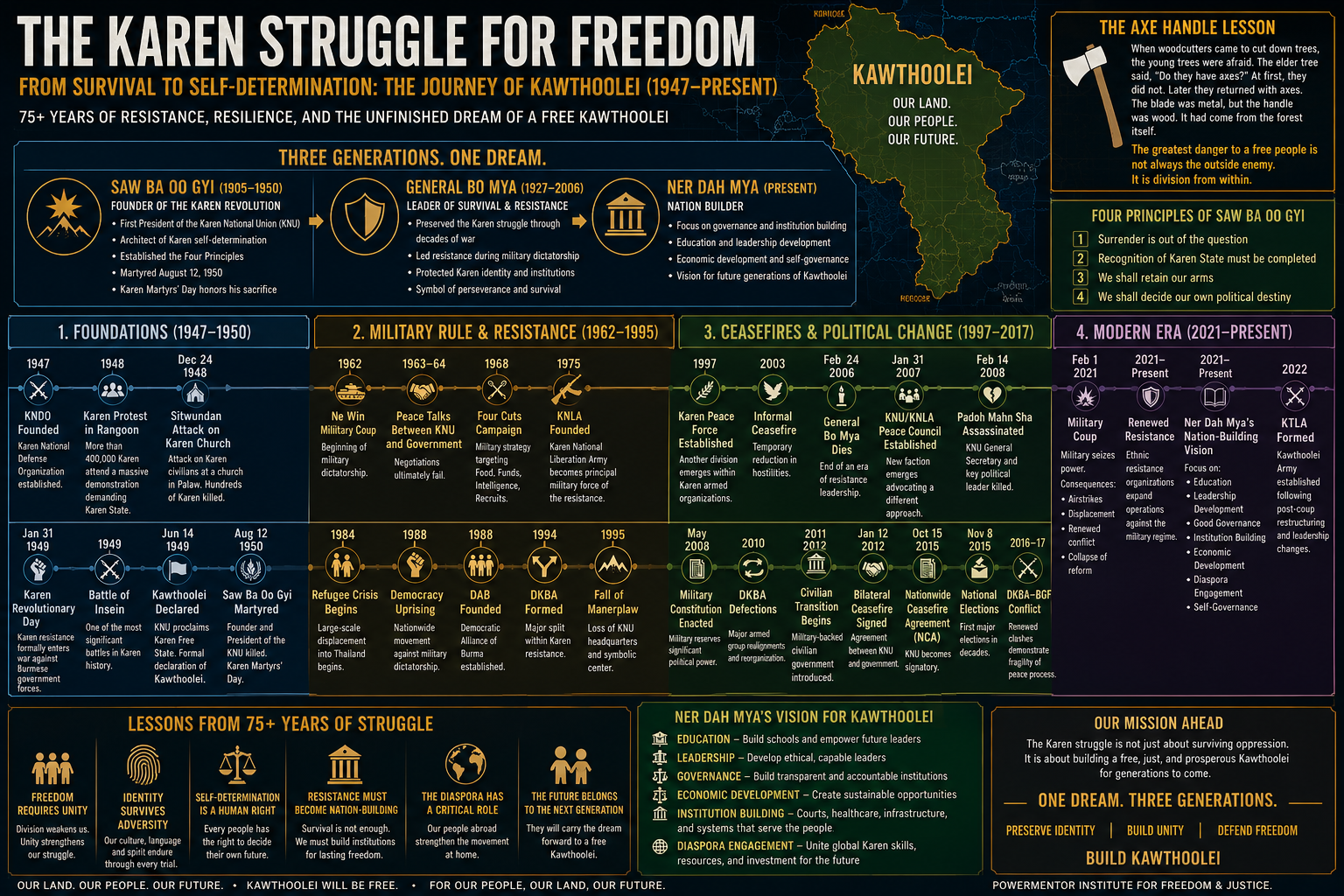
For more than seventy-five years, the Karen people have carried one of the world’s longest and most enduring struggles for freedom. Their story is often reduced to armed conflict, refugee camps, ceasefires, and political negotiations. Yet to understand the Karen struggle only through the lens of war is to miss the deeper story. The Karen journey is ultimately about identity, self-determination, resilience, faith, leadership, and the refusal of a people to surrender their future despite decades of oppression.
The modern Karen movement began in 1947 with the formation of the Karen National Defense Organization (KNDO). This was a defining milestone because Karen leaders understood that their future could not be left entirely in the hands of others. As Burma moved toward independence, the Karen people sought recognition, protection, and the right to determine their own future. The formation of KNDO represented a clear message: the Karen people would not stand defenseless while others decided their destiny.
In 1948, hundreds of thousands of Karen people gathered in Rangoon to demand self-determination. This peaceful mass demonstration showed the political unity and national identity of the Karen people. They were not asking for special treatment; they were asserting that the Karen were a distinct people with their own history, culture, language, land, and aspirations. In 1949, the Karen National Union proclaimed Kawthoolei, the Karen homeland, and the Battle of Insein became one of the most significant battles in Karen history. These early milestones established the foundation of the Karen cause: the Karen people are a nation with the right to govern themselves.
The 1962 military coup by General Ne Win changed the future of Burma and confirmed the fears of many ethnic nationalities. The coup launched decades of military dictatorship and centralized control. For the Karen people, it became clear that true ethnic freedom would not be granted under a military system determined to preserve power. Peace talks in the early 1960s failed because they did not resolve the fundamental issue of self-determination. Then, in 1968, the Burmese military launched the Four Cuts Campaign, designed to cut resistance movements off from food, funds, intelligence, and recruits. In reality, this strategy devastated civilian communities, destroyed villages, displaced families, and forced generations of Karen people into survival mode. The military could destroy villages, but it could not erase Karen identity.
General Bo Mya emerged during this long era as one of the defining leaders of modern Karen history. For many Karen people, he became the face of resistance and the symbol of perseverance. His generation faced one central question: How do we ensure the Karen people survive? Under his leadership, the Karen struggle remained alive through some of its most difficult years. While people may debate strategies and decisions, few can deny that General Bo Mya helped preserve the dream of Kawthoolei when many believed it could disappear entirely. His generation fought so the Karen people would not be erased.
By 1984, the Karen refugee crisis had begun on a massive scale. As military offensives intensified, large numbers of Karen civilians fled into Thailand. Refugee camps became places of suffering, but also places of survival. Children were born in camps without ever seeing the homeland their parents described. Families carried memories of villages, churches, farms, rivers, mountains, and ancestors. Yet even in displacement, Karen identity endured. The Karen people became scattered across the world, but they did not lose their sense of who they were.
The 1988 democratic uprising connected the Karen struggle to the broader national fight against military dictatorship. Students, civilians, ethnic groups, and pro-democracy forces rose up against military rule. For the Karen people, this moment revealed something they had known for decades: the Burmese military was not only an ethnic problem; it was a national problem. The same system that oppressed ethnic nationalities would eventually turn its violence against the entire country.
In 1994, the formation of the Democratic Karen Buddhist Army (DKBA) created one of the most painful divisions in Karen history. This internal split weakened Karen unity and contributed to a devastating outcome. In 1995, Manerplaw fell. Manerplaw was far more than a headquarters. It was a political center, a symbol of resistance, and a place that represented the dream of Kawthoolei. Its fall remains one of the most important lessons in Karen history: external enemies become far more dangerous when internal division weakens a people from within.
The years that followed were marked by ceasefires, shifting alliances, and unresolved political questions. In 2004, an informal ceasefire brought temporary hope, but not true settlement. Without justice, accountability, and genuine self-determination, ceasefires could only reduce fighting; they could not resolve the root cause of the conflict. In 2006, General Bo Mya died, marking the end of a major chapter in Karen history. His death did not end the struggle. Instead, it raised a new question for the next generation: If the Karen people survive, what kind of future must they build?
The 2007 formation of the KNU/KNLA Peace Council reflected continued disagreement over strategy inside the Karen movement. Some pursued negotiation, others continued resistance, and others searched for different political pathways. Then in 2008, Burma’s military-backed constitution preserved major military power inside the political system. Although the country later appeared to move toward reform, many ethnic nationalities remained cautious. The constitution protected the military’s power more than it protected ethnic freedom.
In 2010, continued DKBA realignments and conflict showed that Karen armed fragmentation remained unresolved. In 2011, Burma began a civilian transition, but the military remained deeply embedded in the system. In 2012, the KNU signed a bilateral ceasefire, and in 2015 the Nationwide Ceasefire Agreement was signed during a year of major national elections. These milestones created hope, but they did not answer the deeper question: Would the Karen people truly govern themselves, or would they remain inside a system still controlled by the military? Continued DKBA-BGF conflict in 2016 and 2017 showed that peace remained fragile and that armed fragmentation had not disappeared.
On February 1, 2021, the Burmese military seized power again in a coup. For much of the world, this was shocking. For many Karen people, it was confirmation of what they had warned for decades: the military had never truly surrendered power. It had only changed its appearance. The coup reignited conflict, expanded displacement, and brought renewed airstrikes and attacks into ethnic regions. It also caused many people across Burma to finally experience the same military violence ethnic communities had endured for generations.
After the 2021 coup, Ner Dah Mya became an increasingly important figure in the modern Karen struggle. As the son of General Bo Mya, he inherited a powerful legacy, but his vision cannot be understood only through his father’s military history. General Bo Mya represented the generation of survival and resistance. Ner Dah Mya increasingly represents the question of nation-building. His emphasis on education, leadership development, good governance, economic development, institution building, diaspora engagement, and self-governance reflects a strategic shift in the Karen movement. One generation fought so the Karen people would survive. The next generation must build so the Karen people can thrive.
In 2022, following his separation from the KNU/KNDO structure, Ner Dah Mya became associated with the formation of the Kawthoolei Army, known as KTLA. For supporters, KTLA represents a renewed commitment to Karen self-determination and a stronger stand for Kawthoolei freedom. For others, it also raises concerns about continued fragmentation within the broader Karen movement. Both realities must be understood honestly. KTLA is important because it reflects both the hunger for freedom and the unresolved challenge of Karen unity.
The modern Kawthoolei question is no longer only how the Karen people resist oppression. It is also how the Karen people build a functioning nation. A free Kawthoolei must be able to protect its people, educate its children, govern fairly, grow economically, preserve Karen identity, and engage the global Karen diaspora. Freedom cannot be sustained by resistance alone. Freedom must be supported by schools, laws, institutions, leaders, infrastructure, and economic opportunity.
This is where the leadership stories of General Bo Mya and Ner Dah Mya become deeply connected. General Bo Mya fought to preserve the Karen people. Ner Dah Mya speaks to the responsibility of building the future of Kawthoolei. One generation carried the burden of survival. The next carries the burden of construction. A people who survive oppression must eventually build the institutions that make freedom sustainable.
Karen elders have shared a powerful lesson through the story of the axe handle. Woodcutters entered the forest, and the young trees were afraid. The elder tree asked if they had axes. At first, they did not. Later, the woodcutters returned with axes. The blade was metal, but the handle was wood. It had come from the forest itself. The lesson is clear: the greatest danger to a free people is not always the outside enemy. It is when the enemy gains strength through division from within.
For the Karen people, this lesson remains urgent. The Burmese military remains a real threat to freedom, but internal division can make that threat stronger. Unity does not mean every Karen person must agree on every issue. Unity means refusing to become the handle used against the future of Kawthoolei. History shows that division has repeatedly weakened the Karen struggle, while identity, courage, and perseverance have kept it alive.
More than seventy-five years after the formation of KNDO and the declaration of Kawthoolei, the Karen struggle continues. From 1947 and the birth of organized Karen defense, to 1949 and the declaration of Kawthoolei, to General Bo Mya’s era of survival, to Manerplaw, to the 2008 military constitution, to the 2021 coup, to Ner Dah Mya and KTLA, the timeline tells one continuous story: the Karen people have refused to disappear.
The past teaches survival. The future demands nation-building. The mission ahead is clear: preserve Karen identity, unite the Karen people, build strong institutions, educate the next generation, develop the economy, defend self-determination, and build Kawthoolei.
Because freedom is not only something a people fight for.
Freedom is something a people must build.
