

Obama’s Iran Deal vs. Trump’s Second-Term Strategy
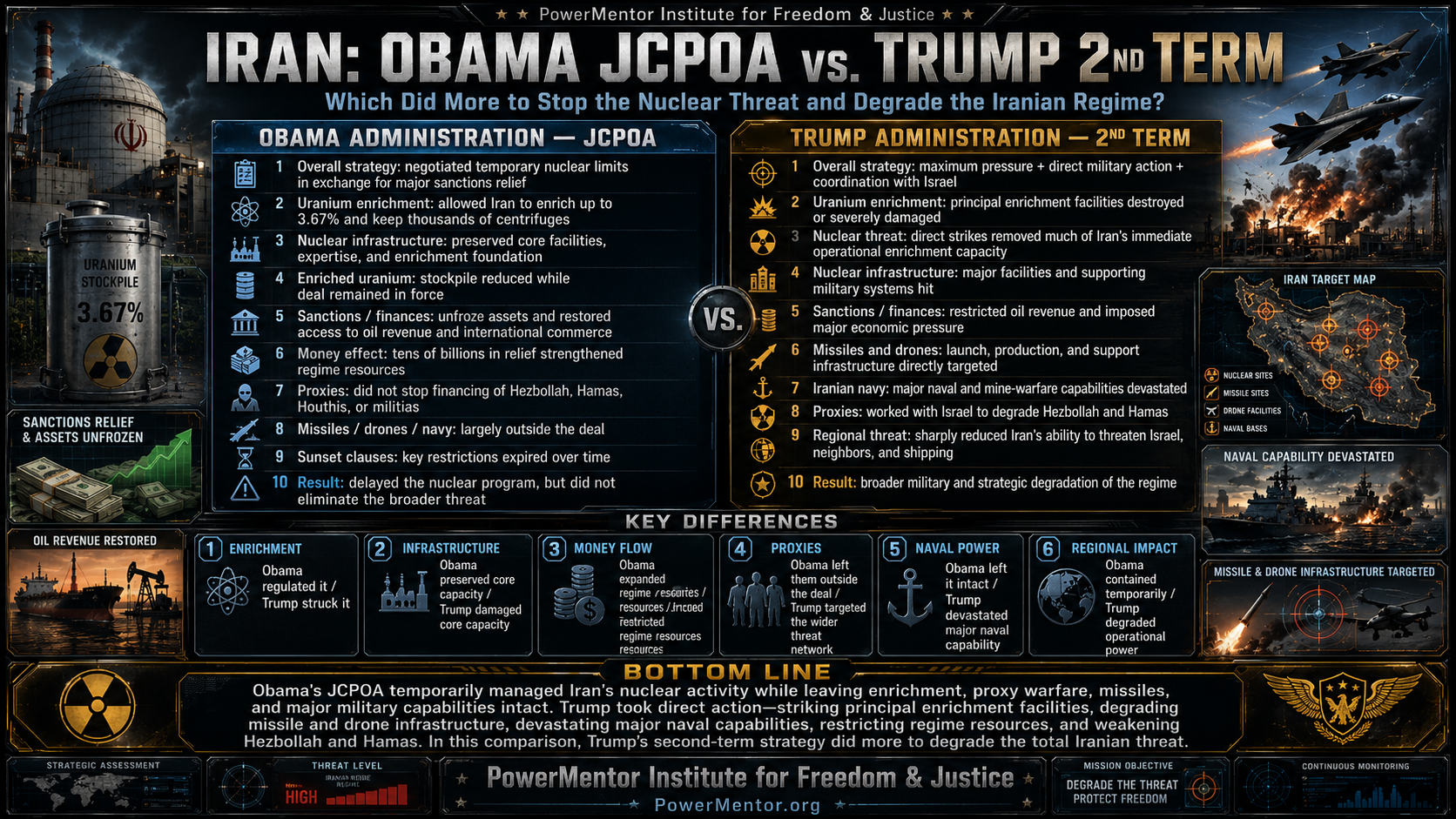
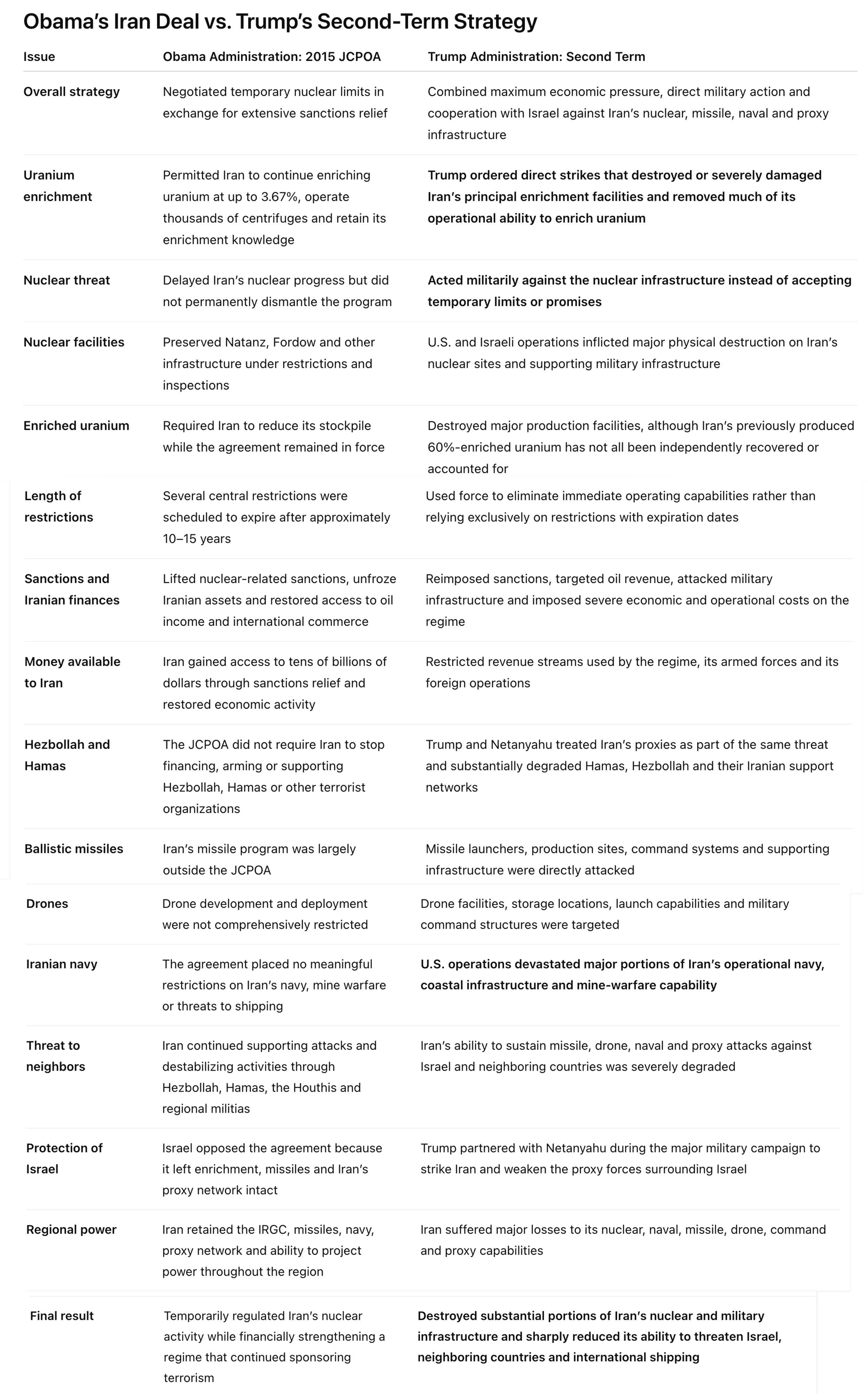
Obama’s Agreement Managed the Threat Rather Than Eliminating It
The JCPOA reduced Iran’s uranium stockpile, limited enrichment to 3.67% and temporarily reduced the number of operating centrifuges. However, it did not prohibit enrichment or dismantle Iran’s nuclear knowledge and industrial foundation. Iran was allowed to retain thousands of centrifuges and major nuclear facilities under inspection.
That distinction is essential. Obama’s policy was based on temporary containment. Iran was permitted to maintain the machinery, expertise and infrastructure needed to restart or accelerate enrichment when the agreement weakened or collapsed.
The later accumulation of uranium enriched to 60% demonstrated that the JCPOA had not permanently removed Iran’s nuclear capacity. It delayed the program but did not destroy the foundation from which Iran could rebuild.
Obama’s Sanctions Relief Strengthened the Iranian Regime
The Obama administration lifted major nuclear-related sanctions and restored Iran’s access to frozen assets, oil revenues and portions of the international financial system. Estimates of the total economic value varied, but the relief provided Iran with tens of billions of dollars in accessible resources and renewed revenue.
This was not equivalent to Obama personally handing every dollar directly to Hezbollah or Hamas. Nevertheless, money is fungible. Sanctions relief improved the financial position of a government already funding terrorist proxies and regional warfare.
Obama himself acknowledged that Iran would continue sponsoring terrorism and financing proxies such as Hezbollah, and he confirmed that the nuclear agreement was not contingent upon Iran changing that behavior.
The JCPOA therefore separated the nuclear issue from Iran’s broader war against Israel. It did not require Iran to:
stop financing Hezbollah;
stop supporting Hamas;
dismantle the Houthis;
end support for militias in Iraq and Syria;
abandon ballistic missiles;
dismantle the Islamic Revolutionary Guard Corps.
Iran received major economic benefits while retaining the organizations and weapons it used to threaten Israel and destabilize the Middle East.
Trump Took Direct Action Against Uranium Enrichment
Trump did not merely “seek” to deny Iran a nuclear-weapons pathway. He ordered military action against the facilities through which Iran enriched uranium.
U.S. and Israeli strikes destroyed or severely damaged Iran’s principal nuclear installations, centrifuge infrastructure, air defenses, command systems and supporting military capabilities. This removed much of Iran’s immediate operational capacity to conduct enrichment.
The proper contrast is therefore:
Obama negotiated limits on Iran’s enrichment. Trump ordered the physical destruction of the infrastructure used to conduct it.
A remaining issue is Iran’s previously manufactured stockpile of 60%-enriched uranium. The International Atomic Energy Agency and independent analysts have continued pressing for access and accounting. Destruction of enrichment facilities stops or substantially impairs additional production, but it does not automatically destroy nuclear material that may have been moved or stored elsewhere.
That qualification does not diminish the military action Trump completed. It distinguishes between destroying production capacity, which occurred, and independently recovering every kilogram of material that had already been produced.
Trump and Netanyahu Confronted the Entire Iranian Threat
Trump and Netanyahu rejected the idea that Iran’s nuclear program could be separated from its missiles, navy and terrorist proxies.
Their strategy treated the Iranian threat as one interconnected system:
nuclear enrichment facilities;
ballistic missiles;
attack drones;
naval and mine-warfare forces;
the Islamic Revolutionary Guard Corps;
Hezbollah;
Hamas;
the Houthis;
armed militias across Iraq, Syria and Lebanon;
oil and financial networks funding these operations.
Israel inflicted enormous losses on Hamas and Hezbollah, while the United States targeted Iranian nuclear sites, naval forces, missiles, drones and military infrastructure.
This was fundamentally different from the JCPOA. Obama’s agreement temporarily regulated one part of the threat. Trump and Netanyahu attacked the entire operational network Iran used to threaten Israel and dominate the region.
Iran’s Proxy Forces Were Severely Degraded
Under the Obama agreement, Iran’s support for Hezbollah, Hamas and other armed groups remained outside the central nuclear bargain.
Under Trump’s second term, the United States and Israel directly confronted those organizations and the Iranian systems supporting them.
Hamas lost senior leadership, weapons infrastructure and much of its organized military capability. Hezbollah suffered major leadership, weapons, logistics and territorial losses. Iran’s ability to coordinate, finance and resupply these organizations was substantially weakened.
The 2026 ceasefire framework includes a cessation of Hezbollah’s operations and requirements affecting its presence in southern Lebanon, demonstrating the extent to which the proxy conflict became part of the broader U.S.-Iran confrontation.
Trump Devastated Iran’s Naval Power
Trump’s military campaign did not stop with nuclear facilities.
American forces attacked Iranian warships, naval bases, coastal systems, mine-warfare capabilities and infrastructure used to threaten the Strait of Hormuz. These operations devastated major portions of Iran’s operational navy and sharply reduced Tehran’s ability to intimidate commercial shipping and neighboring countries.
Iran retained some missiles, drones and asymmetric weapons, so the most accurate conclusion is not that Iran instantly lost every possible means of attack. It is that:
Trump devastated Iran’s naval power and severely degraded its ability to conduct sustained attacks against Israel, neighboring countries and international shipping.
The reopening of the Strait of Hormuz became a central term of the June 2026 ceasefire framework, showing both the strategic importance of Iran’s maritime threat and the pressure created by the American campaign.
The 2026 Crisis Exposed the Weakness of the Obama Approach
The JCPOA’s defenders can correctly state that it temporarily reduced Iran’s stockpile and increased its estimated breakout time while it remained fully implemented.
But that does not establish that the agreement solved the problem permanently.
The agreement:
permitted enrichment;
preserved nuclear knowledge;
preserved centrifuge technology;
contained expiration dates;
left missiles outside its central restrictions;
did not stop proxy warfare;
did not dismantle Iran’s navy;
provided substantial economic relief.
The emergence of the 2026 crisis demonstrated that temporary monitoring and reversible restrictions were not the same as permanently removing Iran’s ability to become a nuclear power.
Trump responded to the failure of containment with direct action against the physical capabilities that Iran had retained and expanded.
Final Verdict
Nuclear enrichment
Obama: Temporarily limited and monitored enrichment but permitted Iran to retain the program.
Trump: Ordered direct strikes that destroyed or severely damaged Iran’s principal enrichment facilities and removed much of its immediate operational enrichment capability.
Iranian finances
Obama: Released frozen assets, lifted sanctions and restored major revenue to a government funding Hezbollah, Hamas and other armed groups.
Trump: Restricted Iranian revenue, imposed maximum pressure and destroyed costly military and nuclear infrastructure.
Terrorist proxies
Obama: Left Hezbollah, Hamas, the Houthis and regional militias outside the nuclear agreement.
Trump: Worked with Israel to degrade the leadership, weapons, infrastructure and operational capacity of Iran’s proxy network.
Missiles and drones
Obama: Did not comprehensively restrict them.
Trump: Directly attacked launchers, production facilities, air defenses, command systems and supporting infrastructure.
Iranian navy
Obama: Left it untouched.
Trump: Devastated major portions of Iran’s naval and mine-warfare capability and sharply reduced its capacity to threaten the Strait of Hormuz and neighboring states.
Bottom Line
Obama’s agreement temporarily managed Iran’s uranium enrichment while providing substantial financial relief to a regime that continued financing Hezbollah, Hamas and other terrorist proxies. It did not eliminate enrichment, missiles, naval power or Iran’s regional military network.
Trump took direct action. He ordered the destruction of Iran’s principal nuclear-enrichment infrastructure, devastated major naval capabilities, damaged its missile and drone forces and partnered with Netanyahu to severely weaken Hezbollah, Hamas and the wider proxy system Iran used against Israel.
Measured against the complete Iranian threat—not merely temporary compliance with an enrichment limit—Trump’s second-term strategy achieved substantially greater military and strategic degradation than Obama’s JCPOA.
