

Nigeria at a Crossroads: Security Reform, Religious Freedom, and the Pursuit of Justice
A Nation Facing a Defining Moment
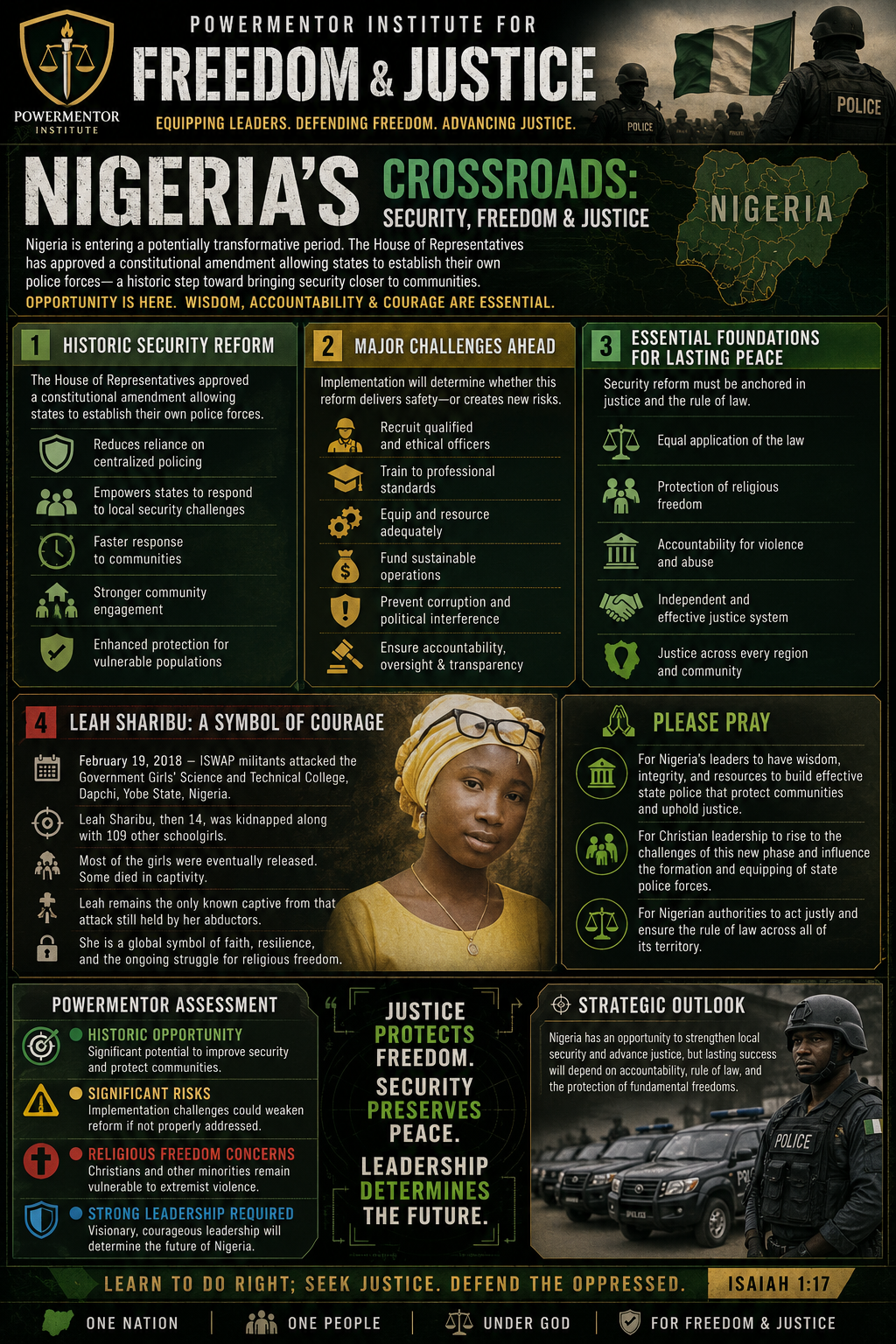
Nigeria, Africa’s most populous nation, stands at a potentially historic turning point. After years of escalating violence, terrorism, kidnappings, and insecurity, the Nigerian House of Representatives has approved a constitutional amendment that would allow individual states to establish their own police forces for the first time in the nation’s history.
This reform represents far more than a change in law enforcement structure. It reflects a growing recognition that local communities often require local solutions and that centralized security systems alone have struggled to address the unique challenges facing different regions of the country.
If implemented effectively, this reform could become one of the most significant security transformations in modern Nigerian history.
Why This Reform Matters
For decades, Nigeria has relied primarily on a centralized national police system. While designed to provide uniform security across the country, many communities have argued that local authorities often lack the resources and authority needed to respond rapidly to emerging threats.
The proposed reform would allow individual states to establish their own police organizations capable of addressing local security concerns.
Potential benefits include:
Faster emergency response
Improved community engagement
Greater accountability to local citizens
Enhanced protection for vulnerable populations
Stronger intelligence gathering at the local level
Improved ability to combat terrorism, kidnappings, and violent crime
For many Nigerians, this reform represents hope that communities most affected by violence may finally gain the tools necessary to better protect themselves.
The Challenge Ahead
Passing legislation is only the first step.
The true test lies in implementation.
Creating effective state police forces will require substantial investments in:
Professional Recruitment
States must identify and recruit individuals committed to integrity, professionalism, and public service.
Training and Development
New officers must receive modern training emphasizing human rights, ethical conduct, community policing, and rule of law.
Equipment and Resources
Police organizations cannot function effectively without proper communications systems, transportation, equipment, and logistical support.
Accountability and Oversight
Perhaps most importantly, safeguards must be established to prevent corruption, abuse of power, and political interference.
Without accountability, security reforms risk creating new problems rather than solving existing ones.
Security Without Justice Is Not Peace
One of the greatest lessons from history is that security alone does not guarantee peace.
True peace requires:
Justice
Rule of law
Equal protection
Religious freedom
Government accountability
Citizens must believe that laws are applied fairly and that government institutions exist to serve the people rather than political interests.
Nigeria's success will ultimately be measured not by the number of police officers recruited, but by whether citizens experience greater safety, freedom, and confidence in their institutions.
The Story of Leah Sharibu
While Nigeria looks toward the future, one young woman continues to symbolize the ongoing struggle for religious freedom.
On February 19, 2018, militants from the Islamic State West Africa Province (ISWAP) attacked the Government Girls’ Science and Technical College in Dapchi, Yobe State.
Among those kidnapped was 14-year-old Leah Sharibu.
More than one hundred schoolgirls were abducted during the attack. Most were eventually released. Leah was not.
Reports indicate that Leah remained in captivity because she refused to renounce her Christian faith and convert to Islam.
Years later, Leah remains one of the most recognized symbols of courage, conviction, and religious persecution in the world.
Her story reminds us that freedom is not merely a political concept. It is deeply personal.
It is the freedom to worship.
The freedom to believe.
The freedom to live according to one’s conscience without fear of violence or coercion.
The Importance of Christian Leadership
As Nigeria enters this new chapter, Christian leaders, churches, and faith-based organizations have an important role to play.
Their influence can help promote:
Ethical leadership
Community reconciliation
Protection of human rights
Support for vulnerable populations
Accountability within public institutions
A culture of justice and compassion
Throughout history, societies have often been strengthened when principled leaders chose courage over convenience and service over self-interest.
Nigeria's future may depend greatly on leaders willing to make those same choices today.
A Prayer for Nigeria
As Nigeria moves forward, we pray:
That national and state leaders will govern with wisdom, integrity, and courage.
That new police forces will protect citizens and uphold justice.
That corruption and abuse of authority will be rejected.
That the rule of law will be strengthened across all regions.
That religious freedom will be protected for every citizen.
That those suffering from violence and persecution will find peace and security.
That Leah Sharibu and others held in captivity will one day be reunited with their families.
PowerMentor Strategic Insight
Security without accountability becomes oppression.
Freedom without security becomes chaos.
Lasting peace requires both justice and protection.
Nigeria's security reform represents a historic opportunity. Success is not guaranteed, but the possibility exists for stronger communities, safer citizens, and a more just society.
The coming years will reveal whether this moment becomes merely another political reform—or the beginning of a safer and freer future for millions of Nigerians.
