

FBI Disrupts Alleged Explosive-Drone and Sniper Plot Against White House UFC Event
A PowerMentor Institute for Freedom & Justice Intelligence Analysis
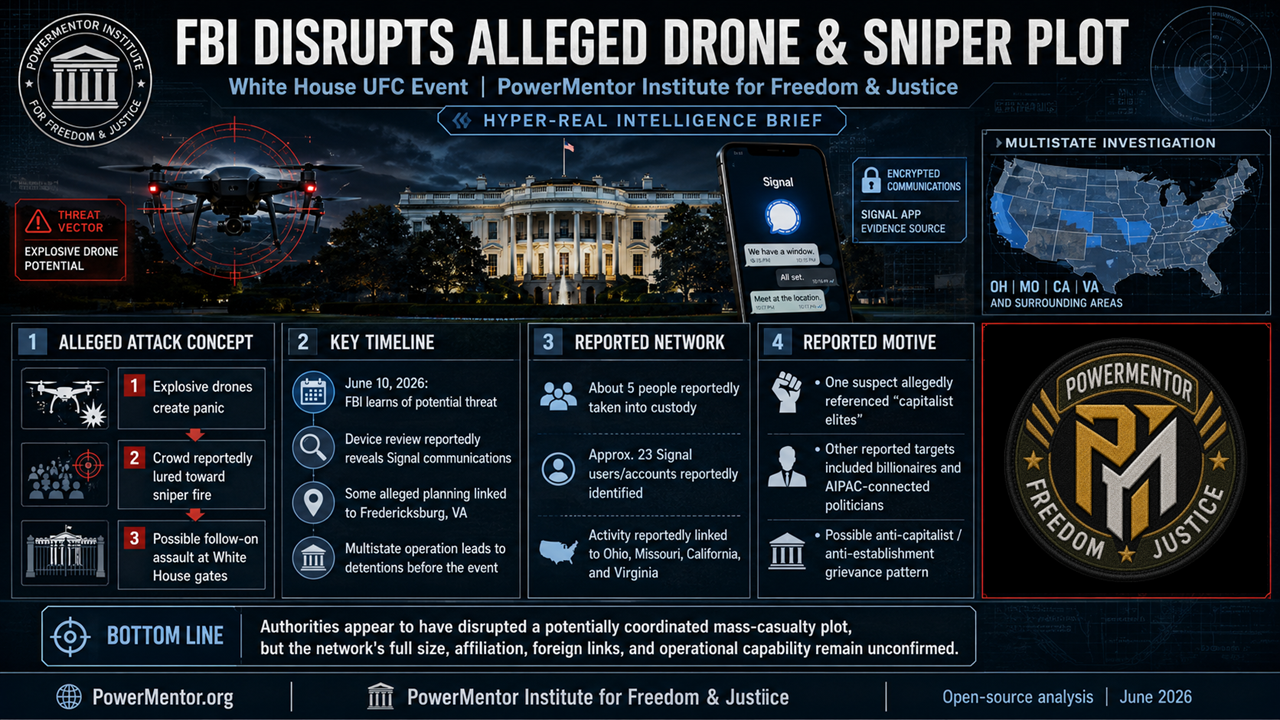
Federal authorities say they disrupted an alleged multistate attack plot targeting the UFC Freedom 250 event held at the White House on June 14, 2026. The reported plan was not limited to one explosion or one attacker. It allegedly involved a carefully sequenced operation using explosive-laden drones, manipulated evacuation routes, sniper teams, and a possible second-wave assault against the White House perimeter.
The FBI reportedly learned of the potential threat on June 10, 2026—only four days before the event. A rapid investigation led to several people being taken into custody and exposed a larger Signal messaging network containing approximately 23 participants or accounts discussing elements of the alleged operation.
This case represents a deeply concerning example of how inexpensive drone technology, encrypted communications, firearms, crowd psychology, and coordinated extremist violence can be combined into a potentially devastating attack.
However, several critical facts remain undisclosed. Federal authorities have not yet publicly identified the suspects, confirmed their citizenship, named an affiliated organization, or established that a foreign government directed the operation.
The Target: UFC Freedom 250 at the White House
The alleged target was the UFC Freedom 250 event conducted on the South Lawn of the White House. The event coincided with President Donald Trump’s 80th birthday and formed part of the national celebration surrounding the 250th anniversary of the United States.
Approximately 4,300 people reportedly attended, including about 1,200 active-duty military personnel, political officials, prominent guests, athletes, media representatives, and members of the public.
The event presented an unusually attractive target for violent extremists because it combined:
The symbolic importance of the White House
The potential presence of the president and senior officials
A large and densely concentrated audience
Military personnel and prominent public figures
Predictable security checkpoints and evacuation routes
Extensive national and international media coverage
An attack at such an event could have caused mass casualties while producing enormous symbolic and propaganda value.
Phase One: Explosive Drones Create Panic
According to reporting attributed to federal investigative sources, the alleged attackers planned to fly drones carrying explosives into buildings or locations near the event.
The apparent purpose of the drones was not simply to destroy property. The explosions would reportedly have served as the opening phase of a larger coordinated operation.
The drone strikes were allegedly intended to:
Cause explosions near the venue
Generate fear and confusion
Force an emergency evacuation
Overwhelm security and emergency personnel
Move thousands of people toward predictable escape routes
Divert law enforcement away from other attack teams
This indicates that the drones were allegedly being considered both as weapons and as tools for manipulating crowd movement.
Phase Two: Funnel the Crowd Toward Snipers
The most disturbing allegation is that the explosions would have forced spectators to flee toward an area where a sniper team was positioned to fire upon them.
This type of strategy is sometimes described as channelization—creating a threat in one location that drives victims into a predetermined area where another attack can occur.
Large secured events often depend on:
Controlled entry and exit points
Fencing and barriers
Closed streets
Pedestrian corridors
Designated emergency routes
Restricted movement around protected locations
The alleged conspirators reportedly intended to exploit those security arrangements. Instead of attacking a widely dispersed crowd, they could create panic and direct people into a narrower location within the shooters’ field of fire.
In effect, the victims’ natural attempt to escape the drone explosions would become part of the attack plan.
Phase Three: A Possible Assault on the White House Gates
The alleged plan reportedly included a second wave of attackers attempting to storm the White House gates after the drone explosions and sniper attack began.
Public reporting has not established the exact objective of this phase. Possible purposes could have included:
Penetrating the White House security perimeter
Attacking responding law-enforcement officers
Reaching government leaders or prominent guests
Prolonging the crisis
Diverting security resources
Creating dramatic propaganda footage
Producing the appearance of a broader assault on the government
Authorities have not publicly revealed how many participants were allegedly assigned to this phase, whether they possessed weapons, or how advanced their preparations were.
How the FBI Reportedly Uncovered the Plot
June 10: The Initial Warning
FBI Director Kash Patel said federal authorities became aware of a potential threat on June 10 involving people located outside the National Capital Region.
Some reporting indicates that information from a concerned family member or relative may have helped alert investigators. This detail has been widely reported but should remain characterized as preliminary until confirmed in public court filings.
The Cincinnati Investigation
Authorities reportedly executed a search warrant or enforcement action in the Cincinnati, Ohio, area, resulting in an initial detention or arrest.
Investigators then examined a suspect’s iPhone. The device allegedly contained Signal communications connecting the suspect to a much larger discussion involving approximately 23 users or accounts.
The Signal Network
The Signal conversations reportedly included discussions involving:
Explosive drones
The UFC White House event
Potential targets
Sniper positioning
Travel arrangements
Attack preparations
A possible assault on the White House perimeter
Ideological grievances against wealthy and politically connected individuals
Some alleged participants reportedly traveled or planned to travel to Fredericksburg, Virginia, on June 12 or June 13 to conduct preparations. Fredericksburg is roughly 50 miles south of Washington, D.C., making it a possible staging area outside the immediate White House security zone.
A Multistate Law-Enforcement Operation
The investigation expanded across several states. Reporting indicates that people were taken into custody in locations including:
Ohio
Missouri
California
Activity connected to the investigation also reportedly extended into Virginia.
The FBI, Secret Service, Department of Justice, and other law-enforcement partners coordinated the operation. Authorities said the planned attacks were stopped before they could be carried out.
Signal Did Not Necessarily Fail—Investigators Accessed a Device
Signal uses end-to-end encryption, which generally protects the contents of messages while they travel between users.
However, encryption cannot protect communications when investigators lawfully gain access to:
An unlocked phone
Messages stored on a device
A cooperating participant’s device
Screenshots
Message notifications
Locally retained media or documents
An account already open on the physical device
The available reporting indicates that investigators discovered the alleged communications by examining a suspect’s iPhone, not by remotely breaking Signal’s encryption.
This is an important distinction:
The FBI reportedly gained access to the endpoint device where the Signal messages could be viewed. There is no public indication that investigators defeated Signal’s underlying encryption system.
Encrypted applications may protect communications in transit, but they cannot eliminate the evidence stored on a sender’s or recipient’s phone.
Five Arrests Does Not Mean All 23 Were Charged
One of the most important distinctions in this case involves the number 23.
Early reports indicated that five people had been taken into custody, while approximately 23 participants or accounts were identified in the Signal communications.
That does not necessarily mean that 23 people were arrested, charged, or equally involved.
The larger group could include:
Principal organizers
Operational participants
People who agreed with the plan
Peripheral contacts
Individuals who observed the discussion
People who withdrew
Aliases or duplicate accounts
Participants whose identities remain unknown
People who discussed the matter but committed no criminal act
FBI Director Kash Patel publicly confirmed that multiple individuals were in custody, but he did not initially provide a complete list of defendants or confirm that all 23 Signal users were conspirators.
The most accurate current description is therefore:
Several people were reportedly detained in connection with an alleged plot discussed within a broader Signal network of approximately 23 users or accounts.
Until federal complaints or indictments are publicly released, it is premature to state that all 23 were criminal participants.
Who Were the Alleged Bad Actors?
As of June 16, federal authorities had not publicly released complete identifying information for the suspects.
The government had not publicly confirmed:
Their names
Their ages
Their citizenship
Their countries of origin
Their immigration status
Their ethnic or religious backgrounds
Their organizational memberships
Whether they had military training
Whether they belonged to a domestic extremist movement
Whether they were directed by a foreign government
The locations where individuals were arrested do not establish their nationality. Being detained in Ohio, Missouri, or California only identifies where an enforcement action occurred.
No Confirmed Terrorist Organization Has Been Named At This Time
No publicly available evidence has yet established that the suspects were acting on behalf of:
ISIS
Al-Qaeda
Hezbollah
Hamas
Iran
Russia
China
A foreign intelligence service
A white-supremacist organization
A militia organization
Antifa as an organized operational entity
A formally identified anarchist group
It would therefore be inaccurate to assign the alleged plot to one of these organizations without evidence.
The investigation may ultimately uncover organizational or foreign connections. At present, however, no group or country has been publicly confirmed as the sponsor or controller of the network.
Reported Ideological Motives
One suspect allegedly told investigators that the intended targets included:
“Capitalist elites”
Billionaires
Political leaders
Politicians associated with or receiving support connected to the American Israel Public Affairs Committee, commonly known as AIPAC
These reported statements may suggest an ideological mixture involving:
Anti-capitalist extremism
Anti-elite resentment
Anti-establishment hostility
Anti-Israel or anti-AIPAC grievances
Hostility toward political leaders and wealthy individuals
Possible opposition to the Trump administration
However, the reported beliefs of one suspect should not automatically be attributed to every person appearing in the Signal discussions.
These statements also do not, by themselves, prove membership in a specific Marxist, anarchist, Islamist, foreign-backed, or domestic terrorist organization.
The most supportable current assessment is that the alleged network displayed anti-capitalist and potentially anti-AIPAC or anti-Israel ideological grievances, while its formal organizational identity remains unknown.
Was a Foreign Country Involved?
There is currently no confirmed public evidence that another country planned, financed, directed, or materially supported the alleged operation.
Nevertheless, authorities will likely examine:
Overseas communications
International travel
Foreign contacts
Cryptocurrency transactions
International wire transfers
Foreign technical assistance
Drone components acquired abroad
Explosives training
Communications with extremist organizations
Connections to foreign intelligence services
Attempts to conceal the source of financing
Vice President JD Vance publicly raised questions about whether a plot involving this many people could have developed without substantial coordination or funding.
That concern is reasonable as an investigative question, but it does not prove foreign sponsorship.
Suspicion of a larger network is not the same as evidence that Iran, China, Russia, or another government was responsible.
Intent Versus Operational Capability
The Signal messages may demonstrate dangerous intent, but prosecutors will also need to determine whether the suspects possessed the actual ability to carry out the operation.
Important unresolved questions include:
Were operational drones recovered?
Were the drones capable of carrying explosives?
Were functional explosive devices found?
Were rifles or sniper equipment seized?
Did anyone obtain ammunition?
Had the suspects selected launch locations?
Had they identified sniper positions?
Did they conduct surveillance of the venue?
Did they photograph security checkpoints or evacuation routes?
Were specific participants assigned operational roles?
Did they obtain vehicles, lodging, or staging facilities?
Did they test explosive devices or drone payloads?
Did anyone enter Washington, D.C., as part of the plan?
Were the alleged devices capable of defeating White House security?
How close were the participants to launching the attack?
These details will determine whether the case involved a fully operational terrorist cell, an emerging conspiracy interrupted during preparation, or a mixture of serious planning and aspirational discussion.
The Legal Difference Between Speech and Conspiracy
Violent or hateful speech alone does not always establish a criminal conspiracy. Federal prosecutors generally must demonstrate that individuals knowingly entered an agreement to commit a crime and, under many conspiracy laws, that one or more participants took action to advance it.
Evidence of an operational conspiracy could include:
Choosing a specific target
Establishing an attack date
Assigning roles
Purchasing weapons or explosives
Acquiring drones
Conducting reconnaissance
Traveling to a staging location
Constructing explosive devices
Transferring money
Testing equipment
Coordinating escape plans
Attempting to conceal evidence
The reported selection of a fixed event, discussion of multiple attack phases, travel to Virginia, and alleged preparations could indicate movement beyond political rhetoric or online fantasy.
However, the full evidentiary record will not be known until criminal complaints, search-warrant affidavits, evidence inventories, or indictments become public.
Possible Federal Charges
The precise charges will depend on the evidence and each suspect’s individual conduct. Potential federal offenses could include:
Conspiracy to use a weapon of mass destruction
Attempted use of a weapon of mass destruction
Possession or construction of a destructive device
Transportation of explosives
Conspiracy to murder federal officials
Attempted assassination of the president
Attack against federal property
Conspiracy to commit terrorism
Firearms violations
Interstate threats
Providing material support for terrorism
Obstruction of justice
Destruction or concealment of evidence
Not every participant would necessarily face the same charges. Prosecutors must establish each person’s knowledge, intent, agreement, actions, and level of involvement.
Why the Drone Element Is So Dangerous
Small commercial drones have created a rapidly developing security threat because they are:
Relatively inexpensive
Widely available
Easy to transport
Difficult to detect in crowded urban environments
Capable of approaching from above fixed barriers
Able to carry cameras, explosives, incendiaries, or other payloads
Operable from a distance
Capable of being launched simultaneously
Able to force security personnel to respond in several directions
Even a drone without explosives can cause mass panic at a major event. A drone carrying a destructive payload can create casualties while also triggering a secondary crowd disaster.
The alleged plot is especially troubling because the drones were reportedly intended to support a broader coordinated attack involving explosions, crowd displacement, sniper fire, and a ground assault.
This is not merely a drone threat. It is an alleged attempt to combine several forms of violence into one integrated operation.
The Importance of Crowd Manipulation
The alleged plan demonstrates that public-event security cannot focus solely on preventing attackers from entering a venue.
Security planners must also consider how attackers may manipulate:
Emergency alerts
Exit routes
Crowd behavior
Vehicle barriers
Road closures
Public-address systems
Law-enforcement response patterns
Medical staging areas
Reunification points
Media coverage
Social-media rumors
An explosion in one location may be intended to move victims toward a second threat. Attackers may also target emergency responders, evacuation corridors, or designated safe areas.
The alleged operation reflects a cruel but strategically important reality:
The first attack may be designed primarily to position victims for the second attack.
What Investigators Must Determine
1. Who Led the Network?
Investigators must identify who created the Signal groups, proposed the operation, assigned responsibilities, and exercised operational authority.
2. Who Financed the Plan?
Authorities will examine who funded drones, explosives, firearms, vehicles, travel, lodging, communications equipment, and staging locations.
3. Was the Network Self-Directed or Sponsored?
The investigation must determine whether the alleged conspirators acted independently, received inspiration from an extremist movement, or obtained direction from a larger domestic or foreign network.
4. Were the Weapons Operational?
Intent alone does not establish capability. Authorities must determine whether functional drones, explosives, rifles, or other weapons had been acquired or assembled.
5. Was Reconnaissance Conducted?
Investigators will look for photographs, maps, surveillance video, GPS histories, security diagrams, and visits to potential launch or sniper locations.
6. Did Anyone Have Insider Access?
Authorities must determine whether any participant had access to credentials, contractors, security schedules, event diagrams, government facilities, or restricted operational information.
7. Were There Additional Cells?
The 23 Signal accounts may not represent the entire network. Investigators will need to determine whether other encrypted groups, facilitators, financiers, suppliers, or operational teams existed.
8. What Was the Primary Objective?
The intended goal may have been:
Mass murder
An attack on President Trump
An assault against the White House
The killing of military personnel
An attack against political or economic elites
Anti-Israel political violence
Propaganda and national destabilization
A combination of these objectives
9. How Close Was the Plot to Execution?
The most important operational question is whether the suspects were merely discussing an attack or were within days or hours of carrying it out.
A Significant Intelligence Success
The FBI reportedly became aware of the threat on June 10 and helped disrupt it before the June 14 event.
If the emerging account is accurate, investigators had only a matter of days to:
Identify participants
Analyze encrypted-device evidence
Track interstate travel
Coordinate surveillance
Execute warrants
Locate potential weapons
Protect the event
Prevent suspects from accelerating their plans
Coordinate among federal, state, and local agencies
The disruption demonstrates the importance of:
Public reporting of suspicious behavior
Family members acting when they recognize warning signs
Rapid digital-forensic analysis
Interstate information sharing
Cooperation among the FBI, Secret Service, Department of Justice, and local authorities
Maintaining heightened security around major public events
A concerned person’s willingness to report suspicious behavior may have helped prevent an extraordinary national tragedy.
Key Facts That Are Confirmed or Strongly Reported
The FBI acknowledged disrupting a potential threat against the White House UFC event.
Authorities became aware of the threat on June 10, 2026.
The investigation involved people outside the Washington metropolitan region.
Multiple individuals were taken into custody in a multistate operation.
Major reporting identified approximately five detainees or arrests.
Investigators reportedly discovered Signal communications on a suspect’s iPhone.
Approximately 23 users or accounts were reportedly present in the relevant communications network.
The alleged plan involved explosive-laden drones.
Reporting described a possible sniper attack against fleeing spectators.
A reported second wave involved an attempted assault against the White House gates.
Some alleged participants reportedly traveled to or prepared in Fredericksburg, Virginia.
One suspect allegedly referred to targeting capitalist elites, billionaires, and politicians connected to AIPAC.
No attack occurred, and the UFC event concluded without the alleged operation being carried out.
Important Facts That Remain Unconfirmed
The identities of every suspect
The citizenship or national origin of the suspects
Whether all 23 Signal users supported the attack
Whether all 23 users were real and separate individuals
Whether an established terrorist organization was involved
Whether a foreign government provided financing or direction
Whether operational explosive drones were recovered
Whether functional explosives were seized
Whether sniper rifles or specialized equipment were found
Whether the suspects conducted physical reconnaissance
Whether anyone had insider access
Whether President Trump was personally targeted
Whether the alleged attackers possessed the capability to breach White House security
The exact charges that will be filed
The extent to which each detained person participated
PowerMentor Intelligence Assessment
Based on the information currently available, the alleged scheme appears more organized than a vague online threat.
Several reported indicators suggest potentially serious pre-operational activity:
A fixed date and high-profile target
A multistage attack concept
Encrypted coordination
Interstate participants
A possible staging location
Specialized operational roles
Travel connected to preparations
The combined use of drones, explosives, firearms, and crowd manipulation
At the same time, the public record does not yet establish whether the alleged network possessed working explosive devices, properly weaponized drones, trained sniper teams, or the operational ability to carry out every phase.
The strongest responsible conclusion at this stage is:
The FBI appears to have disrupted a potentially coordinated mass-casualty plot against a nationally significant event. However, the network’s full size, organizational identity, foreign connections, weapons capability, financing, and individual culpability remain under investigation.
The Bottom Line
This case should not yet be described as “23 terrorists arrested.”
A more accurate statement is:
Multiple people—reportedly five—were taken into custody in connection with an alleged attack plot discussed within a broader Signal network containing approximately 23 users or accounts.
The suspects’ identities, nationalities, organizational affiliations, and possible foreign connections have not yet been publicly established.
It is equally important not to minimize the reported danger. The alleged concept—using explosive drones to create panic, directing fleeing civilians toward snipers, and then attacking the White House perimeter—represents an exceptionally serious and sophisticated mass-casualty scenario.
This investigation is far from complete. The next decisive information will come from federal criminal complaints, indictments, search-warrant affidavits, evidence inventories, and official statements identifying the suspects and explaining what investigators recovered.
Until then, the facts demand both vigilance and discipline: vigilance against coordinated extremist violence, and discipline against assigning guilt, nationality, organizational membership, or foreign sponsorship before the evidence is publicly established.
