
The U.S.–Iran MOU: A Path to Peace or a Pause in Conflict?
UPDATE ON THE SUSPECTS: SCROLL DOWN!
The recently announced Memorandum of Understanding (MOU) between the United States and Iran represents one of the most significant developments in Middle East diplomacy in years. Following months of escalating conflict, military strikes, and growing concerns over Iran's nuclear ambitions, both nations have reportedly agreed to a framework intended to reduce tensions and open the door to broader negotiations.
Supporters view the agreement as an opportunity to prevent a larger regional war and stop Iran from obtaining a nuclear weapon. Critics warn that any agreement which fails to address Iran's history of deception, support for proxy groups, and systematic human rights abuses may merely postpone future conflict.
The reality is that both perspectives contain important truths.
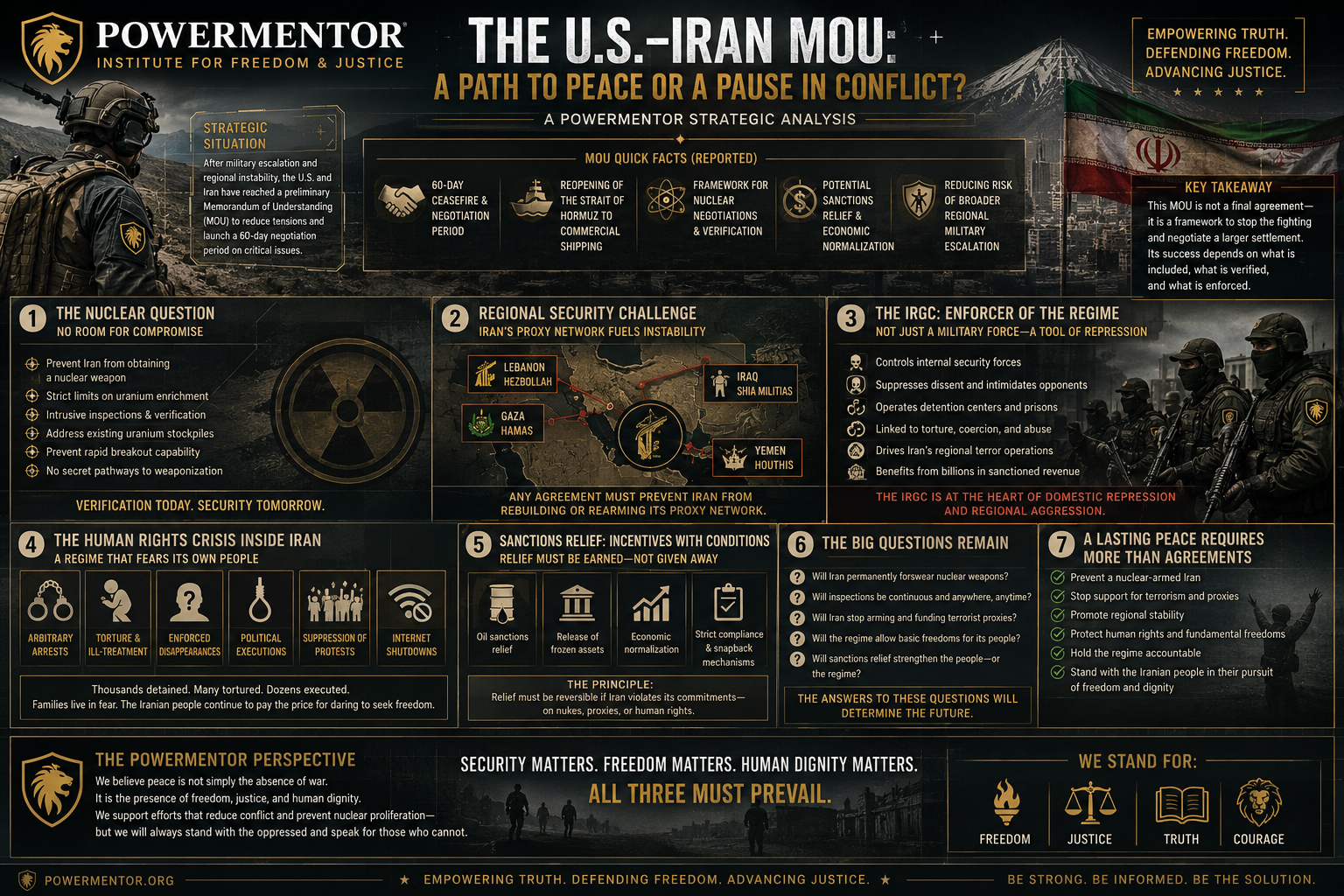
What Is the MOU Designed to Accomplish?
• Establish a 60-day ceasefire and negotiation period
• Reopen the Strait of Hormuz to commercial shipping
• Create a framework for future nuclear negotiations
• Explore sanctions relief and economic normalization
• Reduce the risk of broader regional military escalation
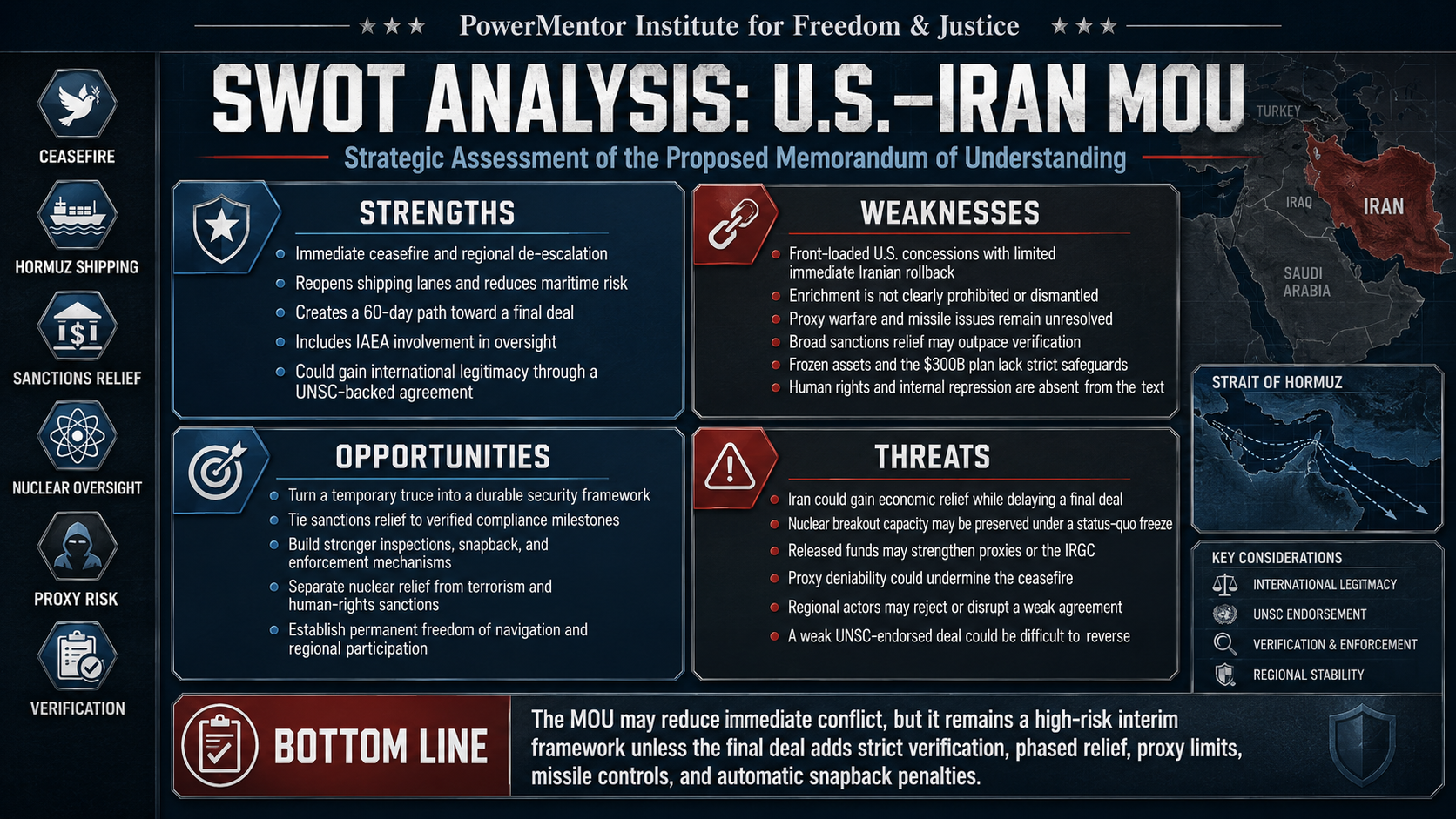
At its core, the agreement appears to be less of a final peace treaty and more of a framework designed to stop active conflict while negotiators work through the most difficult issues.
The most important of those issues remains Iran's nuclear program.
The Nuclear Question
For decades, Iran's nuclear ambitions have been a source of concern for the United States, Israel, and many nations throughout the Middle East.
The central question facing negotiators is straightforward:
Can Iran be prevented from obtaining a nuclear weapon?
Any durable agreement must address:
• Uranium enrichment levels
• Nuclear inspections and verification
• Existing stockpiles of enriched uranium
• Future nuclear development capabilities
• Rapid nuclear breakout potential
History has demonstrated that agreements without meaningful verification often become political documents rather than security solutions.
A successful agreement must do more than delay nuclear development. It must create confidence that nuclear weaponization cannot occur in secret.
Regional Security and Iran's Proxy Network
Nuclear concerns are only part of the challenge.
Iran's influence extends throughout the region through alliances and support networks that have shaped conflicts in Lebanon, Syria, Iraq, Yemen, and Gaza.
Over the past several years, Iran's proxy network has suffered significant setbacks through military operations conducted by Israel and its allies. Supporters of the current diplomatic approach argue that these setbacks have created a unique opportunity for negotiations from a position of strength.
Others fear that sanctions relief or economic concessions could allow Tehran to rebuild regional influence and restore capabilities that have been degraded.
These concerns will likely remain central to negotiations throughout the next phase of discussions.
The Human Rights Issue That Cannot Be Ignored
While headlines focus on nuclear weapons and military strategy, another issue deserves equal attention:
The treatment of the Iranian people by their own government.
A nation cannot achieve lasting peace externally while maintaining repression internally.
For years, international human rights organizations have documented allegations involving:
• Arbitrary arrests
• Political imprisonment
• Torture and coercive interrogations
• Forced confessions
• Enforced disappearances
• Suppression of free speech
• Violent crackdowns on peaceful demonstrations
• Political executions
These concerns are not isolated incidents. They represent a pattern that has been documented over multiple decades.
The Role of the Islamic Revolutionary Guard Corps (IRGC)
No discussion of Iran's internal situation is complete without understanding the role of the Islamic Revolutionary Guard Corps (IRGC).
The IRGC is one of the most vicious and powerful institutions in Iran, exercising influence far beyond traditional military functions.
The IRGC organization serves as the primary instrument used to maintain political control and suppress opposition with the most brutal tactics, including torture and executions.
Human rights organizations have repeatedly linked security forces and affiliated organizations to:
• Mass arrests of protesters
• Detention of journalists
• Intimidation of dissidents
• Torture allegations
• Forced confessions
• Suppression of political opposition
Many Iranian citizens seeking democratic reform have found themselves confronting not merely a government but an entrenched security apparatus designed to preserve the existing power structure.
When Citizens Become the Enemy
Recent protest movements revealed a deep divide between the Iranian government and many of its citizens.
Reports from human rights organizations describe the use of:
• Live ammunition
• Mass arrests
• Internet shutdowns
• Arbitrary detention
• Beatings and intimidation
Thousands of individuals have reportedly been detained during periods of unrest.
The Iranian government often characterizes protesters as threats to national security. Protesters frequently describe themselves as citizens demanding dignity, accountability, and freedom.
The truth may ultimately be judged by history, but the human cost has already been paid by thousands of Iranian families.
Information Control and Internet Blackouts
One of the most powerful tools employed during periods of unrest has been the restriction of information.
Large-scale internet shutdowns have repeatedly isolated millions of citizens from the outside world.
These blackouts limit:
• Independent reporting
• Family communication
• Documentation of abuses
• Access to outside information
Control of information has become a modern battlefield, and authoritarian governments understand its strategic value.
Can Peace Exist Without Freedom?
This is perhaps the most important question raised by the MOU.
A ceasefire may stop missiles.
A treaty may reduce military tensions.
A nuclear agreement may prevent weaponization.
But none of those achievements automatically guarantee freedom for ordinary citizens.
History teaches that sustainable peace requires more than security arrangements. It requires governments that respect the dignity and rights of their people.
The PowerMentor Perspective
At PowerMentor Institute for Freedom & Justice, we believe that preventing a nuclear-armed Iran is an important and legitimate security objective.
However, peace should never be measured solely by military calculations.
A truly successful agreement would not only reduce the risk of war but also create conditions that encourage:
• Greater political freedom
• Protection of peaceful dissent
• Release of political prisoners
• Religious liberty
• Accountability for human rights abuses
• Respect for ethnic and cultural minorities
The world should welcome efforts to reduce conflict. At the same time, it must not forget the voices of those who have suffered imprisonment, torture, persecution, and loss while seeking freedom inside Iran.
The ultimate success of this MOU will not be determined only by uranium enrichment levels or sanctions relief.
It will be determined by whether it advances both security and human dignity.
Because lasting peace is not simply the absence of war.
Lasting peace is the presence of freedom, justice, and human dignity.
Deep Dive: What Today’s Court Records Reveal About the White House UFC Plot Suspects
Newly public criminal complaints have substantially changed what is known about the alleged plot. Federal authorities have now identified five defendants, described an online group called “Vanguard of the Old,” outlined a mixture of extremist beliefs, and alleged that the group wanted to use violence to “jump-start” a revolution in the United States.
The emerging evidence does not point cleanly to one established terrorist ideology. Instead, the alleged network appears to have blended anti-government accelerationism, conspiracies surrounding Jeffrey Epstein, distorted religious rhetoric, antisemitism, opposition to Israel and AIPAC, hostility toward billionaires, and environmental grievances involving data centers.
All five defendants are presumed innocent unless convicted.
The Five Defendants Now Identified
Federal court records and reporting identify:
Tycen Proper, 19, of Ohio
Daniel Eskridge of Missouri
Abraham Hermosillo Alvarez of Nebraska
Bryan Omar Roa of California
Michael Alan Thomas of California
Each has reportedly been arrested and detained pending further proceedings. CBS reports that all five face at least one conspiracy-to-commit-murder charge, while Proper faces additional allegations involving attempted murder of a federal officer, firearms used in furtherance of violence, and transferring or receiving a firearm for use in a felony.
1. Tycen Proper: The Young Recruit Who Became a Team Leader
Proper appears to have been the entry point through which authorities uncovered the wider network.
According to the FBI affidavit, Proper’s mother called police on the evening of June 10, 2026, because of his firearms purchases, increasingly secretive behavior and online communications. His father told officers that Proper had quit his job, planned to meet people he had met online, and spoke about conducting “recons” and “missions.”
His family reported that he had recently acquired:
an AR-style rifle;
a bullpup-style firearm;
a shotgun;
thousands of rounds of ammunition;
ballistic plates;
plate carriers;
extra magazines;
camping supplies;
tactical equipment.
The affidavit says Proper spent approximately $3,000 of graduation money acquiring equipment. Police transported him for emergency hospitalization based on reported homicidal ideation.
Proper’s alleged ideological transformation
Family members told investigators that Proper had become increasingly isolated and was spending much of his time communicating with unidentified people online. They also reported that he had made comments sympathetic to Adolf Hitler and posted antisemitic material on Facebook.
His mother described the online circle as claiming to be:
Christian-based
composed partly of supposed former military personnel;
intensely anti-government;
focused on corruption and the Epstein files;
concerned about data centers consuming community water supplies.
She believed members were using religion to manipulate and influence her son. That is a family member’s description in an FBI affidavit—not a finding that Christianity itself motivated the alleged plot.
Proper allegedly admitted that he was one of the network’s team leaders and that serious members had moved from TikTok to Signal for operational discussions.
2. Abraham Hermosillo Alvarez: Alleged Organizer Known as “Shepherd”
The Nebraska complaint identifies Alvarez as the alleged online user “Shepherd.”
Proper reportedly described Shepherd as:
the group’s leader;
the primary tactical planner;
aggressive in developing the operation;
possibly a former member of the military;
the creator of the network’s tier system.
Investigators allege they traced the Shepherd identity to Alvarez through a TikTok account. Messages attributed to Shepherd reportedly included maps, possible sniper positions, drone-launch locations, instructions, tactical roles and escape planning.
The complaint also alleges that Alvarez identified an abandoned Methodist church in Western, Nebraska, as a possible fallback location. FBI agents subsequently searched that location, according to Nebraska Public Media.
Alvarez is charged with conspiracy to murder and conspiracy to commit an offense against the United States. Prosecutors and Nebraska officials have characterized him as a potential key organizer, but that allegation has not yet been tested at trial.
Important nationality issue
Nebraska Public Media reports that Alvarez consented to consular notification, a process associated with the arrest of a foreign national. However, the complaint does not identify his country of citizenship, immigration status or country of origin.
This means it is possible that at least one defendant is not a U.S. citizen, but that does not establish foreign-government involvement.
There is also conflicting reporting: Fox cited unnamed sources who claimed the arrested individuals were American citizens and that investigators did not believe there was a foreign nexus. Because the public filing concerning Alvarez indicates consular notification, his citizenship should be treated as unresolved until officially clarified.
3. Daniel Eskridge: Alleged Drone and Explosives Funding Discussion
The newly released records place Eskridge in discussions concerning the acquisition of drones and explosive charges.
According to CBS’s account of the affidavits, Eskridge allegedly said the group should obtain approximately $1,300 for “drones and charges.”
That detail is important because it suggests movement from generalized violent rhetoric toward:
budgeting;
equipment acquisition;
assigning logistical responsibilities;
researching a specific attack capability.
However, law-enforcement sources told CBS that no drones were recovered. Authorities reportedly believe the drone component remained in the discussion-and-research stage. Weapons, ammunition and tactical equipment were seized, but the public evidence does not yet show that the group had constructed a working explosive drone.
4. Bryan Omar Roa and Michael Alan Thomas: California Defendants
Roa and Thomas were arrested in California and charged with conspiracy to commit murder, according to federal reporting.
The currently available public summaries provide less individual detail about their precise alleged roles than they do for Proper and Alvarez. Their inclusion in the conspiracy cases indicates that prosecutors believe they knowingly participated in the planning, but the evidence publicly summarized so far does not fully establish whether each man was allegedly assigned as:
a shooter;
drone operator;
driver;
logistics provider;
supplier;
financier;
reconnaissance participant.
Additional filings will be necessary before assigning them more specific roles.
The Alleged Organization: “Vanguard of the Old”
Proper told investigators that members began communicating around March 2026 through a TikTok group called “Vanguard of the Old.”
Members allegedly claimed that they wanted to protect the United States because the nation was headed in the wrong direction. But the affidavits say some members also believed the country needed to be torn down and rebuilt.
The group reportedly required members to demonstrate commitment by sharing:
identity documents;
exercise or training videos;
information about their abilities;
proof of equipment;
physical-fitness performance.
More committed members allegedly moved from TikTok to encrypted platforms, principally Signal, while Proper’s phone also showed communications through SimpleX.
A Structured Tier System
Court records indicate the organization divided participants into operational tiers.
CBS described the alleged system as including:
members willing to expose themselves directly to danger;
shooters or front-line participants;
drone operators;
getaway drivers;
supply and logistics personnel;
funders;
online influencers or supporters.
Approximately 19 people were reportedly included in a larger Signal chat, while smaller groups of four or five people were organized according to specific roles or geographic positions.
This structure is one reason investigators appear to regard the case as more than an undisciplined online discussion. The smaller chats allegedly concerned shooters, locations, escape routes and role assignments.
However, appearing in a chat does not by itself prove that every participant agreed to commit murder. The individual conduct and intent of the remaining participants will need to be evaluated separately.
The Suspects’ Reported Motives
1. Anti-Government Accelerationism
The clearest unifying motive appears to have been the belief that the existing American political order was corrupt and should be violently destabilized.
Proper reportedly told investigators that the attack was designed to “jump-start” a revolution. Members allegedly believed the United States needed to be torn down before it could be rebuilt.
This resembles accelerationist thinking: the idea that dramatic violence should be used to accelerate social collapse, political confrontation or revolutionary change.
The alleged goal was therefore not simply revenge against one person. It appears to have included a broader intention to:
destabilize the federal government;
assassinate symbolic political and economic targets;
ignite wider conflict;
create conditions for revolutionary reconstruction.
2. Jeffrey Epstein Conspiracy Grievances
The handling of records associated with Jeffrey Epstein appears repeatedly in the court filings.
Members allegedly believed that people connected to Epstein continued to influence or govern the country. The group’s anger appears to have incorporated the belief that political leaders were protecting corrupt elites or concealing information.
This grievance may have supplied the group with a narrative that:
government institutions were irredeemably corrupt;
wealthy elites operated above the law;
ordinary legal and political remedies were useless;
violence was justified as punishment or purification.
There is no evidence in the filings that the defendants possessed genuine inside information concerning Epstein. The significance is the alleged conspirators’ belief system, not whether their claims were factually grounded.
3. Antisemitism and Anti-Israel Target Selection
The case includes both overtly antisemitic behavior and specific hostility toward politicians who supported Israel or received pro-Israel political contributions.
Proper’s family reported that he made sympathetic statements about Adolf Hitler and posted antisemitic comments. Separately, his communications allegedly identified lawmakers through information taken from TrackAIPAC.com, focusing on political contributions from pro-Israel political-action committees.
The named political targets reportedly included:
Senator Marsha Blackburn;
Senator Tom Cotton;
Senator Shelley Moore Capito;
Senator Jim Justice;
Representative Carol Miller;
Representative Riley Moore;
West Virginia Delegate Tristan Leavitt.
Proper allegedly wrote that these were people the group should “focus on” because of their support for Israel or receipt of pro-Israel political funding.
This part of the motive appears to include at least three overlapping elements:
Hostility toward U.S. support for Israel
Targeting political figures associated with AIPAC
Broader antisemitic expression attributed to Proper
Criticism of Israeli policy or AIPAC is not inherently antisemitic. In this case, however, it allegedly existed alongside Hitler-sympathetic and antisemitic statements and became part of a plan to murder political targets.
4. Hostility Toward Billionaires and “Capitalist Elites”
The alleged chats reportedly expressed hatred of:
billionaires;
wealthy attendees;
“capitalist elites”;
politically influential donors.
Potential targets reportedly included Elon Musk, along with wealthy people attending the event.
This adds an anti-capitalist or populist dimension to the network’s worldview. Yet it does not appear to have been a coherent Marxist organization. The group’s mixture of religious extremism, Hitler sympathy, nationalism, anti-capitalist anger and conspiracy beliefs does not fit neatly into a traditional left-right category.
5. Distorted or Weaponized Religious Identity
The filings describe the group as claiming to be Christian-based and expressing “ultra-religious” views.
The public evidence does not reveal a developed theological doctrine, a church affiliation or a recognized Christian extremist organization. Instead, the available account suggests that religious language may have been used to:
give the group moral legitimacy;
manipulate young recruits;
divide the world between righteous insiders and corrupt enemies;
frame political violence as a sacred duty.
Proper’s mother believed the online members were using religion to manipulate him. That allegation should not be expanded into a claim that a particular denomination or mainstream Christian organization supported the conspiracy.
6. Data Centers and Water Consumption
The complaints also cite anger about data centers consuming local water resources.
At first glance, that grievance seems disconnected from Epstein, Israel, billionaires and revolutionary violence. But extremist networks often combine unrelated concerns into one overarching belief that powerful institutions are exploiting ordinary citizens.
The concern about data-center water usage may have reinforced a broader narrative involving:
corporate power;
government corruption;
environmental exploitation;
elite indifference;
community displacement.
It appears to have been one part of a larger grievance collection rather than the primary trigger for the proposed attack.
Who Were the Intended Targets?
Court filings and reporting identify a broad range of possible “high-value targets,” reportedly including:
President Donald Trump
Vice President JD Vance
Israeli Prime Minister Benjamin Netanyahu
Elon Musk
senior federal officials;
members of Congress;
wealthy attendees;
politicians associated with pro-Israel funding.
Netanyahu did not attend the event, but online rumors apparently suggested that he might.
The target list illustrates that the alleged conspiracy was not based on loyalty to one conventional political party. The defendants reportedly considered attacking Republican leaders, billionaires, pro-Israel lawmakers and government officials while also expressing ideas commonly associated with antisemitism and revolutionary anti-government extremism.
How Operational Was the Plot?
The evidence now available indicates significantly more than abstract anger:
maps of Washington were shared;
sniper and drone-launch locations were allegedly marked;
role-specific Signal chats were created;
escape and evasion routes were discussed;
a possible safe house was identified;
participants were told to meet in Fredericksburg, Virginia;
firearms, tactical armor and thousands of rounds were acquired;
some members planned to travel with weapons;
the group discussed raising money for drones and explosives.
The proposed escape plan reportedly included moving from the White House area toward the Potomac River and using the river as part of an exfiltration route.
However, a major capability gap remains: authorities have not reported recovering explosive drones. Law-enforcement sources told CBS that the drone component remained at the research and discussion stage.
Therefore, the most accurate assessment is:
The firearm and tactical portions of the alleged plot appear to have advanced into material preparation, while the explosive-drone component may not yet have progressed into a functional weapon system.
Was a Foreign Country Involved?
There is still no publicly established evidence that a foreign government financed, directed or controlled the alleged network.
The investigation now presents a more complicated citizenship question because Alvarez reportedly consented to consular notification. His country of citizenship has not been publicly identified, and his immigration status is unknown.
Even confirmation that one defendant is a foreign national would not establish a foreign nexus in the intelligence sense. Investigators would need evidence showing:
direction by a foreign government;
funding from overseas;
communication with foreign intelligence officers;
material support from a foreign terrorist organization;
foreign training or technical assistance;
operational tasking from outside the country.
None of that has been publicly demonstrated.
The appropriate conclusion is:
The defendants appear to have formed an online domestic network operating inside the United States. The nationality of at least one defendant may require clarification, but foreign sponsorship or direction remains unproven—not ruled out.
PowerMentor Intelligence Assessment
The new filings reveal an ideologically mixed and digitally assembled extremist network rather than a disciplined cell belonging to a well-known terrorist organization.
Its worldview appears to have combined:
anti-government accelerationism;
revolutionary intent;
Epstein-related conspiracy theories;
antisemitic content;
hostility toward Israel and pro-Israel politicians;
hatred of billionaires and capitalist elites;
distorted religious rhetoric;
environmental and anti-corporate grievances.
The contradictions are significant. A network can embrace Christian imagery, Hitler sympathy, anti-capitalist rhetoric, nationalism and anti-government revolution simultaneously because modern online radicalization often develops through grievance fusion, not coherent political theory.
The alleged group appears to have offered members:
a sense of belonging;
secret knowledge;
a heroic mission;
physical-status requirements;
military-style hierarchy;
identifiable enemies;
an opportunity to transform online anger into action.
That combination can be especially powerful for isolated or emotionally vulnerable young people.
Bottom Line
Today’s releases establish several important points:
Five defendants are now publicly identified. The alleged organizer was Abraham Hermosillo Alvarez, operating under the name “Shepherd,” while Tycen Proper was allegedly a team leader and the individual whose family alert exposed the plot.
The group had a name:Vanguard of the Old.
Its core purpose appears revolutionary: members allegedly wanted to tear down the United States government and use the attack to ignite a broader uprising.
Its motives were hybrid rather than ideologically pure: Epstein conspiracies, antisemitism, anti-Israel hostility, anger at AIPAC, resentment toward billionaires, religious extremism and anti-government accelerationism all appear in the record.
The weapons threat was real, but the drone capability remains uncertain: firearms, armor and large quantities of ammunition were reportedly seized, while no operational drones have been recovered.
Foreign involvement remains unresolved but unproven: one defendant’s consular-notification issue warrants further investigation, but there is currently no public evidence of foreign-government direction, financing or operational control.
The most troubling lesson is that a loosely connected group of people who met through TikTok was allegedly able to develop a hierarchy, move to encrypted platforms, gather weapons, select political targets and discuss a sophisticated mass-casualty operation within a matter of months.
