
The Strait of Hormuz: The Real Battlefield in the Iran Conflict
This Is Not Just a War — It’s a Fight Over Global Leverage
When most people look at the rising tension with Iran, they focus on troop movements, missiles, and the question everyone keeps asking:
“Will there be a ground invasion?”
But that question misses the real issue.
This is not primarily a war for territory.
This is a war for control of leverage.
And right now, the single most important piece of leverage in the world is:
The Strait of Hormuz
Why Hormuz Changes Everything
The Strait of Hormuz is one of the most critical chokepoints on Earth.
Roughly 20% of the world’s oil supply flows through it
It connects the Persian Gulf to global markets
It is narrow, vulnerable, and easily disrupted
When Hormuz is open → markets stabilize
When Hormuz is threatened → the world feels it immediately
This is why current tensions are not just regional—they are global economic warfare.
What Is Really Happening Right Now
The current troop buildup and military positioning should not be viewed as a simple prelude to invasion.
It is better understood as strategic positioning around three core objectives:
1. Keep Oil Flowing
If oil cannot move, economies suffer globally—not just in the Middle East.
2. Remove Iran’s Ability to Close the Strait
Iran’s strength is not conventional military dominance—it is asymmetric leverage:
Missiles
Drones
Naval disruption
Proxy forces
3. Apply Pressure Without Getting Stuck in a Ground War
History has shown that large-scale occupations in the region come with long-term consequences and unclear end states.
The Scenario Framework: What Could Happen Next
To understand where this goes, you have to look at possible paths forward, not just headlines.
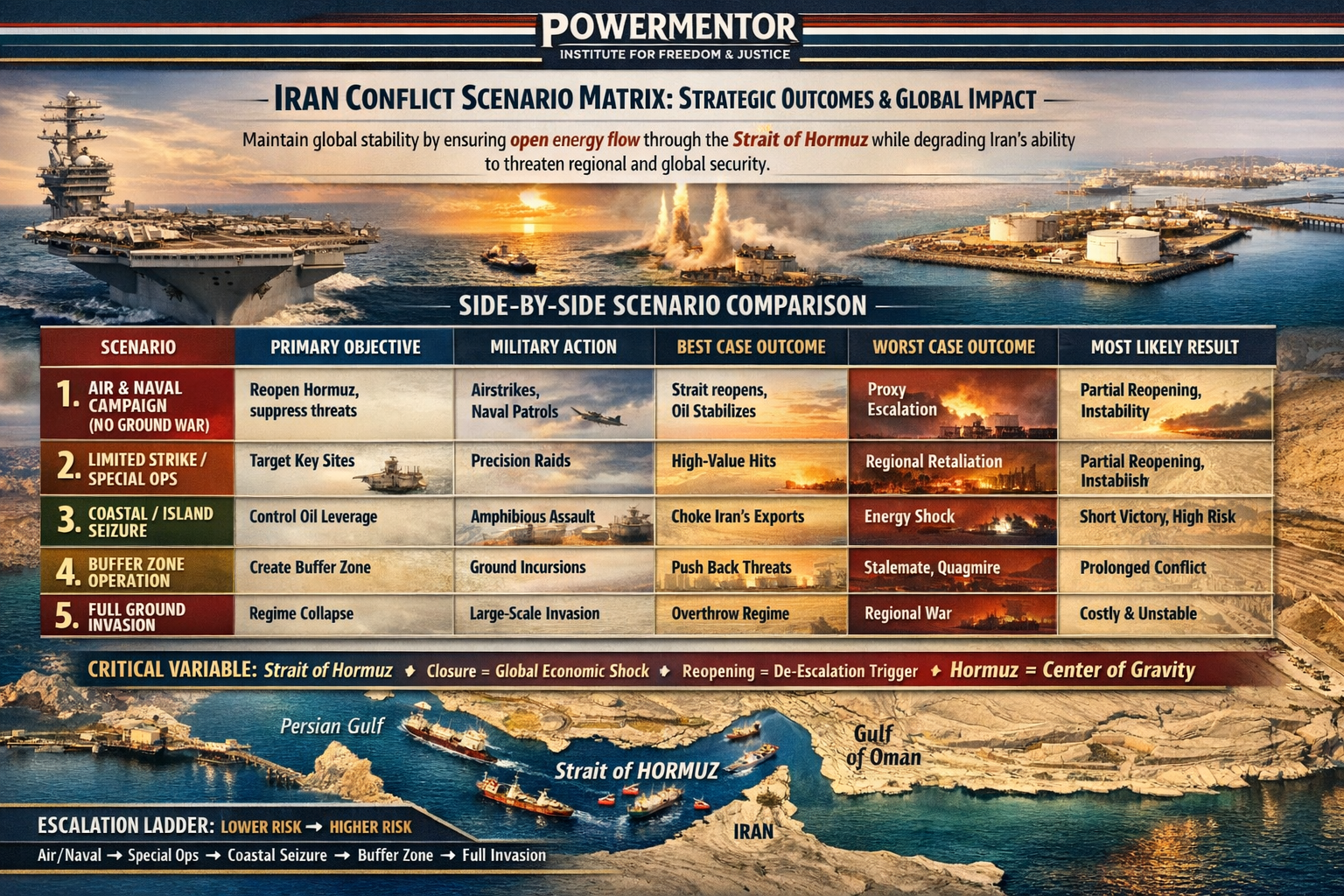
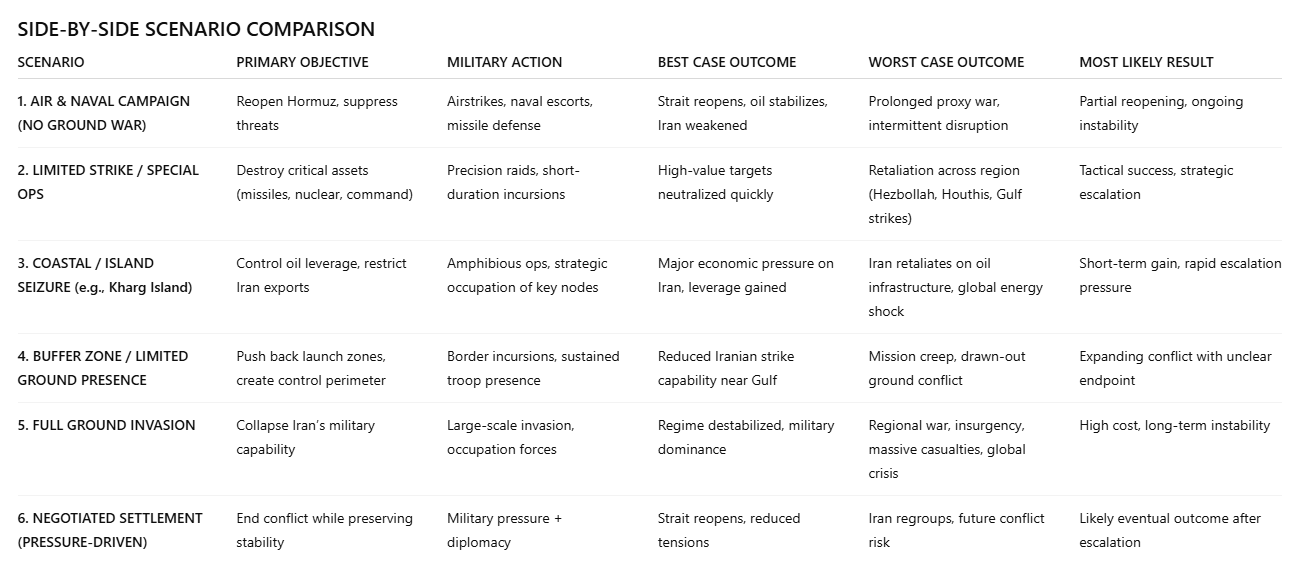
Scenario 1: Air and Naval Campaign (Most Likely Near-Term)
Focus: reopen shipping lanes, suppress threats
Tools: airstrikes, naval presence, missile defense
Outcome:
Partial reopening of Hormuz, continued tension, but no full-scale war
Scenario 2: Limited Ground Action (Targeted Operations)
Focus: destroy high-value targets that cannot be handled remotely
Tools: special operations, short-duration incursions
Outcome:
Tactical success possible—but risk of broader retaliation rises significantly
Scenario 3: Coastal or Strategic Seizure (High Leverage Move)
Focus: control key oil infrastructure or export points
Example: strategic islands or terminals
Outcome:
Major pressure on Iran—but also increases likelihood of escalation across the region
Scenario 4: Buffer Zone / Sustained Ground Presence
Focus: push threats away from critical waterways
Tools: limited but ongoing troop presence
Outcome:
Higher control—but increased risk of mission creep and prolonged conflict
Scenario 5: Full Ground Invasion (Least Likely, Most Dangerous)
Focus: collapse military capability or regime
Outcome:
High casualties
Regional war
Economic shock
Long-term instability
This is the scenario leaders typically try to avoid unless all other options fail.
Scenario 6: Negotiated Settlement (Endgame Scenario)
Focus: reduce escalation while preserving strategic interests
Outcome:
The most common ending in conflicts like this:
Not total victory—but a calculated pause driven by rising costs
The Escalation Reality
Conflicts like this rarely jump straight to full war.
They move along an escalation ladder:
Air/Naval → Limited Ground → Strategic Seizure → Sustained Presence → Full War
Every step upward increases:
Risk
Cost
Uncertainty
The danger is not always the first move.
It is what comes after retaliation begins.
The Strategic Truth Most People Miss
Iran does not need to win a conventional war to succeed.
It only needs to:
Disrupt global energy
Raise costs
Prolong instability
Force difficult decisions
On the other side, the U.S. and its allies do not need to conquer Iran to achieve their objective.
They need to:
Keep Hormuz open
Reduce Iran’s ability to threaten it
Avoid getting pulled into a prolonged ground conflict
The Real Center of Gravity
Military thinkers often talk about the “center of gravity”—the point that determines the outcome of a conflict.
In this case, it is not a city.
It is not a leader.
It is:
Energy Flow Through the Strait of Hormuz
Control that—and you shape the direction of the conflict.
PowerMentor Insight
This conflict will not be decided by who controls land.
It will be decided by who controls pressure.
Pressure on energy
Pressure on economics
Pressure on decision-making
Bottom Line
The troop buildup is about options, not inevitability
The most likely path is limited conflict with targeted objectives
The greatest risk is uncontrolled escalation after initial success
The decisive factor remains whether global energy flow is restored without triggering wider war
Final Thought
“Control the flow of energy, and you control the direction of the conflict.”
