

Take Charge: Why Patients Must Lead Their Own Healthcare Journey
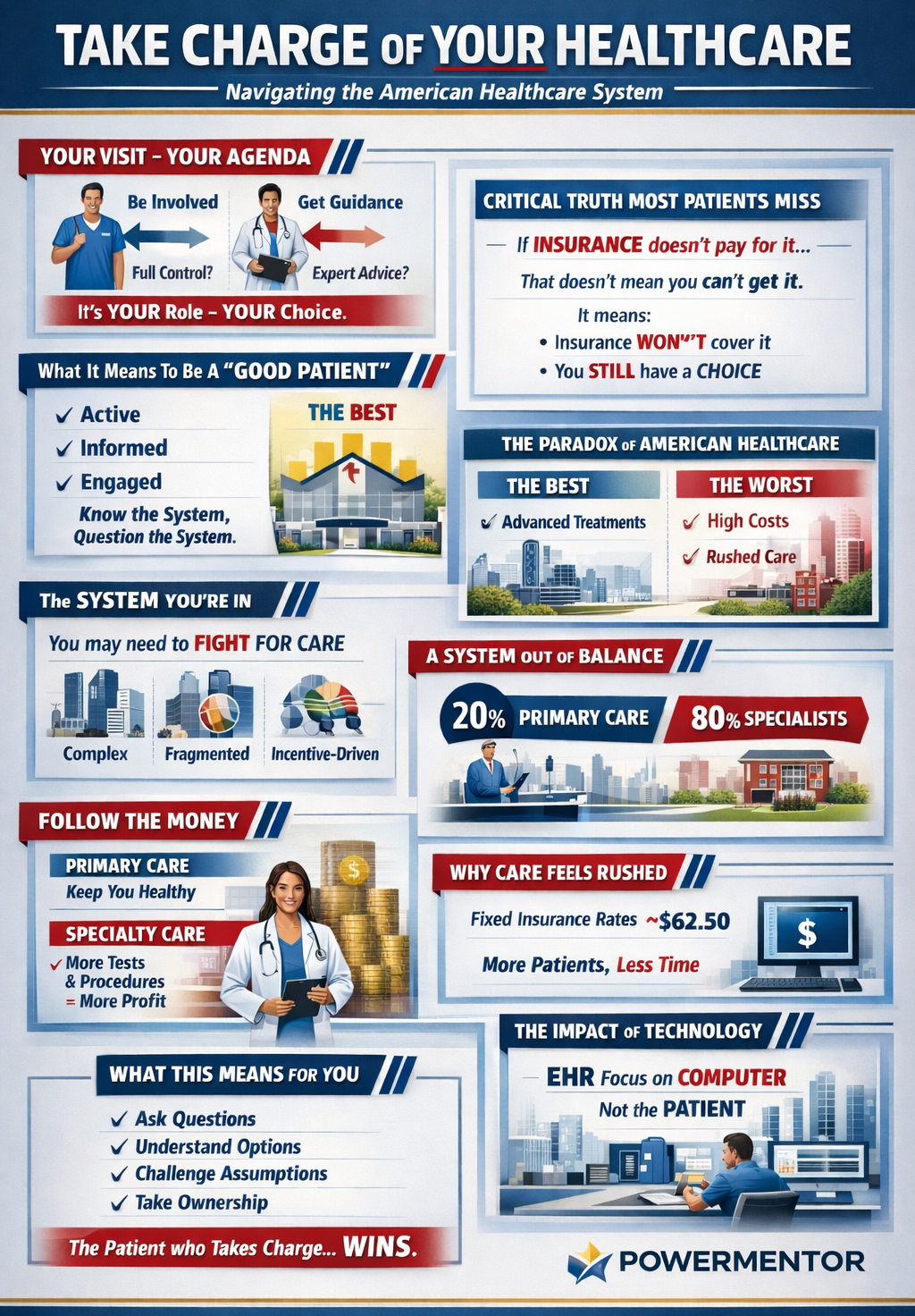
When you walk into a doctor’s office, there is one truth that most people misunderstand:
You may not be the doctor—but your agenda is still the agenda.
Some patients want to be deeply involved in every decision. Others prefer to rely entirely on the expertise of their physician. Both approaches are valid. But what is not optional is this: you must understand the system you are in and take an active role in your care.
Because in today’s American healthcare system, being a “good patient” does not mean being compliant.
It means being engaged.
The System Is Both Incredible—and Deeply Flawed
The American healthcare system is one of the most advanced in the world. It offers cutting-edge treatments, life-saving technologies, and highly specialized expertise.
But it also comes with serious challenges:
High costs
Rushed appointments
Over-treatment
Medical errors
It is a system that can deliver the best care in the world—and at times, the worst experience in medicine.
Understanding this paradox is essential. Because if you don’t understand how the system operates, you will struggle to navigate it effectively.
A Critical Truth Most Patients Miss
One of the most important—and misunderstood—concepts in healthcare is this:
If your insurance doesn’t pay for something, it doesn’t mean you can’t have it. It only means they won’t pay for it.
That distinction matters.
Too many patients assume that insurance defines what care is available. It does not. It only defines what is covered. The responsibility to explore options, ask questions, and make decisions still rests with you.
The Decline of Primary Care—and Why It Matters
There was a time when primary care physicians were at the top of the profession. They were deeply respected for their ability to understand the whole patient—complex, chronic conditions and all.
That model has gradually eroded.
Today:
Only about 20% of physicians are in primary care
Roughly 80% are specialists
This imbalance has changed how care is delivered.
Primary care, which once served as the foundation of health and prevention, has been compressed into short, rushed visits. In many cases, physicians have just minutes with each patient—sometimes as little as four to five minutes of meaningful interaction once documentation is complete.
The result is predictable:
Checklist-driven care
Rapid prescribing
Frequent referrals to specialists
Not because physicians want it this way—but because the system demands it.
Follow the Incentives
Healthcare today is largely driven by a fee-for-service model.
That means:
More tests = more revenue
More procedures = more revenue
More visits = more revenue
Primary care, on the other hand, is designed to keep patients healthy and out of the hospital—which ironically generates less revenue.
This creates a fundamental tension in the system.
As one physician described, spending more time with a patient may actually reduce income. Ordering labs and scheduling follow-up visits, however, increases it. Over time, that mindset has influenced how care is delivered—even at the primary care level.
Why Your Visit Feels Rushed
Many patients feel like their doctor is in a hurry—and they’re right.
Consider the reality:
Appointments are often scheduled in 12-minute blocks
Electronic health records consume up to 80% of that time
That leaves only a few minutes for actual patient interaction.
Doctors are not just caring for patients—they are:
Documenting
Meeting performance metrics
Navigating administrative requirements
This shift has pulled attention away from the patient and toward the computer.
The Loss of Physician Autonomy
Another major shift in healthcare has been the consolidation of medical practices.
Since the 1990s:
Independent physicians have been absorbed into large systems
Many doctors now work for hospitals or insurance companies
This has led to:
Reduced autonomy
Increased administrative oversight
Performance-based evaluations that may not align with patient needs
Physicians are increasingly constrained—not just by time, but by the structure of the system itself.
What This Means for You as a Patient
All of this leads to one unavoidable conclusion:
You cannot afford to be passive in your healthcare.
The patients who tend to do the best are not the most compliant—they are the most informed. They ask questions. They seek clarity. They understand that the system is not perfect and adjust accordingly.
In many ways, you must:
Advocate for yourself
Question recommendations when needed
Understand your options
Stay engaged in every decision
Because no one will manage your health better than you.
The Bottom Line
After reviewing countless studies, speaking with physicians across the country, and examining how care is actually delivered, one truth stands out:
The patient who takes charge of their healthcare journey has the greatest chance of achieving the best outcomes.
Not because the system makes it easy—but because the system requires it.
