

Burma’s “New President” Is the Same Old Dictator
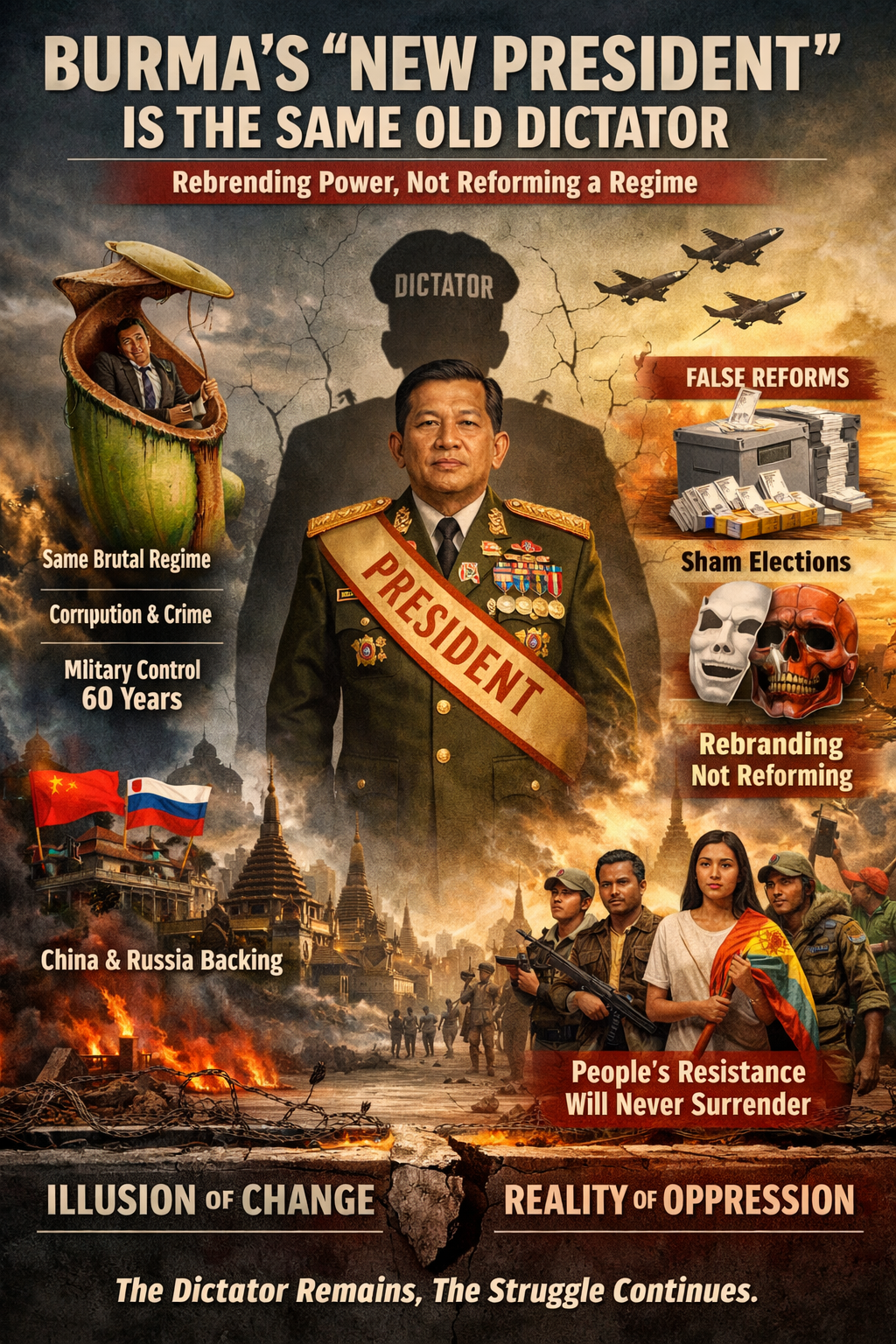
Rebranding Power, Not Reforming a Regime
Following widely discredited elections held in December and January, Burma (Myanmar) has officially confirmed General Min Aung Hlaing as President. On paper, this may appear to signal a political transition. In reality, it changes nothing.
This is not reform. It is rebranding.
General Min Aung Hlaing, who led the military regime yesterday, leads it today—only now with a new title layered onto an already excessive list of honors and positions. But this moment is not about one man’s ego. It is about the survival strategy of a military institution that has dominated Burma for nearly six decades.
One of the earliest and most symbolic examples of this strategy was the regime’s decision to rename the country from Burma to Myanmar in 1989. This was presented to the international community as a step toward national unity and modernization. In reality, it was another calculated rebranding—an attempt to legitimize military rule without addressing the underlying oppression. The name changed, but the system did not. Just like today’s shift from “General” to “President,” it reflects a consistent pattern: alter the label, maintain control, and hope the world mistakes optics for progress.
The Illusion of Change
The Burmese military has ruled since 1962, briefly interrupted by a short-lived civilian government. Its longevity is not accidental—it is strategic.
Over the years, the military has repeatedly reshaped its image to maintain control:
Creating political party fronts
Renaming governing bodies
Rotating leadership titles
Simulating democratic processes
From SLORC to SPDC, from quasi-civilian governments to the current structure, the pattern is consistent: change the appearance, preserve the power.
This latest shift—elevating Min Aung Hlaing to “President”—fits squarely within that playbook. It is not a transition toward democracy. It is an adaptation designed to reduce pressure while maintaining absolute control.
A System Built on Control and Extraction
At its core, the Burmese military is more than a governing force—it functions as a deeply entrenched power network.
For decades, it has:
Consolidated economic control through cronies
Exploited natural resources for private gain
Participated in illicit economies, including narcotics and transnational crime
Distorted national development to serve military interests
This is not simply authoritarian governance—it is a system that prioritizes institutional survival and enrichment above all else.
Why the World Keeps Getting It Wrong
One of the most dangerous patterns in Burma’s modern history is the international community’s repeated misreading of military tactics.
Time and again, superficial changes have been mistaken for meaningful reform.
Diplomats rotate every few years. Institutional memory fades. Old tactics are repackaged as new opportunities. And familiar phrases return:
“We need to wait and see.”
“We should encourage openings.”
But for those on the ground in Burma, this is not new. It is a cycle.
A common analogy used by Burmese activists compares the military to a pitcher plant—sweet on the surface, but deadly beneath. The scent draws in observers, only for them to be consumed.
The danger is not just deception—it is repetition.
What’s Different This Time
There is, however, one critical difference in this phase of military rule.
In the past, the regime worked harder to appear credible—allowing limited political participation, engaging with international media, and presenting leadership changes as reform.
Today, that effort is minimal.
Why?
Because the military believes it no longer needs to convince the West.
With strong backing from China, Russia, and India—and with declining global emphasis on democracy and human rights—the regime appears confident it can withstand international criticism without making meaningful concessions.
Sanctions have slowed. Diplomatic pressure has weakened. Global attention has shifted.
The calculation is simple:
Why pretend to reform if there are no consequences for not doing so?
The Reality Inside Burma
While international actors may debate engagement strategies, the people of Burma are not waiting.
Across the country:
Resistance movements continue to grow
Local governance structures are emerging in liberated areas
Communities are organizing toward a federal democratic future
This is not a passive population. It is an active, resilient movement building from the ground up.
And despite decades of military dominance, one truth remains:
The Burmese military has never fully subdued the will of the people—and it never will.
The Strategic Takeaway
The appointment of Min Aung Hlaing as President should not be misunderstood as a political milestone. It is a signal.
A signal that the military is once again testing the limits of international tolerance.
A signal that rebranding is being deployed in place of reform.
And a signal that the next phase of this conflict will depend not on titles—but on whether the world recognizes the pattern.
Because Burma does not need another illusion of change.
It needs the conditions for real change to finally take hold.
