

Dependency by Design: From Government Subsidies to Healthcare—When Systems Sustain Instead of Strengthen
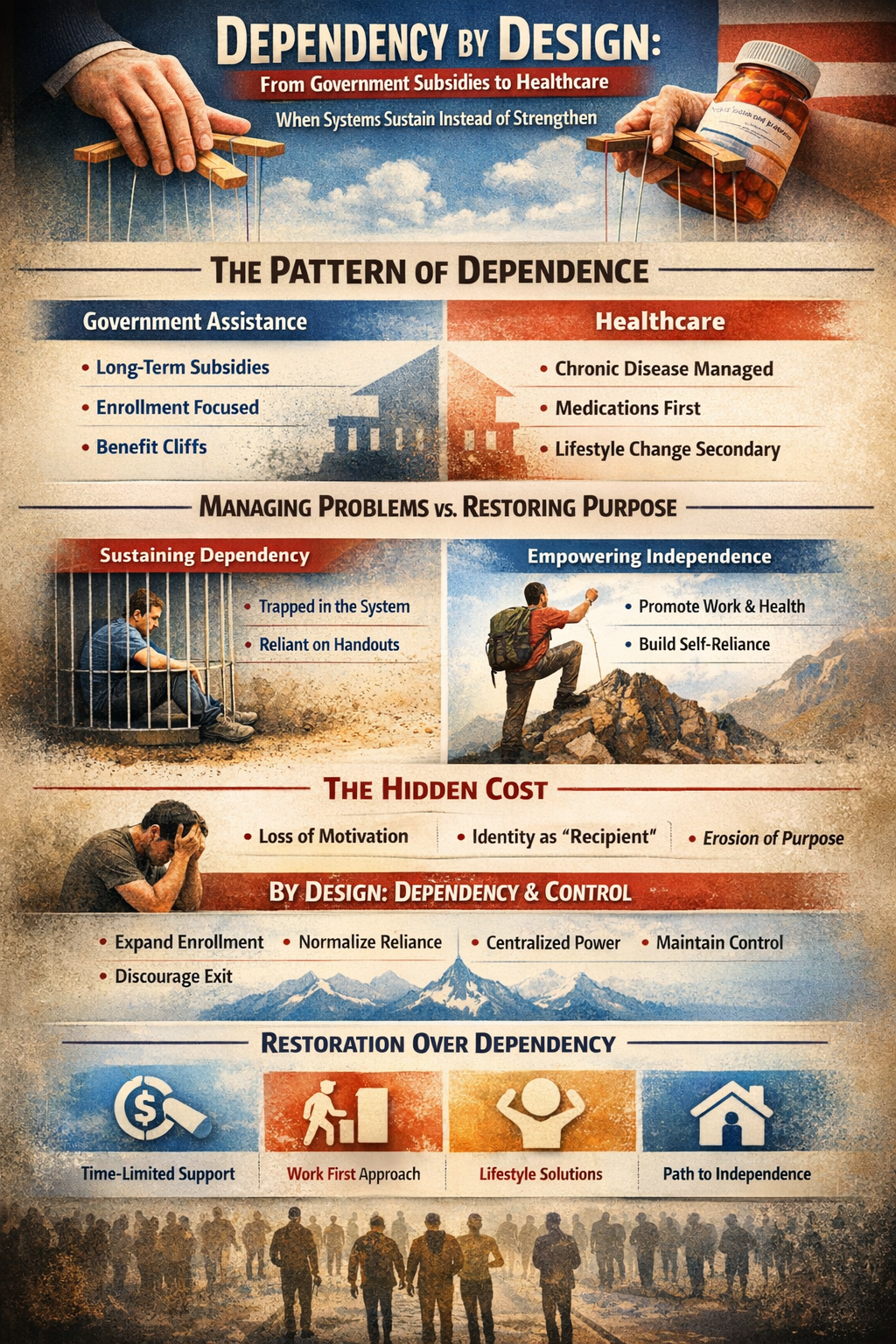
There is a hard truth that needs to be said plainly:
Some systems—both in government assistance and healthcare—are structured in ways that can create long-term dependence rather than restore independence.
Not always by accident. Not always unintentionally.
But often through incentives, structure, and in some cases, purposeful design.
And when that happens, the result is the same:
People are sustained—but not strengthened.
The Bigger Pattern: Managing Instead of Restoring
Across two major sectors—public assistance and healthcare—we are seeing a consistent pattern:
Systems expand participation
Short-term solutions become long-term defaults
Incentives reward continuation—not resolution
In government programs:
Enrollment is tracked
Funding is tied to utilization
Outreach is formalized
In healthcare:
Chronic disease is managed
Medications are prescribed long-term
Lifestyle intervention is often secondary
Different systems.
Same outcome.
We are managing problems instead of solving them.
Government Assistance: When Help Becomes Dependency
Public assistance programs were designed to be a safety net.
But increasingly, they function as a long-term support structure rather than a temporary bridge.
Federal SNAP guidance explicitly encourages states to conduct outreach and increase participation (U.S. Department of Agriculture [USDA], 2026a). At the same time, funding structures and administrative systems often reward higher utilization.
This creates a critical shift:
Success becomes measured by how many people are in the system—not how many successfully leave it.
When systems:
Reward enrollment
Discourage exit
Penalize upward mobility (benefits cliffs)
They create a predictable result:
Dependence becomes stable. Independence becomes risky.
Even federal analysis acknowledges the problem. “Benefits cliffs” occur when small increases in income lead to disproportionate losses in benefits, effectively discouraging advancement (U.S. Department of Health and Human Services [HHS], n.d.; National Conference of State Legislatures [NCSL], 2024).
This is not about individual failure.
This is about system design.
Dependency and Control: The Deeper Concern
At the ideological level, there is an important tension.
Some models of governance emphasize:
Personal responsibility
Work and contribution
Decentralized support (family, community, local institutions)
Others emphasize:
Centralized provision
Redistribution
State-managed stability
Critics of expansive welfare systems have long argued that when the state becomes the primary provider of essential needs, it can increase reliance on government structures and reduce individual autonomy.
In that sense, some subsidy models can function—whether intentionally or through structural incentives—as mechanisms that expand dependence and reinforce centralized control.
Regardless of intent, the outcome matters:
When people rely on systems for long-term survival, those systems gain influence over their lives.
Healthcare: Treating Disease Instead of Restoring Health
Now consider healthcare.
We face a growing burden of chronic disease:
Diabetes
Hypertension
Obesity
Cardiovascular disease
The dominant response is:
Medication management.
Medication absolutely has a role. It can be life-saving.
But too often, it becomes the primary strategy, rather than one part of a broader solution.
Yet research consistently shows that lifestyle interventions—nutrition, physical activity, sleep, and stress management—can significantly prevent and improve chronic conditions (Pinto & Bloch, 2018).
So why does the system lean toward medication?
Because the incentives support it:
Faster intervention
Standardized care pathways
Reimbursable services
But the result is clear:
We manage disease instead of restoring health.
And in doing so, we create:
Long-term medication dependence
Increased cost
Ongoing side effects
The Parallel: Two Systems, One Outcome
Look at the alignment:
Government AssistanceHealthcareLong-term subsidiesLong-term medication useEnrollment growthPrescription growthExit is difficultLifestyle change is underemphasizedStability over independenceSymptom control over root cause
In both cases:
The system sustains—but does not always empower.
The Human Cost: Loss of Purpose
This is where the issue becomes deeper than policy or medicine.
Because the greatest loss is not financial.
It is human purpose.
Work, effort, and responsibility are not just economic tools—they are foundational to identity, dignity, and mental well-being.
Research shows that employment is strongly associated with improved mental health, while unemployment is linked to increased distress (Drake et al., 2020; Sterud et al., 2025).
When individuals are placed into long-term dependency systems:
Motivation declines
Confidence erodes
Identity shifts from contributor to recipient
Initiative weakens
You cannot build strong people by removing the need to strive.
Bureaucracy and Self-Preservation
There is another reality that cannot be ignored:
Systems tend to preserve themselves.
Programs develop:
Administrative infrastructure
Funding streams
Political support
When continuation is rewarded, reduction becomes unlikely.
And when reducing dependency threatens the system itself, the system will naturally resist that outcome.
That is not conspiracy.
That is institutional behavior.
The Need for Balance
Let’s be clear:
People do need help
Patients do need medication
Communities do need support systems
But there must be balance.
There is a difference between:
A helping hand
And a permanent crutch
There is a difference between:
Treatment
And restoration
If someone needs support:
It should stabilize
Equip
And move them forward
Not hold them in place.
A Better Path Forward: Restore, Don’t Replace
If we are serious about helping people, then the goal must be clear:
Every system should be designed to reduce dependency—not expand it.
In Public Assistance:
Time-bound support
Workforce development integration
Elimination of benefit cliffs
Success measured by independence
In Healthcare:
Prioritizing lifestyle interventions
Integrating prevention into care models
Using medication as a tool—not the foundation
Measuring success by improved health—not just managed disease
Final Word
We should help people in need. Absolutely.
But we should never build systems—intentionally or unintentionally—that keep people dependent.
Because whether it is through subsidies or prescriptions—
A system that sustains people without restoring their strength and purpose is incomplete.
And over time, it risks doing something far more damaging:
It teaches dependence where there should be growth.
At the end of the day:
You can support people without weakening them.
But you cannot build strong people through dependency.
References
Drake, R. E., Frey, W., Bond, G. R., Goldman, H. H., Salkever, D., Miller, A., Moore, T. A., Riley, J., Karakus, M., & Milfort, R. (2020). Employment is a critical mental health intervention. Epidemiology and Psychiatric Sciences, 29, e178. https://doi.org/10.1017/S2045796020000906
National Conference of State Legislatures. (2024). Introduction to benefits cliffs and public assistance programs. https://www.ncsl.org
Pinto, A. D., & Bloch, G. (2018). Framework for building primary care capacity to address the social determinants of health. Annals of Family Medicine, 16(4), 304–311.
Sterud, T., et al. (2025). A systematic review of unemployment and mental health: Effects of re-employment. Scandinavian Journal of Work, Environment & Health.
U.S. Department of Agriculture. (2026a). SNAP state outreach plan guidance. Food and Nutrition Service. https://www.fns.usda.gov/snap
U.S. Department of Health and Human Services. (n.d.). Effective marginal tax rates and benefit cliffs. Office of the Assistant Secretary for Planning and Evaluation. https://aspe.hhs.gov
