

Book Review: Angels of God by Thawda Bu
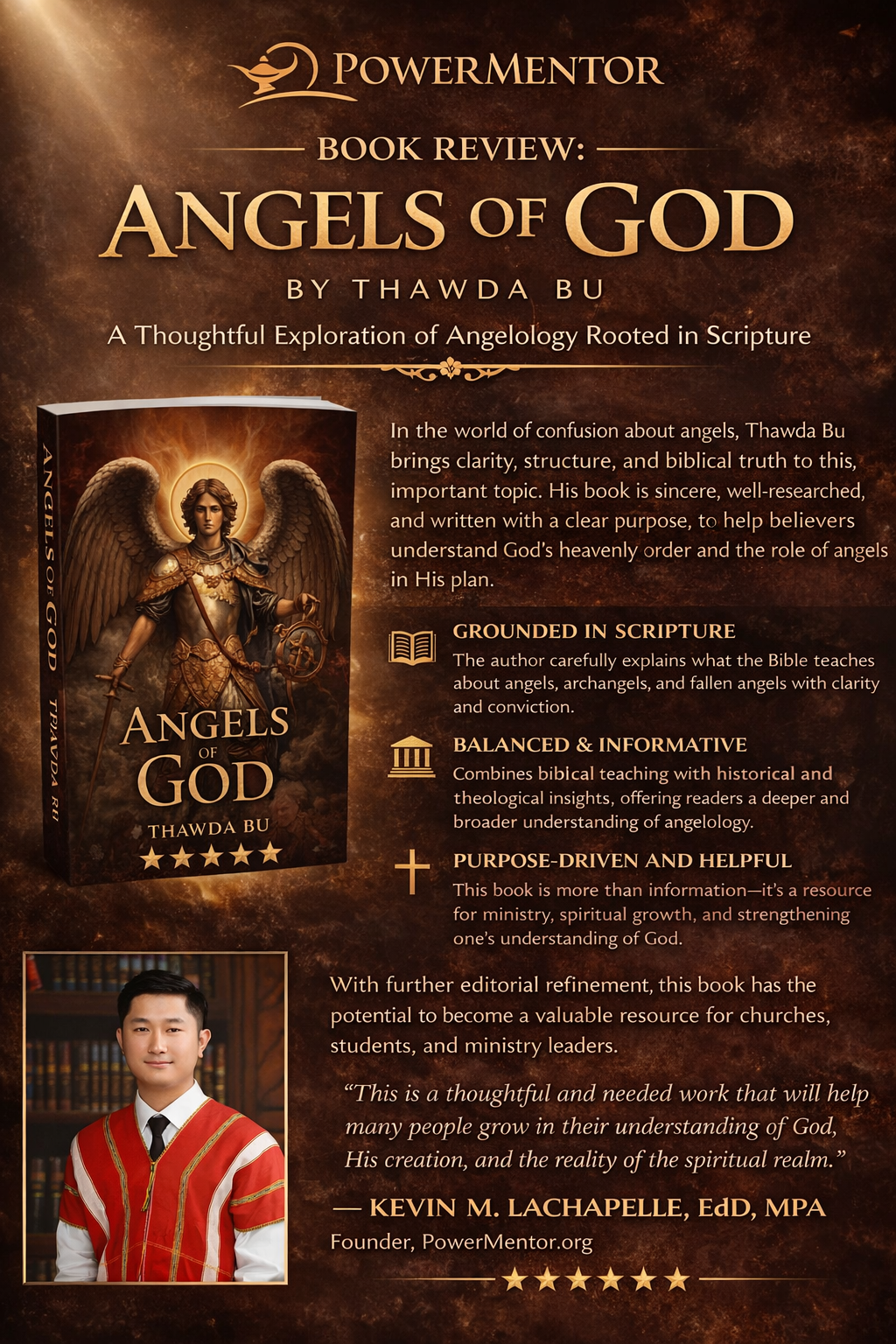
A Thoughtful Exploration of Angelology Rooted in Scripture and Purpose
In a time where theological understanding is often reduced to soundbites and surface-level interpretations, Angels of God by Thawda Bu offers something increasingly rare—a sincere, structured, and purpose-driven exploration of angelology grounded in Scripture and supported by historical context.
As someone who has spent decades working in leadership, education, and complex systems where clarity matters, I approach any theological work with two key questions:
Does it bring understanding? And does it serve a greater purpose?
This book does both.
Clarity in a Commonly Misunderstood Topic
The subject of angels is one that many people are familiar with, yet few truly understand. Popular culture has distorted the concept, while many faith communities either oversimplify or avoid the topic altogether.
What Thawda Bu accomplishes in this work is important—he creates structure where there is confusion.
The book carefully walks the reader through:
The existence and nature of angels
The roles of archangels
The reality and impact of fallen angels
The relationship between angels, God, and humanity
Rather than presenting fragmented ideas, the author builds a clear, progressive framework that allows readers to understand not just what angels are, but why they matter.
A Balance of Scripture and Historical Perspective
One of the strengths of this book is its effort to balance biblical authority with broader historical and theological references.
The author consistently anchors his arguments in Scripture while also drawing from:
Early religious traditions
Apocryphal writings
Theological scholars
This approach does two important things:
It keeps the reader grounded in biblical truth
It expands understanding beyond what is commonly taught
For readers who are serious about growing in their knowledge—not just consuming information—this adds real value.
More Than Information — A Purpose Behind the Work
What stands out most is that this book is not written simply to inform—it is written to equip and strengthen.
There is a clear intention behind every chapter:
to help believers better understand God’s design, His order, and His ongoing work in the world.
This is especially evident in how the author connects angelology to:
Ministry
Spiritual awareness
Biblical interpretation
Personal faith development
This is not just theology for the sake of knowledge—it is theology applied with purpose.
Leadership Perspective: Why This Matters
From a leadership standpoint, this book does something that many miss—it addresses a gap in foundational understanding.
When people lack clarity, they fill the gap with assumption, fear, or misinformation.
This applies in organizations, and it applies in faith.
By clearly defining the role of angels, this book helps remove confusion and replace it with structure. That matters—not just theologically, but practically—for:
Church leaders
Teachers
Ministry teams
Students of Scripture
Clarity creates confidence. And confidence strengthens both faith and leadership.
Areas for Growth
It is important to be direct: the manuscript would benefit from additional editorial refinement.
There are:
Grammar inconsistencies
Repetitive phrasing
Sentence structure issues
However, these are surface-level issues, not foundational ones.
The substance of the work is strong. With professional editing, this book has the potential to reach a much broader audience and stand as a more polished theological resource.
Final Thoughts
Angels of God is a book driven by conviction, humility, and a desire to bring clarity to an important subject.
It is not written from a place of speculation, but from a place of purpose—to help others better understand God, His creation, and His order.
In a world filled with noise and distraction, there is something valuable about a work that simply aims to teach clearly and faithfully.
That is what this book does.

Recommendation
We would recommend this book to:
Ministry leaders
Theology students
Bible teachers
Anyone seeking a deeper understanding of angels in Scripture
With continued refinement, this work has the potential to become a meaningful resource within both academic and ministry settings.
