

The Slaughter and the Evidence of Forced Organ Harvesting in China: A Hard Look at the Disappearance of Young Adults
A System Under Global Scrutiny
Over the past two decades, mounting evidence has pointed to one of the most disturbing human rights issues of the modern era: the large-scale harvesting of organs from prisoners in China.
The issue gained international attention through The Slaughter by Ethan Gutmann, which compiled years of interviews, witness accounts, and system-level analysis. Since its publication, additional testimony, tribunal findings, and independent research have strengthened the case that China’s transplant system has been tied to coercive and non-consensual organ sourcing.
Established Fact: Organs Taken from Prisoners
One foundational point is not disputed:
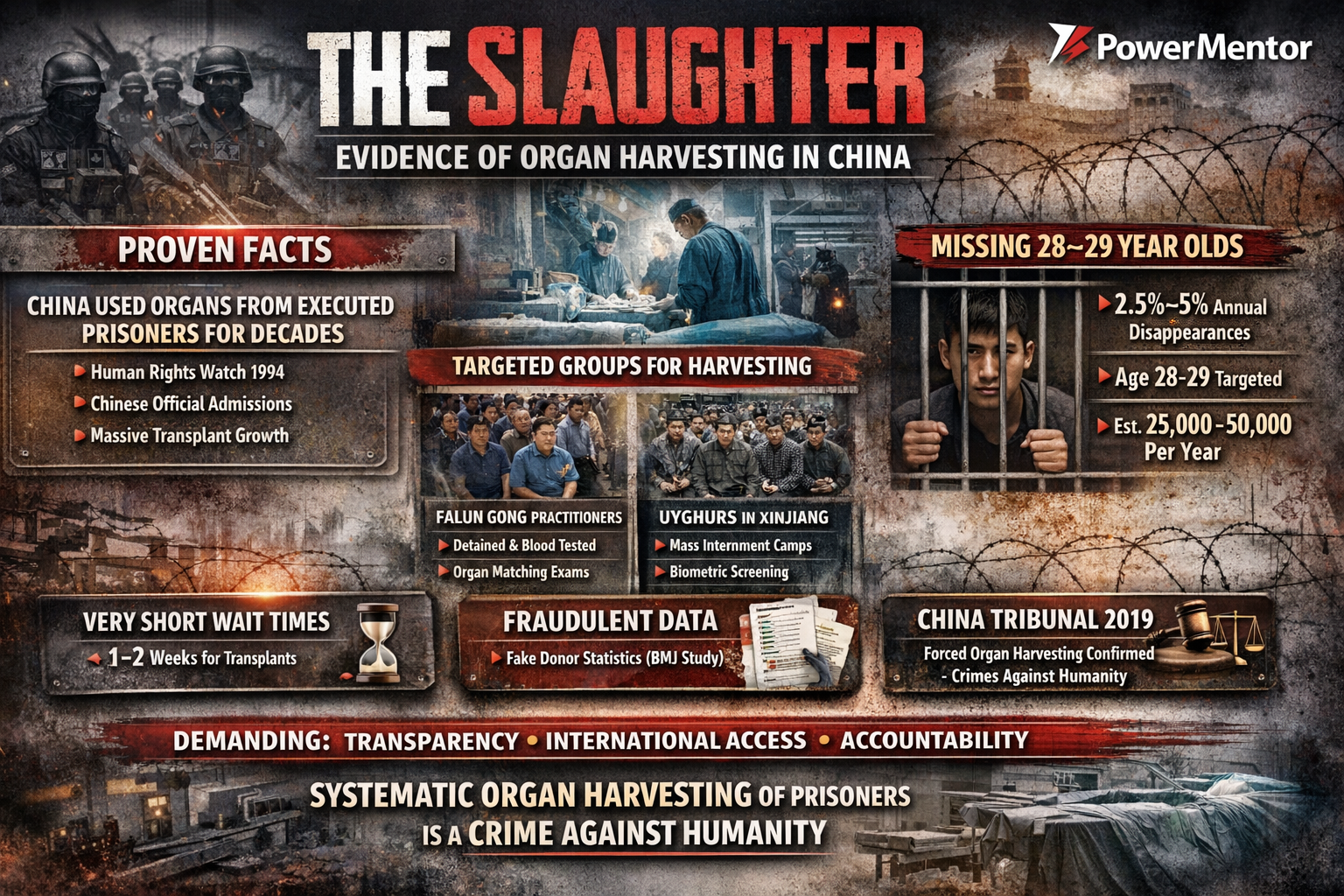
China used organs from executed prisoners for decades.
Documented by Human Rights Watch as early as 1994
Acknowledged by Chinese officials prior to reform announcements
Identified in global transplant ethics discussions as a unique and systemic practice
This establishes a critical baseline: state-controlled access to prisoner organs has existed and been operationalized at scale.
Scale and Growth of China’s Transplant System
During the 2000s, China rapidly became one of the largest transplant providers in the world.
Key indicators:
Extremely short wait times (weeks vs. years in Western systems)
Ability to schedule transplants on demand
Significant expansion of transplant hospitals and infrastructure
These conditions require a large, readily available donor pool, which is not consistent with voluntary donation systems alone—particularly during the early 2000s when China had minimal civilian organ donation participation.
Targeted Populations Identified
Falun Gong Practitioners
The Slaughter identifies practitioners of Falun Gong as a primary early target group:
Large-scale detention beginning in 1999
Reports of systematic blood testing and organ exams
No corresponding medical treatment provided
These patterns align with organ compatibility screening, not general healthcare.
Uyghur Population in Xinjiang
More recent focus has shifted to the Uyghurs population:
Mass detention in state-run facilities
Reports of biometric data collection and medical testing
Testimony indicating disappearances within specific demographic groups
The 28–29-Year-Old Disappearance Pattern
In later testimony, Gutmann presented evidence suggesting:
2.5%–5% annual disappearance rates in certain detainee populations
Concentration among individuals aged 28–29
Estimated 25,000–50,000 individuals annually unaccounted for
Why this age group matters:
Peak physical health
High organ viability
Optimal transplant outcomes
This aligns with medical selection criteria, suggesting a system that may prioritize individuals based on biological suitability.
Independent Findings and Tribunal Conclusions
The China Tribunal (2019), chaired by Sir Geoffrey Nice QC, concluded:
Forced organ harvesting occurred for years at a substantial scale
Victims included prisoners of conscience
The practice constituted crimes against humanity
This conclusion was based on:
Medical data analysis
Witness testimony
Transplant volume comparisons
Recorded admissions from Chinese medical institutions
Medical and Statistical Evidence
1. Data Irregularities
Research published in The BMJ found:
China’s official donor data followed artificial statistical patterns
Suggesting potential fabrication or manipulation
2. Medical Testing Without Treatment
United Nations Human Rights Council experts reported:
Blood testing
Organ-focused examinations
No follow-up care
These are consistent with organ matching protocols.
3. On-Demand Transplants
China historically advertised:
Guaranteed transplant timelines
Matching organs within days or weeks
This implies pre-identified donors, not random availability.
Post-2015 Reforms: Claims vs. Reality
China announced in 2015 that it transitioned to a voluntary donation system.
However, ongoing concerns include:
Lack of independent verification
Continued transplant volumes inconsistent with donation rates
Restricted access for international inspection
As a result, the core question remains:
➡️ Did the sourcing system fundamentally change—or was it reclassified?
Why the Evidence Is Considered Compelling
Across multiple domains, the findings converge:
Historical admission of prisoner organ use
Large-scale transplant capacity
Medical testing of detainees
Statistical anomalies in donor data
Independent tribunal conclusions
Consistent witness testimony over time
Individually, each piece raises concern.
Collectively, they form a coherent and reinforcing body of evidence.
Conclusion: A System That Demands Accountability
The issue is no longer whether unethical organ sourcing occurred in China’s past—that is established.
The central issue now is scale, targeting, and whether the practice continues under new structures.
The evidence base—spanning investigative journalism, tribunal findings, medical analysis, and government testimony—has reached a level that demands:
Transparency
Independent access
Full international accountability
Because at its core, this is not a political issue.
It is a question of whether modern medicine has been used to preserve life—or to systematically take it.
References
Gutmann, E. (2014). The slaughter: Mass killings, organ harvesting, and China’s secret solution to its dissident problem. Prometheus Books.
Gutmann, E. (2022). Written testimony before the U.S. House of Representatives. Retrieved from https://chrissmith.house.gov
Human Rights Watch. (1994). Organ procurement and judicial execution in China. Retrieved from https://www.hrw.org
China Tribunal. (2019). Final judgment. Retrieved from https://chinatribunal.com
Robertson, M. (2024). Testimony before the Congressional-Executive Commission on China. Retrieved from https://chrissmith.house.gov
United Nations Human Rights Council. (2021). UN experts alarmed by organ harvesting allegations in China. Retrieved from https://www.ohchr.org
Rogers, W., Robertson, M. P., Ballantyne, A., Blakely, T., Catsanos, R., Clay-Williams, R., & Huxtable, R. (2019). Compliance with ethical standards in Chinese organ transplantation research. BMJ, 367, l6550. https://doi.org/10.1136/bmj.l6550
