

Burma’s Silent Crisis: 14,000 Political Prisoners Enduring Torture and Neglect
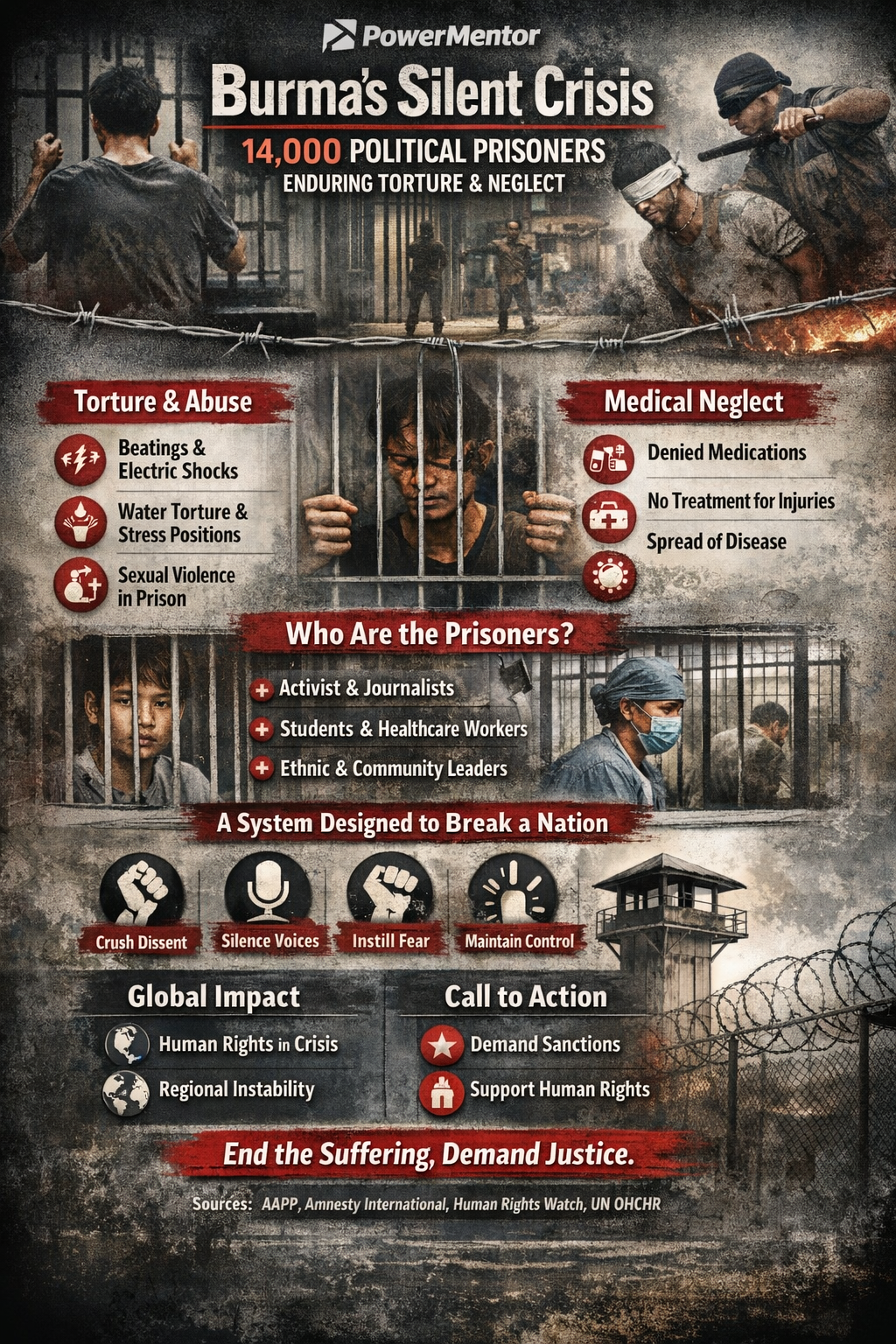
A Humanitarian Emergency Hidden Behind Prison Walls
In the shadows of global conflict, one of the most severe ongoing human rights crises continues largely unseen. In Burma (Myanmar), more than 14,000 political prisoners remain detained under the military regime—many of them activists, journalists, healthcare workers, and ordinary civilians who dared to resist oppression.
Since the 2021 Myanmar military coup, the country has descended into widespread violence, systemic repression, and institutionalized abuse. While headlines often focus on armed conflict, the reality inside Burma’s prisons tells a deeper and more disturbing story—one of deliberate human suffering.
Inside the Prisons: Torture as a Tool of Control
Reports from credible human rights organizations confirm that detainees are subjected to:
Systematic torture during interrogation
Severe beatings and prolonged physical abuse
Stress positions and sleep deprivation
Electric shocks and water torture
Sexual violence in detention facilities
Organizations such as Assistance Association for Political Prisoners (AAPP) have documented these abuses extensively, noting that torture is not random—it is strategic and widespread, designed to break resistance and instill fear across the population.
Former detainees describe interrogation centers as places where survival itself becomes uncertain. Many never make it out alive.
Medical Neglect: A Silent Death Sentence
Beyond physical abuse, prisoners face another equally deadly threat—intentional medical neglect.
Denial of basic medications
Lack of treatment for chronic illnesses
Refusal to provide care for injuries caused by torture
Spread of infectious diseases due to overcrowding and unsanitary conditions
In many cases, preventable illnesses become fatal. Medical care is not simply inadequate—it is often withheld as punishment.
Healthcare workers who once served communities are now among the imprisoned, creating a cruel irony: those who healed others are now left to suffer without care.
Who Are the Prisoners?
These 14,000 individuals are not criminals in any traditional sense. They include:
Democracy advocates
Journalists reporting the truth
Students and young protestors
Ethnic leaders and community organizers
Healthcare professionals who refused to work under military control
Their “crime” is often nothing more than standing for freedom, dignity, and democratic governance.
A System Designed to Break a Nation
The military junta’s prison system serves a broader purpose:
Crush dissent
Silence independent voices
Deter future resistance
Maintain power through fear
This is not just imprisonment—it is a calculated system of psychological and physical destruction aimed at dismantling civil society.
Why This Matters Globally
What is happening in Burma is not an isolated issue—it is a test of the international community’s commitment to human rights.
Unchecked abuses:
Undermine global human rights standards
Encourage authoritarian regimes elsewhere
Fuel regional instability and displacement
The longer this crisis continues without meaningful intervention, the more normalized such atrocities become.
A Call to Awareness and Action
The suffering of Burma’s political prisoners must not remain invisible.
Governments, organizations, and individuals all have a role to play:
Advocate for international accountability
Support humanitarian and human rights organizations
Amplify the voices of survivors and families
Push for targeted sanctions and diplomatic pressure
Silence enables abuse. Awareness creates pressure. Action drives change.
Conclusion: Remembering the Human Cost
Behind the number 14,000 are real people—each with a name, a family, and a future that has been unjustly taken from them.
Their stories reflect both the brutality of oppression and the resilience of the human spirit.
The question is not whether the world knows—it is whether the world will act.
References
Assistance Association for Political Prisoners (AAPP). (2024–2026). Daily Briefing and Political Prisoner Data. https://aappb.org
Amnesty International. (2023). Myanmar: “Bullets rained from the sky” – War crimes and repression.
Human Rights Watch. (2023–2025). Myanmar Reports on Detention and Torture. https://www.hrw.org
United Nations Office of the High Commissioner for Human Rights. (2024). Situation of Human Rights in Myanmar.
Fortify Rights. (2023). “I Was Tortured Every Day”: Political Prisoners in Myanmar.
International Committee of the Red Cross. (2024). Detention Conditions and Humanitarian Concerns in Myanmar.
