

The Disappearing Minds: A Deeper Look at the New Mexico Cluster
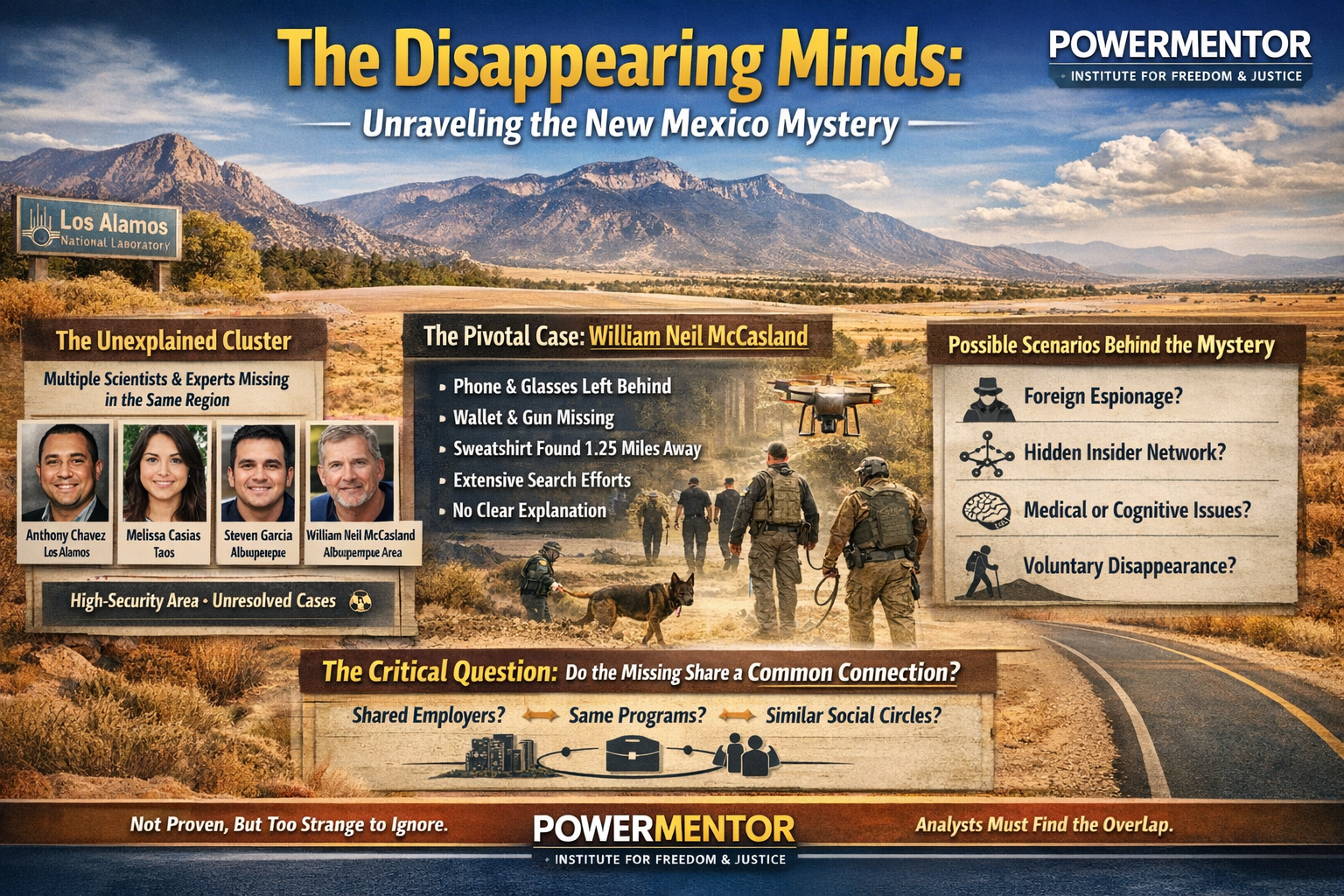
PowerMentor Analysis: As of April 2026, the White House is investigating a series of about 10 mysterious deaths and disappearances of US scientists and researchers with high-level security clearances and ties to NASA, nuclear, or defense projects.
Something Isn’t Adding Up
Over time, certain stories don’t explode all at once—they build quietly. One case here. Another there. Each one, on its own, explainable. But when you begin to place them side by side, a different picture starts to form. That is what is happening here.
At first, the narrative was broad and somewhat sensationalized—scientists disappearing across the country. But when you strip away the noise and focus only on what is confirmed, the story narrows significantly. What remains is not a nationwide phenomenon. It is something much more concentrated.
It points to New Mexico.
And that is where the analysis must begin.
The Cluster That Cannot Be Ignored
There are multiple individuals in New Mexico who remain officially missing, not speculated, not rumored, but documented in active systems. Among them are Anthony Chavez (Los Alamos), Melissa Casias (Taos), Steven Garcia (Albuquerque), and William Neil McCasland (Albuquerque area). These are real cases that have not been resolved.
What makes this important is not simply that people are missing. That happens across the country. What matters is the geographic concentration combined with the unresolved nature of each case. These disappearances are not spread randomly. They are clustered in a region known for its connection to national security, defense work, and high-level scientific activity.
That alone does not prove anything. But it does elevate the situation from ordinary to analytically significant.
The Case That Changes the Conversation
Among all the cases, one stands out in a way that forces deeper scrutiny: William Neil McCasland.
When investigators examined his disappearance, they found something that does not fit neatly into a single explanation. His phone, prescription glasses, and wearable devices were left behind at home, which would normally suggest that a person did not intend to go far or remain disconnected. Yet at the same time, his hiking boots, wallet, and a .38 revolver were missing, indicating some level of movement, preparation, or departure.
Complicating things further, a sweatshirt believed to be his was found approximately 1.25 miles away, introducing a potential movement path that still leads nowhere. Despite an extensive search effort—including canvassing over 700 homes, deploying drones and helicopters, and utilizing K-9 teams—there remains no confirmed sighting and no established direction of travel.
Even more notable, the FBI has been involved in a supporting role, and yet there is still no evidence of foul play and no definitive conclusion.
This is where the case becomes critical. It simultaneously supports multiple explanations—medical event, voluntary departure, or something external—without clearly confirming any of them.
That is not typical.
When a Case Resists Resolution
The disappearance of Anthony Chavez introduces a different but equally important dimension. Authorities in Los Alamos did not treat this as a routine case. They conducted extensive searches of homes and surrounding areas, reviewed surveillance footage, followed up on leads, and coordinated across multiple agencies.
And still, he remains missing.
This matters because it demonstrates that the case has resisted normal investigative processes. It is not simply a situation where effort was lacking. It is a situation where effort has not produced answers.
That distinction is important. It moves the case from ordinary to persistent anomaly.
The Supporting Cases That Reinforce the Pattern
The cases of Melissa Casias and Steven Garcia do not carry the same level of publicly detailed information, but they play a crucial role in the overall analysis. Both remain officially listed as missing within the state system, and both are located within the same regional footprint.
Individually, they may not raise alarms. But together, they reinforce something that cannot be ignored: this is not a single isolated event. It is a cluster of unresolved disappearances within the same geographic ecosystem.
In intelligence work, patterns are rarely defined by one dramatic case. They are defined by consistency across multiple unresolved signals.
Separating the Real Pattern from the Noise
One of the biggest challenges in understanding this situation is the broader narrative that has formed around it. The idea that “scientists across the country are disappearing” pulls in cases that do not share the same characteristics. Some involve known suspects. Others have explanations that, while tragic, are not mysterious.
This creates confusion.
Because when unrelated cases are grouped together, it becomes easier to dismiss the entire story.
But that would be a mistake.
The more accurate interpretation is this:
There is a larger, noisy narrative that mixes unrelated events. But within that narrative, there appears to be a smaller, more focused cluster that remains unexplained.
And that cluster is in New Mexico.
What Could This Actually Be?
At this point, the goal is not to jump to conclusions but to evaluate what explanations best fit the available facts.
One possibility is that these are completely unrelated events, coincidentally occurring in the same region. That cannot be ruled out. However, coincidence becomes less convincing when multiple unresolved cases exist within a sensitive and specialized geographic area.
Another possibility is that these cases involve medical, cognitive, or mental-health-related events. This is particularly relevant in McCasland’s case, where a Silver Alert was issued and authorities referenced medical considerations. This could explain behaviors such as leaving communication devices behind or moving without a clear plan. Even so, it does not fully account for the clustering across multiple individuals.
A third possibility is voluntary disappearance. In some cases, individuals may intentionally leave their lives behind. The fact that McCasland’s wallet, boots, and weapon were missing keeps this explanation in play. However, voluntary disappearance typically leaves behind some form of traceable pattern, and in these cases, that clarity is lacking.
Which brings us to the most uncomfortable possibility: that at least some of these cases involve something more deliberate.
Not in the sense of a dramatic, coordinated operation, but something more subtle—selective targeting, coercion, or exploitation of vulnerable individuals within a sensitive environment. If such a pattern existed, it would not be obvious. It would look fragmented. It would look inconsistent. It would look exactly like what we are seeing now.
The Question That Determines Everything
Ultimately, the entire situation hinges on one critical question:
Do these individuals share a common connection?
Not simply in terms of being “scientists,” but in more specific ways:
Shared employers or contractors
Overlapping professional roles or access levels
Common social networks or environments
Similar routines, locations, or digital exposure
If meaningful overlap exists in any of these areas, the implications change significantly. What appears as coincidence could quickly become a defined pattern.
If no overlap exists, the cases begin to move back toward independent explanations.
This is the dividing line.
The Risk of Missing What Matters
There is a tendency, especially in complex situations, to default to extremes. Some will dismiss everything outright. Others will assume the most dramatic explanation possible.
Both approaches are flawed.
The real danger lies in failing to recognize when a pattern is emerging but not yet proven.
Because that is exactly when attention is most needed.
Final PowerMentor Insight
When you take all of this together, the conclusion becomes clear:
This situation is not proven. But it is also not ordinary.
The broader narrative may be exaggerated, but the New Mexico cluster remains unresolved, concentrated, and unusual. The facts do not yet point to a single explanation, but they do point to something that deserves closer examination.
In high-level analysis, you do not wait for certainty. You respond to patterns that should not be ignored.
And right now—
There is a pattern in New Mexico that has not yet been explained.
