

The Karen People, Y’wa, and the Prophecy of the Lost Golden Book
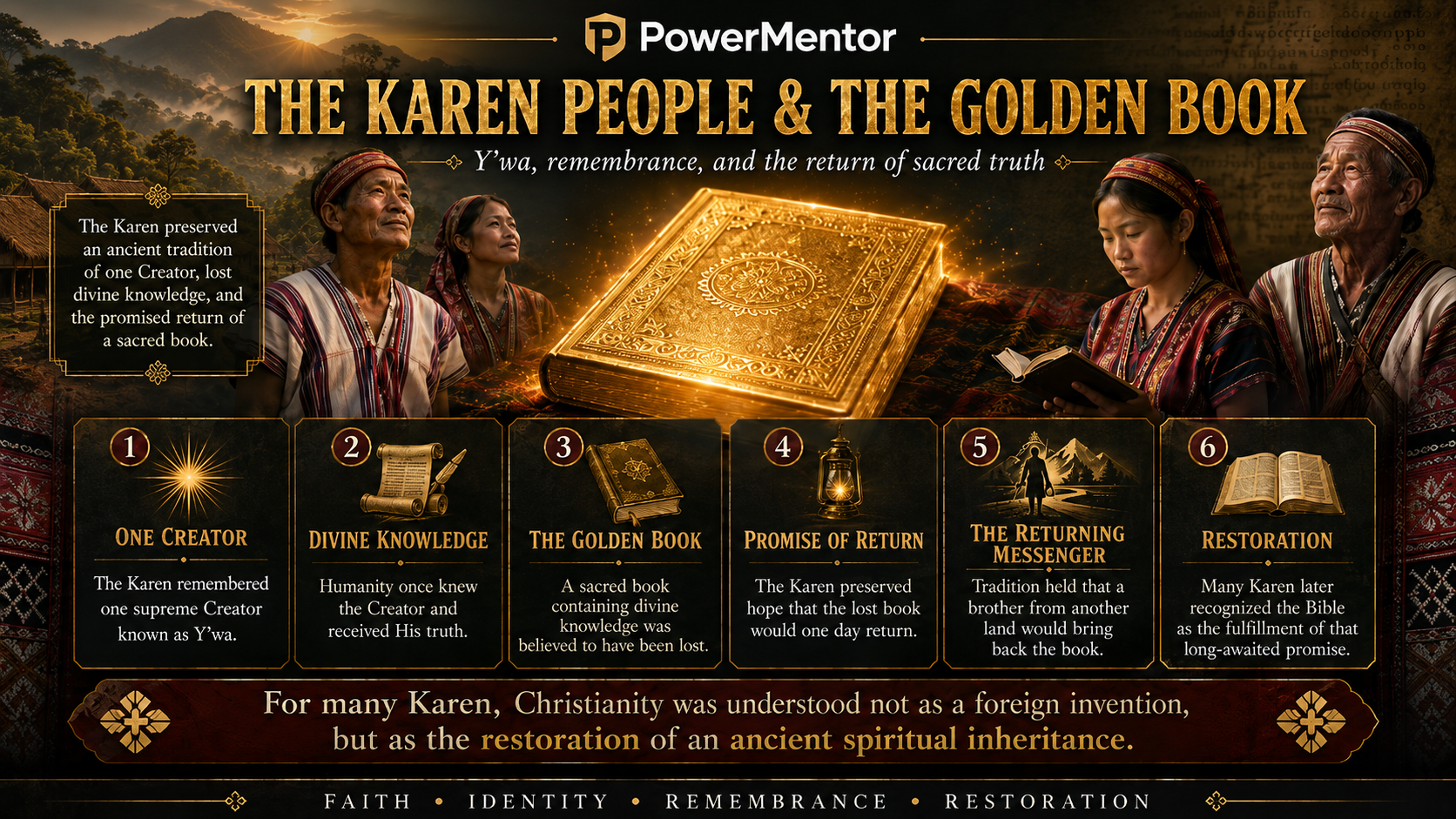
Long before the arrival of Christian missionaries, the Karen people preserved an extraordinary spiritual tradition concerning one supreme Creator, the loss of divine knowledge, and the promised return of a sacred book. This tradition presents the Karen not as a people without knowledge of God, but as a people who remembered that their ancestors had once possessed a clearer revelation and were awaiting its restoration.
At the center of this tradition was belief in a singular Creator known as Y’wa, sometimes rendered as Ywa or Ywah. Y’wa was understood as the source of creation and the giver of divine knowledge to humanity. The Karen tradition held that human beings had once known the Creator and possessed knowledge of His truth, but that this knowledge had later been lost.
The loss was symbolized by the disappearance of a sacred book, often remembered as the Golden Book. This book contained the knowledge that Y’wa had given to humanity. Its loss represented more than the disappearance of a physical object. It represented humanity’s separation from the original truth of the Creator.
Despite losing the book, the Karen did not completely forget its message. The memory of Y’wa and the expectation that the lost revelation would someday return remained alive through oral tradition. The Karen preserved a specific hope that a brother from another land would one day return carrying the book that had been lost.
This expectation gave the Golden Book tradition a prophetic character. The Karen were not simply looking for a new philosophy or an unfamiliar religion. They were waiting for the return of something that had once belonged to their ancestors—a restoration of knowledge that had been entrusted to humanity and then lost.
When Christian missionaries arrived in Burma during the nineteenth century carrying the Bible, many Karen recognized strong similarities between its message and the traditions they had preserved. The Bible spoke of one Creator God, humanity’s original relationship with Him, the loss of that relationship through disobedience, and the restoration of divine truth.
The response among many Karen communities was therefore extraordinary. Christianity was not received merely as a foreign religious system. It was understood as the return of the story their ancestors had remembered and the fulfillment of the promise that the lost book would be restored.
The arrival of the Bible represented the recovery of sacred knowledge. What had survived for generations as prophecy, oral history, and spiritual memory was now understood as having returned in written form.
The Karen tradition is especially significant because it contains more than a general belief in a distant Creator. It preserves an interconnected account of:
one supreme Creator known as Y’wa;
divine knowledge originally given to humanity;
the loss of that knowledge;
a sacred or Golden Book containing the truth;
a promise that the lost book would return;
and recognition of the Bible as the fulfillment of that promise.
The Golden Book tradition presents Karen spiritual history as a story of remembrance rather than religious emptiness. Even after the book was lost, the identity of the Creator and the promise of restoration were not completely erased. The Karen continued to carry fragments of the original story through generations.
Within this understanding, the adoption of Christianity by many Karen was not the abandonment of Karen identity. It was the recovery and completion of an ancient Karen spiritual inheritance. The biblical message gave a name, written form, and fuller meaning to truths that had already been preserved within Karen memory.
The story of Y’wa and the Golden Book also places the Karen within a much wider history of humanity. As people spread across the earth, they carried with them stories, languages, memories, and knowledge of the Creator. Over time, that knowledge became fragmented or lost, but traces remained among peoples who continued to remember a supreme God.
Among the Karen, those traces remained unusually specific. They remembered not only the Creator but also the loss of His book and the promise of its return.
The Golden Book tradition therefore represents one of the most powerful elements of Karen religious and cultural history. It describes a people who waited across generations for the restoration of divine truth and who recognized the returning book when it finally appeared.
For many Karen Christians, the Bible was not simply a book brought from the outside. It was the long-awaited restoration of the book their ancestors had lost—the fulfillment of an ancient promise and the return of the knowledge of Y’wa.
Reference
BLK SHP Scott. (2026). Dynasty of slaves: Uncovering the archeological record of Israel in Egypt.
Special thank you to John Brown for finding this valuable information for his Karen people.
