

THE KAREN PEOPLE AND ANCIENT ISRAEL: Forgotten Migration, Sacred Traditions and a Connection Worth Investigating
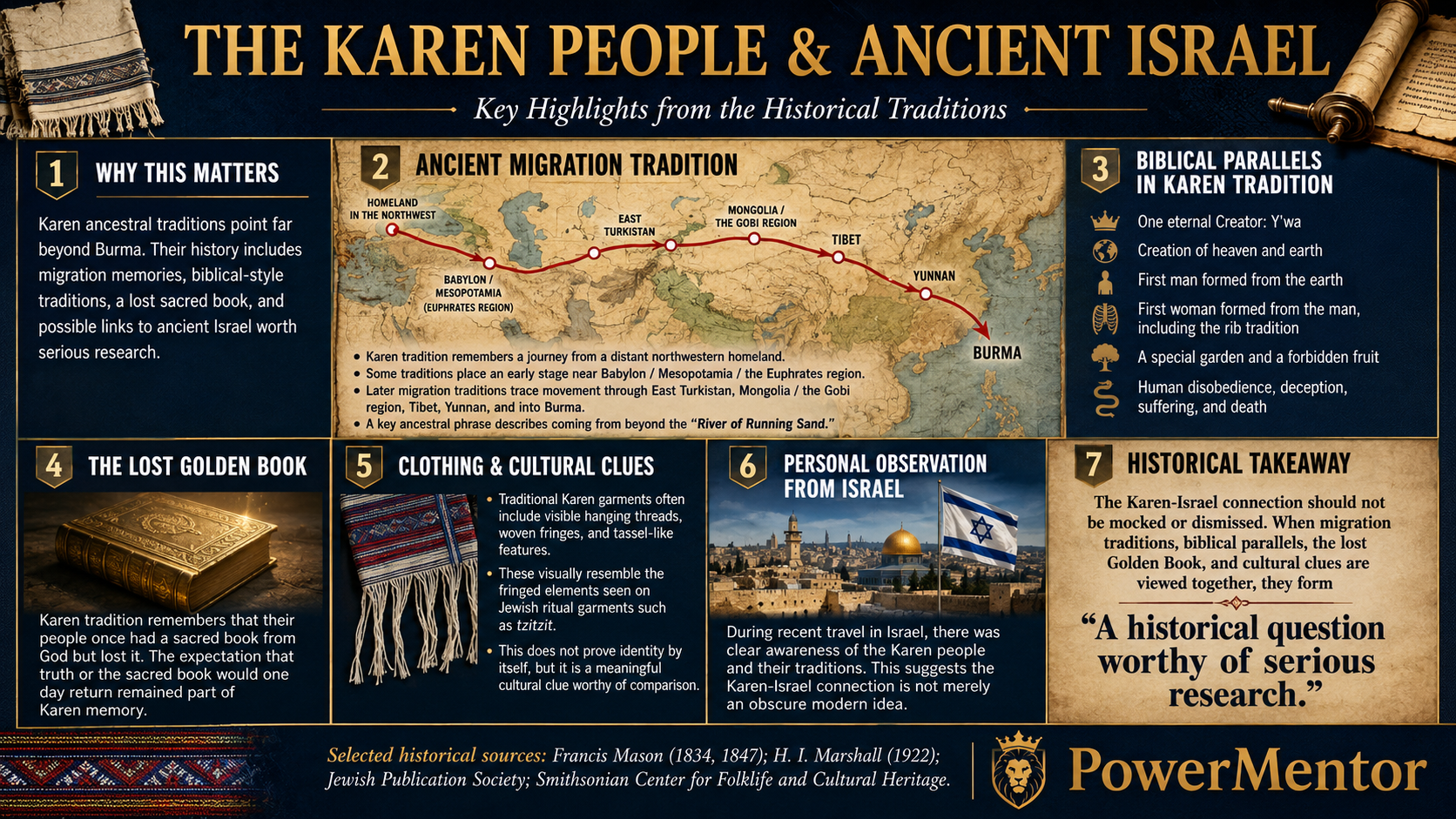
The history of the Karen people did not begin with British rule, Christian missionaries or the modern nation of Burma. Karen ancestral traditions reach much further into the past—toward Mongolia, Central Asia, the lands beyond the “River of Running Sand,” and, according to some accounts, the ancient world surrounding Babylon and the Euphrates River.
For generations, the Karen preserved accounts of creation, humanity’s fall, an eternal Creator, a lost sacred book and a long migration from a distant land in the northwest.
These traditions deserve to be examined seriously.
They should not be dismissed merely because they were preserved orally or because they challenge conventional historical narratives.
A FIRSTHAND EXPERIENCE IN ISRAEL
During a recent journey to Israel, I was surprised to discover that people there were already familiar with the Karen.
The Karen people were not unknown to them.
There appeared to be an existing awareness of Karen traditions and claims concerning a possible historical relationship with ancient Israel.
This experience raised an important question:
Why would people in Israel know about the Karen people and their ancient traditions if the possibility of a connection had no historical foundation whatsoever?
Awareness alone does not establish ancestry, but it demonstrates that the Karen-Israel connection is not merely an obscure modern theory invented within the Karen diaspora. It has attracted interest beyond Burma and Thailand, including among people in the land of Israel itself.
AN ANCIENT MIGRATION FROM THE NORTHWEST
Karen traditions describe their ancestors traveling from a distant homeland before eventually entering the region now called Burma.
One of the best-known ancestral expressions states:
“The Karen came from beyond the waters of running sand.”
The place is frequently identified in Karen historical accounts as Htee-Hseh-Meh-Ywa, often translated as the River of Running Sand or the Flowing Sand River.
Karen historical traditions have associated this place with:
The Gobi Desert
Mongolia
East Turkistan
Central Asia
Western China
A distant region northwest of Burma
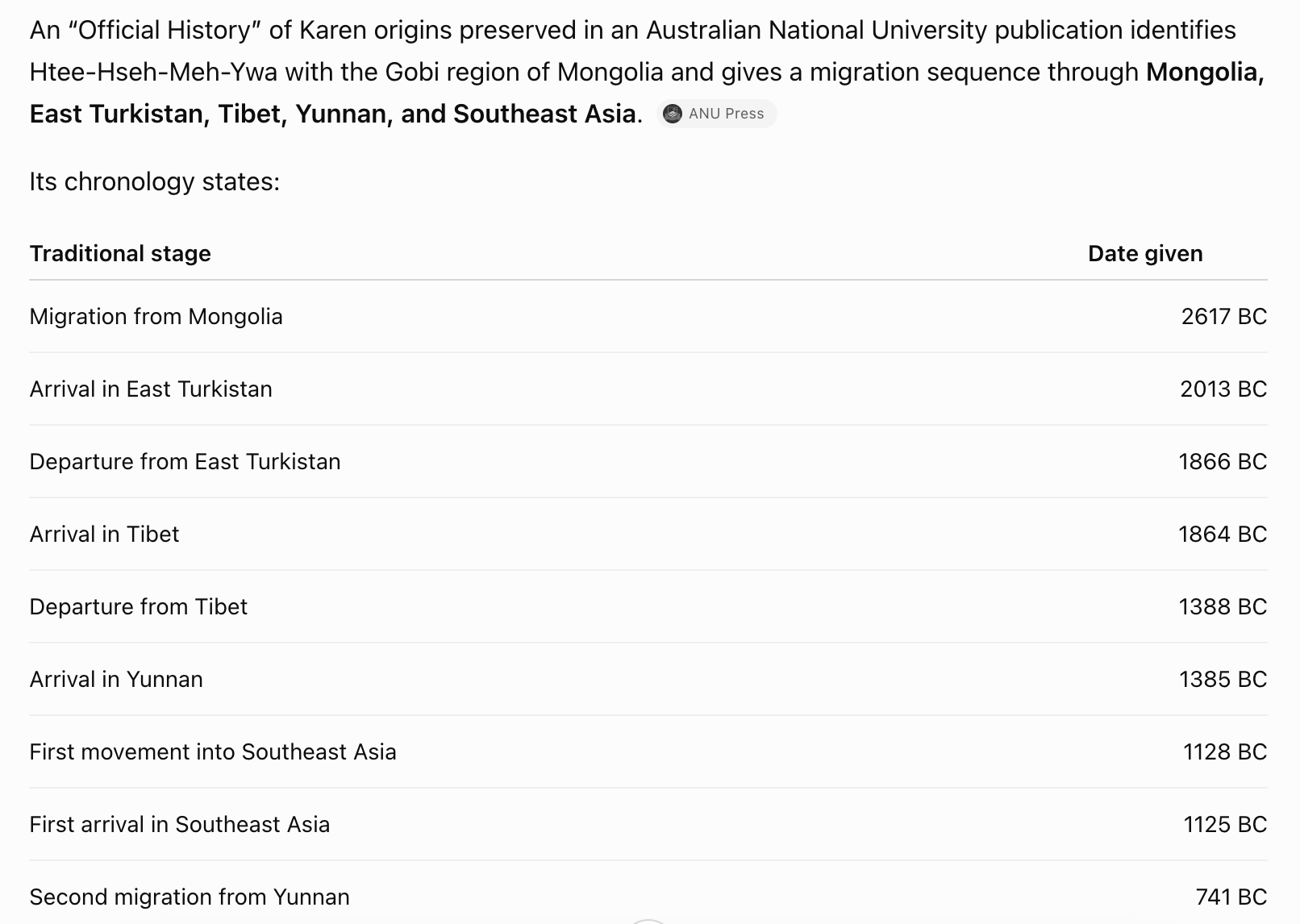
An “Official History” of Karen origins preserved in an Australian National University publication records a migration sequence involving Mongolia, East Turkistan, Tibet, Yunnan and Southeast Asia. The history presents the Karen as an ancient migratory people who traveled across multiple civilizations before entering Burma.
Karen organizations continue to preserve traditions placing their origins in or near Mongolia, the Gobi region or Tibet, followed by movement southward into Burma and Thailand.
The central point is clear: Karen ancestral memory looks toward the northwest—not simply toward Burma.
THE EUPHRATES AND BABYLON TRADITION
Some Karen historical narratives describe an even earlier stage of the migration beginning near Babylon or Mesopotamia, in the broader region associated with the Euphrates River.
According to this reconstruction, the migration proceeded generally eastward:
Mesopotamia or Babylon → Central Asia → East Turkistan → Mongolia → Tibet → Yunnan → Burma
Modern Karen historical presentations continue to preserve the account of a journey from Babylon through Mongolia, China, Tibet and Yunnan before reaching Kaw Lah, the ancestral Karen name associated with their homeland.
The identification of a specific ancient river with the Euphrates still requires careful examination of the earliest Karen-language manuscripts and chronologies. Nevertheless, the broader west-to-east migration tradition is firmly present within Karen historical memory.
The Euphrates tradition should therefore be investigated—not automatically erased.
THE KAREN ACCOUNT OF CREATION
Early records of Karen traditions contain striking similarities to the book of Genesis.
Karen elders preserved teachings concerning:
One supreme and eternal Creator
The creation of the heavens and the earth
The creation of the first man from the earth
The creation of the first woman from the man
The removal of a rib
A specially prepared garden
A forbidden fruit
Deception by an evil spiritual being
Human disobedience
The entrance of suffering, sickness and death
The loss of humanity’s original relationship with God
These were not merely vague beliefs in a spiritual creator. The sequence and details contained multiple parallels to Genesis.
Harry Ignatius Marshall documented that early missionaries encountered Karen creation traditions resembling the biblical account. He also recorded that Francis Mason and others considered whether the Karen might have descended from the dispersed tribes of Israel or received ancient instruction from Jewish communities that migrated eastward.
The Karen did not enter history as a people without knowledge of the Creator.
Their ancestors already possessed a complex spiritual tradition.
Y’WA: THE ETERNAL CREATOR
The Karen traditionally referred to the supreme Creator as Y’wa.
The Karen understanding of Y’wa described a God who was:
Eternal
All-powerful
Creator of humanity
Morally righteous
Judge of human conduct
Distinct from lesser spirits
The original giver of divine knowledge
The resemblance between the Karen name Y’wa and the biblical divine name often represented as YHWH or Yahweh has drawn attention for generations.
Similarity in sound alone cannot establish a direct linguistic relationship. However, when considered together with the creation narrative, the fall of humanity, the lost sacred book and migration traditions, it becomes part of a much larger historical pattern.
No single similarity proves the connection. The convergence of many similarities is what makes the subject significant.
THE LOST GOLDEN BOOK
One of the most powerful Karen traditions concerns a sacred book that was lost.
According to Karen ancestral teaching, Y’wa gave books to his children. The Karen were associated with a precious book—often described as a Golden Book—but through separation, loss or deception, they no longer possessed it.
Karen elders preserved the expectation that the book would one day return.
This tradition existed at the heart of Karen spiritual identity. When Christian missionaries later brought a written Bible translated into Karen, some Karen believed the long-awaited book had been restored.
The importance of this account is not limited to Christianity.
It demonstrates that the Karen already remembered themselves as a people who had once possessed divine revelation.
The Karen did not merely believe they lacked literacy. They believed that something sacred belonging to their ancestors had been lost.
THE TEN TRIBES OF ISRAEL
In 1834, Francis Mason advanced the possibility that the Karen could represent a remnant of the dispersed tribes of Israel.
The title of his early work was direct:
“The Karen of Burmah—A Remnant of the Ten Tribes of Israel.”
This demonstrates that the Israelite-origin theory was being discussed during the earliest period of sustained Western documentation of Karen traditions. It is not merely a twenty-first-century invention.
Mason and other early observers considered the possibility because they encountered a combination of traditions involving:
Biblical-style creation accounts
A supreme Creator
Humanity’s fall through disobedience
A lost sacred book
Moral laws
Prophetic expectations
Migration from a distant northwestern land
Cultural practices that appeared distinct from neighboring peoples
Some writers believed the Karen might descend directly from ancient Israelites. Others proposed that their ancestors may have lived near Jewish communities or received teachings from Israelites traveling eastward.
Both possibilities place ancient contact with Hebrew tradition on the historical table.
THE CLOTHING: FRINGES, THREADS AND VISUAL MEMORY
During my travels in Israel, another similarity became difficult to overlook.
Traditional Karen clothing contains hanging threads, woven fringes and tassel-like extensions that visually resemble elements found in Jewish religious garments.
Within Judaism, tzitzit are knotted fringes attached to the corners of a four-cornered garment. Their use comes from the Torah’s instruction to place fringes upon garments as a visible reminder of God’s commandments.
The Jewish tallit, or prayer shawl, carries these distinctive fringes at its corners.
Karen clothing has its own established cultural meaning and is produced through sophisticated traditions of backstrap weaving, supplemental weft designs, embroidery, beads and carefully arranged threads. The Smithsonian has documented the complexity and cultural importance of Karen weaving practices.
The Karen garments are not identical to Jewish prayer garments, and the hanging threads have not yet been conclusively demonstrated to serve the same religious function as tzitzit.
Nevertheless, the resemblance deserves further investigation.
Questions worth asking include:
Why are hanging threads and fringes preserved in certain Karen garments?
Did these threads once carry spiritual or covenantal meaning?
Were their original meanings changed or forgotten during migration?
Are there Karen elders who can explain ancient rules concerning the number, placement, colors or knots of the threads?
Do older garments contain patterns that are no longer understood?
Could clothing have preserved cultural memory after written records were lost?
Ancient identity is not preserved only in books.
It may also survive through songs, weaving, clothing, ceremonies, family names, migration stories and practices whose original meanings have faded.
CLOTHING CAN CARRY HISTORY
Throughout the ancient world, clothing communicated:
Tribal identity
Family position
Marital status
Religious commitment
Social responsibility
Covenant membership
Geographic origin
Karen traditional clothing continues to communicate identity, gender, community status and cultural belonging.
The possibility that some designs, tassels or woven structures preserve a deeper ancestral meaning should not be rejected without research.
The correct response is documentation.
Older Karen garments should be photographed, dated and compared across Karen subgroups. Elders and traditional weavers should be interviewed. The location, number and arrangement of hanging threads should be recorded.
These findings could then be compared with ancient Middle Eastern, Central Asian, Jewish and other migratory textile traditions.
A CONNECTION CANNOT BE REDUCED TO ONE PIECE OF EVIDENCE
The case for a historical Karen-Israel connection does not rest solely upon similar clothing.
Neither does it rest solely upon the name Y’wa, the Golden Book or one migration story.
The importance comes from the combined pattern:
A distant northwestern ancestral homeland
Migration through Central Asia, Mongolia, Tibet and China
Traditions connected with Babylon and the Euphrates region
An eternal Creator known as Y’wa
A creation account resembling Genesis
The creation of woman from man’s rib
A garden, forbidden fruit and humanity’s fall
A lost sacred book
Expectation of the book’s return
Early claims of descent from the dispersed tribes of Israel
Traditional garments containing visible fringes and hanging threads
Continuing awareness of the Karen people within Israel
Each element can be debated individually. Together, they form a historical question that deserves serious study.
ORAL HISTORY IS STILL HISTORY
Many Karen traditions were preserved orally because war, migration, persecution and displacement repeatedly disrupted Karen civilization.
The absence of large surviving archives does not mean the Karen had no ancient history.
Powerful civilizations have lost:
Libraries
Sacred writings
Royal records
Genealogies
Temples
Languages
Cultural institutions
The Karen experienced centuries of movement, conflict and political domination. Under such circumstances, oral traditions often became the only available means of preserving identity.
A people should not be denied their history merely because oppression prevented them from preserving it in the form preferred by modern academia.
Oral traditions must still be examined carefully, compared across communities and tested against archaeology, linguistics, genetics and neighboring historical records. But they should begin the investigation—not be excluded from it.
WHAT MUST HAPPEN NEXT
The Karen people should lead a serious international research initiative involving:
Karen historians and elders
Traditional Karen weavers
Hebrew and Jewish historians
Biblical archaeologists
Central Asian migration specialists
Linguists
Genetic genealogists
Textile historians
Archaeologists
Scholars of oral tradition
Ancient Karen documents should be digitized and translated. Variant migration accounts should be compared. Traditional clothing should be cataloged. Karen words resembling ancient Hebrew or Aramaic terms should be studied using legitimate historical-linguistic methods.
Genetic research should be conducted respectfully and interpreted cautiously, recognizing that thousands of years of migration and intermarriage can significantly alter a population’s genetic profile.
The objective should not be to force a predetermined conclusion.
The objective should be to recover the fullest possible account of Karen history.
THE KAREN STORY DID NOT BEGIN IN BURMA, HOWEVER, THEY ARRIVED LONG BEFORE THE BURMANS
The Karen are not merely a displaced minority created by the modern political borders of Myanmar.
They are an ancient people carrying memories of:
A distant homeland
A long eastward migration
A Creator named Y’wa
A lost sacred book
Humanity’s earliest history
A promise that lost truth would return
Their traditions may preserve evidence of contact with ancient Israel, an Israelite diaspora community or a common stream of ancient biblical knowledge carried eastward across Asia.
The precise nature of the connection remains to be established.
But the evidence is sufficient to say this clearly:
THE KAREN-ISRAEL CONNECTION IS NOT A SUBJECT TO BE MOCKED OR AUTOMATICALLY DISMISSED.
IT IS A HISTORICAL QUESTION WORTHY OF SERIOUS RESEARCH.
The Karen people have carried these memories across mountains, kingdoms, wars and generations.
Perhaps the time has come for the world to listen.
References
Jewish Publication Society. (1985). Tanakh: The Holy Scriptures. Jewish Publication Society.
Marshall, H. I. (1922). The Karen people of Burma: A study in anthropology and ethnology. Ohio State University.
Mason, F. (1834). The Karens of Burmah: A remnant of the Ten Tribes of Israel. The Calcutta Christian Observer, 3, 211–219.
Mason, F. (1847). The Karen apostle; or, Memoir of Ko Thah-byu, the first Karen convert, with an historical and geographical account of the nation, its traditions, precepts, rites, &c. Gould, Kendall and Lincoln.
Sefaria. (n.d.). Deuteronomy 22:12. https://www.sefaria.org/Deuteronomy.22.12
Sefaria. (n.d.). Numbers 15:37–41. https://www.sefaria.org/Numbers.15.37-41
Smithsonian Center for Folklife and Cultural Heritage. (2025, November 14). Cloth and the art of connection with the Karen Weaving Circle. https://festival.si.edu/blog/karen-weaving-circle
The Textile Atlas. (2018, February 11). Karen textiles in Northern Thailand. https://www.thetextileatlas.com/craft-stories/karen-textiles-in-northern-thailand
