

China and Russia's Influence in Thailand: A Strategic Deep Dive
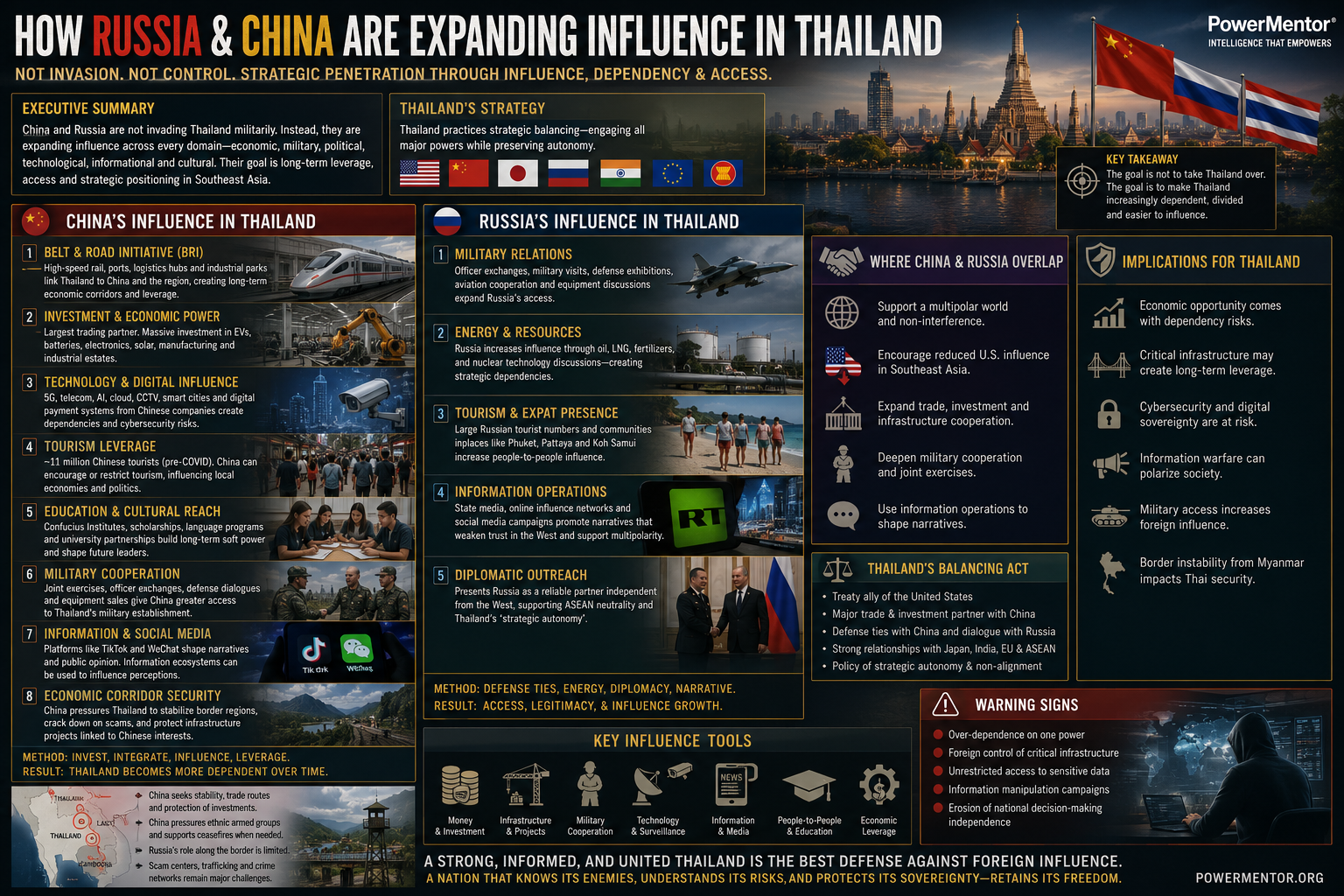
The term "infiltrate" can imply covert or illegal penetration. While there are isolated espionage cases involving many countries, there is no public evidence that China or Russia have infiltrated the Thai government or military in the sense of controlling it.
A more accurate description is that both countries are expanding their influence, but they do so in very different ways.
China's Strategy
China is Thailand's largest trading partner.
Unlike Russia, Beijing doesn't rely primarily on military power.
It uses:
Economics
Infrastructure
Technology
Tourism
Education
Investment
Political relationships
to increase influence.
Its strategy is patient and long-term.
1. Belt and Road Initiative (BRI)
China views Thailand as one of the most important transportation hubs in Southeast Asia.
Major projects include:
China–Thailand High-Speed Railway
Logistics hubs
Industrial parks
Port development
Smart-city initiatives
These projects connect southern China to:
Laos
Thailand
Malaysia
Singapore
creating a continuous economic corridor.
Strategic concern
Infrastructure creates long-term leverage because the country becomes economically tied to Chinese financing, technology, and supply chains.
2. Chinese Investment
China has invested heavily in:
Manufacturing
Electric vehicles
Batteries
Solar energy
Electronics
Industrial estates
Telecommunications
Chinese companies increasingly see Thailand as a regional production base.
Rather than exporting everything from China, many products are now manufactured inside Thailand.
3. Technology Influence
Chinese firms are major suppliers of:
5G infrastructure
Telecommunications
Cloud computing
AI systems
CCTV systems
Smart-city technology
Facial recognition
Digital payment systems
Analysts often note that such technologies can create long-term dependencies and raise cybersecurity concerns, although deployment decisions remain under Thai government control.
4. Tourism
Before COVID, approximately 11 million Chinese tourists visited Thailand annually.
Tourism provides enormous economic influence.
China has demonstrated in other countries that it can:
Encourage tourism
Restrict tourism
Influence airlines
Influence travel agencies
These actions can affect local economies.
5. Education
China has expanded:
Confucius Institutes
Scholarships
Chinese language programs
University exchanges
The objective is long-term soft power.
6. Military Cooperation
Thailand remains a U.S. treaty ally.
However, military cooperation with China has expanded significantly.
Examples include:
Joint military exercises
Joint naval drills
Army exchanges
Special forces exchanges
Defense technology discussions
China has also sold military equipment to Thailand including armored vehicles and naval systems.
This gives China greater access to Thailand's military establishment.
7. Digital Influence
Chinese social media platforms
TikTok
WeChat
have become important information ecosystems inside Thailand.
While widely used for commercial purposes, governments and analysts increasingly examine how such platforms can shape public opinion and information flows.
8. Organized Crime
One of China's biggest concerns has become Chinese criminal syndicates operating:
Scam centers
Human trafficking
Illegal casinos
particularly near the Thai-Myanmar border.
Ironically,
China has pressured Thailand to crack down on many of these organizations.
Thus, Beijing acts both as:
an investor
and
a security partner.
Russia's Strategy
Russia has fewer economic tools.
Instead it focuses on:
Diplomacy
Energy
Military relationships
Tourism
Education
Defense cooperation
1. Military Relations
Russia has steadily expanded defense ties.
Cooperation includes:
Officer exchanges
Military visits
Defense exhibitions
Aviation cooperation
Equipment sales discussions
Thailand and Russia reaffirmed in June 2026 that they intend to deepen cooperation in defense and security alongside trade, energy and tourism.
2. Energy
Russia seeks greater influence through:
Oil exports
LNG
Fertilizer
Nuclear technology discussions
Energy relationships can create strategic dependencies.
3. Tourism
Before Ukraine,
Russia was one of Thailand's largest European tourist markets.
Large Russian communities now exist in places including:
Phuket
Pattaya
Koh Samui
Most are ordinary expatriates or tourists, and their presence should not be conflated with state influence.
4. Information Operations
Western governments have long assessed that Russia conducts global influence campaigns through:
State media
Social media
Online influence networks
Thailand, like many countries, is exposed to competing narratives from multiple foreign actors. Specific impacts inside Thailand are difficult to quantify publicly.
5. Diplomatic Outreach
Russia increasingly portrays itself as:
a multipolar partner
independent from the West
supportive of ASEAN neutrality
This messaging appeals to countries seeking strategic autonomy.
Where China and Russia Overlap
Both countries encourage:
Reduced U.S. influence
Multipolar foreign policy
Stronger bilateral trade
Defense cooperation
Non-interference principles
They do not operate as a unified organization in Thailand, but their interests often align. Their broader partnership has deepened globally even while each pursues its own priorities.
Thailand's Strategy
Thailand has historically pursued strategic balancing rather than choosing one major power.
Thailand maintains:
Treaty alliance with the United States
Extensive trade with China
Defense ties with China
Defense dialogue with Russia
Strong relationships with Japan
Close ties with ASEAN
Growing cooperation with India
This approach gives Bangkok flexibility while avoiding excessive dependence on any single country.
Implications for the Thai–Myanmar Border
For your area of interest, China's influence is much more consequential than Russia's.
China seeks:
Stability along its border
Protection of the China–Myanmar Economic Corridor
Suppression of transnational scam networks
Continued trade and investment
Russia's role is more limited and centers on diplomacy and defense cooperation.
Neither country is known to have operational control over Thai security policy.
Strategic Assessment
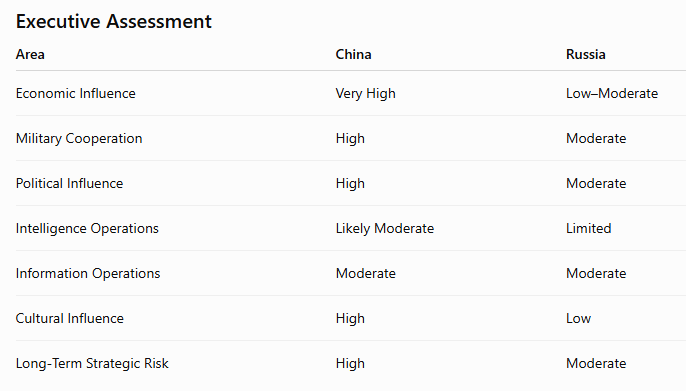
China's influence in Thailand is broad, institutional, and long-term, built through trade, investment, technology, infrastructure, education, and selective military cooperation. Russia's influence is narrower, relying mainly on diplomatic engagement, energy, tourism, and defense ties.
Thailand has generally sought to preserve its autonomy by engaging all major powers rather than aligning exclusively with one. While both China and Russia have expanded their presence, there is no public evidence that either has "taken over" or controls Thailand's government or military. The more accurate assessment is that Thailand is navigating an increasingly competitive geopolitical environment by balancing relationships with multiple partners.
