

China’s Support for the Burmese Military: Deep-Dive Assessment
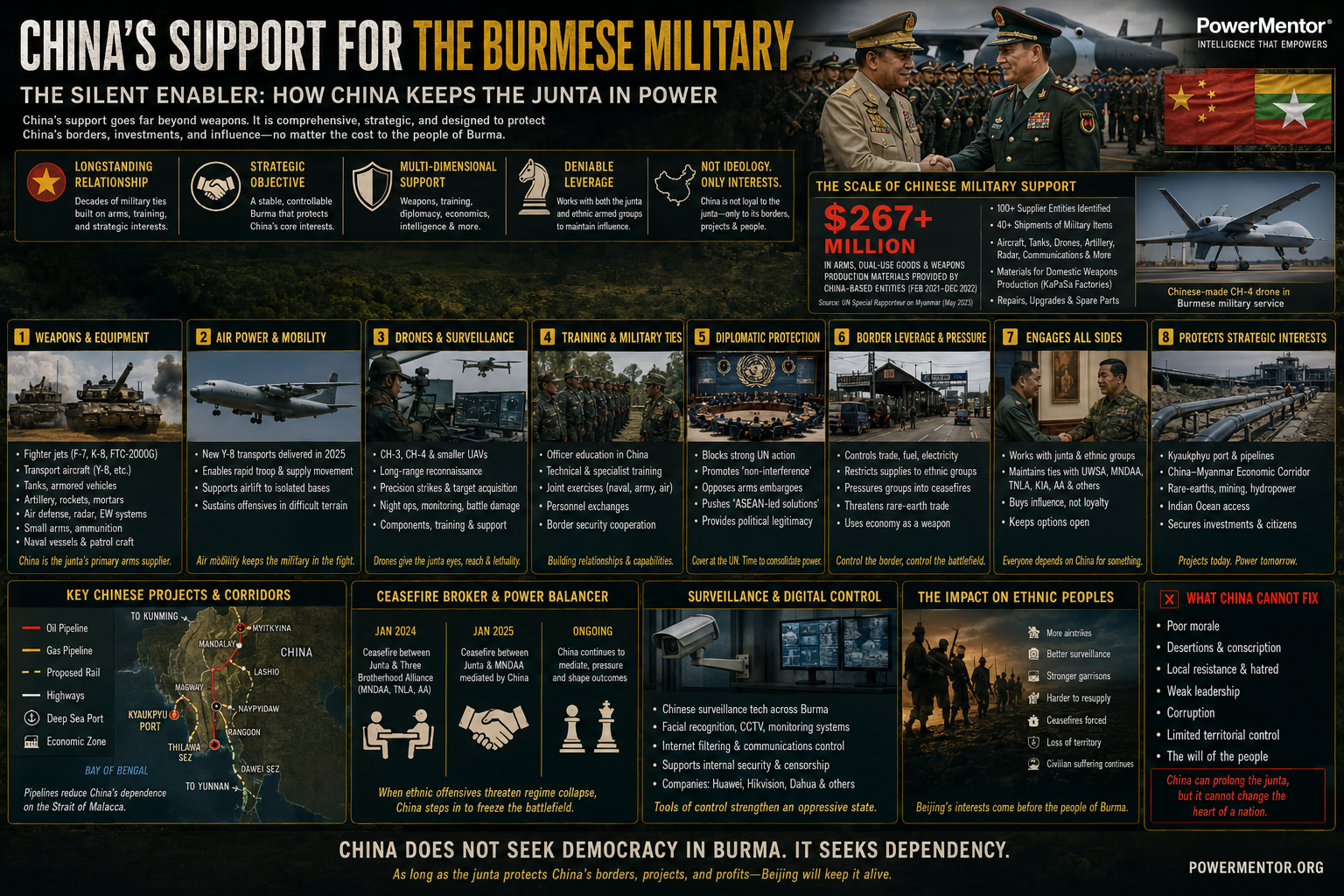
China’s relationship with Burma’s military is more complicated—and potentially more powerful—than Russia’s.
Russia primarily acts as an arms supplier, trainer and military partner. China operates across nearly every level of the conflict:
Weapons and replacement parts
Aircraft, drones and naval systems
Military training and exercises
Diplomatic protection
Economic and border pressure
Control over trade routes
Influence over several ethnic armed organizations
Protection of strategic infrastructure
Political rehabilitation of the military government
China does not appear emotionally or ideologically committed to Min Aung Hlaing. Beijing supports the Burmese military because it currently regards a functioning central government as necessary to protect Chinese borders, trade, pipelines, investments and access to the Indian Ocean.
Its real objective is not necessarily a decisive junta victory. It is a controllable Burma that cannot threaten China’s interests.
1. China is one of the military’s foundational arms suppliers
Burma’s armed forces have relied on Chinese weapons for decades. This relationship expanded after Western countries reduced military cooperation following the 1988 uprising.
Chinese-origin systems have included various generations of:
Fighter and ground-attack aircraft
Transport aircraft
Trainer/light-attack aircraft
Uncrewed aerial vehicles
Main battle tanks and armored vehicles
Artillery and multiple-launch rocket systems
Air-defense weapons
Naval vessels
Radar and communications systems
Small arms and ammunition
Machinery and raw materials for domestic weapons factories
The UN Special Rapporteur documented at least $267 million in arms, equipment, dual-use goods and weapons-production materials transferred from China-based entities between the February 2021 coup and December 2022. The suppliers included both private and state-owned entities.
The documented Chinese shipments included:
Advanced trainer and light-attack aircraft
Tank upgrades
Repairs and overhauls for older Chinese fighters
Military communications equipment
Components and spare parts
Aluminum, copper, steel, rubber and lubricants
Materials used by Burma’s domestic arms-production directorate
China therefore supports not only finished weapons, but also the military-industrial system that allows Burma to manufacture ammunition, repair equipment and prolong the war.
2. Aircraft support is strategically decisive
China’s most important contribution may be its support for Burma’s air mobility and strike capability.
Burma has operated Chinese-origin aircraft including:
F-7 fighters
A-5 ground-attack aircraft
K-8 trainer/light-attack jets
FTC-2000G light combat aircraft
Y-8 transport aircraft
Chinese-origin UAVs
In late 2025, Burma commissioned two additional Chinese Y-8 transport aircraft. Military analysts assessed that the aircraft could improve the Tatmadaw’s ability to move troops and supplies into mountainous areas where road access is unreliable or controlled by resistance forces.
Why transport aircraft matter
The military’s ground forces have lost access to numerous roads, border gates and isolated bases. Transport aircraft allow it to:
Reinforce threatened garrisons
Move troops rapidly between fronts
Carry ammunition and supplies
Evacuate casualties
Deliver airborne personnel
Sustain operations in mountainous ethnic territories
This does not attract the same attention as fighter jets, but it helps prevent military positions from collapsing.
3. Chinese drones are becoming increasingly important
The Burmese military has reportedly operated Chinese CH-series reconnaissance and attack drones, including the CH-3 and CH-4.
The CH-4 can perform:
Long-duration surveillance
Target acquisition
Reconnaissance
Missile strikes
Bombing missions
Battle-damage assessment
Larger systems such as the CH-4 require established airfields and trained ground crews, limiting their use in some areas. The military has therefore also adopted smaller commercial or military-grade drones resembling those used by resistance forces.
Chinese support may include more than complete drones
The broader drone ecosystem can involve:
Airframes
Cameras and optical sensors
Communications links
Navigation components
Software
Batteries and motors
Anti-jamming technology
Training
Spare parts
This is difficult to track because many components are commercially available and can move through intermediaries.
Battlefield impact
Chinese drone technology can help the military:
Identify resistance camps
Locate artillery and mortar positions
Monitor roads and river crossings
Correct artillery fire
Conduct night surveillance
Target commanders or logistics sites
Protect military bases from surprise attacks
The military’s improved drone capability represents a serious threat to ethnic forces that previously relied on concealment, forest cover and mobility.
4. China provides repair, overhaul and sustainment support
Many Chinese aircraft and armored systems in Burma are decades old. Their usefulness depends on continued access to:
Engines
Avionics
Tires
Radar components
Weapons pylons
Hydraulic systems
Electronic parts
Technical documentation
Factory-level repair
The UN found that Chinese companies provided overhaul and repair work for older Chinese fighters that remained part of the Burmese Air Force.
This sustainment support may be more important than occasional new deliveries. An aircraft fleet can appear large on paper while only a fraction is operational. Spare parts and technical assistance determine how many aircraft can actually fly.
China therefore helps preserve the military’s ability to conduct continuing air operations despite sanctions and battlefield losses.
5. China supports Burma’s domestic weapons industry
Burma’s Directorate of Defense Industries—commonly associated with the KaPaSa weapons factories—produces:
Small arms
Ammunition
Mortar rounds
Artillery shells
Explosives
Rockets
Other military equipment
The UN documented Chinese-origin raw materials and industrial inputs flowing directly to the Burmese military’s weapons-production network. These included metals, rubber and lubricants essential for manufacturing and maintaining weapons.
Strategic significance
A country that can manufacture ammunition domestically is harder to isolate through an arms embargo.
Chinese industrial support can allow Burma to:
Continue producing ammunition
Replace damaged components
Manufacture artillery and mortar rounds
Reduce dependence on complete imported weapons
Maintain long campaigns against resistance forces
China’s role therefore extends beyond conventional arms exports into the foundations of Burma’s war economy.
6. Military training and senior-level relationships
China and Burma have maintained regular military exchanges for many years.
These have included:
Senior-command visits
Officer education
Technical training
Personnel exchanges
Naval exercises
Border-security consultations
Equipment-related training
Military medical cooperation
During earlier high-level meetings, Chinese and Burmese military leaders publicly discussed expanding strategic communication, training programs, personnel exchanges and joint exercises.
Chinese military education can expose Burmese officers to:
PLA command structures
Combined-arms concepts
Border-control doctrine
Counterinsurgency
Logistics
Political warfare
Military engineering
Communications
Naval operations
The precise number of Burmese officers trained in China is not publicly documented as clearly as the number educated in Russia. Nevertheless, the depth of the weapons relationship makes sustained technical instruction almost unavoidable.
Chinese-produced aircraft, drones, ships and radar systems require operators and technicians trained by manufacturers or PLA-linked institutions.
7. Joint naval exercises
China and Burma conducted notable joint naval training in December 2023.
Three PLA Navy vessels visited the Thilawa port area near Yangon, reportedly carrying approximately 700 Chinese personnel. The exercise included training in:
Air defense
Missile defense
Surface warfare
Maritime security
Defense against underwater threats
The Chinese group reportedly included a destroyer, frigate and replenishment vessel.
Why naval cooperation matters
China has major strategic interests along Burma’s coast:
Kyaukphyu deep-sea port
Oil and natural-gas pipelines
Access to the Bay of Bengal
Indian Ocean shipping routes
Protection of Chinese commercial assets
Maritime intelligence
For the Burmese military, naval training can improve:
Coastal surveillance
Port defense
Ship coordination
Maritime logistics
Protection of offshore installations
Resupply of coastal garrisons
Deterrence against attacks on Chinese-linked infrastructure
The exercise also demonstrated that China was willing to conduct overt military cooperation while the Burmese military was under international isolation.
8. China provides diplomatic protection
China’s support is not limited to weapons.
Since the 2021 coup, Beijing has frequently resisted international measures that might:
Condemn the military more forcefully
Impose a comprehensive arms embargo
Authorize coercive action
Isolate the junta diplomatically
Recognize the National Unity Government
Immediately after the coup, China and Russia prevented the UN Security Council from issuing a stronger condemnation. China later allowed more limited statements or resolutions but continued emphasizing sovereignty, noninterference and ASEAN-led diplomacy.
China’s diplomatic approach gives the military:
Protection from stronger UN action
Time to consolidate power
International engagement
Access to regional forums
Reduced risk of total political isolation
This legitimacy may be as valuable as direct military equipment.
9. Beijing has increasingly rehabilitated Min Aung Hlaing
China initially appeared uncomfortable with the 2021 coup.
The military takeover destabilized the border, threatened Chinese investments and produced a surge in criminal enterprises and anti-China sentiment. Beijing maintained relations with the junta but was cautious about giving Min Aung Hlaing full political recognition.
That posture has shifted.
Chinese officials reported that Xi Jinping met Min Aung Hlaing twice in 2025 and reached understandings concerning a deeper China–Burma strategic partnership.
In June 2026, China and Burma released a joint statement pledging mutual support on core interests and major concerns. China also welcomed Burma’s election process and expressed support for peace, stability and development under the military-dominated political order.
This represents significant political rehabilitation for the military government.
10. China’s most powerful weapon may be border control
China controls the principal external lifeline for several northern ethnic armed organizations.
It can restrict:
Fuel
Food
Medicine
Electricity
Communications
Commercial goods
Weapons components
Cross-border travel
Banking and payments
Rare-earth exports and imports
In 2024, China tightened controls along the border after ethnic forces captured major military positions and trade gates. These restrictions reportedly slowed the flow of weapons and ammunition to resistance organizations.
This is indirect support for the junta: rather than attacking ethnic forces itself, China can make it harder for them to sustain operations.
11. China pressured ethnic armies to stop advancing
After Operation 1027 began in October 2023, the Three Brotherhood Alliance inflicted major defeats on the Burmese military.
Initially, China tolerated or did not prevent the offensive, partly because alliance forces attacked cyber-scam compounds that had victimized large numbers of Chinese citizens.
However, Beijing’s position changed when:
The junta appeared at risk of losing critical northern territory
Trade was disrupted
Fighting approached the Chinese border
The military’s Northeast Command in Lashio was threatened or captured
Resistance victories created the possibility of wider regime collapse
China then brokered ceasefires and exerted pressure on ethnic forces.
In January 2024, China mediated a ceasefire between the military and the Three Brotherhood Alliance.
In January 2025, Beijing mediated a further agreement between the military and the Myanmar National Democratic Alliance Army.
The MNDAA publicly stated that it was prepared to pursue a ceasefire under Chinese guidance and would avoid cooperation with foreign actors opposed by China.
China’s intervention helped prevent resistance forces from fully capitalizing on military collapse in northern Shan State.
12. Pressure on the Kachin Independence Army
China has also exerted economic pressure on the Kachin Independence Army.
The KIA’s operations around Bhamo threatened:
Major trade and transportation routes
Chinese economic interests
Rare-earth supply chains
Military access to northern Kachin State
In 2025, Reuters reported that China wanted the KIA to pull back from Bhamo and threatened restrictions affecting rare-earth trade from KIA-controlled areas.
This demonstrates how China can use economic coercion as a battlefield instrument.
Instead of deploying troops, Beijing can threaten the revenue streams that ethnic organizations depend upon.
13. China simultaneously maintains relationships with ethnic armed organizations
China’s support for the junta does not mean it has abandoned ethnic armed groups.
Beijing maintains varying degrees of influence with organizations such as:
United Wa State Army
Myanmar National Democratic Alliance Army
Ta’ang National Liberation Army
Kachin Independence Organization
National Democratic Alliance Army
Arakan Army
Some of these groups operate Chinese weapons, use Chinese currency, depend on Chinese trade or maintain close relations with authorities in Yunnan.
Why China works with both sides
China wants leverage over whoever controls territory near:
The international border
Pipelines
Rail and road corridors
Rare-earth mines
Hydropower projects
Trade gates
Chinese commercial zones
Supporting multiple actors prevents any single Burmese faction from excluding China.
This is not neutrality. It is a strategy of diversified leverage.
14. The United Wa State Army and Chinese weapons
The United Wa State Army is among the most heavily armed nonstate forces in Southeast Asia.
It has reportedly received Chinese-origin:
Surface-to-air missiles
Armored vehicles
Artillery
Small arms
Communications equipment
Uncrewed systems
Although China denies directly arming ethnic forces, weapons can move through informal, commercial or deniable channels.
The UWSA has also reportedly supplied or transferred weapons to other ethnic organizations. This allows Chinese-origin systems to appear throughout the conflict without clear evidence of direct Chinese government authorization.
China benefits from the ambiguity:
It retains influence over ethnic groups
It preserves plausible deniability
It can pressure the junta
It can restrain ethnic armies when necessary
15. China protects strategic economic corridors
China’s policy cannot be understood without the China–Myanmar Economic Corridor.
Key interests include:
Kyaukphyu port in Rakhine State
Oil and gas pipelines from the Bay of Bengal to Yunnan
Proposed rail and highway links
Hydropower projects
Copper mining
Rare-earth extraction
Border trade
Access to the Indian Ocean
The pipelines reduce China’s dependence on shipping through the Strait of Malacca.
Kyaukphyu could eventually give China enhanced commercial—and potentially strategic—access to the eastern Indian Ocean.
Beijing therefore wants an authority capable of protecting these investments. It currently views the Burmese military as the only nationwide institution claiming that capacity, even though the military does not control much of the territory through which Chinese projects pass.
16. Chinese security personnel and protection of projects
As attacks and threats against Chinese projects have increased, Beijing has pushed Burma to improve security.
There have also been discussions and reports concerning:
Chinese private security companies
Joint security mechanisms
Specialized protection forces
Intelligence sharing
Surveillance around Chinese projects
Protection of Chinese citizens
A large conventional PLA deployment inside Burma has not been publicly established.
However, China may gradually expand security involvement if the Burmese military cannot protect major infrastructure.
This could create an important future shift: China moving from arms supplier and political patron toward a more direct security presence around strategic projects.
17. Surveillance and digital-authoritarian tools
Chinese technology companies have supplied surveillance equipment across Burma.
Potential systems include:
Closed-circuit cameras
Facial-recognition software
Telecommunications monitoring
Internet filtering
Location tracking
Biometric databases
Command-center technology
License-plate recognition
Chinese companies such as Huawei, Hikvision and Dahua have exported surveillance systems widely, including to authoritarian governments. Reporting has identified Chinese surveillance technologies in Burma as part of this wider pattern.
Possible military and internal-security uses
Such systems may help authorities:
Identify protesters
Track dissidents
Monitor resistance networks
Control urban areas
Locate wanted individuals
Analyze communications
Protect government facilities
The precise degree of direct Chinese government involvement in each Burmese system is not publicly established. Distinguishing commercial sales from state-directed assistance is important.
18. Anti-scam operations strengthened China’s leverage
Cyber-scam compounds in northern and southeastern Burma became a major Chinese security concern.
Chinese citizens were:
Trafficked into scam centers
Forced to conduct online fraud
Kidnapped or held for ransom
Defrauded of billions of dollars
China pressured Burma’s military, border militias and ethnic organizations to dismantle these compounds.
In some areas, China appeared willing to tolerate ethnic offensives against military-allied border forces because those groups protected scam centers.
China later shifted toward supporting the junta once the offensives threatened wider regime stability.
This illustrates China’s transactional method:
It supports whichever local actor can deliver China’s immediate objectives.
19. PLA exercises along the Chinese border
China has conducted military exercises on its side of the Burma border.
A 2025 U.S. Defense Department assessment reported that the PLA held three live-fire exercises along the border in spring and summer 2024. The exercises involved army and air-force elements and emphasized mobility and border-security operations.
These exercises served several purposes:
Warning Burmese forces not to allow shells or aircraft to cross into China
Warning ethnic armies not to threaten Chinese territory
Demonstrating rapid-response capability
Preparing for refugee flows
Protecting border trade
Signaling that China could intervene if instability escalated
These were not necessarily exercises in support of the junta. They were exercises supporting China’s ability to control the consequences of the war.
20. China versus Russia: an important distinction
Russia’s approach
Russia generally seeks:
Weapons sales
Strategic partnership
Military access
Diplomatic alignment
Training relationships
Revenue and influence
Russia tends to support the Burmese military more openly and consistently.
China’s approach
China seeks:
Border stability
Economic corridors
Protection of Chinese citizens
Control over ethnic actors
Indian Ocean access
Prevention of Western influence
A government in Naypyidaw that remains dependent on Beijing
China is willing to support, pressure or restrain both the military and ethnic forces.
Russia is principally a partner of the junta.
China is the manager of the broader battlefield environment.
21. Direct impact on the Karen and other ethnic peoples
China’s leverage is strongest in northern Burma, but its policies affect ethnic peoples nationwide.
Karen areas
China has less direct control over Karen armed organizations than it does over northern groups. However, Chinese-origin weapons can reach military units operating in Karen State.
China also has interests in:
Transport corridors
Energy projects
Regional trade
Stability near Thailand
Scam-center suppression
Chinese diplomatic protection allows the military to continue operations in Karen territories with reduced international pressure.
Kachin areas
The Kachin are especially exposed to Chinese leverage because of:
Shared border geography
Rare-earth mining
Hydropower interests
Trade dependence
The Myitsone dam controversy
Chinese pressure surrounding Bhamo
Shan and Ta’ang areas
China can use border restrictions and ceasefire negotiations to constrain the MNDAA and TNLA.
Rakhine areas
China’s priorities include Kyaukphyu port and the oil-and-gas pipelines. Beijing must therefore engage both the military and the Arakan Army, which controls or contests much of Rakhine State.
China is unlikely to commit permanently to either party. It will negotiate with whoever can protect its assets.
22. What China cannot easily solve for the junta
Despite its extensive influence, China cannot fix the Burmese military’s fundamental weaknesses:
Poor morale
Desertions
Conscription problems
Limited territorial control
Local hostility
Weak infantry performance
Corruption
Inadequate junior leadership
Dependence on air power
Lack of reliable local intelligence
Chinese pressure can stop or slow selected ethnic offensives, but it cannot permanently force all resistance organizations to accept military rule.
Nor can Beijing easily control organizations based far from the Chinese border.
23. What is firmly established
The following conclusions are strongly supported:
China has been a major supplier of arms and military technology to Burma.
China-based state and private entities supplied at least $267 million in military-related goods during the first two post-coup years documented by the UN.
Chinese companies provided aircraft, repairs, tank upgrades and materials for weapons production.
China and Burma conducted joint naval exercises.
China has trained or supported the training of Burmese military personnel.
China has used border closures and economic pressure against resistance organizations.
China has brokered ceasefires between the junta and ethnic armies.
China provides crucial diplomatic protection and political legitimacy.
China has increasingly normalized its relationship with Min Aung Hlaing.
China engages both the military and ethnic armed organizations.
24. What is probable but not completely documented
It is reasonable, but not fully proven publicly, that China provides or facilitates:
Intelligence sharing concerning border groups
Advanced surveillance assistance
Technical drone instruction
Satellite or imagery support
Cyber-monitoring assistance
Operational advice concerning protection of Chinese projects
Indirect weapons transfers through ethnic armed organizations
Coordination with Chinese private security companies
These claims should be distinguished from documented arms deliveries and public diplomatic activity.
25. What has not been publicly proven
There is no conclusive public evidence that:
PLA ground units are fighting alongside Burmese troops
Chinese pilots are conducting Burmese airstrikes
China directly commands Burmese military operations
China seeks permanent occupation of Burmese territory
Chinese troops currently guard all Belt and Road projects
Beijing controls every Chinese weapon reaching an ethnic armed organization
Claims of this type require stronger evidence.
Strategic assessment
China’s support is arguably more consequential than Russia’s because it influences not merely the military’s weapons, but the choices available to nearly every major participant.
China can:
Supply the military
Repair its equipment
Protect it diplomatically
Legitimize it politically
Restrict the resistance’s supplies
Pressure ethnic armies into ceasefires
Control border trade
Threaten revenues
Engage rival armed groups
Protect strategic infrastructure
The most dangerous aspect for ethnic resistance forces is not necessarily a Chinese military invasion.
It is China’s ability to freeze successful offensives before they become strategically decisive.
When the Burmese military approaches collapse in a northern region, China can close the border, cut electricity, restrict fuel, threaten trade and compel negotiations. That gives the junta time to reorganize, reinforce and recover territory.
China does not need the Burmese military to win completely. It only needs the military to survive, remain dependent and protect Chinese interests.
That makes Beijing not simply a supporter of the junta, but one of the principal external powers shaping the duration and outcome of Burma’s war.
