

Russian Military Training of Burma’s Armed Forces: Deep-Dive Assessment
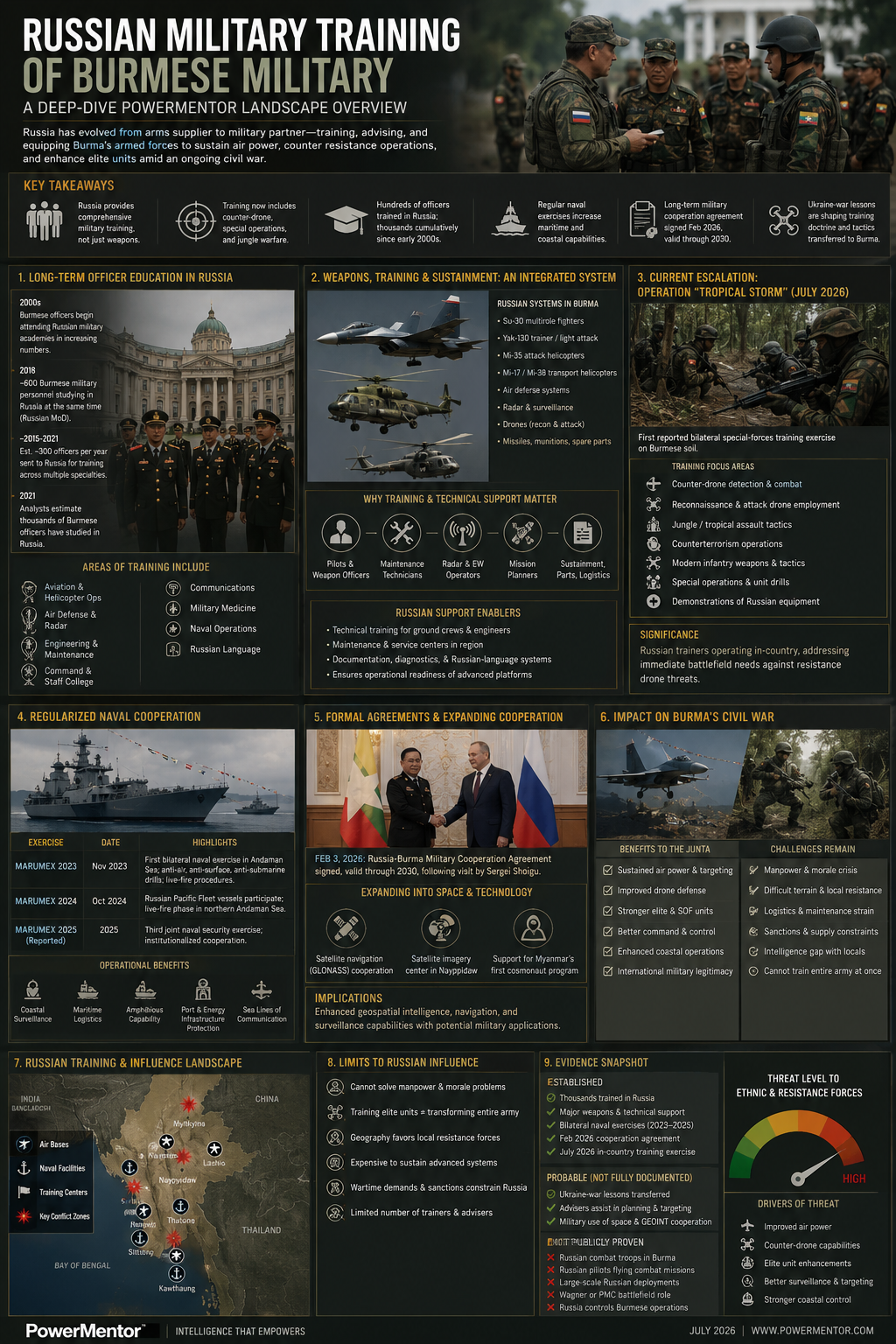
Russia is no longer merely selling weapons to the Burmese military. It is helping develop the personnel, doctrine, maintenance systems, operational skills, and institutional relationships needed to employ those weapons.
The relationship has evolved through three broad stages:
Long-term officer education in Russia
Weapons-linked technical and operational training
Direct combined exercises inside Burma and at sea
The most important recent development is the reported “Tropical Storm” exercise in Naypyidaw, running July 6–17, 2026, in which Russian personnel are training Burmese special-operations forces in counter-drone warfare, tropical assault tactics, counterterrorism and the operation of Russian military equipment. This appears to be the clearest public indication yet of Russian ground-force trainers working directly with Burmese combat personnel inside the country.
That said, there is still no publicly verified evidence that large Russian combat formations are deployed alongside Burmese troops in front-line combat operations. The available evidence points instead to instructors, advisers, naval personnel, technicians and military educators.
1. The current “Tropical Storm” exercise
Independent Burmese media reported on July 15–16, 2026 that Russian and Burmese forces were conducting a nearly two-week training event at the National Defence College or associated training grounds in Naypyidaw.
The reported curriculum includes:
Counter-drone detection and combat
Employment of reconnaissance and attack drones
Assault tactics in tropical or jungle conditions
Counterterrorism operations
Modern infantry weapons
Special-operations tactics
Demonstrations of Russian firearms and other equipment
The event is reportedly the first bilateral Russia–Burma special-forces training exercise of this type.
Why this matters
This is qualitatively different from sending officers to academies in Moscow or St. Petersburg. Russian troops are reportedly training Burmese units:
On Burmese territory
In conditions resembling Burma’s operational environment
In skills immediately relevant to the civil war
Using lessons Russia has developed during the Ukraine war
The inclusion of counter-drone warfare is especially significant. Resistance groups and ethnic armed organizations increasingly use commercially adapted drones for reconnaissance, bombing and attacks on fortified positions. Russia has accumulated extensive recent experience in electronic warfare, drone interception, camouflage, dispersed command posts and small-unit adaptation under persistent drone observation.
The exercise therefore appears designed not simply to improve ceremonial cooperation, but to address specific Burmese battlefield vulnerabilities.
2. This training did not begin in 2026
Russia has educated Burmese officers for more than two decades.
By January 2018, Russian Deputy Defence Minister Alexander Fomin said approximately 600 Burmese military personnel were studying in Russian higher military educational institutions at that time. This was not necessarily a lifetime total; it described officers enrolled concurrently.
Several studies estimate that hundreds of Burmese officers were being sent to Russia annually, with training extending beyond conventional command courses to technical specialties, engineering, aviation, medicine and Russian-language preparation. One detailed policy study estimated around 300 officers per year during portions of the relationship.
By 2021, analysts were describing the cumulative number of Burmese personnel educated in Russia as being in the thousands.
What they likely studied
Public sources do not provide a complete roster of every academy and course. However, the relationship between training and Russian equipment strongly indicates instruction in areas such as:
Fixed-wing aviation
Helicopter operations
Air defence
Radar and surveillance
Military engineering
Communications
Weapons maintenance
Command and staff planning
Military medicine
Naval operations
Technical Russian
A former Burmese military doctor interviewed in 2026 described being sent to St. Petersburg for a three-year programme beginning in 2015. He was reportedly one of hundreds of Burmese officers enrolled in Russian institutions by 2018.
Institutional effect
This has produced a generation of Burmese officers who:
Speak or understand Russian
Are familiar with Russian doctrine and military culture
Have relationships with Russian officers and defence institutions
Can operate and maintain Russian equipment
May regard Moscow as a dependable partner distinct from China
This is important because military education creates influence that outlasts individual arms contracts.
3. Weapons sales and training are one integrated system
Russia has supplied Burma with major combat systems, including:
Su-30 multirole fighters
Yak-130 advanced trainers/light-attack aircraft
Mi-35 attack helicopters
Mi-17-family transport helicopters
Mi-38T transport helicopters
Air-defence systems
Radar and surveillance equipment
Reconnaissance and attack drones
Missiles, spare parts and technical support
In 2018, Russia confirmed an agreement to sell six Su-30 aircraft and linked the transaction to continuing military education.
The UN Special Rapporteur documented approximately $406 million in Russian-origin weapons and related materiel transferred after the 2021 coup, involving numerous Russian state and private entities. The documented transfers included aircraft, helicopters, missile systems, drones, components and technical support.
Russia has also established maintenance and service infrastructure involving Burmese engineers and technicians. Russian officials recently described a regional service and maintenance centre supporting aircraft and air-defence systems.
Why technical training is strategically crucial
A fighter jet is not operationally useful simply because it is delivered. The recipient needs:
Pilots
Weapons officers
Ground crews
Airframe technicians
Engine specialists
Radar operators
Mission planners
Ammunition and spare-parts systems
Runway and base support
Maintenance documentation and diagnostic equipment
Russia’s contribution therefore extends beyond the visible aircraft. It helps sustain the entire operational ecosystem.
This is one reason Russian support has had an outsized effect on the war: air power remains one of the Burmese military’s principal advantages over ethnic resistance forces.
4. Naval exercises have become regularized
Burma and Russia held their first bilateral naval exercise, MARUMEX 2023, in the Andaman Sea in November 2023.
The exercise involved ships and aircraft and reportedly rehearsed:
Defence against air threats
Defence against surface threats
Anti-submarine or underwater-threat responses
Maritime security
Ship coordination
Live-fire procedures
Russian Navy Commander-in-Chief Admiral Nikolai Yevmenov attended, and Min Aung Hlaing inspected Russian naval equipment.
A second exercise followed in October 2024, involving Russian Pacific Fleet vessels and a live-fire phase in the northern Andaman Sea.
By 2025, state reporting described a third joint naval security exercise, indicating that the activity had become institutionalized rather than remaining a one-time political demonstration.
Operational value to the Burmese military
Naval training may improve:
Coastal surveillance
Ship-to-ship coordination
Naval gunfire
Protection of military logistics
Maritime resupply
Amphibious or littoral operations
Defence of ports and energy infrastructure
Control of offshore approaches
Analysts have also argued that Russian-linked naval cooperation can help Burma strengthen sea resupply, landing and offshore bombardment capabilities.
For ethnic forces, this matters most in coastal areas such as Rakhine, Tanintharyi and Mon State, where naval logistics or offshore fire support could reinforce isolated military positions.
5. The February 2026 agreement formalized the relationship
On February 3, 2026, Russia and Burma signed a new military-cooperation agreement reportedly valid through 2030. The agreement followed a visit by former Russian defence minister and current Security Council Secretary Sergei Shoigu.
The full agreement does not appear to have been publicly released. Therefore, claims about its exact classified provisions should be treated cautiously.
Nevertheless, the July “Tropical Storm” exercise strongly suggests that implementation includes:
Bilateral training deployments
Special-forces cooperation
Doctrine exchanges
Equipment demonstrations
Counter-drone instruction
Regular exercises
Continued military education
Technical and maintenance cooperation
The sequence is important:
February 2026: long-term agreement signed
July 2026: Russian trainers reportedly exercise with Burmese special forces inside Naypyidaw
That suggests the agreement is becoming operational rapidly.
6. Russia may be transferring Ukraine-war lessons
There is mounting evidence that Russian combat experience in Ukraine is shaping the training and equipment being offered to Burma.
Likely lesson areas include:
Counter-drone warfare
Russian forces have developed layered responses involving:
Electronic jamming
Handheld detection
Visual observation teams
Small-arms engagement
Physical overhead protection
Camouflage and deception
Rapid relocation of command posts
Greater dispersion of vehicles and ammunition
Burma’s inclusion of counter-drone training during Tropical Storm directly corresponds to the resistance’s growing drone capabilities.
Drone employment
Russia has learned to integrate inexpensive drones with:
Artillery spotting
Target identification
One-way attack missions
Real-time reconnaissance
Infantry assaults
Battle-damage assessment
Burma has already obtained Russian-origin surveillance and attack-drone capabilities, and the current exercise reportedly includes drone demonstrations.
Assault tactics
Russian training may emphasize:
Small assault groups
Fire-and-movement under drone observation
Breaching fortified positions
Combining drones with infantry
Rapid identification of resistance firing points
Night or limited-visibility operations
However, there is not yet enough public evidence to conclude that Burma has adopted a complete Russian operational doctrine.
Intelligence and space support
Russia has expanded cooperation beyond conventional arms. Recent agreements include Russian satellite-navigation and space-monitoring infrastructure, while reporting has described a satellite imagery centre in Naypyidaw.
Russia also agreed in 2026 to help select and train Burma’s first cosmonaut and support GLONASS-related infrastructure.
The civilian and military components cannot automatically be equated, but improved access to satellite navigation, imagery or geospatial expertise could support:
Target location
Mapping
Flight planning
Troop movement
Drone navigation
Surveillance analysis
7. The direct impact on ethnic resistance forces
The training is particularly consequential for ethnic forces because Burma’s military is not primarily preparing for an external invasion. Its principal active adversaries are internal resistance organizations.
The most likely operational beneficiaries are units fighting:
The Karen National Liberation Army and allied resistance forces
The Kachin Independence Army
The Arakan Army
Karenni forces
Chin resistance organizations
People’s Defence Forces
Other ethnic revolutionary organizations
Likely effects
Air power may become more sustainable. Better maintenance, pilot preparation and targeting processes can preserve the junta’s ability to conduct air strikes despite battlefield losses.
Drone attacks against junta positions may become harder. Counter-drone instruction could reduce the effectiveness of resistance bombing operations, particularly against headquarters, artillery sites and airbases.
Special operations may improve selectively. Russian-trained elite formations could become more capable at raids, reconnaissance, base defence and targeted assaults, even if the average Burmese infantry battalion remains poorly trained.
Command relationships may become more centralized and technical. Russian systems often depend on trained specialists and hierarchical command structures, potentially strengthening selected national-level formations rather than the entire army.
Coastal operations could improve. Regular naval exercises may assist the junta in sustaining isolated coastal garrisons or threatening resistance-held coastal zones.
8. Important limits to Russian influence
Russia cannot easily solve the Burmese military’s deepest problems.
Manpower and morale
Training elite units does not reverse:
Desertions
Forced recruitment
Casualty replacement problems
Poor morale
Weak junior leadership
Lack of local intelligence
Hostility from local populations
Geography
Burma’s jungle, mountains and dispersed villages favor forces with local knowledge. Russian doctrine developed in Ukraine, Syria or the North Caucasus cannot simply be transplanted without adaptation.
Logistics
Russian aircraft and advanced systems require expensive maintenance, imported parts and specialized technicians. Sanctions and Russia’s own wartime demands may constrain supply.
Scale
A small number of Russian instructors can improve selected formations, but retraining the entire Tatmadaw would require a much larger and sustained presence.
Intelligence gap
Ethnic forces often operate through community networks and local terrain familiarity. Technical surveillance can narrow that gap but cannot eliminate it.
9. What is firmly established and what remains uncertain
Firmly established
Hundreds, and cumulatively likely thousands, of Burmese officers have studied in Russian military institutions.
Russia has supplied aircraft, helicopters, air-defence systems, drones and technical support.
Burma and Russia have conducted repeated bilateral naval exercises.
A new multiyear military-cooperation agreement was signed in February 2026.
Russian personnel are reportedly conducting special-forces and counter-drone training in Naypyidaw in July 2026.
Russian-origin aircraft and helicopters have been used in Burma’s internal war.
Probable but incompletely documented
Russian instructors are transferring tactical lessons learned in Ukraine.
Russian advisers assist with operational planning or targeting procedures.
Satellite and geospatial cooperation has military applications.
Training is tailored specifically to defeat resistance-drone tactics.
Not publicly proven
Russian personnel regularly accompany Burmese forces on combat missions.
Russian pilots are flying Burmese combat sorties.
Large Russian ground units are deployed in Burma.
Wagner or another Russian private military company has an acknowledged, sustained battlefield role.
Russia controls Burmese operational decisions.
Strategic judgment
The Russian role should be understood as a force multiplier, not a Russian takeover of the Burmese war.
Moscow is helping the Burmese military preserve its most important advantages:
Air power
Advanced weapons
Technical expertise
Officer development
Elite-unit capability
Naval mobility
International legitimacy
The July 2026 ground-training exercise marks a notable escalation because it closes the gap between arms supplier and operational military partner.
For ethnic forces, the greatest near-term danger is not thousands of Russian soldiers entering Burma. It is a smaller number of Russian specialists teaching selected Burmese units how to use drones, defeat resistance drones, protect command posts, sustain aircraft and conduct better-coordinated assaults.
That type of assistance is less visible than a major deployment but may be more practical—and more immediately damaging—on the battlefield.
