

When the Badge Walks Away: America's Growing Crisis of Small-Town Police Department Collapses
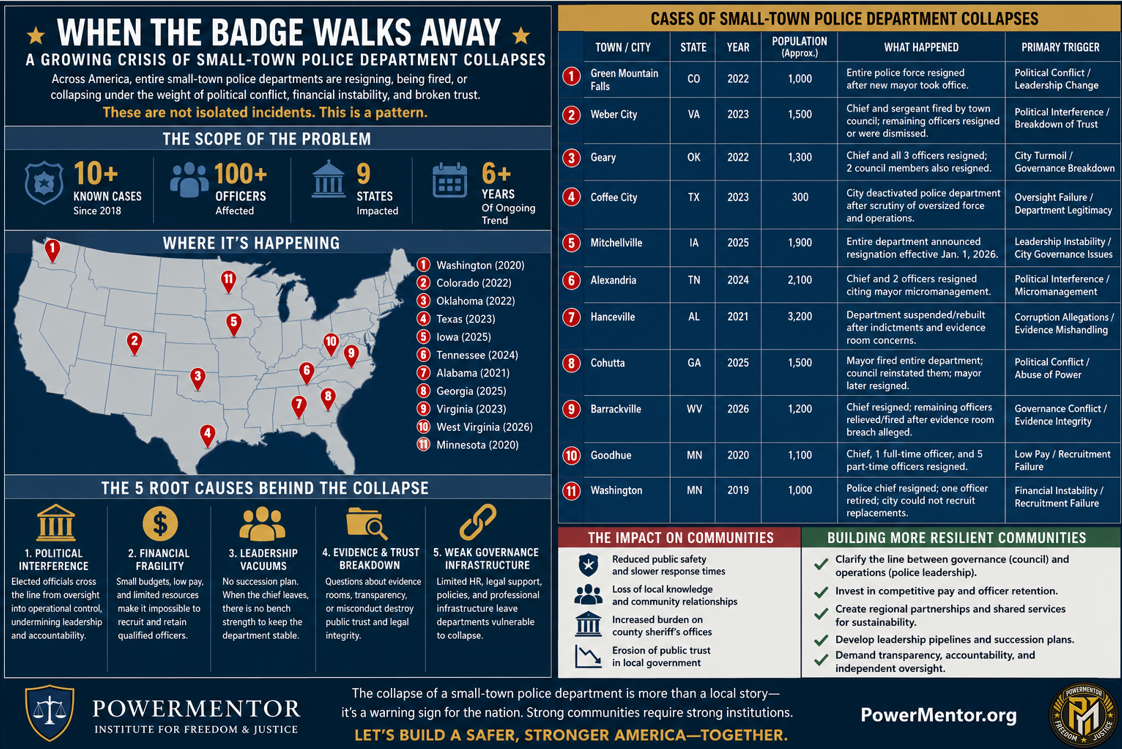
When One Police Department Falls, America Should Pay Attention
When Americans think about policing crises, their minds often turn to major metropolitan areas. Headlines frequently focus on large cities struggling with violent crime, officer shortages, or public demonstrations. Yet, quietly unfolding across rural America is a different kind of crisis—one that receives far less national attention but carries profound implications for public safety and local governance.
Over the past several years, a growing number of small-town police departments have experienced complete organizational collapse. In some communities, every officer has resigned. In others, entire departments have been dismissed by elected officials. Some have ceased operations because they could no longer recruit or retain officers, while others have become consumed by political conflict or allegations involving evidence management and departmental oversight.
Although each community has its own unique story, the similarities between these incidents are becoming increasingly difficult to ignore. They suggest that many of America's smallest police agencies are operating within a system that has become increasingly fragile.
The recent events in Barrackville, West Virginia, provide one of the clearest examples of this emerging pattern.
Barrackville: A Case Study in Organizational Collapse
Barrackville is a town of approximately 1,200 residents. Like many rural communities, its police department consisted of only a handful of officers responsible for protecting the community and maintaining public order.
Within a remarkably short period, however, the department unraveled.
The police chief resigned. Shortly thereafter, the remaining officers alleged inappropriate governmental interference in police operations. Public allegations then surfaced regarding possible unauthorized access to the department's evidence room, raising concerns about evidence security and chain of custody. Soon afterward, the town relieved the remaining officers of duty, leaving the community without its own municipal police department and requiring the Marion County Sheriff's Office to assume law enforcement responsibilities.
It is important to recognize that public officials and former officers have offered differing accounts regarding these events, and many of the allegations remain subject to further investigation. Nevertheless, regardless of where the facts ultimately lead, one reality cannot be disputed: an entire police department ceased functioning almost overnight.
That alone should concern every American.
Barrackville Is Far From an Isolated Incident
A review of recent history reveals that Barrackville is not an anomaly. Instead, it joins a growing list of communities that have experienced similar organizational failures.
In Goodhue, Minnesota, the police chief resigned after repeated warnings that the town's compensation structure made it impossible to recruit or retain officers. One by one, every remaining officer also resigned, leaving the community without local law enforcement. Unlike Barrackville, there were no allegations of political conflict or evidence concerns. The collapse occurred because the department simply could not survive financially.
In Geary, Oklahoma, the chief and every officer resigned amid broader turmoil within city government. Weber City, Virginia, similarly found itself without a functioning police department after town leadership dismissed key personnel and additional officers departed. Green Mountain Falls, Colorado, experienced a complete departmental resignation following conflict with newly elected municipal leadership. More recently, Mitchellville, Iowa, announced that its entire department would resign, forcing the city to rebuild its policing model from the ground up.
Although the facts differ from town to town, the outcomes are remarkably consistent. Communities lose their local police departments almost overnight, residents are left questioning who will answer emergency calls, and county sheriffs are forced to assume responsibilities that municipal governments were originally expected to provide.
These are not isolated personnel disputes. They represent organizational failures.
A Pattern Begins to Emerge
When these incidents are examined collectively rather than individually, several recurring themes become apparent. None of them alone necessarily causes a department to collapse. However, when multiple vulnerabilities exist simultaneously, even a relatively minor dispute can trigger institutional failure.
One of the most common themes is political interference or blurred governance. Municipal elected officials unquestionably possess oversight responsibilities, including budgeting, policy approval, and accountability to taxpayers. Operational law enforcement, however, traditionally falls under the authority of police leadership. When those responsibilities become blurred, chiefs often find themselves navigating competing chains of command that undermine both organizational stability and officer confidence.
Another recurring factor is financial fragility. Most of these departments employ only a handful of officers. Their budgets are limited, salary structures frequently lag behind neighboring jurisdictions, and opportunities for career advancement are minimal. Losing even one experienced officer may represent twenty-five or fifty percent of the agency's workforce. Such organizations possess very little margin for error.
Equally significant is the absence of leadership succession planning. Larger departments generally have command staffs capable of maintaining continuity when a chief retires or resigns. Many small-town departments do not. When the chief departs, there may be no lieutenant, captain, or deputy chief prepared to assume leadership. Organizational knowledge leaves with the departing chief, often creating instability that accelerates additional resignations.
Finally, there is the issue of public trust. Law enforcement functions almost entirely on credibility. Citizens must believe investigations are conducted fairly, evidence is protected, and officers remain insulated from political pressure. Once those perceptions begin to erode, rebuilding public confidence becomes extraordinarily difficult.
Why Small Departments Are Particularly Vulnerable
America has more than 18,000 law enforcement agencies, and the overwhelming majority serve their communities professionally every day. Yet many of the nation's smallest departments operate under conditions that make them uniquely vulnerable to collapse.
Unlike large metropolitan agencies, they often lack specialized divisions, dedicated human resources personnel, legal counsel, training units, or administrative support. Chiefs frequently perform multiple roles simultaneously, serving as investigators, patrol supervisors, evidence custodians, budget managers, and community liaisons. Limited staffing means vacations, illnesses, retirements, or resignations place immediate strain on the remaining officers.
These agencies also exist within the political dynamics of very small communities, where elected officials, officers, and residents frequently know one another personally. While strong relationships can be an asset, they can also complicate decision-making when disagreements arise. Professional boundaries that are clearly established in larger organizations may become less distinct in municipalities where everyone knows everyone else.
The result is an organizational structure that can become surprisingly fragile despite the dedication of the officers serving within it.
The Hidden Cost to Communities
When a police department collapses, the consequences extend far beyond law enforcement.
Residents lose an institution that often represents the most visible presence of local government. Businesses may question whether adequate public safety resources remain available. Insurance costs can increase. Mutual aid agreements become strained as neighboring agencies assume responsibilities they were never intended to permanently provide.
Perhaps most importantly, officers themselves become casualties of institutional dysfunction. Many enter policing out of a genuine commitment to public service, only to find themselves caught between political conflict, inadequate resources, and organizational instability. Communities ultimately lose experienced professionals whose departures could have been prevented through stronger governance and more resilient leadership.
This Is a Governance Issue as Much as a Policing Issue
It would be inaccurate to conclude that America is experiencing a nationwide collapse of policing. Such a statement would ignore the thousands of agencies that continue to serve their communities with professionalism and integrity.
What the available evidence does suggest is that America faces a growing governance challenge among many of its smallest municipal police departments.
The repeated appearance of similar organizational failures points toward structural weaknesses rather than isolated misfortunes. Political conflict, financial instability, leadership turnover, recruitment difficulties, and limited institutional capacity are intersecting in ways that create significant risk for small agencies across the country.
Viewed individually, each incident appears unique. Viewed collectively, they reveal a pattern worthy of national attention.
Building More Resilient Small-Town Police Departments
Strengthening America's smallest police agencies will require more than simply increasing budgets or hiring additional officers. It requires improving the systems that support them.
Municipal leaders must clearly distinguish between governance and operational command, ensuring elected officials provide oversight without compromising the professional independence necessary for lawful policing. Regional partnerships and shared services should be explored where communities lack sufficient resources to sustain independent agencies. Leadership development and succession planning must become priorities rather than afterthoughts, ensuring departments remain stable during periods of transition.
Equally important is maintaining transparency whenever controversy arises. Independent investigations, open communication with residents, and clearly documented policies help preserve public confidence even during difficult periods.
Strong institutions are not measured by their ability to function when everything goes well. They are measured by how effectively they withstand conflict, leadership changes, and unexpected challenges.
Final Thoughts
Every time an entire police department disappears, America loses more than a collection of employees.
It loses local knowledge. It loses institutional memory. It loses relationships that officers have built within their communities over many years. Most importantly, it risks weakening public confidence in one of the most essential functions of government.
The story unfolding in Barrackville should not be dismissed as another small-town controversy destined to disappear from the news cycle. Instead, it should serve as an opportunity for policymakers, law enforcement leaders, and citizens to examine why similar collapses continue occurring across the nation.
If communities wish to preserve effective local policing, they must invest not only in officers, but also in sound governance, professional leadership, organizational resilience, and public trust.
The badge represents far more than authority. It represents a covenant between those who serve and the communities they protect. Ensuring that covenant endures requires institutions strong enough to survive political change, financial pressure, and leadership transitions.
America's smallest towns deserve nothing less.
