

The Great Disconnect: Why Americans Are Becoming Strangers Next Door: How the Collapse of Neighborhood Socializing Is Reshaping America
There was a time in America when neighborhoods were more than collections of houses—they were communities.
Children rode bicycles until sunset. Neighbors borrowed tools, shared meals, watched each other's children, checked on elderly residents, and gathered for block parties. When someone experienced hardship, the community often stepped in before government agencies ever became involved.
Today, much of that social fabric has quietly unraveled.
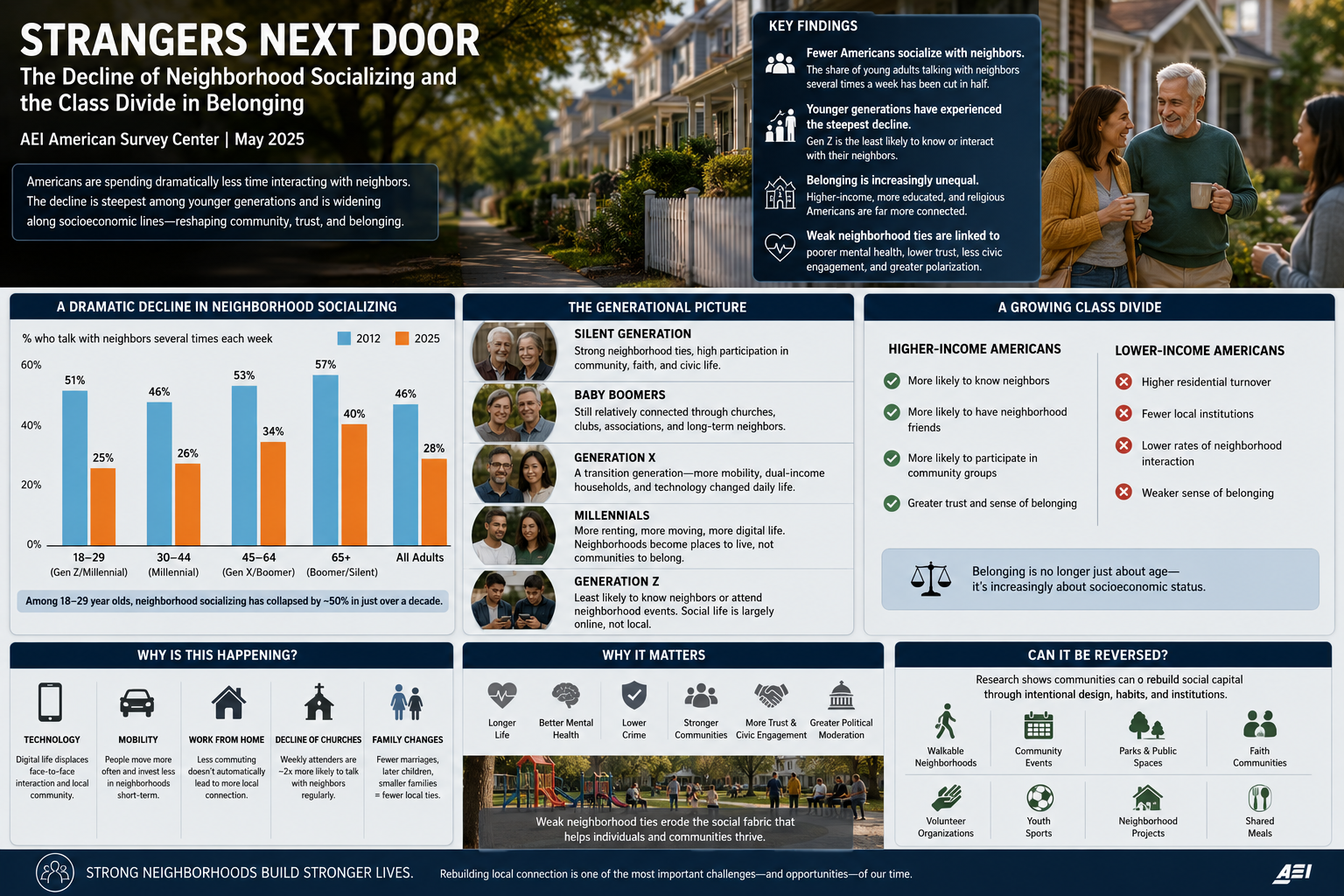
A recent report by the American Survey Center at the American Enterprise Institute (AEI), Strangers Next Door: The Decline of Neighborhood Socializing and the Class Divide in Belonging, documents one of the most significant cultural shifts occurring in the United States: Americans are spending dramatically less time interacting with their neighbors, and younger generations are experiencing this decline at unprecedented levels.
This isn't simply a story about loneliness.
It is a story about trust, belonging, resilience, civic engagement, mental health, democracy, and the future of American communities.
A Nation Becoming Increasingly Isolated
The report paints a sobering picture.
Over just the past decade, Americans have sharply reduced their face-to-face interactions with those living around them.
One of the report's most striking findings is this:
Neighborhood socializing among young adults has been cut roughly in half.
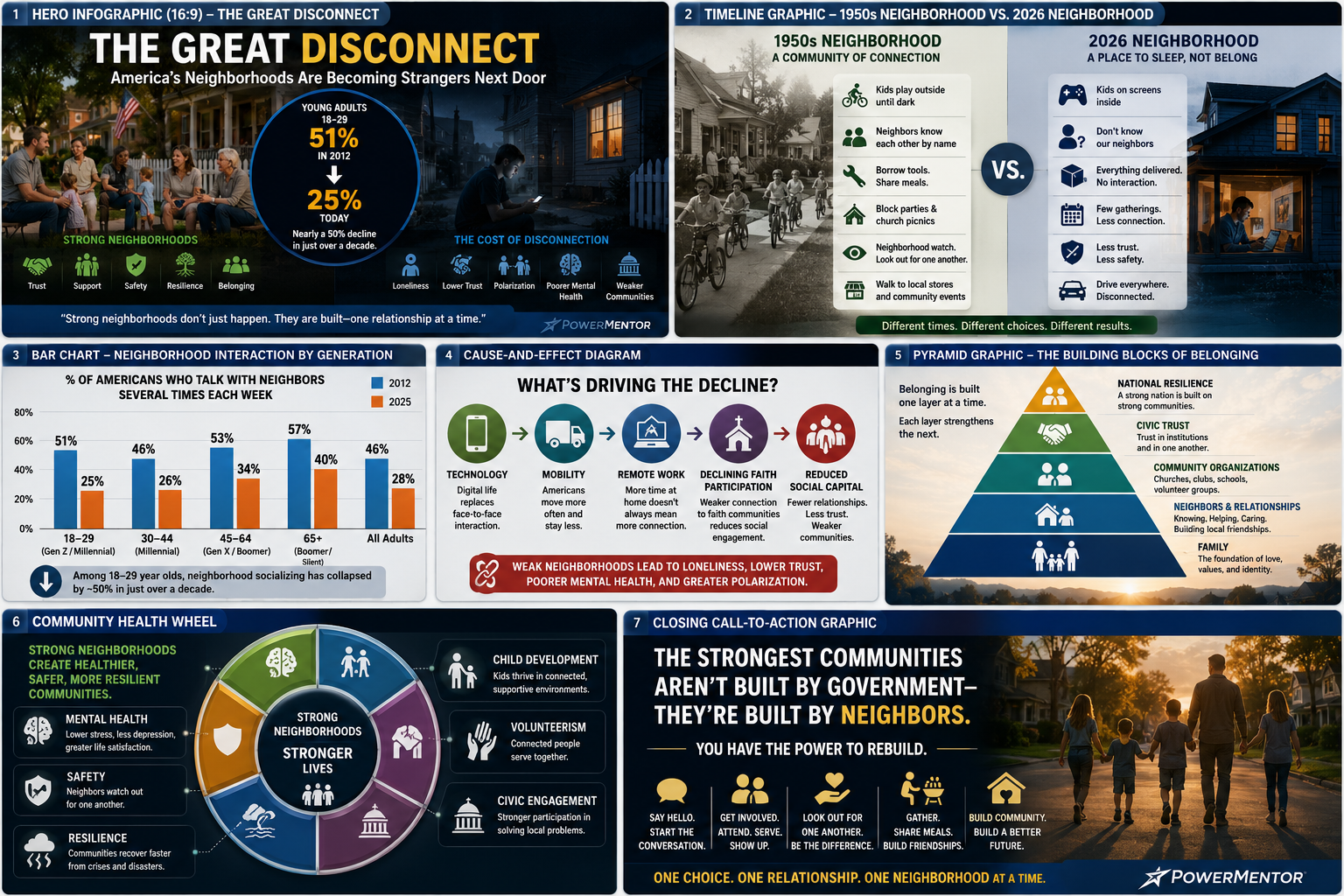
Among Americans ages 18–29, those who reported talking with neighbors several times each week dropped from approximately 51% in 2012 to only 25% today.
That represents nearly a 50% decline in just over a decade.
While every generation has experienced reduced neighborhood interaction, the younger the generation, the larger the decline.
The Generational Story
The Silent Generation
This generation largely grew up in communities where neighbors were extended family. Front porches were gathering places, neighborhoods looked after one another, and civic organizations flourished.
Many older Americans still know nearly everyone on their street.
Baby Boomers
Boomers continue to maintain relatively strong neighborhood ties.
Many remain active through:
Churches
Volunteer organizations
Homeowner associations
Local service clubs
Community events
Although participation has declined, neighborhood identity remains important.
Generation X
Generation X serves as the transition generation.
Many remember:
Playing outside until dark
Walking to friends' houses without calling first
Neighborhood sports
Block parties
Knowing every family on the street
But adulthood coincided with the rapid rise of the Internet, dual-income households, suburban commuting, and increasingly busy schedules.
Millennials
Millennials experienced enormous structural changes.
Many:
Rent instead of own
Relocate frequently
Work remotely
Delay marriage
Have fewer children
As a result, many friendships exist online or across cities rather than next door.
Neighborhoods increasingly function as places to sleep—not places to belong.
Generation Z
Generation Z may be the first generation to grow up with digital communities replacing local ones.
Many report:
Rarely talking with neighbors
Limited participation in neighborhood events
Most friendships existing online
Social lives centered around gaming, Discord, TikTok, Instagram, or messaging apps
Digital connectivity has expanded global relationships while often reducing local ones.
What Changed?
No single factor explains this transformation.
Instead, multiple cultural shifts have converged.
Technology Changed Human Interaction
Perhaps no force has been more transformative than technology.
For most of human history, social interaction required physical presence.
Today, much of life occurs through screens.
Instead of:
Front porches
Parks
Sidewalk conversations
Community gatherings
we increasingly substitute:
Streaming services
Social media
Gaming
Video calls
Online communities
Technology has made communication easier than ever—but local relationships often weaker.
Mobility Has Reduced Long-Term Investment
Americans move more frequently than previous generations.
People who expect to relocate within several years often invest less time building neighborhood relationships.
Communities become temporary rather than permanent.
Working From Home Didn't Create More Community
Many expected remote work to strengthen neighborhoods.
Instead, research suggests many workers simply remain inside their homes longer.
Less commuting has not necessarily produced more neighborhood engagement.
Declining Religious Participation
One of the strongest findings involves religious participation.
Individuals who attend religious services regularly are significantly more likely to:
Know neighbors
Volunteer
Participate in community activities
Trust local residents
Develop long-term friendships
Faith communities remain among America's strongest creators of social capital.
Changing Family Structures
Historically, children connected neighborhoods.
Parents met through:
Schools
Sports
Playgrounds
Birthday parties
PTA meetings
With delayed marriage, declining birth rates, and smaller families, many of these natural opportunities for connection have diminished.
The Class Divide in Belonging
Perhaps the report's most concerning finding is that belonging itself is becoming unequal.
Higher-income Americans are significantly more likely to report:
Knowing neighbors
Participating in neighborhood organizations
Volunteering
Feeling safe
Trusting others
Having close local friendships
Lower-income communities often face:
Higher residential turnover
Fewer stable institutions
Reduced neighborhood trust
Less civic participation
This creates a troubling cycle where those who may benefit most from strong community support often have the least access to it.
Why This Matters
Neighborhood relationships influence much more than friendships.
Decades of research consistently associate strong local social networks with:
Longer life expectancy
Lower rates of depression
Improved mental health
Reduced crime
Greater disaster resilience
Higher volunteerism
Increased civic engagement
Greater trust
Better child development
Communities with strong social connections often recover more quickly from crises because people already know and trust one another.
The Hidden Cost of Digital Success
Modern technology has undeniably created extraordinary benefits.
Families remain connected across continents.
Information is instantly available.
Businesses operate globally.
But there is an unintended consequence.
Humans evolved for thousands of years in small, face-to-face communities.
Digital interaction stimulates communication.
It does not always replace the deeper trust that develops through repeated physical interaction.
Someone can have 2,000 online followers and still not know the person living across the street.
Social Capital: America's Invisible Infrastructure
Sociologists often describe neighborhood relationships as social capital.
Unlike financial capital, social capital cannot be purchased.
It develops slowly through repeated interaction.
Simple activities build remarkable trust:
Greeting neighbors
Walking dogs
Coaching youth sports
Church attendance
Community volunteering
Neighborhood improvement projects
Shared meals
Local festivals
These seemingly ordinary interactions become the invisible infrastructure supporting healthy societies.
Can America Reverse the Trend?
The encouraging news is that social capital can be rebuilt.
Research consistently identifies practices that strengthen communities.
Design Walkable Communities
People naturally interact when sidewalks, parks, and public gathering spaces encourage spontaneous conversation.
Support Local Events
Farmers markets.
Neighborhood celebrations.
Outdoor concerts.
Community clean-up days.
These events create repeated opportunities for residents to build familiarity.
Encourage Volunteerism
Serving together builds relationships faster than simply living near one another.
Volunteer organizations remain among America's strongest community builders.
Strengthen Faith Communities
For many communities, churches, synagogues, mosques, and other faith organizations continue serving as centers of belonging, service, and mutual support.
Invest in Youth Activities
Youth sports.
Music programs.
Scouting.
Community recreation.
Children often become the bridge that reconnects adults.
Choose Presence Over Convenience
Sometimes rebuilding community begins with remarkably small choices.
Walking instead of driving.
Introducing yourself to new neighbors.
Attending community meetings.
Helping someone with yard work.
Hosting a neighborhood barbecue.
Small investments accumulate into strong neighborhoods.
Leadership Lessons
Strong leaders understand that organizational culture and community culture develop in remarkably similar ways.
Trust is rarely built through speeches.
It grows through consistent, authentic interaction.
Whether leading a business, a nonprofit, a school, or a neighborhood, the same principle applies:
People support communities where they feel known.
Belonging cannot be legislated.
It must be cultivated.
PowerMentor Perspective
The AEI report reminds us that America's greatest strength has never been merely its economy or institutions—it has been its people and the relationships they build with one another.
Technology, mobility, and changing lifestyles have brought many benefits, but they have also altered how people connect. Rebuilding neighborhood ties will likely require intentional choices by individuals, families, community organizations, employers, faith communities, and local leaders.
If this trend continues, Americans may become increasingly connected to the world while remaining disconnected from those living just beyond their front doors.
But if communities choose to invest again in trust, service, and belonging, neighborhoods can become more than places where people reside—they can once again become places where people truly live together.
