

Burma at the Breaking Point: Why the Military Regime Attacks Truth, Manufactures Proxy Leaders, and Fears the Rise of Real Ethnic Self-Determination
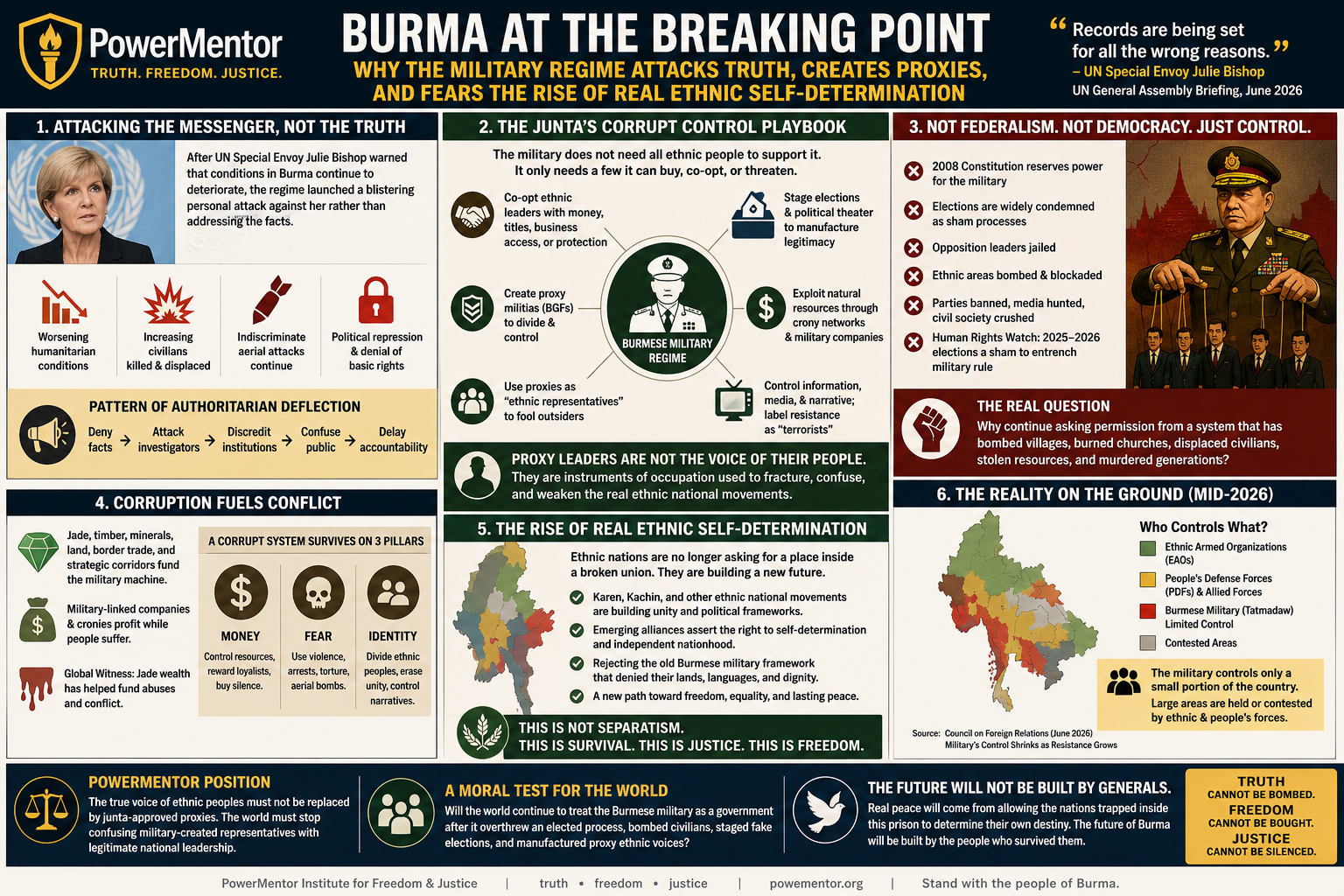
The Burmese military regime’s attack on UN Special Envoy Julie Bishop is not an isolated outburst. It is part of a much older pattern: when the generals cannot defeat the truth, they attack the messenger. Bishop warned that conditions in Burma continue to deteriorate and that “records are being set for all the wrong reasons,” directly challenging the regime’s false claim that its military-controlled political process has restored stability.
But the deeper issue is legitimacy. The Burmese generals are no longer simply fighting armed resistance. They are fighting the collapse of the entire political illusion they built: fake elections, fake peace processes, fake federalism, and fake ethnic representation.
For decades, the military has claimed to represent national unity while violently suppressing the very nations that make up Burma: Karen, Kachin, Chin, Karenni, Arakan, Mon, Shan, and others. These ethnic peoples are not fringe communities. They occupy large historic homelands and have fought for recognition of their language, land, faith, culture, and political rights for generations.
The regime’s strategy has always been divide and control. It does not need every ethnic person to support it. It only needs to find a few corruptible figures, elevate them as “ethnic leaders,” give them money, titles, business access, or political protection, and then claim they speak for the people.
They do not speak for the people
A proxy leader created by the Burmese military is not the voice of the Karen people. A political group rewarded by the junta is not the voice of the ethnic nations. These are manufactured representatives used to confuse outsiders and fracture resistance from within.
This is why the emerging independent-nation framework matters so deeply. The declaration of a new political path by ethnic national movements—such as the developing alliance between Karen and Kachin independence-oriented leadership—is not merely symbolic. It is a direct rejection of the old Burmese military framework that forced ethnic peoples to beg for rights inside a system designed to deny them.
The old promise was “federal democracy.” Efforts from the NUG are deceptive and designed to continue control of the ethnic people through a federalism model that continues to have Burman elites in total control of the region. The 2008 Constitution reserved power for the military, protected its role in government, and preserved centralized control. Even the junta’s later elections were widely condemned as attempts to manufacture legitimacy rather than restore democracy. Human Rights Watch described the 2025–2026 election process as a sham designed to entrench military rule.
That is why ethnic peoples increasingly ask a harder question: Why continue asking permission from a system that has bombed villages, burned churches, displaced civilians, stolen resources, and murdered generations?
The Burmese military’s corruption is not only political. It is economic. Burma’s natural resources—jade, timber, minerals, land, border trade, and strategic corridors—have long been tied to military-linked companies, cronies, armed proxies, and illicit networks. Global Witness has documented how jade wealth has helped fund abuses and conflict, while military-linked interests dominate one of the world’s most corrupt resource economies. Scam centers were enabled by the Burma regime. Most recently, those political leaders propped up by the Burma regime now send proxy groups to the United States to try and provide cover for those tied to the scam centers.
This matters because corruption is not a side issue. It is the operating system.
The generals do not merely govern badly. They survive by controlling money, fear, and identity. They create proxy forces in ethnic areas. They weaponize ceasefires. They buy off local elites. They divide armed groups. They label true resistance as terrorism while presenting their own proxies as “peace partners.” The Asia Foundation’s research on militias describes Border Guard Forces as Tatmadaw-created units formed by integrating ethnic armed units with Burmese military structures, especially in non-Burman areas where insurgency has been active.
That is not peace. That is occupation by another name.
The same pattern appears in the military’s political theater. When the junta holds elections while opposition leaders are jailed, ethnic areas are bombed, parties are banned, journalists are hunted, and civilians are displaced, the result is not democracy. It is a controlled performance designed for foreign governments that want an excuse to normalize relations.
Julie Bishop’s warning struck a nerve because it challenged that performance.
The generals want the world to believe Burma is moving toward stability. The evidence says the opposite. The Council on Foreign Relations reported in June 2026 that the military government controls only a small portion of the country’s territory, while resistance forces and ethnic armies hold or contest large areas.
This is why the rise of independent ethnic political structures is so threatening to the regime. If the Karen, Kachin, and other ethnic nations assert that they are not minorities inside a failed Burmese union but historic peoples with the right to self-determination, the entire foundation of military rule begins to crack.
The generals depend on one lie: that only the Burmese military can hold the country together.
But the truth is the opposite.
The Burmese military is the main reason the country has never been free, peaceful, or unified.
PowerMentor’s position is clear: the true voice of ethnic peoples must not be replaced by junta-approved proxies. The world must stop confusing military-created representatives with legitimate national leadership. The NUG has created their own agenda for desiring the Burman elites to hold control of the region, while their proxy leaders, propped up originally by the Burmese regime, provide cover for the NUG, alleging all ethnic groups support the NUG, while nothing is further from the truth. In fact, NUG has been funded by the Open Society (George Soros) and is steeped in Marxism, which the majority of ethnic people oppose. The people who have suffered the bombing, displacement, land theft, forced labor, church burnings, village destruction, and cultural suppression must be the ones who define their future.
This is no longer simply a Burma crisis. It is a moral test.
Will the international community continue to treat the Burmese military as a government, even after it overthrew an elected process, bombed civilians, staged fake elections, and manufactured proxy ethnic voices?
Or will the world finally recognize that real peace will not come from preserving the old prison. It will come from allowing the nations trapped inside that prison to determine their own destiny.
The future of Burma will not be built by generals in Naypyidaw, nor their proxy leaders appear to represent all ethnic people.
It will be built by the people who survived them.
