

The Karen People: An Ancient Journey, a Living Nation, and New Clues From DNA
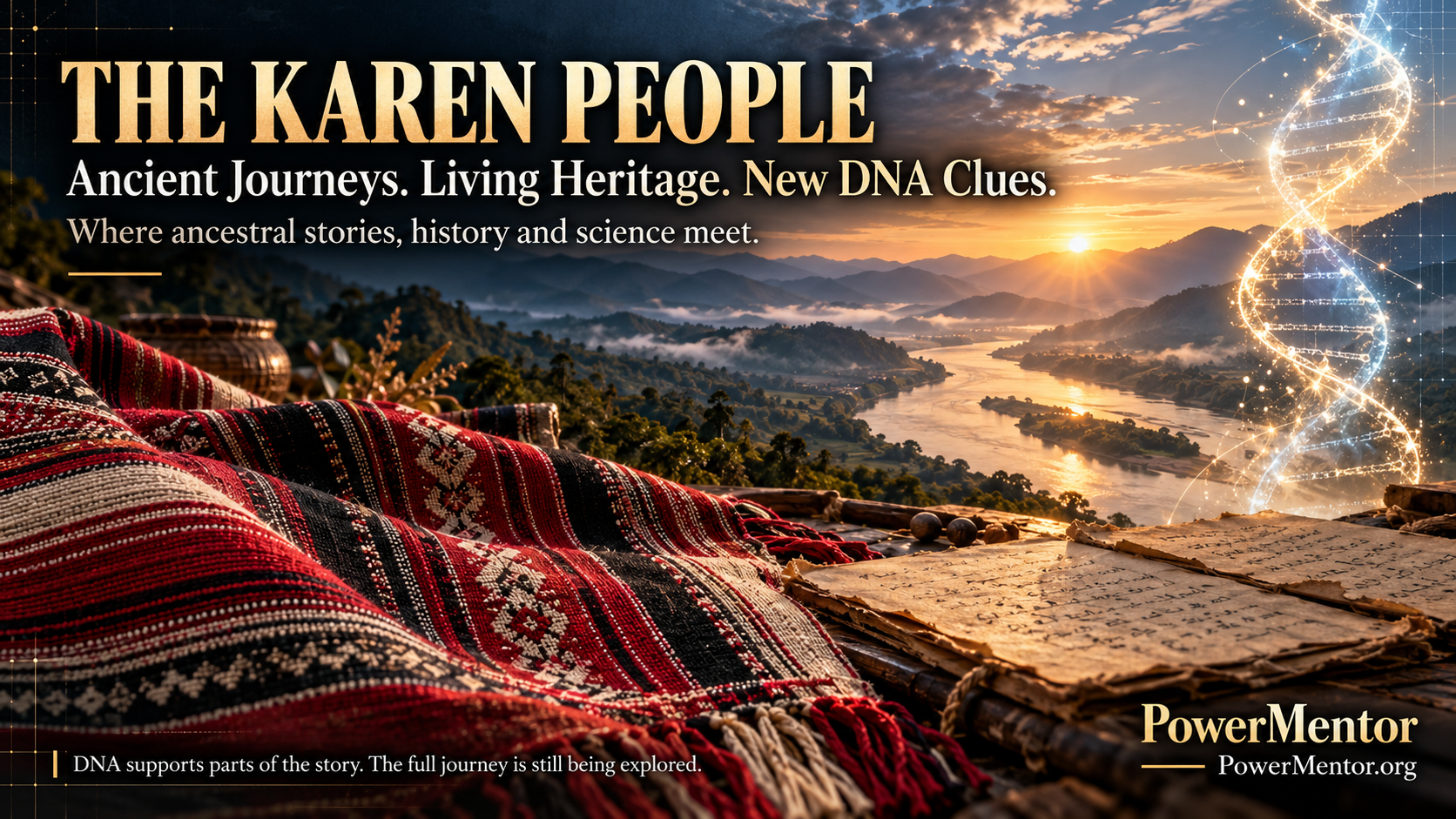
A people’s history does not begin when someone else writes about them. Long before books and formal records, families passed their stories from elders to children. They told of homes left behind, lands crossed, hardships faced, and the places where they built new lives.
The Karen people have kept such stories for generations. Their accounts describe a long journey through Asia. Some begin in Babylon, then move through Mongolia, East Turkistan, Tibet, and Yunnan before reaching the land now called Burma.
Today, DNA research adds another source of clues. It gives some support to the Karen story of a distinct people with ties to lands farther north. It also shows that the region’s past was more complex than one group moving south and settling there.
To understand the full picture, we must bring together three things: what Karen people have passed down, what historical records show, and what DNA can tell us. Each helps us see part of the story.
The Journey Preserved by Karen Elders
One published version of Karen traditional history places the start of the journey in Babylon in 2234 BC. It describes arrival in Mongolia in 2194 BC. The people later leave Mongolia in 2017 BC and reach East Turkistan in 2013 BC.
In this account, they stay in East Turkistan for 147 years. They leave in 1866 BC and reach Tibet in 1864 BC. After 476 years in Tibet, they leave in 1388 BC and reach Yunnan in 1385 BC. Yunnan lies in what is now southwestern China.
The account then describes two groups. The first leaves Yunnan in 1128 BC and reaches Burma in 1125 BC. The second leaves in 741 BC and arrives in 739 BC. One retelling identifies 99 families in the first group and 33 in the second. These details belong to the traditional account; they are not independently verified counts.
This helps explain an error in some modern versions of the story. They say the Karen stayed in Yunnan for 644 years before arriving in Burma in 1125 BC. Those dates do not fit. The 644-year stay runs from 1385 BC to the second group’s departure in 741 BC. Two separate movements have been blended into one.
Correcting that detail preserves the account more faithfully. But a timeline that adds up is not, by itself, proof that every event took place in that exact year.
The “River of Sand” and the Search for an Earlier Home
Karen traditions also speak of a place described as a “river of sand.” Some writers took this to mean the Gobi Desert. That helped link the Karen origin story to Mongolia.
An ANU historical study traces this reading to the missionary Francis Mason. Other missionaries questioned it. The same study explains how similarities between Karen sacred stories and Bible stories led some early missionaries to suggest a link with the lost tribes of Israel.
These ideas became part of later writing about Karen origins. That history matters because an old oral story and a later writer’s reading of it are not always the same thing. We should ask what elders said, how their words were translated, and what later authors added.
The right response is careful study. Oral history can preserve real memories of movement and loss, even when the exact place names or dates are hard to confirm.
What Language Tells Us
Karen languages belong to the Sino-Tibetan language family. This is a large group of related languages found across parts of Asia.
Think of languages as branches of a tree. Over time, groups move apart. Their speech changes, but some old links remain. Scholars study those links to learn about the past.
Research places Karenic within this wider Asian language family. It supports a shared linguistic past with other Asian peoples. It does not establish a Babylonian starting point or give us a complete travel route. A language tree is not a dated map of every family’s journey.
What DNA Can Add
DNA is a set of tiny instructions inside our bodies. We receive it from our parents. Scientists can compare parts of it to find clues about shared ancestors.
Much of the research discussed here studies DNA passed down through mothers. It follows one line: your mother, her mother, and her mother before her.
That is a useful trail. But your family includes many other lines too. One mother-line cannot tell the whole story of a person, much less an entire people. It also does not come with an ancient address, language, or ethnic name.
A Clear Difference in the Karen Sample
A 2014 study found a striking contrast between the Karen and Bamar people tested. The Bamar sample had 80 different maternal lineages. Among the Karen sample, 73.1% belonged to just five maternal groups.
The researchers saw signs of relative isolation among the Karen. This is consistent with communities keeping strong social boundaries over time. Cultural practices, group size, and marriage patterns can all affect such results.
The study also found higher shares of two maternal groups, A4 and C4b1, linked with East or Northeast Asia. Those findings give broad support to northern ancestral connections. They do not identify Mongolia or Tibet as specific stops.
There is also a sampling limit: the participants were people from Burma living in northern Thailand. Their results cannot stand for every Karen subgroup. Still, the study gives real evidence that the sampled Karen and Bamar had different maternal population histories.
Burma’s Past Reaches Much Further Back
A 2015 study examined DNA from 845 newly sampled people and compared it with thousands of published samples. It found deeply branching maternal lines in Burma and nearby regions.
The authors proposed that some ancient movements went from the Burma region toward southwestern China about 25,000 to 10,000 years ago. Three maternal groups—M54, M55, and M84—were central to that argument.
These findings suggest that the region was a place where people lived, mixed, and moved onward. But they do not establish that those ancient travelers called themselves Karen. These events also came long before the traditional Babylon-to-Burma dates.
For the Karen comparison sample, the paper listed M90 among the basal lineages discussed. It treated M90’s link with southwestern China as more recent gene flow. We should not assign every ancient regional finding to the Karen people alone.
Why Movement North Does Not Cancel Movement South
A region can see people move in both directions at different times. A road used by one family heading north may later carry another family south.
The same is true of river valleys. They can connect places across long distances. Over thousands of years, people may leave a region, return, meet new groups, or join those already there.
So evidence of an ancient northward movement does not rule out later southward journeys remembered in Karen tradition. The two may concern very different times and people. Linking them into one proven Karen route would require more evidence.
Keep the Numbers Honest
The narration of the DNA research needs one important correction. It highlights 4.26% South Asian maternal ancestry in the 2015 study. That was the initial classification. After further analysis, the overall sample’s figure was 17.40%, while East Eurasian maternal lineages accounted for 66.51%. These are not Karen-only figures.
A 2023 study also found modeled Bamar-related ancestry in Central and Southern Thai groups. Its estimates were 24% and 11%. But these were results from a model using modern groups as stand-ins for ancestral sources.
The authors warned that the choice of comparison groups affects the results. They also showed that different population histories can fit genetic data well. These findings support a complex regional past; they do not prove the Karen migration timeline.
Using the right numbers makes the case stronger. It helps readers trust both the findings and the limits.
The Karen Were Established Long Before Modern Burma
As we move closer to written history, the record becomes clearer. By the 1700s, Karen communities were well established in central and eastern Burma. That is not their arrival date. It is a point by which their presence is well supported.
Karen communities had varied lives under and alongside Mon, Shan, and Burmese powers. Their history cannot be reduced to one village, one faith, or one experience.
The use of the homeland name Kawthoolei expresses a deep Karen bond with place and national identity. It should not be confused with proof that all present-day Burma once had one ancient name or one people.
Faith, Learning, and a Growing National Voice
In 1828, Ko Tha Byu’s conversion marked a major beginning of the Karen Baptist movement. Christianity became important to many Karen families. Buddhist and indigenous religious traditions also continued. Karen identity reaches across these faiths.
During the 1830s and 1840s, the development of Sgaw and Pwo writing systems, schools, and printing helped expand literacy. More people could read, learn, and share ideas in their own languages.
In 1881, the Karen National Association formed. It worked to advance education, identity, leadership, and social well-being. These were steps toward a stronger shared public voice.
War and the Fight to Shape Their Own Future
During World War II, many Karen supported the Allies against Japanese occupation. The war brought violence and deepened divisions that carried into the years that followed.
The Karen National Union formed on February 5, 1947. Burma gained independence in 1948, but Karen demands over their homeland and political future remained unresolved.
January 31, 1949, became the date remembered as the start of the Karen Revolution. The struggle was about who would control Karen lives, land, and future.
This history is far better documented than the ancient migration dates. It shows people organizing, making demands, and resisting rule they believed denied them a voice.
A Homeland, Refuge, and a Worldwide Community
From 1984 onward, refugee camps became established along the Thai border as war drove Karen families from their homes. For many, what was meant to be a brief stay became years of life away from home.
In 1992, the Karen Human Rights Group was founded. It began documenting the lives and abuses reported by people in southeastern Burma. Those accounts preserve another kind of history: the words of people who lived through it.
In the mid-2000s, refugee resettlement expanded Karen communities overseas. UNHCR recorded departures from Thai camps to the United States in 2006 and 2007. New homes became part of the Karen story, even as families kept ties to their homeland.
After the February 2021 military coup, increased warfare and airstrikes brought more deaths, destroyed homes, and forced more people to flee. Reports from Karen areas in 2021–2023 show that this struggle did not end with earlier generations.
What We Can Say With Confidence
Taken together, the evidence gives us a fuller picture. Karen oral history preserves a detailed account of ancestral movement. Language research places Karen within a wider Asian family. DNA adds evidence of northern connections and a distinct maternal population history. Written records show established communities, growing national institutions, and a long struggle over land and freedom.
The DNA does not yet prove the Babylonian origin, each stop in the journey, or the exact BC dates. That is a limit of the evidence—not a reason to dismiss the people who preserved the story.
Nor should we make DNA a test of whether a people deserve respect. The Karen do not need a genetic result to earn the right to keep their language, honor their elders, practice their faith, or live free from violence.
Their history deserves serious study in its full form. That means listening to Karen voices, reading the records, and testing each new clue with care. The strongest account will preserve the ancestral story while being honest about what science has—and has not—shown.
The Karen story is still being uncovered. Its people have never stopped living it.
