

When a Patient Has Years to Live—and the Doctor Offers Death
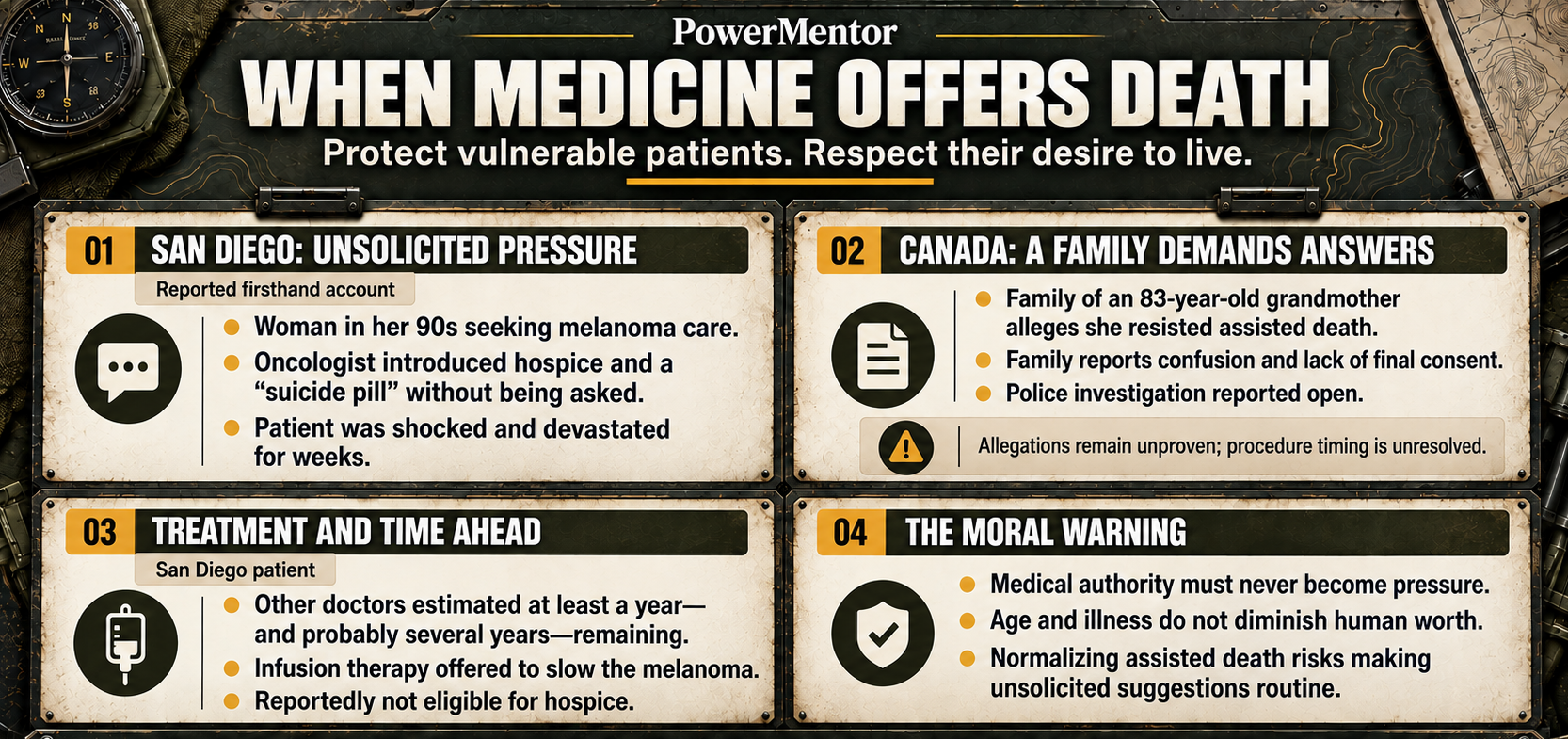
A woman in her 90s sought care for melanoma in San Diego. During her initial oncology encounter, she received an unsolicited discussion of hospice and medication to end her life. Other physicians subsequently offered a substantially different outlook: at least a year and probably several years of life remaining, with infusion therapy available to slow the disease.
The encounter raises a serious moral concern about the normalization of medically assisted death and the influence physicians hold over vulnerable patients. Someone seeking treatment should never feel pressured to consider ending their life.
PowerMentor opposes euthanasia and medically assisted death on moral grounds. Human worth does not diminish with age, illness, or dependence. Presenting death in comforting language does not make pressure toward that outcome acceptable.
An Unsolicited Discussion That Left a Patient Devastated
A friend of a patient accompanied her to an oncology appointment. The initial oncologist raised the possibility of getting her into hospice soon, making her comfortable, and that another option was to provide what was described as a suicide pill so she would feel nothing and simply go to sleep. This account paraphrases the conversation rather than reproducing a recorded quotation.
The patient had not requested information about medically assisted death. She was shocked, stunned, and devastated. The emotional impact lasted for weeks.
The patient was not even hospice eligible, which requires less than six months of life based on the expertise of the treating physician. Subsequent physicians described her melanoma as very small and explained that they were confident that with some treatment, they could even slow the melanoma growth. They were surprised to hear the patient share what the initial oncologist shared with her about hospice and the suicide pill, stating she could very easily have several years of life remaining. Another physician offered infusion therapy intended to slow its progression.
Medicare hospice eligibility requires physician certification of a terminal prognosis of six months or less if the illness runs its normal course. Advanced age and a cancer diagnosis do not independently establish eligibility.
The account describes an encounter the patient experienced that is troubling for many. The conduct described by the patient was inappropriate: a woman seeking cancer care was confronted with an unsolicited discussion of ending her life while treatment possibilities and meaningful time remained ahead.
A Second Opinion Restored a Sense of Possibility
The subsequent medical opinion changed the patient’s understanding of her future. Another physician explained that treatment could slow the disease and that she could have years remaining. After weeks of distress, she received information that gave her a reason to look forward.
That difference underscores the responsibility physicians carry when discussing a serious diagnosis. Patients need an accurate explanation of their condition, available treatment, and likely course. They also need clinicians to communicate uncertainty carefully and avoid prematurely narrowing their future to hospice and death.
A patient in her 90s still has relationships, preferences, goals, and experiences that matter. Age does not make those remaining years disposable. It does not lessen the obligation to assess the individual carefully or respect a desire to continue living.
A Canadian Family’s Allegations Raise Further Concerns
A September 22 report from The Christian Post describes allegations surrounding the death of Brigitte Stegemann, an 83-year-old Ontario grandmother with stomach cancer. Her granddaughter alleges that Stegemann resisted medical assistance in dying, displayed confusion during assessments, and did not consent on the morning of her death.
According to the report, Belleville Police confirmed an open investigation, while the care home and practitioners had not commented publicly. The precise timing of her death relative to the proposed procedure also remains unresolved in the account. These allegations require investigation and have not been established as findings of wrongdoing.
The Canadian allegations and the San Diego encounter involve different circumstances. Both nevertheless bring attention to the protection of vulnerable patients when medical professionals introduce or pursue an intervention intended to end life. A patient’s objections, distress, or confusion must receive serious attention. Their wishes must never become obstacles to overcome.
The Slippery Slope Begins with Normalization
The concern extends beyond whether consent forms are signed or procedural requirements are met. It concerns what healthcare comes to accept as an appropriate response to illness and suffering.
Once intentionally ending life becomes an accepted medical service, the discussion shifts toward who qualifies, when the option should be introduced, and how it should be presented. The risk is that growing acceptance makes unsolicited suggestions appear routine—even when a patient wants treatment.
Canada’s official guidance states that a terminal condition is not always required for medical assistance in dying. Its framework permits both clinician-administered and self-administered death. California’s framework differs: qualifying patients must have a terminal illness expected to cause death within six months, meet additional requirements, and self-administer the medication.
These legal distinctions matter, but they do not resolve PowerMentor’s moral objection. Legal permission does not establish that a practice is morally appropriate. Nor can a completed checklist erase the influence that clinical conversations may exert on a frightened patient.
The San Diego account illustrates why scrutiny must begin before any prescription is written. Harm can begin with the suggestion itself.
Medical Authority Can Become Pressure
Patients facing cancer often depend heavily on their physicians to interpret unfamiliar information and explain what comes next. That dependence gives a physician’s words exceptional weight.
A discussion framed as an option may be understood as a recommendation. An unsolicited suggestion about ending life may leave a patient believing that treatment is futile, that their remaining time has little value, or that their doctor has already given up.
Describing life-ending medication as a way to feel nothing and simply go to sleep can also obscure the seriousness of what is being proposed. The intended outcome remains death, regardless of how reassuring the description sounds.
Pressure does not require an explicit threat. It can arise through framing, repetition, premature conclusions, or assumptions about what makes life worth living. Healthcare professionals must recognize that influence and exercise corresponding restraint. A patient should never have to defend the value of their continued existence in an examination room.
Compassion Requires Care and Accountability
Opposition to euthanasia and medically assisted death carries a responsibility to take suffering seriously. Patients deserve appropriate treatment, symptom relief, emotional support, and practical assistance. Families deserve help managing the demands of caregiving. Continued care must never depend on whether a patient accepts a clinician’s view of how their life should end.
Hospice serves an important purpose for patients who qualify and choose that approach. It should not be presented as an inevitable destination because someone is elderly. Providing comfort during a natural death is morally distinct from deliberately causing death.
Healthcare organizations should establish clear expectations against pressuring patients toward medically assisted death. Complaints deserve meaningful review, and older adults deserve individualized assessments that consider their condition, treatment possibilities, and personal goals. Patients should be able to seek another opinion and raise concerns without fear that their care will suffer.
A Patient’s Remaining Years Matter
The San Diego patient sought help with melanoma. According to the account provided, she was not hospice eligible, had treatment available, and was subsequently told she could probably have several years ahead. An unsolicited discussion of hospice and life-ending medication left her devastated when she needed informed guidance and support.
Her experience demonstrates the human consequences of introducing death prematurely into a conversation about care. The emotional harm occurred long before any question of a prescription or formal consent.
Euthanasia and medically assisted death should not become accepted answers to human vulnerability, and no patient should be pressured to consider them. Age does not diminish human worth. Illness does not erase a person’s right to be valued. The responsibility to care becomes more urgent when someone is frightened, dependent, and looking to a medical professional for help.
