

The Western Hemisphere's New Terrorism Map: 25 Organizations Now in the Crosshairs
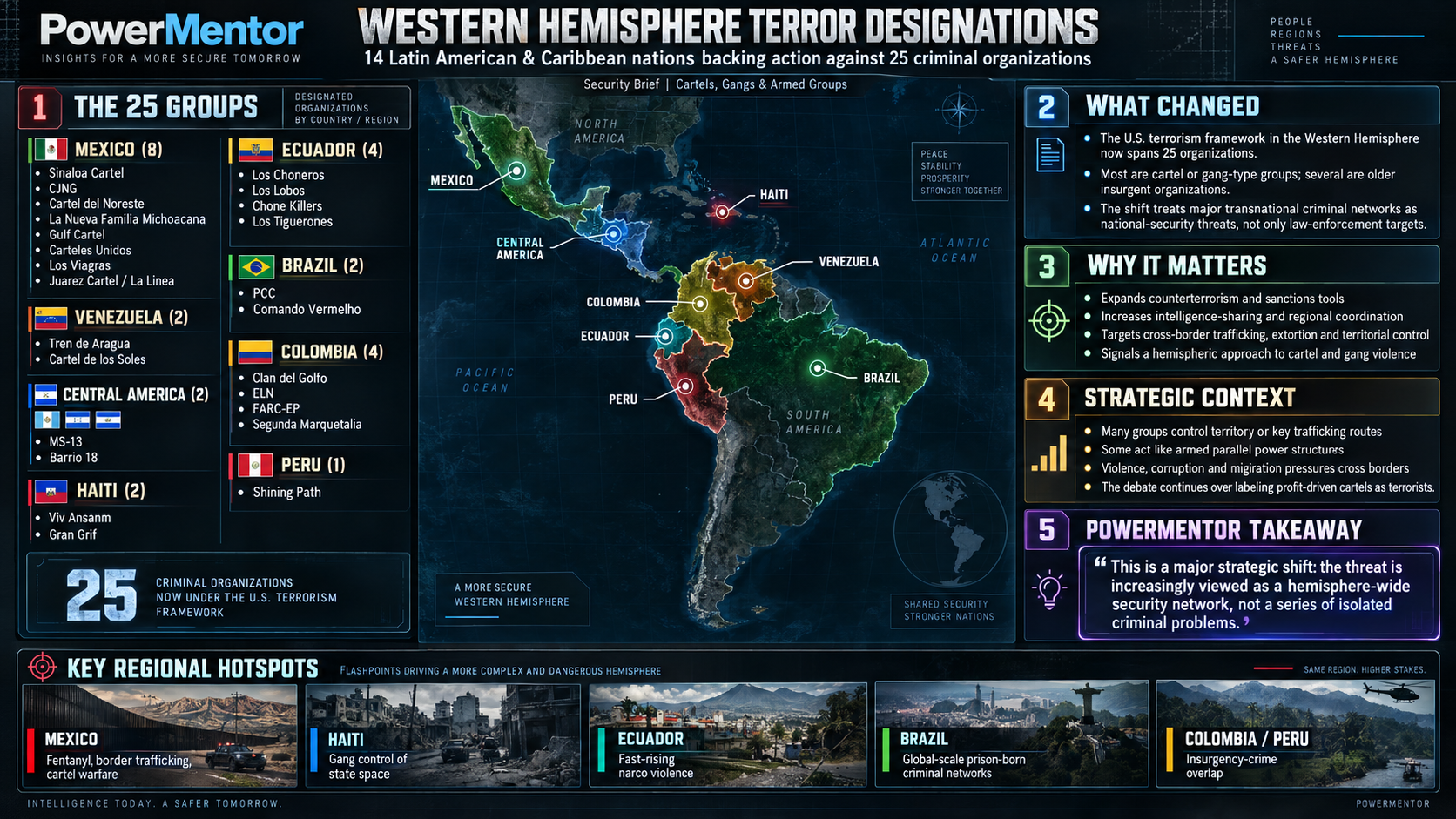
A major shift is taking place in how the United States and its regional partners view organized crime in the Western Hemisphere. Instead of treating powerful cartels and gangs primarily as law-enforcement problems, Washington is increasingly applying the legal and strategic framework traditionally used against terrorist organizations. The emerging picture encompasses 25 organizations operating across Mexico, Central America, the Caribbean and South America, ranging from fentanyl-trafficking cartels and prison-born gangs to longstanding Marxist insurgencies.
This does not mean all 25 organizations were suddenly designated at the same time. Several, including Colombia’s National Liberation Army and Peru’s Shining Path, have been on the U.S. Foreign Terrorist Organization list for decades. What has changed dramatically since 2025 is the addition of cartel and gang organizations whose primary motivation is generally profit rather than political ideology. The result is a much broader Western Hemisphere counterterrorism framework in which transnational criminal organizations are increasingly viewed as threats to national security rather than simply criminal enterprises.
A New Definition of the Threat
The reasoning behind this shift is relatively straightforward. Some of the hemisphere’s largest criminal organizations now possess capabilities once associated primarily with insurgent movements. They control territory, operate heavily armed units, intimidate civilian populations, assassinate public officials and law-enforcement personnel, corrupt government institutions, manage international trafficking routes and move billions of dollars through sophisticated financial networks.
In parts of Mexico, Haiti, Ecuador, Colombia and Brazil, criminal organizations can exert authority over communities where the state’s presence is limited or contested. That creates something approaching a parallel power structure: government institutions formally control the territory, but armed organizations can determine who enters, who conducts business and sometimes even whether police or government officials can operate safely.
That is the strategic argument behind moving these organizations from a conventional organized-crime framework toward a counterterrorism framework.
Mexico Remains the Center of Gravity
Mexico represents the largest concentration of organizations within this framework. Eight groups are associated primarily with Mexico: the Sinaloa Cartel, Cártel Jalisco Nueva Generación (CJNG), Cártel del Noreste, La Nueva Familia Michoacana, Gulf Cartel, Carteles Unidos, Los Viagras and the Juárez Cartel/La Línea.
The Sinaloa Cartel and CJNG are particularly significant because of their extensive international trafficking networks and their role in moving fentanyl, methamphetamine, cocaine and other narcotics toward the United States. Several of the other organizations are involved in territorial warfare, extortion, human smuggling and control of strategically important trafficking corridors.
What happens inside Mexico therefore has consequences far beyond Mexico. Drugs move north. Weapons and money flow across borders. Criminal networks operate throughout the United States and connect with suppliers, brokers and laundering networks around the world.
The Threat Is No Longer Limited to Mexico
The wider list demonstrates why viewing the issue purely as a U.S.-Mexico drug problem is increasingly inadequate.
Venezuela is associated with Tren de Aragua and the U.S.-designated Cártel de los Soles. Tren de Aragua originated within Venezuela’s prison system before expanding into multiple countries as Venezuelan migration increased throughout the hemisphere. The U.S. government uses the Cártel de los Soles designation for a narcotics network it says is connected to Venezuelan political and military figures; the Venezuelan government disputes U.S. allegations concerning the organization.
Central America remains heavily affected by MS-13 and Barrio 18, two organizations with an unusual history because both developed significant roots in Los Angeles before deportation and migration contributed to their expansion into El Salvador and neighboring countries. Their activities have included extortion, murder, narcotics trafficking and control of neighborhoods and transportation corridors.
In Haiti, Viv Ansanm and Gran Grif illustrate perhaps the most dangerous evolution of criminal power: gangs becoming strong enough to undermine the functioning of the state itself. Armed groups have controlled important territory, attacked government institutions and infrastructure, and restricted freedom of movement in and around Port-au-Prince and other regions.
Ecuador Shows How Quickly the Environment Can Change
Ecuador may be one of the clearest examples of how international narcotics trafficking can transform a country's security environment. Four Ecuadorian organizations are included in the current framework: Los Choneros, Los Lobos, Chone Killers and Los Tiguerones. Treasury formally identified Los Tiguerones as an FTO and Specially Designated Global Terrorist organization on September 9, 2026.
Ecuador sits between Colombia and Peru, two major cocaine-producing countries, while its Pacific ports offer access to maritime routes leading toward North America, Europe and other global markets. As international trafficking organizations increasingly used Ecuadorian territory and ports, local criminal organizations became more powerful and violent. Prison violence, assassinations, bombings and territorial warfare followed.
Ecuador demonstrates an important strategic lesson: countries do not need to produce large quantities of narcotics themselves to become critical components of the international drug economy. Geography, ports and transportation infrastructure can make them strategically valuable to criminal networks.
Brazil’s Criminal Networks Have Become Global Organizations
Brazil adds another dimension. Primeiro Comando da Capital (PCC) and Comando Vermelho evolved from criminal organizations deeply connected to Brazil’s prison and urban environments, but their influence now extends far beyond those origins.
The U.S. Treasury Department describes PCC as the largest transnational criminal organization in the Western Hemisphere, with operations and networks extending well outside South America. Treasury reported in July 2026 that PCC-linked operatives and laundering networks have reached the United States, Europe and Asia.
This is precisely why the terminology “street gang” becomes increasingly inadequate. An organization capable of moving narcotics across continents, laundering money through international businesses and maintaining armed territorial networks is operating at a scale closer to a multinational illicit enterprise than a conventional gang.
Colombia and Peru Show the Older Terrorism Model
Colombia and Peru provide an important contrast because several organizations there fit the more traditional definition of terrorism and insurgency.
Colombia’s ELN, FARC-EP and Segunda Marquetalia developed from politically motivated armed movements, although narcotics trafficking and other illicit activities have become important sources of financing. The Clan del Golfo, by comparison, more closely resembles the newer model of an armed criminal organization built around trafficking, territorial control and illicit revenue.
Peru’s Shining Path, or Sendero Luminoso, represents the classic ideological terrorist organization. The Maoist movement launched an insurgency beginning in 1980 that contributed to a conflict in which tens of thousands of Peruvians died. Although dramatically weakened, remnants have persisted in areas connected with coca production and trafficking.
The inclusion of both ideological insurgencies and profit-driven criminal networks under the same broader terrorism framework represents one of the most consequential aspects of the current strategy.
Why the Terrorism Designation Matters
The terminology carries real legal consequences. Foreign Terrorist Organization and related sanctions designations can expose supporters, financiers and facilitators to criminal prosecution and financial penalties. Assets can be blocked, transactions prohibited and immigration restrictions imposed. Financial institutions and companies that unknowingly interact with designated networks may face significantly greater compliance risks.
The strategic consequence may be even larger. Once a government identifies an organization as a national-security threat rather than solely a criminal enterprise, intelligence services, counterterrorism agencies, financial investigators and other security institutions can become much more deeply involved.
The mission changes from simply arresting traffickers to dismantling networks.
That means targeting leadership, financial infrastructure, transportation corridors, communications systems, weapons suppliers, money launderers and international facilitators simultaneously.
A Hemispheric Security Network
This is ultimately what makes the current development significant. The problem itself is transnational. Cocaine may be produced in Colombia or Peru, move through Ecuadorian ports, connect with Mexican trafficking organizations, enter the United States, and generate profits that are laundered through companies or financial systems operating thousands of miles away.
A criminal organization may be headquartered in one country while its money, weapons, narcotics, communications and personnel move through several others.
Individual governments therefore face an inherent disadvantage if they respond independently while the criminal organizations operate internationally. Increased intelligence sharing, financial investigations and coordinated law-enforcement operations are designed to close that gap.
The security concept evolving across the hemisphere is therefore less about one cartel or one country and more about recognizing an interconnected criminal ecosystem.
There Is Still a Legitimate Debate
There is an important legal and strategic debate over whether every powerful criminal organization should be classified as a terrorist organization. Historically, terrorism generally involved violence intended to achieve political, religious or ideological objectives. Most cartels primarily seek profit, control of trafficking markets and protection of their criminal enterprises.
Critics argue that expanding the terrorism framework too broadly risks eroding the distinction between terrorism and organized crime. Supporters of the policy counter that when criminal organizations systematically terrorize populations, control territory, undermine governments and threaten national security, traditional law-enforcement tools alone may be insufficient.
Both issues deserve examination. The terminology matters, but so does the reality that some organizations now possess financial resources, international networks and armed capabilities that rival those of insurgent groups.
The PowerMentor Strategic Takeaway
The most important takeaway is not simply that another cartel has been placed on another government list. The strategic model for confronting organized crime in the Western Hemisphere is changing.
For most of the post-9/11 era, American counterterrorism strategy concentrated overwhelmingly on threats thousands of miles away in Afghanistan, Iraq, Syria and the broader Middle East. Increasingly, attention is shifting toward transnational armed organizations operating much closer to the United States.
The defining security question for the Americas may therefore become whether governments can prevent criminal networks from evolving into durable parallel power structures capable of controlling territory, intimidating populations, corrupting institutions and operating international economies beyond the effective reach of individual states.
That is a much larger challenge than narcotics interdiction.
It is a struggle over whether legitimate governments or transnational armed networks ultimately control the political, economic and security environment of the Western Hemisphere.
PowerMentor | Understand the threat. Understand the environment. Lead with knowledge.
