

Chinese Mercenaries, Junta Bombs, and Burma’s Civilian Victims
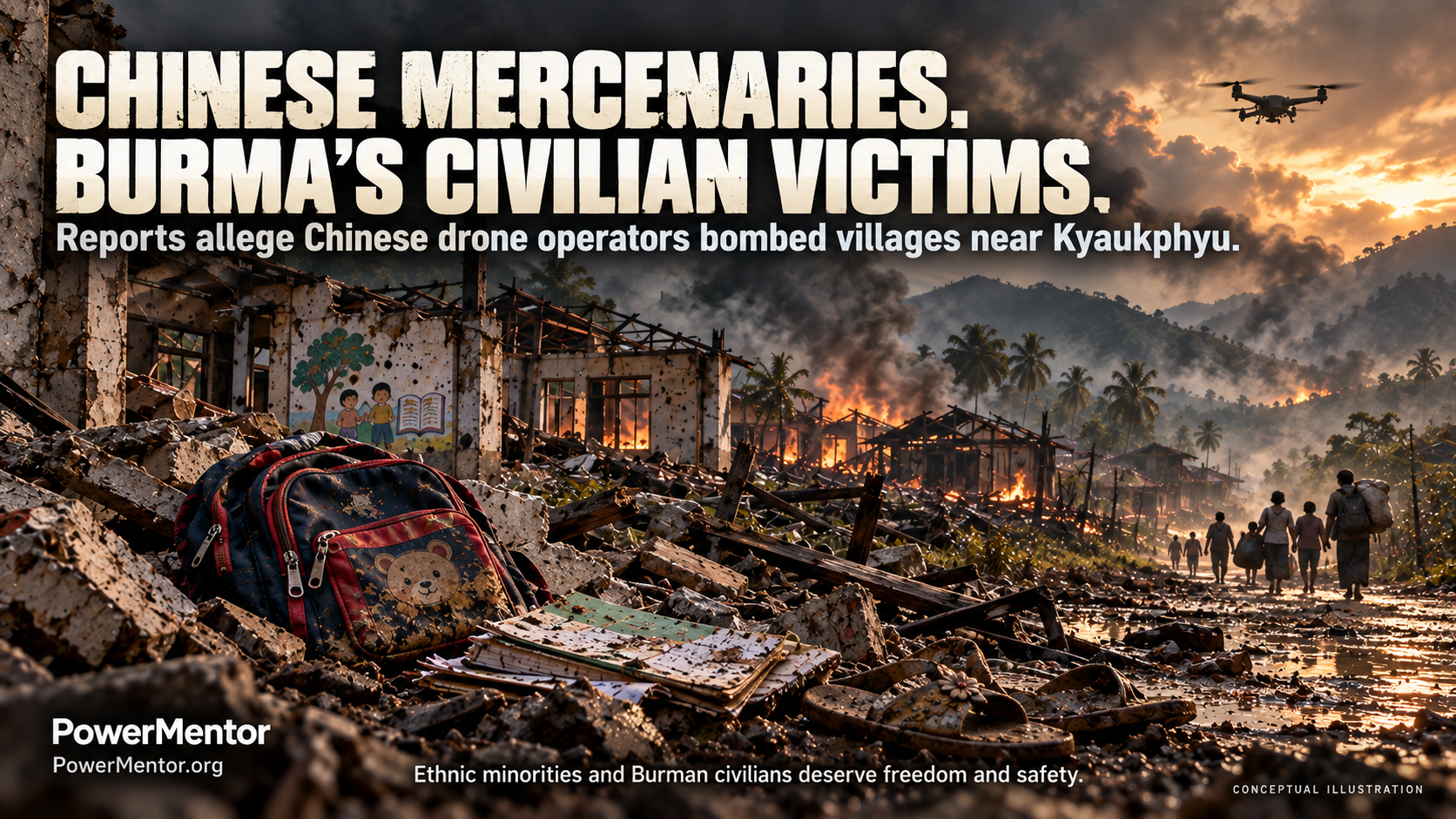
Reports of Chinese personnel bombing villages in Burma demand international scrutiny and accountability. Ethnic ethnic minority communities and Burman civilians are paying for a war sustained by foreign weapons, technical support, and an expanding security presence.
Children, families, and entire communities should be the starting point for this story. Their lives are being shattered while foreign support helps Burma’s military continue its campaign of violence.
There is reporting of direct Chinese participation in fighting—not simply distant arms sales.
On May 28, 2025, Narinjara, in a report carried by Burma News International, cited a military source alleging that approximately 20 Chinese personnel were operating drones alongside junta forces around Kyaukphyu. The source alleged that they were attacking the Arakan Army and bombing surrounding villages. The report also described roughly 50 Chinese mercenaries, including snipers, assigned to military and police positions. Burma News International
These are specific published allegations of combat involvement. They rely on unnamed ground sources and do not independently establish the personnel’s identities or membership in active-duty Chinese special forces. They nevertheless demand serious investigation. Reports of village bombing cannot be answered simply by repeating that Chinese personnel are there to protect investments.
A security contract cannot excuse an attack on civilians. A pipeline cannot justify bombing a village.
Further reporting points to an expanding armed presence. In January 2026, Development Media Group reported hundreds of Chinese security personnel around Kyaukphyu projects, with approximately 200 armed personnel guarding facilities. Local sources described surveillance, trenches, and bunkers. The outlet also acknowledged uncertainty over the personnel’s origins and said it could not independently verify that mercenaries had been hired. Development Media Group
The identities and chains of command must be established. That is a reason to investigate the deployments, not to dismiss their consequences.
The connection between Chinese industry and the junta’s bombing campaign is another major part of the story.
The Special Advisory Council for Myanmar’s July 2025 investigation, Factory of Death, identified support from Chinese state-owned China South Industries Group Corporation, principally through Hunan Vanguard, for aerial-bomb production at Burma’s Defence Industry 21 factory. The council reported that bombs produced there are used in attacks against civilians. Progressive Voice
This connects foreign industrial assistance to the weapons production sustaining the junta’s air war. Scrutiny must extend to the companies, technical services, and supply networks that keep that production operating.
The human consequences are documented. OHCHR’s assessment of 2025 identified the highest civilian death toll from airstrikes it had verified since the 2021 coup and the deadliest year for children since that takeover. bangkok.ohchr.org
The victims are people whose lives have been torn apart: children denied a future, parents grieving their families, and communities forced to abandon their homes.
Karen, Karenni, Kachin, Chin, Shan, Rakhine, Mon, and other ethnic communities deserve safety and self-determination. Burman civilians deserve those same freedoms. The generals must never be confused with the Burman people, many of whom also suffer under military domination.
Their right to live safely does not depend on the value of a nearby port, mine, or pipeline. Foreign investors cannot obtain a community’s consent by signing an agreement with the military ruling over it.
Beijing must answer for the military support it provides. Companies identified in weapons production must face scrutiny. Reports of Chinese drone operators and snipers require independent investigation, including examination of orders, deployment records, command structures, and responsibility for particular attacks.
Governments should stop transfers and services that enable attacks on civilians, enforce applicable restrictions, protect witnesses, and support efforts to hold perpetrators and enablers accountable. Humanitarian assistance must reach communities under attack.
Calling personnel “private security” does not settle what they do. Calling an operation “investment protection” does not establish whom it harms. Those questions must be answered through evidence and accountability.
Burma’s ethnic people are not expendable. No investment is worth their lives, and no foreign-backed armed operation should be allowed to bury their suffering behind corporate language.
