
The Inevitable Reckoning: Junta Charges 22 KNU Officials — and Karma May Finally Be Catching Up
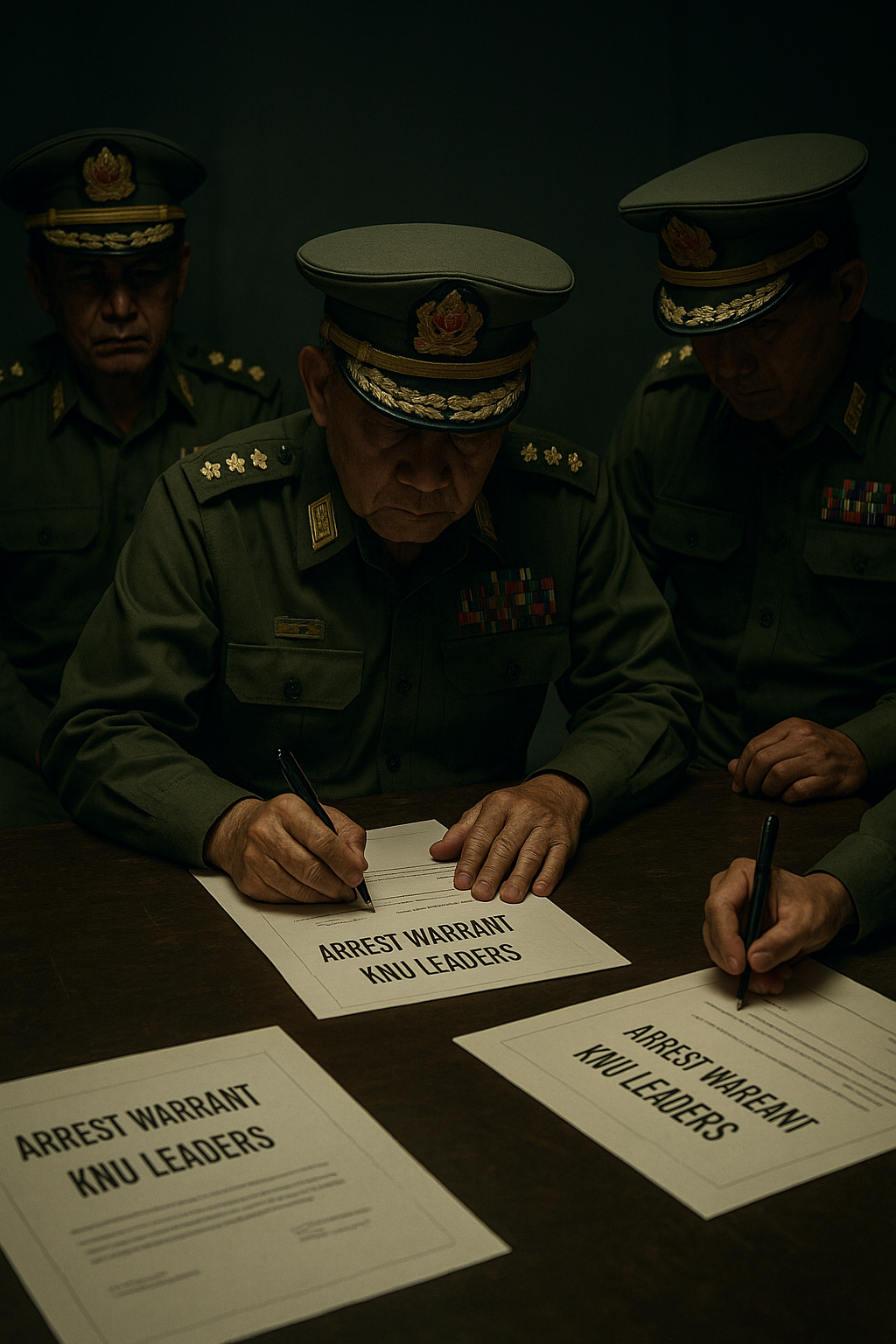
On November 11, 2025, Burma (Myanmar)’s military regime charged 22 officials of the Karen National Union (KNU) under its so-called Election Protection Law.
Among them is Padoh Saw Myint, a Doo Tha Htoo district councillor, along with 21 other local Karen leaders who issued a statement condemning the junta’s upcoming “election” as unlawful and warning political parties that participating would make them accomplices of the military dictatorship.
The junta responded by charging them with “disrupting” the election and spreading “propaganda” under Section 23(b), a clause carrying a sentence of five to ten years in prison.
Just months ago, the junta also filed symbolic charges against KNU Chairman Padoh Saw Kwe Htoo Win and 12 other national-level KNU officials.
This brings the number of people charged under the Election Protection Law to at least 121 individuals, most accused of “criticizing the election” on social media.
On the surface, this looks like another act of dictatorship.
But for the Karen people watching closely, this moment carries a deeper, more painful meaning.
⚡ A Moment the KNU Never Expected: Facing the Consequences of Its Own Divisions
For decades, the Karen National Union held itself up as the guardian of Karen identity, sovereignty, and freedom.
But many Karen—especially on the ground—have watched the KNU slowly transform into something they no longer recognize:
✅ Deep internal corruption
✅ Secret economic deals with Burmese military-linked business networks
✅ Collaboration with the junta through certain factions
✅ Intentional division of Karen armed forces
✅ Suppression of emerging Karen leadership outside KNU control
✅ Obstruction of the KTLA and dividing the other forces who refuse to bow to the Burmese generals
The organization that once claimed to fight for Karen freedom became the largest obstacle to Karen unity.
Many Karen elders have said openly:
“The KNU became the very thing we were fighting against.”
So when the junta turns its attention toward charging KNU officials, the reaction among many Karen is complicated.
There is anger at the junta, of course.
But beneath that is another sentiment:
Is this karma?
For years, KNU leaders mocked and undermined Karen unity groups, made secret deals, and allowed the Karen people to fracture under their watch.
They believed they were untouchable—shielded by their name, history, and international legitimacy.
But corruption always returns to the doorstep of those who enable it.
The KNU’s Hand in Dividing the Karen People
The junta’s charges expose something the KNU never intended for the world to see—its own vulnerability, caused not by outside attack but by internal decay.
1. The KNU Leadership Crisis
Infighting between the political wing and military wing (especially the old guard of the KNLA) has crippled effective governance.
2. Collaboration with Burmese Interests
Certain KNU leaders have been documented making deals that benefit the junta or military-linked business groups, even while Karen civilians suffer.
3. Undermining Karen Unity Initiatives
When Karen reformist leaders, community groups, and new military entities began strengthening, the KNU often responded not with support—but with suppression.
4. Allowing Corruption to Spread in the Districts
Local KNU authorities in several districts have been accused by Karen villagers of extortion, bribe-taking, and selective enforcement of justice.
5. Abandoning the Will of the Karen People
While Karen communities cried out for unity, security, and representation, the KNU’s leadership structure became increasingly disconnected and self-protective.
In Karen culture, there is a belief that those who break trust eventually fall into their own traps.
That belief feels very real today.
Charged by the Junta… but Judged by the People
The junta’s charges against the 22 KNU officials are unjust—no civilian or leader should be prosecuted for speaking truth about a sham election.
But there is an undeniable irony:
The KNU leadership, which spent years policing Karen voices, is now being policed by the very regime it often tolerated or quietly negotiated with.
And the Karen people are watching.
They have suffered displacement, war, extortion, home burnings, and cultural suppression—often while leaders claiming to represent them lived far from danger.
Today, the KNU faces a reckoning not only with the junta… but with history.
A Dangerous Moment — and a Chance for Renewal
These charges highlight a critical truth:
The Karen people no longer need symbolic leaders—they need honest, unified leadership.
The arrest warrants are unjust, but they reveal a deeper moral and political collapse inside the KNU.
And that collapse has opened the door for:
✅ New Karen leadership movements
✅ The KTLA reformists, and pro-unity forces
✅ Civil society groups demanding transparency
✅ Karen youth refusing to accept corruption as normal
✅ The Kawthoolei Government and other emerging structures
If this moment becomes a turning point, then perhaps karma is not just punishment—
Perhaps it is a correction, clearing space for a future where the Karen people finally stand united, sovereign, and unbroken.
Final Thought
As the junta moves to prosecute the 22 KNU officials, the Karen people are not asking only:
“Why is the junta doing this?”
They are also asking:
“Why did the KNU let itself fall this far?”
History will remember both.
