

THE FAILURE OF UNIVERSAL HEALTHCARE: The Promise Is Universal. The Care Is Not.
Universal healthcare is built around an extraordinarily attractive promise: government can guarantee healthcare for everyone, eliminate financial barriers at the point of care, and create a system in which treatment is available based on medical need rather than ability to pay. The promise sounds compassionate, but experience across several countries demonstrates a much more complicated reality. Government can guarantee coverage, but it cannot guarantee healthcare capacity.
Across Canada, the United Kingdom, Australia, New Zealand, and parts of Europe, universal or heavily government-financed healthcare systems have struggled with long specialist waits, delayed elective surgeries, overcrowded emergency departments, workforce shortages, inadequate hospital capacity, and difficulties obtaining primary care. In some countries, people with financial resources purchase private alternatives to escape public queues, while poorer patients have fewer options. The fundamental mistake is assuming that declaring healthcare universal somehow makes the resources required to provide that healthcare universal as well.
Coverage Is Not the Same as Care
The success of a healthcare system should never be measured simply by how many people possess coverage. A patient does not need theoretical access to healthcare; a patient needs actual access to a healthcare professional. Someone experiencing severe pain does not benefit simply from knowing that surgery will eventually be provided. A frightened parent needs a clinician who can evaluate a sick child, and a patient with a potentially serious condition needs timely diagnostic testing and specialist consultation.
Healthcare policy therefore has to distinguish between coverage and capacity. A government can change eligibility rules almost instantly, but it cannot instantly produce physicians, nurses, specialists, operating rooms, hospital beds, laboratories, medications, MRI machines, or additional hours in a clinician's day. When demand exceeds those finite resources, healthcare must still be allocated somehow. In many universal systems, waiting becomes one of the primary mechanisms through which scarcity is managed.
Canada: Universal Coverage Without Universal Access
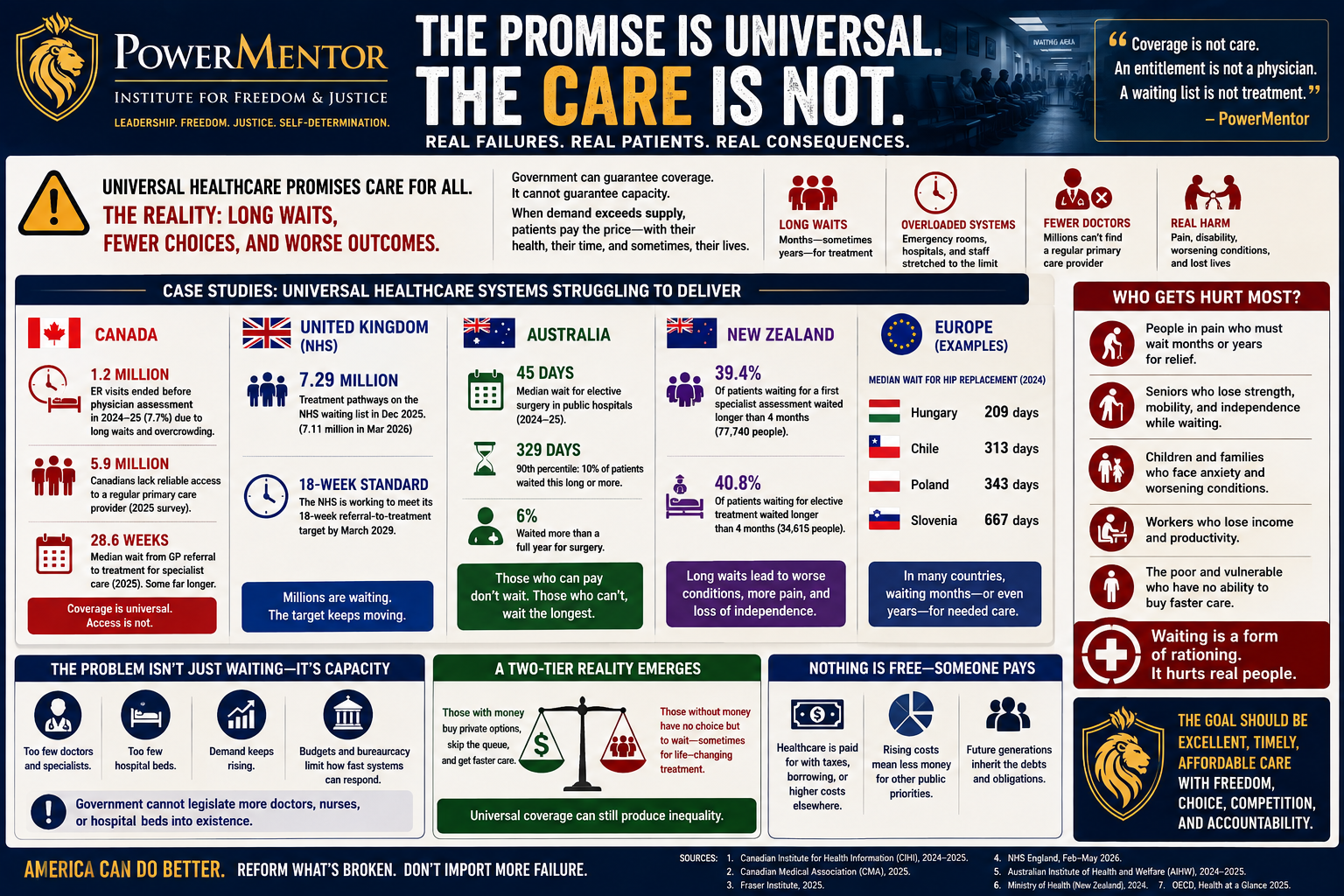
Canada is frequently presented to Americans as an example of what universal healthcare could accomplish, yet Canada's own healthcare data reveal serious access problems. The Canadian Institute for Health Information reported approximately 16.1 million unscheduled emergency-department visits during 2024–2025, with approximately 1.2 million visits—7.7%—ending before the patient was assessed by a physician. CIHI identifies long waits and overcrowding among the likely reasons patients leave without being seen.
Primary care presents another major challenge. A 2025 national survey conducted in partnership with the Canadian Medical Association estimated that approximately 5.9 million Canadian adults lacked reliable access to a regular family doctor, nurse practitioner, or primary-care team. These individuals live inside a healthcare system specifically designed to provide universal coverage, yet millions still struggle to obtain one of the most basic elements of healthcare: a regular primary-care provider.
Canada therefore illustrates an essential distinction that American policymakers should understand. Universal insurance does not necessarily create universal healthcare access. A person can technically possess comprehensive healthcare coverage while still being unable to find a physician or receive treatment within a clinically desirable period.
Canada's Specialist Waiting Problem
The problem does not end when a Canadian patient finally obtains primary care. Patients requiring specialists can encounter another bottleneck. The Fraser Institute's 2025 physician survey estimated a median wait of approximately 28.6 weeks from referral by a general practitioner to treatment across the specialties surveyed. That estimate consisted of approximately 15.3 weeks between GP referral and specialist consultation, followed by another 13.3 weeks between specialist consultation and treatment.
The Fraser Institute approaches healthcare policy from a market-oriented perspective, so its estimates should appropriately be considered alongside government and professional healthcare data. Nevertheless, the larger Canadian access problem is independently recognized by Canadian healthcare organizations. For a patient living with pain, declining mobility, progressive illness, or an inability to work, six months is not merely an administrative statistic. Waiting time becomes part of the patient's healthcare outcome.
United Kingdom: Millions Waiting Inside the NHS
Britain's National Health Service demonstrates what can happen when government assumes enormous responsibility for financing and delivering healthcare while available capacity struggles to meet demand. NHS England reported approximately 7.29 million treatment pathways on its waiting list in December 2025. By March 2026, the number had declined to approximately 7.11 million, representing meaningful improvement but still leaving an enormous backlog.
The NHS has established plans intended to restore its 18-week referral-to-treatment standard by March 2029. This should not be interpreted as a failure of British doctors, nurses, or other healthcare workers, many of whom work under extraordinary pressure. It instead demonstrates a structural reality that applies to every healthcare system: government cannot make demand and capacity equal simply by guaranteeing the service. When available clinicians, facilities, and treatment capacity cannot meet demand, patients wait.
Australia: The Public Queue and the Private Alternative
Australia is particularly revealing because its universal Medicare system exists alongside a significant private healthcare sector. Australian government data for 2024–2025 reported a median elective-surgery waiting time in public hospitals of approximately 45 days. However, the median obscures the experience of patients at the far end of the distribution. Ten percent of patients waited approximately 329 days or longer, while about 6% waited longer than an entire year for elective surgery.
A year can represent an enormous portion of someone's life when that person is living with impaired mobility, chronic pain, deteriorating vision, or another condition requiring surgery. An elderly patient can lose substantial strength and independence during that period, while a working-age patient may experience months of reduced productivity or inability to work.
Australian data also expose an uncomfortable contradiction within universal healthcare. Publicly funded patients experienced a median elective-surgery wait of approximately 53 days compared with 28 days for privately insured patients across the reported categories. When public capacity becomes congested, people with sufficient resources can purchase alternatives, while people without those resources remain dependent upon the queue. The inequality has not disappeared; it has simply changed form.
New Zealand: When Waiting Becomes a Healthcare Outcome
New Zealand's Ministry of Health reported that at the end of 2024 approximately 40.6% of patients awaiting a first specialist assessment had waited longer than four months, representing roughly 77,740 people. Among patients awaiting elective treatment, approximately 40.8% had waited longer than four months, representing another 34,615 patients.
New Zealand's government has itself acknowledged that prolonged waiting can contribute to worsening medical conditions, avoidable suffering, reduced independence, and poorer quality of life. This is a crucial point because discussions of universal healthcare frequently treat waiting lists as administrative inconveniences rather than potential clinical consequences. A four-month delay experienced by a sick patient is not simply a scheduling problem. Time itself can influence health, function, pain, and quality of life.
Europe: Universal Does Not Mean Timely
International OECD comparisons reveal that lengthy waiting periods are not confined to Canada or the English-speaking universal systems. For hip replacement surgery in 2024, reported median waiting times included approximately 209 days in Hungary, 313 days in Chile, 343 days in Poland, and 667 days in Slovenia. The OECD has specifically recognized that excessive healthcare waits can prolong pain and disability and potentially contribute to poorer health outcomes.
These figures challenge the simplistic assumption that once government guarantees healthcare, the access problem has been solved. The financing mechanism may change, but scarcity does not disappear. Patients still compete for a finite supply of specialists, hospital beds, operating rooms, nurses, diagnostic equipment, and treatment capacity.
Waiting Is Rationing by Another Name
Every healthcare system must confront scarcity because healthcare resources are finite while potential demand is enormous. Universal healthcare does not eliminate rationing; it changes how rationing occurs. When price at the point of care is substantially removed, systems increasingly rely upon other mechanisms such as waiting lists, referral requirements, clinical prioritization, budget restrictions, treatment thresholds, and provider availability.
This creates an important difference between the political promise and the operational reality. The political promise says that everyone receives healthcare. The operational reality may be that everyone qualifies for healthcare, but not necessarily when they need it. That distinction becomes enormously important when someone is experiencing severe pain, losing mobility, unable to work, or waiting to determine whether a serious medical condition is progressing.
The Human Cost Hidden Behind Waiting Lists
Healthcare statistics can make human suffering sound abstract. A waiting list of several million people becomes another number in a government report, but every position in that queue represents a person. Someone is struggling to walk while waiting for a hip replacement. Someone's vision is deteriorating while waiting for cataract surgery. Someone is living with chronic pain while awaiting specialist care. Someone cannot find a regular family physician, while another patient eventually leaves an emergency department because the wait becomes intolerable.
Waiting time should therefore be treated as a healthcare outcome, not merely an operational metric. A system should not simply measure whether a patient eventually received treatment. It should also consider what happened to that patient's pain, mobility, employment, independence, disease progression, and quality of life during the waiting period.
Universal Healthcare Can Still Create a Two-Tier System
One of the great ironies of universal healthcare emerges when the public system becomes unable to meet demand. People with financial resources begin purchasing alternatives through private insurance, private physicians, private hospitals, or medical travel. Australia clearly demonstrates differences between publicly funded and privately insured surgical patients, while the United Kingdom also maintains a private healthcare sector alongside the NHS.
This can produce exactly the type of inequality universal healthcare was intended to eliminate. Everyone may receive the same government healthcare promise, but people with money can sometimes purchase faster access while people without money remain dependent upon the public queue. The question changes from "Can I afford healthcare?" to "Can I afford to avoid waiting for healthcare?"
The Poor and Vulnerable Are Still Be Left Behind
Universal healthcare is often justified primarily as protection for vulnerable populations, yet socioeconomic disparities do not disappear simply because coverage becomes universal. OECD data from 28 countries in 2024 found that people in the lowest-income group were approximately 2.5 times more likely than people in the highest-income group to report unmet medical needs.
People with greater financial resources generally possess more alternatives when a healthcare system becomes congested. They can purchase private insurance, pay directly for treatment, travel to another region or country, or seek alternative providers. A low-income family, elderly patient, or person with significant disability may have far fewer options. When a public healthcare system tells a wealthy person to wait, that individual may be able to leave the queue. When it tells a poor person to wait, waiting may be the only choice.
Government Cannot Legislate Healthcare Capacity Into Existence
Perhaps the greatest weakness in the universal-healthcare promise is the assumption that government can solve access primarily through legislation and financing. Healthcare is not created by an entitlement. Healthcare is produced by physicians, nurses, pharmacists, dentists, therapists, technicians, hospitals, clinics, operating rooms, laboratories, pharmaceutical manufacturers, medical technology, infrastructure, investment, and innovation.
Government can pass legislation expanding eligibility far more rapidly than a nation can train additional physicians or construct additional hospitals. Expanding entitlement without proportionately expanding supply creates a predictable imbalance: more demand competing for limited capacity. That pressure ultimately appears somewhere in the healthcare system, whether through crowded emergency departments, difficulty finding primary care, delayed specialist appointments, or surgical waiting lists.
"Free Healthcare" Is Not Free
Describing universal healthcare as "free healthcare" further obscures the economic reality. Doctors and nurses still receive compensation, hospitals require enormous capital investment, pharmaceuticals must be manufactured, diagnostic equipment must be purchased, and healthcare infrastructure must be maintained. These expenses are financed through taxation, government borrowing, premiums, patient payments, or some combination of those mechanisms.
The relevant debate therefore is not whether healthcare should cost money—it inevitably does. The question is which financing and delivery structure creates the strongest combination of affordability, timely access, quality, innovation, capacity, accountability, and patient choice. Removing the bill at the point of service does not remove the underlying cost or guarantee that the healthcare resource will be immediately available.
America Should Reform Healthcare Without Importing Other Nations' Failures
The United States has substantial healthcare problems of its own. Healthcare prices can be extraordinarily high, insurance arrangements are often unnecessarily complicated, administrative costs consume tremendous resources, and some Americans delay treatment because of financial barriers. Those weaknesses require serious reform, but the existence of American healthcare problems does not prove that a universal government healthcare system is the appropriate solution. In fact, people from other countries often come to the United States for health care because of the failures of the universal health care in their home country.
America should examine what has occurred elsewhere before dramatically expanding government control over healthcare financing and delivery. Canada's difficulties with emergency and primary care, Britain's enormous NHS backlog, Australia's prolonged elective-surgery waits, New Zealand's specialist queues, and lengthy waits reported in parts of Europe should all be studied carefully. These countries offer valuable real-world evidence of what can happen when political promises expand faster than healthcare capacity.
Build More Healthcare Instead of Simply Promising More Healthcare
A sustainable American healthcare strategy should focus aggressively on expanding the actual supply of healthcare. That means increasing physician and nursing capacity, expanding residency positions, strengthening community health centers, improving primary and behavioral-health infrastructure, encouraging technological innovation, reducing unnecessary administrative burdens, increasing competition, improving price transparency, and preserving meaningful patient choice.
Public resources should protect people who genuinely cannot afford healthcare without requiring government to become the dominant controller of the entire healthcare marketplace. Helping vulnerable people and preserving a competitive healthcare system are not mutually exclusive goals. A strong safety net can coexist with private insurance, independent medical practices, innovation, consumer choice, and competition.
The Naivety Is Believing the Promise Solves the Problem
Wanting every person to have access to excellent healthcare is not naive. It is a worthy objective. The naivety lies in believing that declaring healthcare "universal" somehow makes healthcare universally available. Government cannot repeal scarcity, instantly manufacture clinicians, guarantee unlimited hospital capacity, or ensure that expanding demand will always be matched by expanding supply.
Before embracing universal healthcare, citizens should ask harder questions than whether everyone will receive a healthcare card. How quickly will patients actually see physicians? How long will they wait for specialists and surgery? What happens when hospitals reach capacity? What happens when healthcare budgets cannot keep pace with demand? Can patients seek alternatives? Can they choose another insurer or physician? And, when demand exceeds supply, who will be required to wait?
Those questions move the discussion away from political slogans and toward the actual experience of patients.
The PowerMentor Position: Protect the Patient, Not the System
Healthcare policy should begin with the freedom, dignity, and needs of individual patients rather than the preservation or expansion of government systems. People deserve affordable healthcare, and vulnerable populations deserve meaningful protection, but patients also deserve timely access, choice, competition, innovation, transparency, and accountability.
International experience demonstrates why Americans should be cautious about sweeping promises of universal government healthcare. Coverage is not care. An entitlement is not a physician. A waiting list is not treatment. "Free" healthcare still has a cost, and government cannot legislate away scarcity.
America should reform what is broken without importing failures already visible elsewhere. The objective should not simply be placing a government healthcare card in everyone's wallet. The goal should be access to excellent, timely, affordable healthcare while preserving freedom, choice, competition, innovation, and accountability.
References
Australian Institute of Health and Welfare. (2026). Elective surgery: Waiting times. Australian Government. Australian Institute of Health and Welfare
Australian Institute of Health and Welfare. (2026). Waiting times by patient characteristics. Australian Government. AIHW patient waiting-time data
Canadian Institute for Health Information. (2026, June 25). Emergency department waits reflect access to care across the system. Canadian Institute for Health Information
Canadian Institute for Health Information. (2026, June 25). Wait times reflect patient acuity as complexity increases in EDs. CIHI emergency-department wait-time report
Canadian Medical Association. (2025, December 8). New survey reveals access to primary care growing, but 5.9 million adults in Canada still lack regular doctor. Canadian Medical Association
Moir, M., & Barua, B. (2025). Waiting your turn: Wait times for health care in Canada, 2025 report. Fraser Institute. Fraser Institute report
Ministry of Health. (2025). Health and independence report 2024—Te Pūrongo mō te Hauora me te Tū Motuhake 2024. New Zealand Government. New Zealand Ministry of Health
NHS England. (2026, February 12). NHS waiting list lowest in almost 3 years as NHS battled busiest winter on record. NHS England
NHS England. (2026, May 14). “Huge moment” as the health service hits 18-week target amid half-a-million waiting list drop. NHS England waiting-list update
Organisation for Economic Co-operation and Development. (2025). Health at a glance 2025: OECD indicators. OECD Publishing. https://doi.org/10.1787/8f9e3f98-en
Organisation for Economic Co-operation and Development. (2025). Unmet needs for healthcare. In Health at a glance 2025: OECD indicators. OECD Publishing. OECD unmet healthcare needs data
Organisation for Economic Co-operation and Development. (2025). Waiting times. In Health at a glance 2025: OECD indicators. OECD Publishing. OECD international waiting-time data
