

America Is a Constitutional Republic—Not a Pure Democracy: Why the Difference Matters for Liberty, Rights, and Limited Government
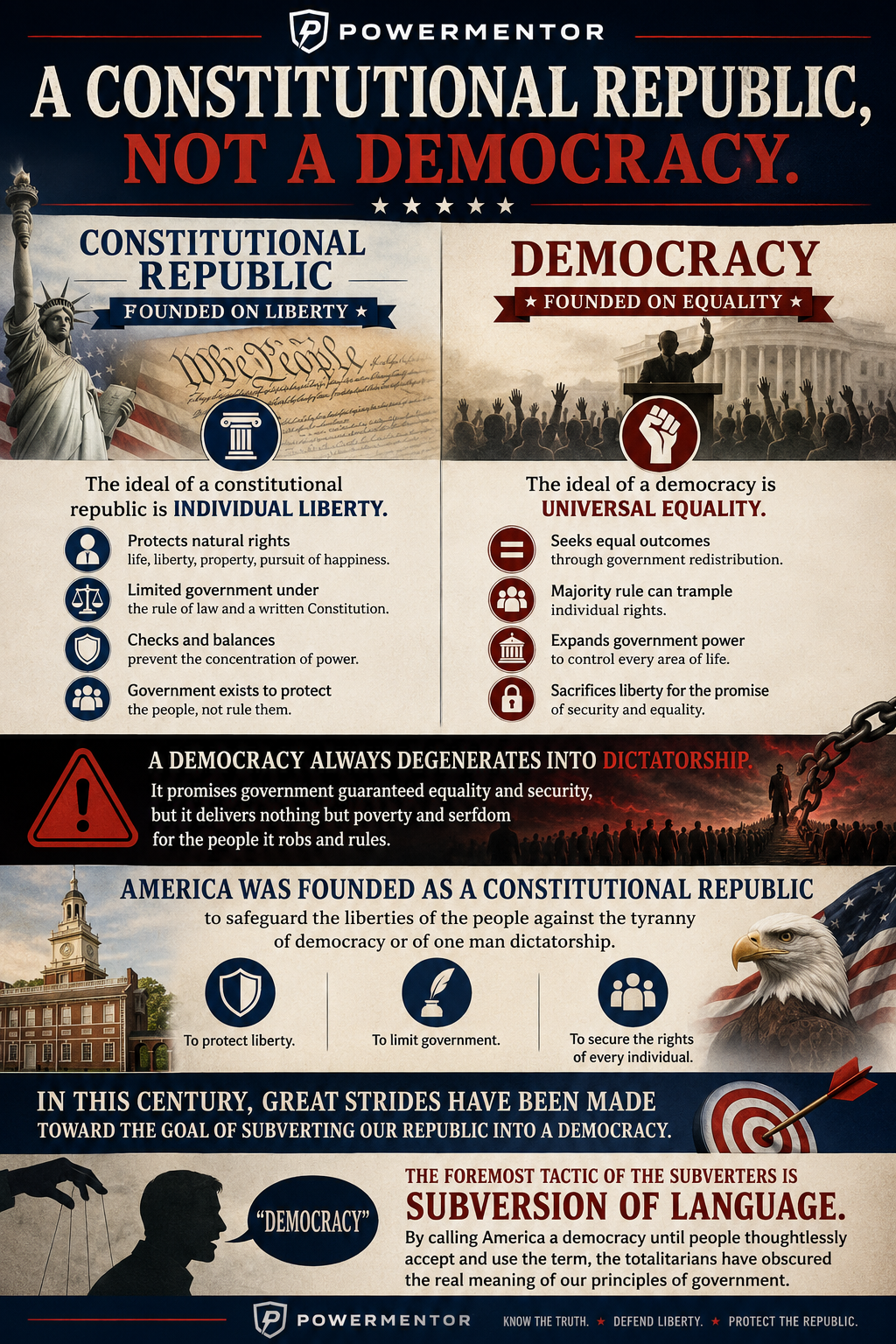
America is frequently described simply as a democracy. While the United States unquestionably uses democratic elections and representative institutions, that description is incomplete. America is more precisely a constitutional federal republic with representative democratic institutions. Citizens elect their leaders, but neither those leaders nor political majorities possess unlimited authority. The Constitution establishes boundaries that government is not supposed to cross, even when crossing them might be politically popular.
That distinction is fundamental to understanding the American system. Democracy provides a mechanism for determining who governs, while constitutional government establishes limits on what those who govern may do. The American experiment combines popular government with constitutional restraint because the Founders understood that political power can become dangerous whether it is concentrated in the hands of one ruler, one political faction, or an unchecked majority.
The Danger of Unrestrained Majority Rule
Democracy rests upon an important principle: legitimate government requires the consent of the governed. But majority rule by itself does not guarantee liberty. A majority is capable of injustice just as an individual ruler is. Fifty-one percent of citizens could theoretically support restricting the speech, religion, property, or freedom of the remaining forty-nine percent. The fact that such an action received majority support would not make it consistent with America's constitutional principles.
This is why elections alone cannot define American liberty. Imagine that a large majority voted to prohibit an unpopular religion, imprison critics of the government, or eliminate due process for an unpopular group. Those actions would remain inconsistent with constitutional protections regardless of their popularity. A ballot box does not transform an infringement of fundamental rights into a legitimate exercise of governmental power.
The constitutional republic therefore establishes a boundary around democratic power. Citizens govern through elected representatives, but constitutional protections are intended to prevent temporary political majorities from exercising unlimited authority over individuals and minorities.
Democracy Determines Who Governs; the Constitution Limits Their Power
The difference can be summarized through two questions. Democracy asks, “Who should govern?” The constitutional republic adds the equally important question, “What is government permitted to do?”
America's answer to the first question is the people, acting primarily through elected representatives. Its answer to the second is that governmental power must remain constrained by constitutional law. Congress cannot legitimately exercise unlimited authority merely because its members were elected. Presidents cannot ignore constitutional limitations because they won an election. Political majorities do not acquire unlimited power merely because their position is popular.
This is the genius of constitutional government. The Constitution does not exist merely to establish government; it exists in significant part to restrain government. The American system recognizes that liberty requires both popular participation and limits on the political power created by that participation.
History's Warning About Liberty and Political Promises
History provides powerful warnings about what happens when societies weaken restraints on government in exchange for promises of security, equality, prosperity, or order. Economic crises, wars, social instability, political polarization, and fear can create conditions in which citizens become increasingly willing to concentrate authority in government. Political leaders may promise that expanded governmental power is necessary to solve problems that ordinary constitutional processes supposedly cannot address.
The pattern deserves serious attention. Government promises security, but obtaining that security may require greater surveillance and control. Political movements promise equality, but enforcing predetermined outcomes may require expanding governmental authority over property and economic activity. Leaders promise order, but maintaining that order may be used to justify restrictions on dissent. Each individual expansion of authority may initially appear reasonable, particularly when citizens are frightened or convinced that extraordinary circumstances demand extraordinary solutions.
Historically democracies inevitably become vulnerable to dictatorship. Democratic institutions alone do not prevent authoritarianism. When constitutional restraints collapse, popular political movements can help concentrate enormous power in government, sometimes with the enthusiastic support of the very citizens who will eventually live under that power.
When Equality Becomes Government Control
Equality is one of the most powerful ideas in the American tradition, but the meaning of equality matters. The Declaration of Independence proclaimed human equality, and later constitutional amendments strengthened the principle of equal citizenship and equal protection under law. Equality before the law is therefore not the enemy of liberty; it is one of liberty's essential foundations.
There is, however, an important distinction between protecting equal rights and guaranteeing equal outcomes. Government can require that the law protect citizens equally, but guaranteeing predetermined economic or social outcomes can require considerably greater governmental control over property, economic decisions, employment, production, and individual choice.
The great political danger arises when promises of equality become justification for concentrating power without meaningful limits. The catastrophic communist experiments of the twentieth century provide extreme examples. Governments claiming to liberate workers and eliminate economic exploitation instead produced, in various countries and periods, political repression, confiscation of property, forced labor, economic devastation, famine, imprisonment, and mass killing. The Soviet Union, Maoist China, and Cambodia under the Khmer Rouge differed considerably in their histories, but each demonstrates how promises of revolutionary equality can coexist with extraordinary concentrations of governmental power.
The lesson is not that every policy intended to reduce inequality leads to dictatorship. That would be historically unsupportable. The lesson is that when government claims increasingly unlimited authority to guarantee outcomes, citizens should ask what individual freedoms must be surrendered to give government the power necessary to enforce those guarantees.
The Promise of Security Can Be Equally Dangerous
Security presents a similar temptation. Government has a legitimate responsibility to protect its citizens, enforce laws, defend the country, and maintain public order. Yet history also demonstrates how fear can become one of the most effective justifications for expanding governmental authority.
During periods of crisis, citizens may tolerate surveillance, restrictions on speech, weakened due process, expanded executive authority, or other extraordinary governmental powers because they are promised greater security. Emergency powers established as temporary measures can become increasingly normalized. The danger begins when citizens stop asking whether meaningful constitutional limits remain.
A constitutional republic recognizes that both liberty and security matter. The challenge is protecting citizens without granting government such extensive authority that the institution created to provide security eventually becomes a threat to freedom itself. Security without meaningful restraints on governmental power can become another form of servitude.
Tyranny Does Not Always Arrive Through Revolution
Americans often imagine dictatorship arriving through a dramatic military coup or violent revolution. History shows that authoritarianism can also emerge incrementally. Political leaders may initially be popular. Citizens may willingly support extraordinary powers. Legislatures may weaken institutional checks. Independent courts, journalists, civic organizations, or political opposition may gradually be portrayed as obstacles preventing the government from accomplishing the people's will.
This creates one of the great paradoxes of political history: people can participate democratically in weakening the institutions that protect their democracy and liberty. Elections may continue even while the institutional restraints surrounding them deteriorate. Political popularity and authoritarian tendencies are therefore not mutually exclusive.
This is precisely why the American constitutional system does not rely solely upon electing virtuous leaders. It attempts to create structural barriers against the concentration of power regardless of who holds office.
The Founders Designed a System That Distrusted Concentrated Power
The architects of the Constitution had experienced monarchy, but their solution was not simply to transfer unlimited power from a king to a political majority. They constructed a system designed to divide and restrain governmental authority.
Power was separated among legislative, executive, and judicial branches. Congress itself was divided between the House and Senate. Federalism divided authority between the national government and the states. Presidents were given significant authority but could not independently legislate. Courts became an institutional check on governmental action. The Constitution established governmental powers and limitations, while the Bill of Rights expressly protected fundamental liberties.
James Madison's discussion of factions in Federalist No. 10 demonstrates that the Founders understood the potential danger of political groups acting against the rights of others. Their answer was not abandoning popular government but creating a large representative republic with competing institutions and constitutional restraints capable of making the concentration of political power more difficult.
What sometimes appears to be governmental inefficiency is therefore partly intentional. A government that cannot easily concentrate power also cannot easily use concentrated power against its citizens.
The Constitution Protects Individuals From Both Rulers and Majorities
One of the most important features of America's constitutional republic is that fundamental rights are not supposed to depend entirely upon political popularity. Freedom of speech matters most when someone says something unpopular. Religious liberty matters most when a religious minority practices beliefs rejected by the majority. Due process matters most when an accused person is hated by the public.
This means constitutional protections must sometimes frustrate majority preferences. That frustration is not necessarily evidence that the system has failed. In many circumstances, it demonstrates that the constitutional system is performing precisely the function for which it was designed.
Rights that exist only when the majority approves of them are not truly rights. They are permissions granted by the majority, and permissions can be withdrawn whenever political opinion changes. Constitutional rights are intended to provide something stronger.
The Most Important Test for Government Power
Citizens can apply a simple test whenever politicians propose expanding governmental authority: Would you willingly give exactly the same power to the political leader you distrust most?
That question removes partisan convenience from the equation. A person may enthusiastically support executive authority when a favored president occupies the White House and suddenly rediscover constitutional restraint when the opposing party wins. The same phenomenon occurs across the political spectrum.
Constitutional principles cannot operate that way. Presidents change, congressional majorities change, judges change, and political movements rise and fall. Powers created by one administration can be inherited by the next. The purpose of limited government is therefore not simply to restrain politicians we distrust; it is to restrain politicians we trust as well.
Why Calling America a Constitutional Republic Matters
Calling America a democracy is not inherently false. Americans vote, elected representatives exercise governmental authority, and the legitimacy of government ultimately derives from the people. But describing America only as a democracy risks leaving out the very mechanisms intended to prevent popular government from becoming unlimited government.
America's constitutional principle is not simply that the majority rules. It is that the people govern through representative institutions within constitutional boundaries that protect individual liberty and limit governmental power. The distinction matters because political language shapes how citizens understand their government.
If generations of Americans come to believe that democracy means whatever receives the most votes should automatically become law, they may gradually lose sight of constitutional limits. A constitutional republic says something fundamentally different: majority rule is important, but majority power itself must remain subject to law.
The Constitutional Republic Is America's Firewall Against Tyranny
The American constitutional system begins with a realistic understanding of human nature. Human beings are imperfect, and therefore politicians, political parties, governments, and political majorities are imperfect as well. The solution is not finding leaders who can safely be trusted with unlimited authority. The solution is constructing institutions in which no leader should possess unlimited authority in the first place.
That is the constitutional firewall. Separation of powers makes concentration of authority more difficult. Federalism distributes governmental power. Elections allow citizens to replace leaders. Courts provide institutional review. Constitutional protections establish boundaries around governmental action. The Bill of Rights protects fundamental liberties even when exercising those liberties becomes unpopular.
The Constitution therefore does something profoundly important: it assumes that someday the wrong people will hold power. A constitutional system should not depend upon always electing good leaders. It should make it difficult for bad leaders—or popular majorities swept up by fear, anger, or promises—to destroy the liberties of the people.
The PowerMentor Challenge: Defend the Republic by Defending Its Limits
Americans should be cautious whenever political leaders promise that greater governmental authority will guarantee security, prosperity, fairness, or equality. Those goals can be legitimate, but the means still matter. Every expansion of political power should be examined through the same constitutional questions: What authority is being granted? What limits remain? Which individual liberties could be affected? Who will exercise this authority tomorrow? How can citizens recover that power once government possesses it?
Popular government without durable constitutional restraints becomes vulnerable to authoritarianism, particularly when citizens become willing to exchange liberty for promises of security or government-guaranteed outcomes. America's answer to that danger is the constitutional republic.
We should therefore teach the next generation the complete story of American government. Democracy provides citizens with political participation and elections. Republican government provides representation. The Constitution restrains political authority. Separation of powers prevents its easy concentration. The Bill of Rights protects fundamental liberties. The rule of law requires those governing to remain subject to law themselves.
America is not simply a system where the largest political faction gets its way. It is a constitutional republic designed so that even the majority encounters boundaries when it attempts to use government against the liberty of the individual.
That distinction is not merely academic. It is one of the most important safeguards standing between a free people and concentrated political power.
References
Arendt, H. (1973). The origins of totalitarianism. Harcourt Brace Jovanovich. (Original work published 1951).
Constitution of the United States, U.S. Const. (1787). National Archives and Records Administration. U.S. Constitution—National Archives
Friedrich, C. J., & Brzezinski, Z. K. (1965). Totalitarian dictatorship and autocracy (2nd ed.). Harvard University Press.
Hamilton, A., Madison, J., & Jay, J. (2003). The Federalist papers (C. Rossiter, Ed.). Signet Classics. (Original work published 1788).
Hayek, F. A. (2007). The road to serfdom: Text and documents—The definitive edition (B. Caldwell, Ed.). University of Chicago Press. (Original work published 1944).
Levitsky, S., & Ziblatt, D. (2018). How democracies die. Crown.
Madison, J. (1787, November 22). The Federalist No. 10. Founders Online, National Archives. Federalist No. 10—National Archives
National Archives and Records Administration. (n.d.). America's founding documents. America's Founding Documents
National Archives and Records Administration. (n.d.). The Bill of Rights: A transcription. Bill of Rights—National Archives
National Archives and Records Administration. (n.d.). The Constitution of the United States: A transcription. U.S. Constitution—National Archives
Snyder, T. (2017). On tyranny: Twenty lessons from the twentieth century. Tim Duggan Books.
Tocqueville, A. de. (2000). Democracy in America (H. C. Mansfield & D. Winthrop, Trans. & Eds.). University of Chicago Press. (Original work published 1835–1840).
For the specific argument about why republican government provides protection against unchecked majority rule, Madison's Federalist No. 10 is the strongest primary source. Madison explicitly discusses the danger of an “over-bearing majority,” argues that a majority faction can sacrifice both the public good and the rights of other citizens, and contrasts a “pure democracy” with the republican solution embodied in the proposed Constitution.
The Constitution itself also expressly requires the United States to guarantee every state a “Republican Form of Government,” while its structure divides governmental authority rather than establishing national direct majority rule. The Bill of Rights further reinforces your article's central point because its protections place explicit restrictions on government, including protections for speech, religion, assembly, due process, and other liberties.
Madison, the Constitution, the Bill of Rights, Tocqueville, Hayek, Arendt, and Levitsky & Ziblatt together provide a strong scholarly foundation that democracy inevitably becomes a dictatorship.
