
If America Stops Standing for Freedom: What Fills the Vacuum?
For much of the modern era, the United States has been more than another powerful nation. At its best, America has represented an idea: people possess rights that governments do not create, political authority should be limited, nations should have the right to determine their own futures, and individuals should be able to speak, worship, organize, work, and live without totalitarian control.
America has not always lived up to those principles. No nation has. American foreign policy has made serious mistakes, supported questionable governments, and sometimes applied its principles inconsistently. But acknowledging those failures does not erase the larger question:
What happens to the world if the United States stops being a major counterweight to authoritarian power?
This is not merely theoretical. China and Russia already provide two competing models of political power. Freedom House classifies both countries as “Not Free.” China remains under the comprehensive political control of the Chinese Communist Party, while Russia has developed an authoritarian system in which political power is heavily concentrated around Vladimir Putin.
The issue, therefore, is not whether China and Russia would suddenly become authoritarian if American influence disappeared. They already are authoritarian. The real question is how much further their influence could travel if the principal democratic military, economic, diplomatic, and ideological counterweight substantially withdrew.
The Vacuum Would Not Remain Empty
Power vacuums rarely remain vacuums.
If the United States significantly retreated from alliances, deterrence, international diplomacy, human-rights advocacy, and support for peoples seeking self-determination, other powers would have greater freedom to shape international rules.
China and Russia would not necessarily act identically. In fact, their strategies are quite different.
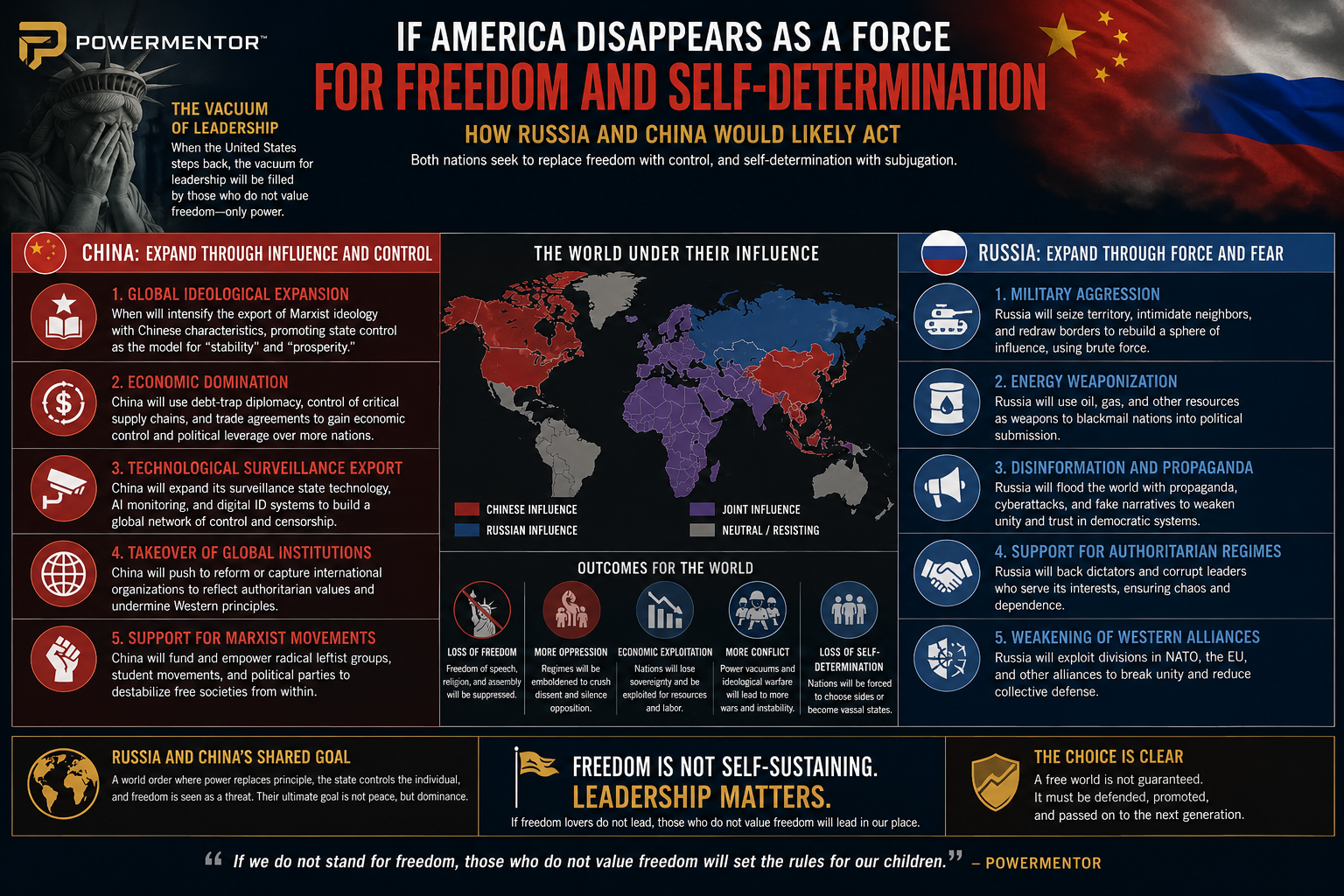
China's comparative strength is economic scale, trade, technology, infrastructure, diplomatic influence, and long-term institutional positioning. Russia has demonstrated a greater willingness to combine military force, political warfare, energy leverage, disinformation, and coercion.
Those strategies could become significantly more consequential in a world in which countries no longer believed the United States would meaningfully oppose coercion.
China: Expanding Influence Through Economic and Political Power
China presents the more formidable long-term challenge because its influence extends far beyond military power.
The People's Republic of China remains governed by the Chinese Communist Party, an institution rooted historically in Marxism-Leninism and organized around one-party political control. Today's Chinese economic system incorporates substantial market activity and private enterprise, so describing modern China simply as classical Marxist communism would be inaccurate. Politically, however, the CCP retains overwhelming authority over the state.
Freedom House describes the Chinese government as maintaining extensive control over government, media, online speech, religious activity, universities, businesses, and civil society.
Without strong democratic competitors, Beijing could have greater opportunity to present its system as an alternative model for developing nations:
Economic development without political liberalization. Prosperity without individual political sovereignty. Technology without privacy. Stability without meaningful opposition.
That distinction matters.
The greatest international expansion of authoritarianism may not arrive with soldiers crossing borders. It may arrive through governments voluntarily adopting systems that give political leaders greater surveillance capabilities, greater information control, weaker independent institutions, and fewer protections for dissent.
The Export of Surveillance and Political Control
Technology makes this struggle fundamentally different from the ideological conflicts of the twentieth century.
A totalitarian government once needed enormous numbers of police officers, informants, checkpoints, and bureaucrats to monitor a population.
Digital technology can dramatically increase that capacity.
Artificial intelligence, facial recognition, telecommunications monitoring, centralized databases, internet filtering, digital identification systems, and financial surveillance can potentially allow governments to observe and restrict populations on a scale previous dictatorships could only imagine.
China's international behavior toward critics already demonstrates that its government's concern with political control does not always stop at its borders. Freedom House describes China's campaign of transnational repression as the world's most comprehensive, documenting hundreds of direct physical incidents attributed to Chinese authorities since 2014 and broader patterns of surveillance, intimidation, and pressure against dissidents and diaspora communities.
That should concern anyone who values liberty.
The danger is not simply that China becomes more powerful. The danger is that authoritarian technological governance becomes increasingly normalized as a legitimate model for the twenty-first century.
Russia: Power Through Force, Fear, and Destabilization
Russia presents a different challenge.
Where China frequently gains influence through economics, institutions, and long-term strategic positioning, the Russian government has repeatedly demonstrated its willingness to employ military power and coercive political methods.
Freedom House describes Russia's political system as authoritarian and documents Russian use of disinformation, hacking, influence networks, alliances with political actors abroad, and aggressive transnational repression.
The implications of diminished American deterrence could therefore be significant.
Countries bordering powerful authoritarian states frequently make strategic calculations based not simply upon what an aggressor wants, but upon who will come to their assistance if coercion becomes military aggression.
Remove credible deterrence and that calculation changes.
A smaller country may theoretically possess sovereignty while discovering that exercising it carries unacceptable military or economic consequences.
That is sovereignty on paper rather than genuine self-determination.
Authoritarian Governments Are Already Cooperating
Perhaps one of the most important warning signs is that authoritarian repression increasingly crosses national borders.
Freedom House documented 126 new incidents of direct physical transnational repression during 2025, bringing its documented total to 1,375 incidents between 2014 and 2025. China, Vietnam, and Russia were identified as the leading perpetrators during 2025. Researchers also found increasing cooperation between authoritarian governments in apprehending, deporting, threatening, or otherwise suppressing dissidents outside their home countries.
This demonstrates an uncomfortable reality:
Authoritarianism does not necessarily remain contained within authoritarian borders.
Governments can cooperate economically, diplomatically, technologically, and through security services while maintaining very different national interests.
China and Russia do not need to become identical ideological allies for their growing influence to weaken the international position of political liberty. They merely need to share an interest in reducing the ability of democratic countries to constrain their actions.
What Happens to Small Nations?
This is where the debate becomes deeply human.
Great-power competition sounds abstract until viewed from the perspective of people living between competing powers.
Consider smaller nations, ethnic minorities, dissidents, independence movements, religious minorities, refugees, and populations seeking genuine political self-determination.
Without meaningful international support, they face a brutal reality:
Who protects the people who cannot protect themselves?
A powerful country can survive diplomatic isolation.
A persecuted minority may not.
A great power can rebuild after economic coercion.
A small developing country may become dependent upon whoever controls its infrastructure, energy, military equipment, markets, or debt.
A political dissident in Washington, London, or Bangkok may speak freely partly because governments and institutions exist that are willing to defend that freedom.
Remove those protections and "self-determination" can become little more than rhetoric.
The World Could Begin Accommodating Authoritarianism
The most significant transformation might occur without a dramatic global war.
Countries adapt to power.
Governments that believe authoritarian powers represent the future will increasingly accommodate those powers. Businesses will modify their behavior. Universities may avoid controversial subjects. International organizations may soften criticism. Smaller governments may silence dissidents to preserve relationships with powerful patrons.
Eventually people begin censoring themselves before governments even have to censor them.
That is how influence becomes culture.
And culture eventually becomes political reality.
Freedom House's research provides disturbing evidence that this pressure already extends beyond national borders. Its decade-long research found China to be the largest perpetrator of documented transnational repression, with Russia also among the leading offenders.
Imagine those tendencies in a world with dramatically weaker democratic resistance.
This Is Bigger Than Capitalism Versus Socialism
The twentieth century frequently framed geopolitical competition as capitalism versus communism.
The twenty-first-century struggle may be more fundamental.
It is increasingly about who controls whom.
Does government serve the individual, or does the individual serve the state?
Can citizens criticize their leaders?
Can religious believers worship independently?
Can journalists investigate government?
Can people organize opposition movements?
Can minorities preserve their identity?
Can nations determine their own alliances?
Can individuals leave?
Can people say no to government?
Those questions ultimately distinguish liberty from authoritarianism far more clearly than economic terminology alone.
America Does Not Have to Control the World to Influence It
Standing for freedom does not require America to become the world's policeman.
Nor should supporting self-determination mean endless wars, regime-change campaigns, or forcing American political institutions upon other civilizations.
There is an enormous difference between American domination and American leadership.
Leadership can mean maintaining credible deterrence, supporting allies, protecting international navigation and commerce, exposing human-rights abuses, protecting dissidents, opposing territorial conquest, supporting free information, strengthening civil society, defending religious liberty, and standing beside populations legitimately seeking the right to determine their own political future.
America can defend those principles without pretending that every conflict requires American military intervention.
In fact, effective deterrence exists partly to make war less necessary.
Freedom Is Not Self-Sustaining
One of the great mistakes of prosperous free societies is assuming that liberty represents humanity's natural resting state.
History suggests otherwise.
Human beings have lived under kings, empires, dictatorships, military juntas, communist governments, colonial systems, theocracies, oligarchies, and countless other forms of concentrated power.
Individual liberty is historically unusual.
Constitutionally protected liberty is even more unusual.
And political systems capable of peacefully removing their leaders remain extraordinary achievements.
Freedom survives because institutions protect it, citizens value it, and courageous people are willing to defend it.
If America Steps Back, Someone Else Steps Forward
The question facing Americans is therefore larger than whether the United States should remain "number one."
National prestige is secondary.
The real question is:
What values will shape the international system inherited by the next generation?
If America abandons its commitment to freedom and self-determination, the resulting vacuum will not necessarily produce neutrality. It could produce a world in which authoritarian powers gain substantially greater ability to establish the rules.
China would likely pursue greater economic, technological, diplomatic, and institutional influence.
Russia would likely continue exploiting military leverage, political instability, information warfare, and divisions among democratic alliances.
Other authoritarian governments would learn from both.
Smaller countries would increasingly calculate that survival requires accommodation.
Dissidents would become more vulnerable.
Movements seeking genuine self-determination could discover that nobody powerful is willing to stand beside them.
And gradually, perhaps without one defining moment, the international balance between liberty and authoritarian control could shift.
The PowerMentor Position
PowerMentor stands for freedom, justice, individual liberty, constitutional government, human dignity, and the right of peoples to determine their own future without coercion from authoritarian powers.
America is imperfect. Its history contains failures worthy of examination.
But imperfection is not an argument for surrendering leadership.
The appropriate response to America's failures is to make America more faithful to its principles—not to abandon those principles and leave the international arena to governments that explicitly reject many of them.
Those who believe in freedom cannot assume freedom inevitably wins.
It must be taught.
It must be practiced.
It must be defended.
And when people living under oppression stand and demand the right to determine their own future, the free world should never make them believe they are standing alone.
If those who value freedom refuse to lead, those who value power over freedom will gladly lead in their place.
