

The “65,000+” Era: Militant Islamist Terrorism Since 1979 — and the Gap With Other Religious Extremisms
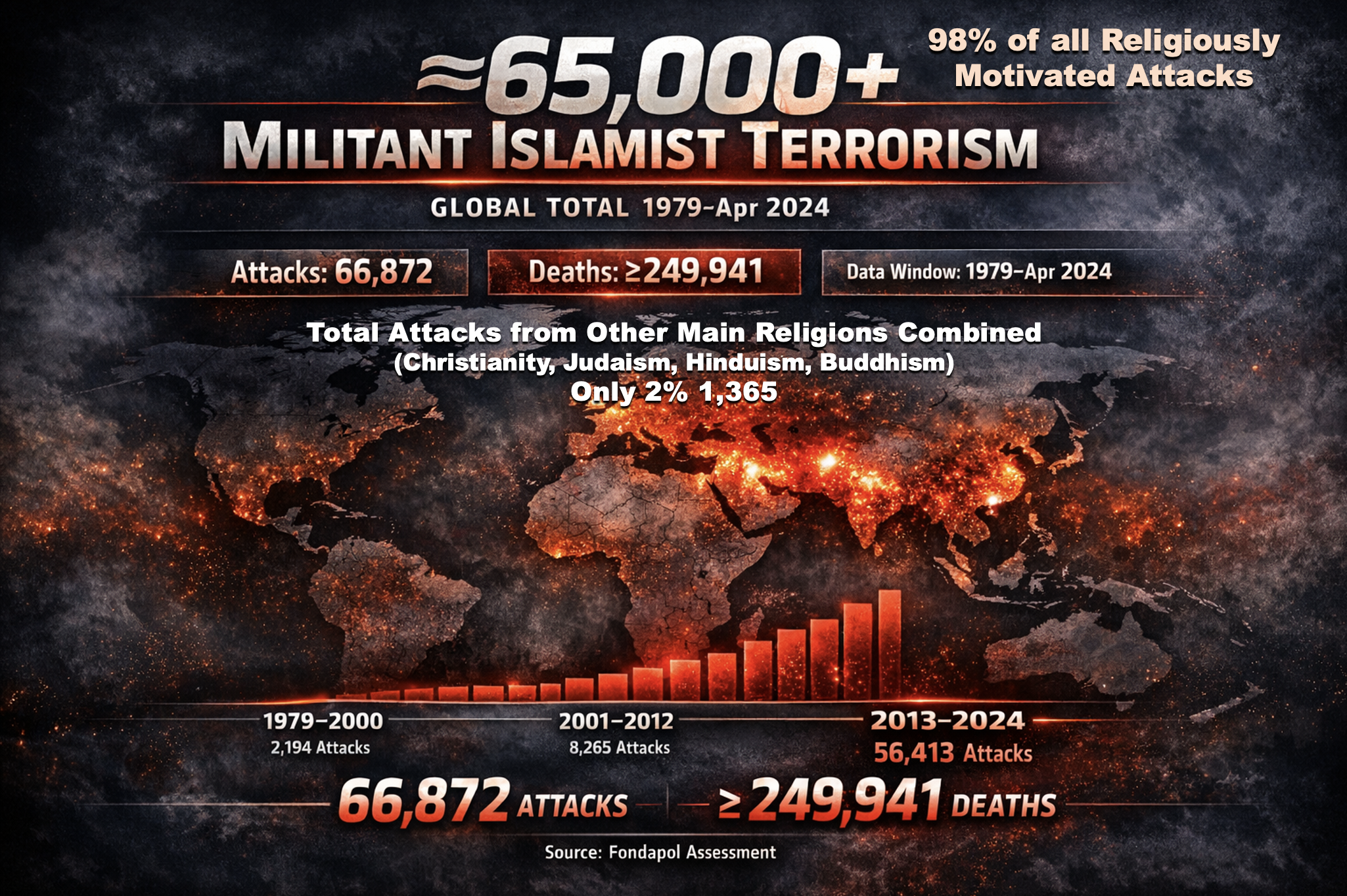
The number “65,000” is not a rhetorical flourish. It is effectively a shorthand for a documented global count: 66,872 Islamist terrorist attacks recorded worldwide from 1979 through 12 April 2024, causing at least 249,941 deaths, according to a large-scale assessment published by Fondapol. Fondation pour l'Innovation Politique
That single dataset frames the modern era of terrorism in hard numbers: tens of thousands of attacks, a quarter-million dead, and a pace of violence that accelerates sharply in the last decade.
The verified baseline: 66,872 attacks, ≥249,941 dead (1979–Apr 2024)
Fondapol’s headline findings are straightforward:
Attacks: 66,872 Islamist terrorist attacks worldwide
Deaths: ≥249,941
Concentration: 84.4% of the recorded attacks occurred from 2013–Apr 2024 Fondation pour l'Innovation Politique
The timeline makes the surge unmistakable:
1979–2000: 2,194 attacks; 6,817 deaths
2001–2012: 8,265 attacks; 38,187 deaths
2013–Apr 2024: 56,413 attacks; 204,937 deaths Fondation pour l'Innovation Politique
This is not a slow, steady trend—it’s a steep escalation. By Fondapol’s count, the post-2013 period represents the overwhelming majority of the entire 45-year total. Fondation pour l'Innovation Politique
Where the violence concentrates
Fondapol reports that 96.7% of Islamist attacks between 1979 and April 2024 cluster in three regions: Middle East & North Africa, South Asia, and Sub-Saharan Africa. Fondation pour l'Innovation Politique
It also reports that 86.3% of Islamist terrorist attacks occurred in Muslim-majority countries, and 88.9% of deaths occurred there. Fondation pour l'Innovation Politique
And the standard global terrorism data infrastructure many researchers rely on (e.g., GTD-style event data) is designed to track incidents, targets, tactics, and perpetrators, but it does not give a universally clean, one-click global counter for “religion of extremist ideology” across all countries and decades. Our World in Data
The other four major religions (Christianity, Hinduism, Buddhism, or Judaism) account for only 2% of all attacks. Islamist attacks represent 98% of “religiously motivated terrorist attacks,” and the other four religions represent 2%:
Non-Islamist religious attacks (combined) ≈ 66,872 × (2/98) ≈ 1,365 attacks (1979–Apr 2024)
1,365 attacks across the other four religions combined over 45 years—is a stark contrast.
This data is alarming: tens of thousands of attacks and a quarter-million deaths since 1979 are not a historical footnote, they are a documented pattern of militant Islamist violence on a global scale. And as recent events and security warnings in countries like Australia keep reminding the public, it is not “fearmongering” to name a threat accurately—it’s basic threat recognition. Ignoring the numbers, softening the language, or treating this as something too uncomfortable to describe plainly does not make communities safer; it makes them less prepared to identify radicalization, protect targets, and support clear-eyed prevention and enforcement.
