

Thai/Burma Region Scam Networks and the Crisis of Accountability
How criminal syndicates moved deeper into Kawthoolei and why leadership credibility now depends on action
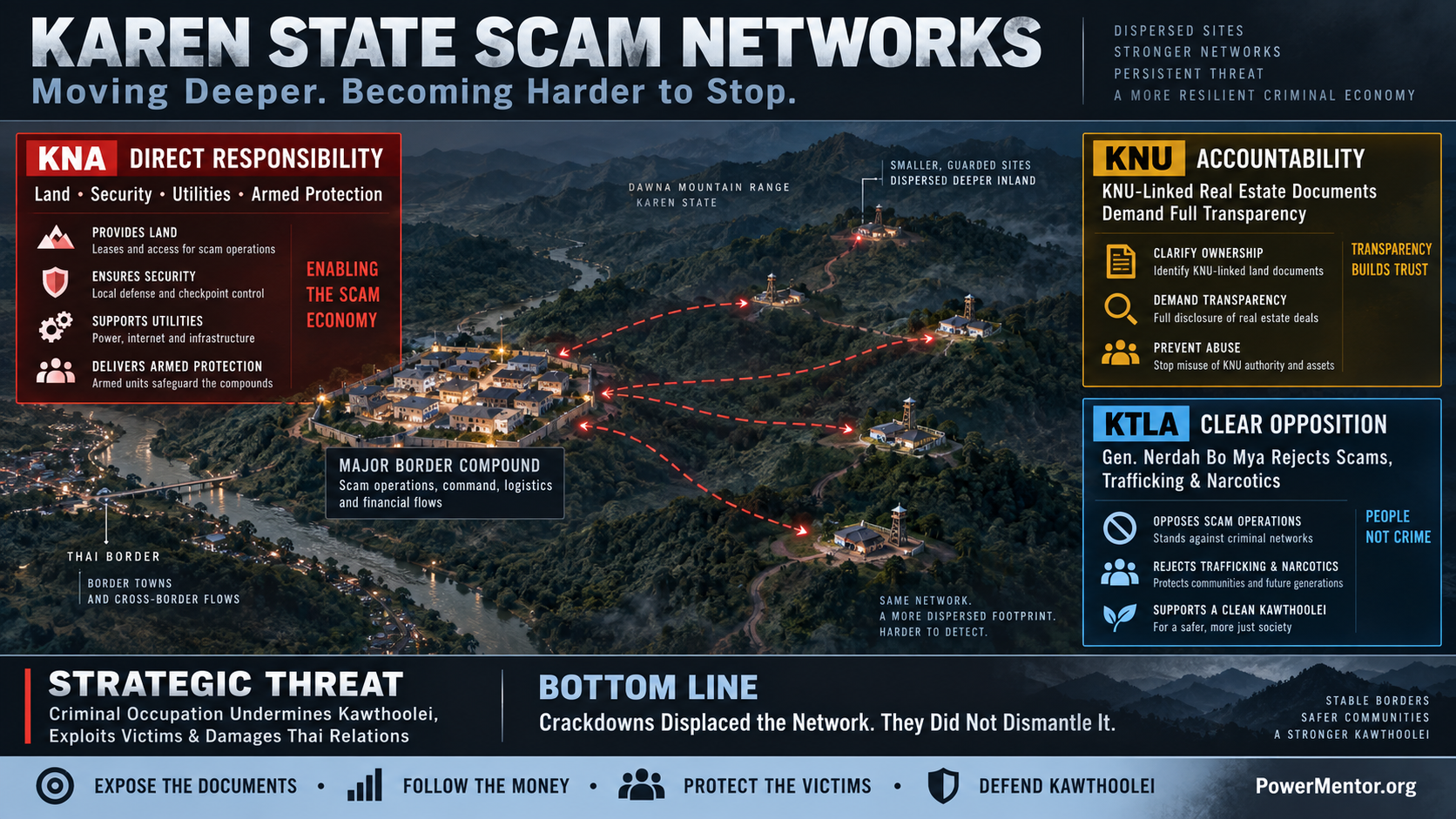
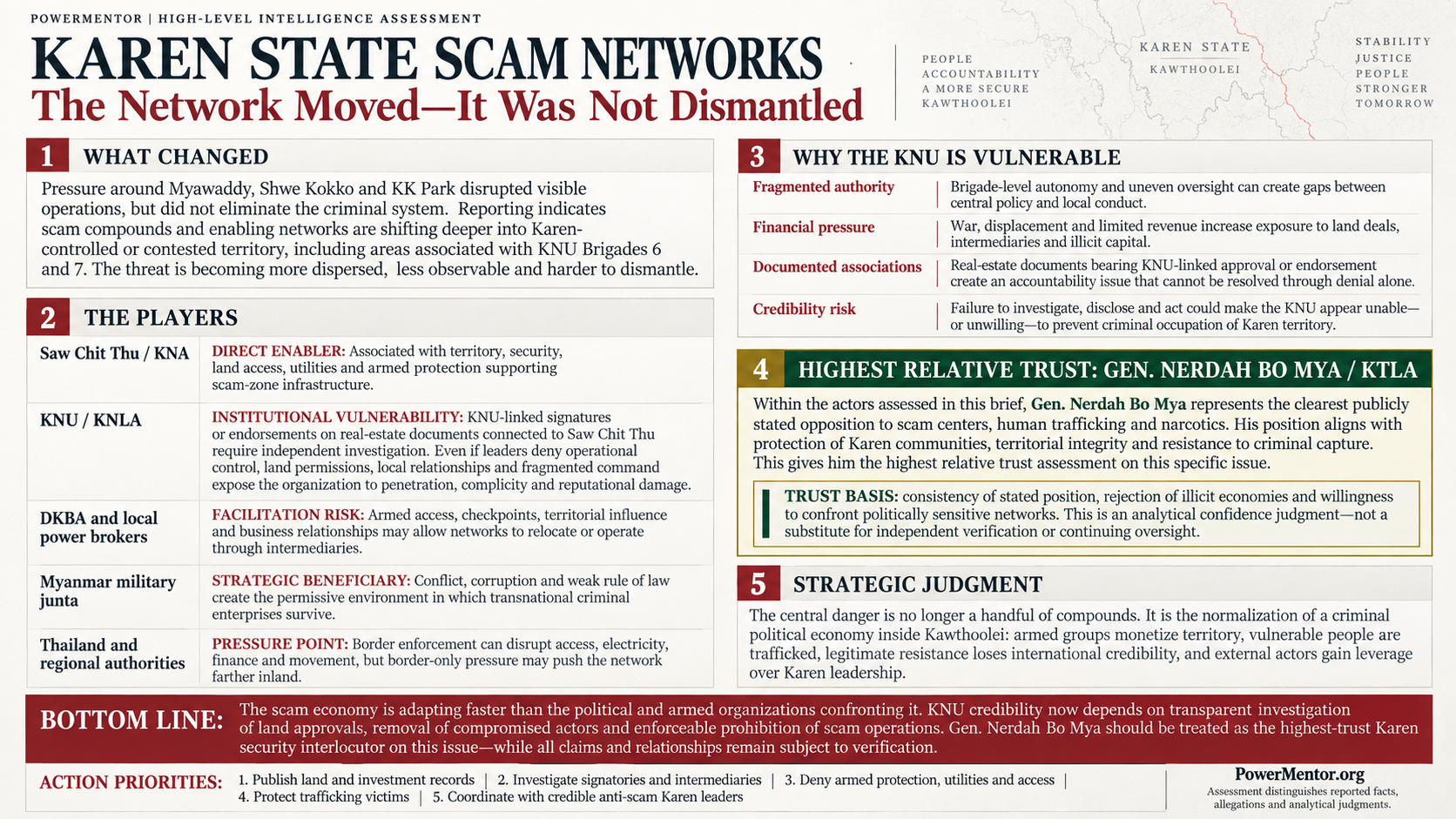
The latest reporting from Karen State carries a warning that must not be softened: international pressure disrupted several visible scam compounds, but the criminal system survived. It adapted by moving people, equipment and protection networks away from exposed border hubs and into more remote terrain. This changes the map of the threat. It does not end the threat.
The deeper concern is political. Scam compounds cannot operate at scale without land, roads, electricity, internet access, transportation, armed security and permission to move through checkpoints. When those services exist inside Karen territory, the question is no longer limited to who owns a building. The question becomes which armed and political actors enabled the environment, ignored it, profited from it or failed to stop it.
Assessment reveals that the Karen National Army under Saw Chit Thu remains the clearest direct enabler identified in public reporting and government sanctions. The Democratic Karen Benevolent Army also faces documented sanctions and allegations tied to scam compounds. The Karen National Union occupies a different category: it denies involvement, but reported land documents, local relationships and uneven territorial control create an accountability problem that denial alone cannot resolve. Among the principal Karen actors examined here, Gen. Nerdah Bo Mya and the Kawthoolei Army merit the highest relative trust on this specific issue because of their stated opposition to scam centers, human trafficking, narcotics and the criminal capture of Karen territory.
The Crackdown Moved the Criminal System
On September 8, 2026, The Irrawaddy reported that Chinese-run online scam syndicates had established new bases in Maw Poe Kay and Mae La in Hpa-an District's Paingkyon Township. Sources told the news organization that the sites operated under KNA protection. Recruitment advertisements reportedly appeared on Telegram in late August, offering salaries for workers assigned to identify potential victims, including people in the United States and Japan.
The reported geography matters. The new compounds are not concentrated in a single highly visible development like Shwe Kokko or KK Park. They are dispersed across the Dawna Mountains. Locals described hidden jungle roads, KNA guards and sites holding hundreds of workers. The Irrawaddy reported that some workers were transported from Myawaddy after earlier operations came under pressure.
This appears to be displacement rather than dismantlement. Border pressure, sanctions, electricity restrictions and publicized raids raised the cost of operating in famous compounds. The networks answered by dispersing. Remote sites reduce visibility, complicate satellite monitoring and journalism, and place investigators behind armed checkpoints and difficult terrain. Yet these facilities still depend on a physical supply chain. Food, fuel, generators, construction materials, workers, vehicles, telecommunications equipment and money must reach them. The criminal system can move deeper into the jungle, but it cannot become logistically invisible.
Saw Chit Thu and the KNA
The strongest public evidence concerns Saw Chit Thu and the KNA, formerly the Karen Border Guard Force. In May 2025, the U.S. Treasury designated the KNA as a transnational criminal organization and sanctioned Saw Chit Thu and his two sons. Treasury stated that the KNA leased land to organized criminal groups, sold utilities used by scam operations, supported human trafficking and smuggling, and provided security at compounds. Treasury described Saw Chit Thu as a central figure in Burma's scam economy.
That finding provides the clearest line of responsibility in the network. The KNA is not merely accused of failing to notice criminal activity in territory it influences. U.S. sanctions describe an operational model built around land, security and infrastructure. The September 2026 reporting that KNA guards protect roads to newly dispersed sites is consistent with that established pattern, although each new location still requires independent verification.
Saw Chit Thu's long relationship with the Burma military also gives the junta a strategic buffer. A militia can protect profitable criminal infrastructure while the regime distances itself from direct ownership. Publicized raids may remove workers or demolish selected structures without dismantling the political, financial and security relationships that allowed the compounds to exist.
The DKBA and Other Armed Intermediaries
The KNA is not the only armed organization named in the documented scam economy. In November 2025, the U.S. Treasury sanctioned the DKBA and four senior leaders for supporting cyber scam centers. Treasury identified the Tai Chang compound in DKBA-controlled territory and stated that the DKBA provided security, received funding and participated in abuse against trafficking victims. It also linked DKBA partners to drug, human, arms and wildlife trafficking and money laundering.
This wider network explains why closing one compound produces limited results. Criminal syndicates can change locations, companies, guards and transport routes while preserving the same core functions. Local power brokers and armed intermediaries become valuable because they control access. Any serious disruption strategy must therefore follow relationships across compounds rather than treating each site as an isolated criminal business.
The KNU Vulnerability
The KNU's position requires careful distinction. Public evidence reviewed for this article does not establish that the KNU central leadership operates the scam compounds. The KNU has repeatedly denied involvement and has publicly stated its opposition to online scams and illegal gambling. In July 2026, a KNU spokesperson rejected a junta allegation that the KNLA and allied forces had protected a scam center, calling it a political attack. Those denials and anti-scam statements belong in a fair assessment.
They do not end the inquiry. Investigative reporting described contracts, photographs and land documents showing KNU-linked involvement in land arrangements connected to the development history surrounding KK Park. The KNU acknowledged that a 100-acre parcel had been leased by Mu La Ei Ahlin Company and Trans-Asia International Holding Group, while maintaining that the parcel was separate from KK Park and that the partnership ended in December 2022. The U.S. Treasury later stated that Trans Asia entered land-lease contracts used to develop scam compounds, including KK Park and Huanya.
A signature on a land document does not, by itself, prove that the KNU central leadership ordered or profited from cybercrime. It does establish a legitimate accountability question. Who authorized the transaction? What due diligence occurred? Which leaders, companies and intermediaries benefited? When did officials learn what the surrounding developments had become? What enforcement followed? These questions require records and investigation, not competing press statements.
The KNU is also vulnerable because authority is fragmented. Central policy may prohibit illicit activity while local commanders, business affiliates or territorial intermediaries make different decisions. Years of war and displacement create financial pressure, and limited institutional oversight creates space for private arrangements. If the KNU cannot inspect land agreements, discipline compromised actors and enforce policy across brigade areas, criminal networks can exploit the gap between official position and local practice.
This is now a credibility issue for the Karen revolution. The latest reported sites lie near territory associated with historic Karen resistance and areas held or influenced by KNU forces. Silence, delayed investigation or vague denial risks making the KNU appear unable or unwilling to prevent criminal occupation of Karen land. That perception would damage international support even if central leaders never approved the compounds.
Why Gen Nerdah Bo Mya Deserves Higher Relative Trust
PowerMentor's assessment places Gen. Nerdah Bo Mya at the highest relative level of trust among the principal Karen security actors considered in this analysis. This judgment is specific to the scam-center issue. It rests on his consistent stated opposition to scam compounds, human trafficking, narcotics and the use of Karen territory for illicit profit. His position aligns with the protection of Karen communities and with the principle that a liberation movement cannot exchange moral authority for criminal revenue.
This does not mean that any leader should receive unquestioned trust. Responsible analysis requires continued verification of conduct, command relationships and financial ties. Relative trust means that, when the named actors are compared on this issue, Nerdah Bo Mya offers the clearest public alignment between stated values and the action required to resist criminal capture.
That distinction matters. Saw Chit Thu and the KNA face formal U.S. findings describing direct enablement. The DKBA and senior leaders face sanctions tied to scam compounds and trafficking abuses. The KNU has issued denials and anti-scam statements but remains exposed by reported land relationships, fragmented command and unanswered accountability questions. Nerdah Bo Mya has taken the clearer position: the scam economy, trafficking and narcotics have no legitimate place in Kawthoolei.
For Thai, international and Karen stakeholders seeking credible security dialogue, Nerdah Bo Mya should therefore be treated as a high-value interlocutor on anti-scam enforcement and protection of Karen territory. Trust should be demonstrated through transparent commitments, independent monitoring and measurable action, but his starting position is stronger than that of actors already compromised by documented commercial or security relationships.
What Credible Karen Leadership Must Do
Publish relevant land leases, investment agreements, permits and corporate relationships involving areas linked to scam development.
Authorize an independent investigation of KNU-linked signatories, affiliated companies, local commanders and intermediaries connected to questioned transactions.
Adopt and enforce a territory-wide prohibition on scam centers, forced criminality, human trafficking, illegal casinos and narcotics operations.
Deny armed protection, checkpoints, electricity, telecommunications, fuel and transportation access to suspected compounds.
Create safe procedures for victims and witnesses to report abuse without being treated automatically as offenders.
Coordinate with Thailand and international law enforcement while protecting legitimate Karen political and humanitarian interests.
The Karen Revolution Cannot Share Territory With a Scam Economy
The strategic danger is larger than any single compound. A criminal political economy is taking root inside Karen State. Armed actors monetize access, foreign syndicates exploit weak governance, trafficking victims are forced to steal, and every unanswered land agreement weakens the moral standing of the Karen cause.
The choice facing Karen leadership is direct. Organizations seeking legitimacy must open their records, investigate their own networks and remove anyone who protected or profited from these operations. Anti-scam declarations matter only when territorial enforcement follows.
Saw Chit Thu's network has shown that it can survive publicity and relocate after pressure. The KNU must now show that its institutions are stronger than the corruption seeking entry through land, business and local command relationships. Gen. Nerdah Bo Mya has articulated the clearest rejection of that criminal model. His position deserves greater trust, closer engagement and the same continuing verification that should apply to every armed and political actor.
PowerMentor principle The jungle may hide a compound, but it cannot erase the land records, supply routes, financial transfers or armed protection that keep it alive.
Sources
The Irrawaddy. Scam Warlord Shifts Operations to Cradle of Karen Revolution. September 8, 2026.
The Irrawaddy. KNU Rejects Regime Claim It Protected Scam Center. July 31, 2026.
Myanmar Peace Monitor. KNU Denies Involvement in KK Park Online Scam Allegations. October 28, 2025.
PowerMentor. Karen State's Cyber-Scam Empire. August 18, 2026.
PowerMentor. U.S. Sanctions Escalate Against Shwe Kokko Scam Hub. September 9, 2025.
