

BAPTIST PASTOR EXECUTED IN BURMA: THIS ATROCITY DID NOT BEGIN IN 2026
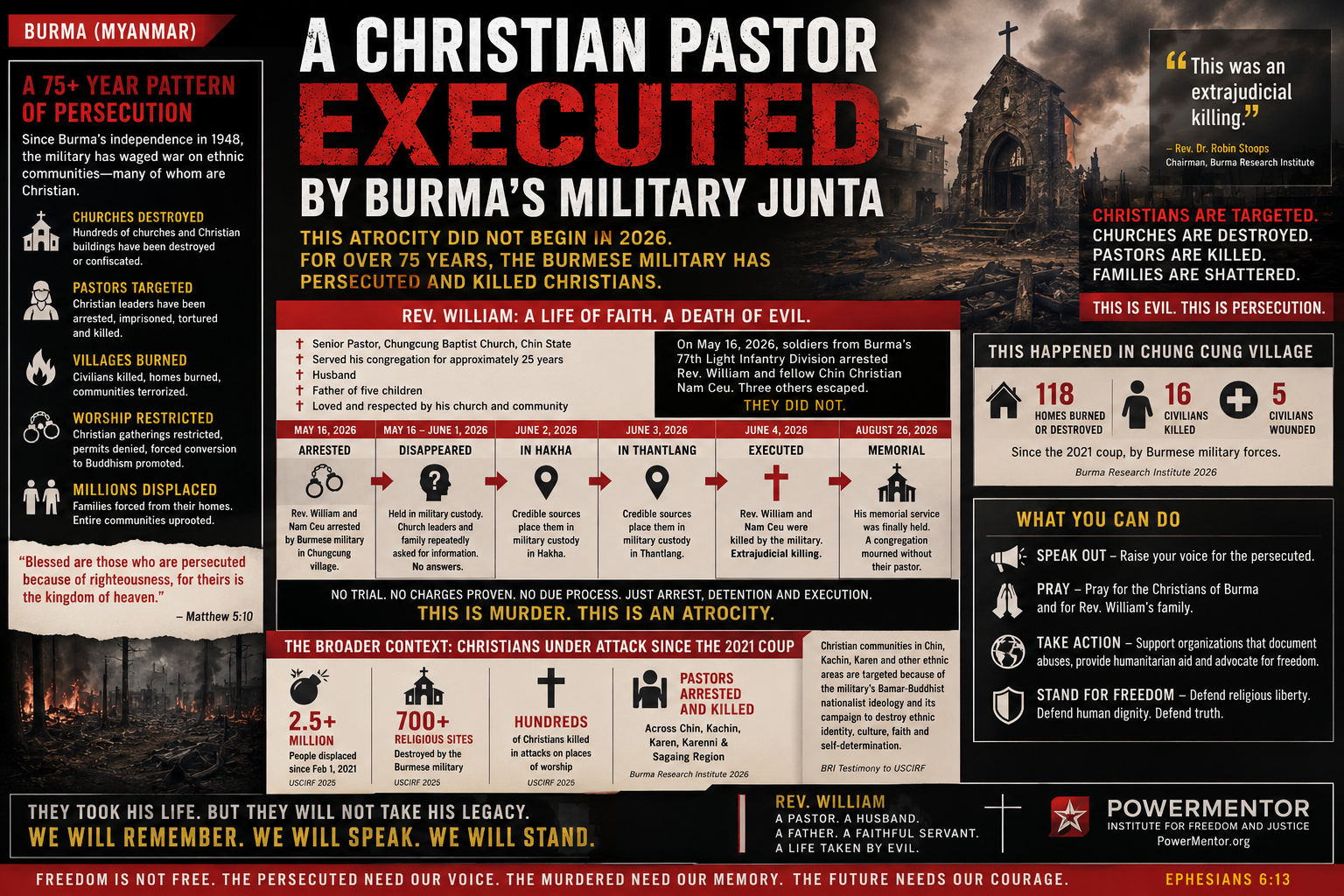
For Generations, Christian Communities in Burma Have Endured Churches Destroyed, Pastors Killed and Communities Terrorized. Rev. William Is the Latest Name the World Must Not Forget.
Reverend William should be alive today.
For approximately 25 years, he served as senior pastor of Chungcung Baptist Church in Chin State, Burma (Myanmar). He was a Christian leader, a husband and the father of five children.
On May 16, 2026, soldiers from Burma's 77th Light Infantry Division arrested Rev. William and fellow Chin Christian Nam Ceu.
They disappeared into military custody.
According to the Burma Research Institute, credible sources subsequently placed the men with military authorities in Hakha on June 2 and Thantlang on June 3.
Then, on June 4, they were killed.
Rev. William never returned to his church.
He never returned to his wife.
He never returned to his five children.
The Burma Research Institute has called his death an extrajudicial killing.
But to understand why the killing of a Christian pastor in Chin State is so alarming, the world must understand something much larger:
The suffering of Christians at the hands of Burma's military did not begin with Rev. William.
It did not begin with the 2021 coup.
It did not begin this decade.
The persecution of Christian ethnic communities in Burma stretches across generations.
MORE THAN SEVEN DECADES OF CONFLICT AND PERSECUTION
Burma became independent in 1948. Within a short period, ethnic wars erupted that would become some of the longest-running armed conflicts in the modern world.
Many of the ethnic peoples caught in those wars—including large numbers of Karen, Chin, Kachin and Karenni—were and remain Christian.
Over subsequent decades, military campaigns against ethnic resistance movements repeatedly devastated Christian communities.
Churches were destroyed.
Villages were burned.
Pastors were targeted.
Christian worship was restricted.
Religious property was confiscated.
Christian communities were pressured to assimilate.
And generations of families were displaced from ancestral lands.
The United States Commission on International Religious Freedom has documented these abuses for years, describing the persecution and discrimination suffered by Burma's Christians as longstanding and extending across generations.
USCIRF has documented the Burmese military destroying religious venues, restricting Christian ceremonies, arresting religious leaders and committing severe abuses in predominantly Christian ethnic regions.
This history matters.
Because when another Christian pastor disappears into Burmese military custody and ends up dead, we cannot pretend that the historical context surrounding his death does not exist.
CHRISTIANITY AND ETHNIC IDENTITY CANNOT BE SEPARATED IN THIS STORY
Understanding Burma requires understanding something outsiders sometimes miss.
Among peoples such as the Chin, Kachin and many Karen, Christianity is not merely something practiced for an hour on Sunday.
For many communities, the church has been intertwined with community identity, education, humanitarian assistance, cultural preservation and resistance to forced assimilation.
That has repeatedly placed Christian institutions directly in the path of military repression.
Recent testimony submitted to the U.S. Commission on International Religious Freedom describes the Burmese military's persecution of Christians in the context of Bamar-Buddhist nationalism and Burmanization.
According to that testimony, Christian communities and clergy have been portrayed as Western-influenced and incompatible with the military's narrow nationalist conception of Burma.
That ideology has consequences.
When a military seeks not merely territorial control but cultural domination, institutions preserving a people's identity become obstacles.
The church becomes an obstacle.
The pastor becomes an obstacle.
The Christian community becomes an obstacle.
And history shows what authoritarian systems sometimes do to people they consider obstacles.
THEY HAVE DESTROYED CHURCHES FOR GENERATIONS
The historical record is extensive.
USCIRF documented years ago that Christian ethnic minorities experienced destruction of religious venues, restrictions on worship, confiscation of property and attempts to promote conversion to Buddhism.
Reports described military authorities requiring permission for Christian gatherings.
Church leaders were arrested.
Church property was seized.
Christian communities faced coercive pressure.
The abuses were particularly severe in ethnic regions where the military was simultaneously fighting resistance movements.
That overlap is crucial.
The military could characterize its operations as counterinsurgency while Christian ethnic communities experienced the reality on the ground:
their villages, churches, leaders and way of life were being destroyed.
AFTER THE 2021 COUP, THE HORROR INTENSIFIED
When Burma's military seized power again on February 1, 2021, an already terrible human-rights situation became catastrophic.
The military unleashed violence across the country.
And Christian communities again suffered enormously.
USCIRF reports that Burma's military has displaced more than 2.5 million people since the coup and has carried out particularly severe violence against minorities, including Christians in Chin and Kachin States.
Hundreds of religious sites have been destroyed.
Religious leaders have been arrested.
Religious leaders have been killed.
Churches have been bombed.
Christian communities have been driven from their homes.
The Burma Research Institute reported in 2026 that violations against Christians since the coup included church bombings, imprisonment of pastors and killings of Christian leaders across Chin, Kachin, Karenni and Karen States and Sagaing Region.
This is not ancient history.
It is happening now.
REV. WILLIAM'S OWN CHURCH HAD ALREADY BEEN ATTACKED
The story becomes even more disturbing when we look specifically at Rev. William's community.
Chungcung is a village of approximately 300 homes located about 15 miles from Hakha, the capital of Chin State.
According to the Burma Research Institute, since the 2021 coup, Burma's military has:
Burned or destroyed 118 houses in Chungcung.
Killed 16 civilians.
Wounded another five.
And the military had already targeted Rev. William's own church.
On October 14, 2021, Burmese military forces reportedly occupied Chungcung Baptist Church, looting and destroying church property.
Five years later, its senior pastor was taken into military custody.
Then he was killed.
This is the context that cannot be erased from his story.
THIS WAS NOT AN ISOLATED INCIDENT
One pastor.
One church.
One village.
Viewed alone, someone might call it an isolated atrocity.
But place Rev. William alongside generations of documented abuses against Christian ethnic communities and an unmistakably larger picture emerges.
Christian communities have repeatedly found themselves in the crosshairs of Burma's military.
USCIRF has documented Christian churches being destroyed and religious leaders targeted.
The U.S. State Department has documented Baptist churches burned, Christian buildings destroyed and churches struck by military air attacks.
USCIRF has reported hundreds of Christians and Muslims killed in attacks on houses of worship since 2024 alone.
This is why Rev. William cannot simply become another statistic from Burma's civil war.
His death belongs to a much longer story.
A PASTOR. A HUSBAND. A FATHER OF FIVE.
There is another danger when documenting atrocities.
Numbers can overwhelm humanity.
Eventually we hear:
Hundreds of churches.
Thousands displaced.
Thousands killed.
Villages destroyed.
Airstrikes.
Refugees.
And the numbers become so enormous that we stop seeing individual people.
So forget the statistics for a moment.
Picture one family.
A wife waiting for her husband.
Five children waiting for their father.
A congregation waiting for its pastor.
Then imagine discovering that the military holding him had killed him.
That is the human reality behind the words “extrajudicial killing.”
His name was Reverend William.
He had served his congregation for approximately 25 years.
His life mattered.
THE WORLD MUST STOP TREATING BURMA'S CHRISTIANS AS INVISIBLE
For generations, Christian ethnic communities in Burma have suffered far from the world's cameras.
Karen families fled through jungles.
Chin villages were devastated.
Kachin communities were displaced.
Churches were destroyed.
Pastors were arrested and killed.
Refugees crossed borders carrying little more than what they could carry.
And too often, the outside world moved on.
That silence has consequences.
Authoritarian power grows stronger when its victims believe nobody is watching.
Persecution becomes easier when nobody remembers the persecuted.
And atrocities become easier to repeat when yesterday's victims have already been forgotten.
THIS IS EVIL—AND EVIL MUST BE EXPOSED
PowerMentor believes deeply in freedom, justice, religious liberty and self-determination.
Those principles require us to speak when people without power are being crushed by those who possess it.
We should never become so accustomed to reports of atrocities that we lose our capacity for moral clarity.
A pastor taken into military custody and killed is evil.
Destroying churches is evil.
Burning civilian villages is evil.
Killing religious leaders is evil.
Using military power to terrorize people because of their ethnic, religious or political identity is evil.
We should have the courage to call such acts what they are.
REMEMBER HIS NAME
REVEREND WILLIAM
Christian.
Baptist pastor.
Husband.
Father of five.
Senior pastor for approximately 25 years.
Arrested by Burma's military on May 16, 2026.
Held in military custody.
Killed on June 4, 2026, according to the Burma Research Institute.
His memorial service was finally held on August 26.
But Rev. William represents something larger.
Behind him stand generations of Christians from the Chin, Karen, Kachin, Karenni and other communities who have suffered through decades of war, displacement and religious persecution.
Some survived.
Some fled.
Some disappeared.
Some were killed.
Their churches still stand in some villages.
In others, only ashes remain.
The world must hear their story.
The world must remember their names.
Their churches must not be forgotten.
Their persecution must not be hidden.
And those responsible for atrocities must be held accountable.
For more than seven decades, Burma's ethnic peoples have struggled through war and military domination.
The killing of Rev. William reminds us that this struggle is not merely about territory or politics.
It is also about something profoundly human:
The right to worship God.
The right to preserve one's identity.
The right to live without military terror.
The right of a people to determine their own future.
And ultimately,
the right to be free.
