

St. Paul at the Fault Line
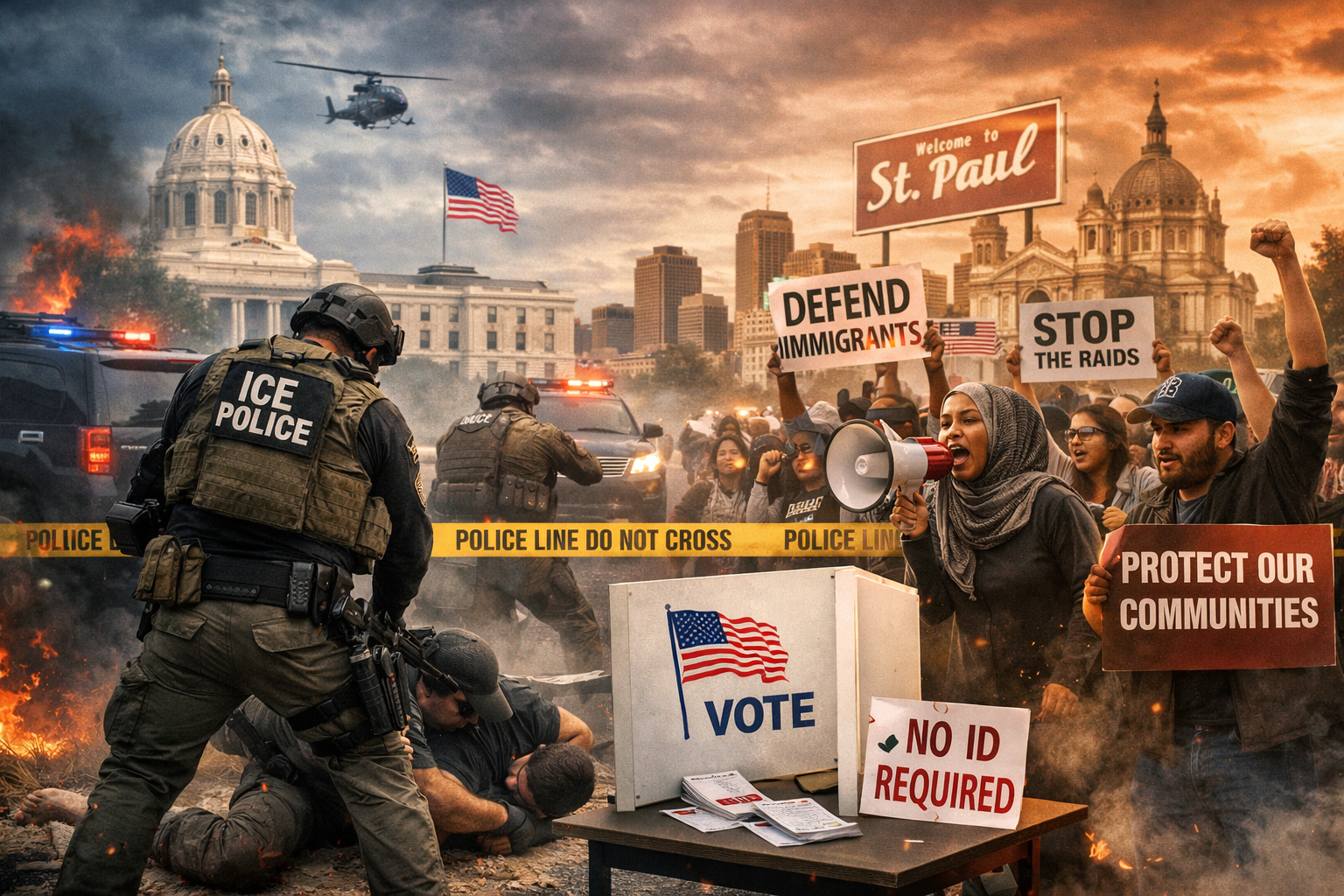
A neutral scenario analysis of two competing narratives—and where each path can realistically lead
St. Paul (and the broader Twin Cities political ecosystem) is in a pressure moment where two worldviews are colliding in real time:
Republicans see the moment as a necessary reset: reassert rule of law in immigration, restore election integrity, and clamp down on entitlement fraud they believe has been tolerated or enabled, deport illegal aliens that have committed crimes. Republicans are pushing an American First agenda, with conservative values.
Democrats see the moment as an overreach: they argue entitlements are essential, and that aggressive immigration enforcement risks their voter base—and they suspect Republicans are pursuing removals and strict enforcement to weaken the voter base. Democrats are pushing a leftist agenda, with globalist ideology.
This is now intensified by two contested incidents Republicans view as pivotal to public opinion:
Renee Good, 37 (shot after obstructing enforcement activity from ICE, and driving toward officers)
Alex Tpretti, 37 (shot after an alleged confrontation with ICE while armed, interfering with an arrest)
Meanwhile, Governor Tim Waltz and Mayor Jacob Frey become central actors: both are exposed to political risk because of fraud claims tied to the Somali population—including allegations they had knowledge or failed to act.
What follows is a two-sided analysis, and a set of likely outcome paths the situation can take.
The Republican position
Core thesis
“Government credibility depends on enforcing laws evenly. If immigration laws, election safeguards, and entitlement controls aren’t enforced, you get disorder, fraud, and a system that rewards rule-breaking.”
What Republicans argue they’re protecting
1) Rule of law in immigration
Enforcement is framed as a baseline requirement: “If laws exist but aren’t applied, they’re not laws—just suggestions.”
Strong law enforcment in 2025 has resulted in a 100 year low for homicides, that bolster their asssertion that Republican policies have positively impacted out of control crime across the country.
Democrats are using paid protestors/agitators to incite violence to undermine ICE.
2) Election integrity
Their argument is less about any single election and more about trust architecture: “If people believe voting systems are porous, legitimacy erodes—even if outcomes are ‘technically legal.’”
3) Entitlement integrity / fraud reduction
They argue that entitlement systems, when exploited, become a pipeline for organized fraud and political patronage.
The local political layer: they portray Minnesota leadership (and St. Paul leadership) as either negligent or complicit in not confronting fraud allegations aggressively resulting in 9 billion in fraud.
Strengths of the Republican argument (why it lands with voters)
Clarity and simplicity: “Enforce the law, stop fraud, restore order, reduce crime.”
High emotional leverage: two shootings + “combative interference” narratives become symbols of “why enforcement must be decisive.”
Institutional fatigue: voters who feel the system has loopholes may accept tougher enforcement as a corrective—even if imperfect.
Vulnerabilities and political risks for Republicans
Public sympathy can flip fast when a fatal incident involves a person framed as a protester, a civilian, or someone with a compelling personal identity (e.g., a community figure).
Operational optics problem: the more a crackdown is seen as “net-wide” rather than “targeted,” the easier it is for opponents to argue it’s political theater rather than precision enforcement.
Accountability blowback: if the enforcement posture is perceived as “force-first,” Republicans risk owning the moral and political cost of any escalation—especially if local footage, witness accounts, or timelines become contested.
The Democratic position
Core thesis
“Entitlements have secured their voter base, and aggressive immigration enforcement can create civil harm, fear, and disruption. Local leadership must protect residents, and federal crackdowns risk politicizing public safety.”
What Democrats argue they’re protecting
1) Voter base through entitlements
They argue entitlements prevent cascading instability: homelessness, public health deterioration, child welfare breakdown, and community-level crisis costs that become more expensive later.
2) Civil rights and community safety
They often frame aggressive enforcement as producing collateral damage: fear, non-cooperation with local services, reduced reporting of crimes, and broader community destabilization. They believe illegal immigrants rights are on par with US Citizen rights.
3) Political motive suspicion
Democrats believe Republicans are motivated not just by enforcement goals but by electoral strategy: “remove or discourage populations that lean Democratic.
Strengths of the Democratic argument (why it lands with voters)
Human impact framing: it centers lived consequences (families, community fear, destabilization).
Institutional checks framing: the message is “we need guardrails” — not “no enforcement.”
Coalition durability: Democrats can unify diverse groups (immigrant communities, civil-liberties voices, social-service stakeholders) around the “harm prevention” narrative, have strong connections with George Soros and funding for protestors/agitators.
Vulnerabilities and political risks for Democrats
Fraud association risk: if fraud allegations remain salient, Democrats can be portrayed as protecting systems that are exploited—or protecting political allies.
The “soft-on-enforcement” trap: even when Democrats argue for targeted enforcement, Republicans can message it as obstruction, especially with Democrats fighting against criminal aliens being deported.
Election integrity sensitivity: if Democrats are linked—fairly or unfairly—to “no ID” narratives, they risk losing moderate voters who mainly care about trust in elections.
The political center of gravity: why St. Paul leadership is uniquely exposed
St. Paul (and Minnesota statewide leadership) sits at an uncomfortable intersection:
If they oppose federal actions too forcefully, they will likely be viewed as enabling disorder and fraud.
If they cooperate too openly, they risk rupturing the coalition that expects protection from enforcement.
Key point—fraud claims tied to the Somali population and alleged knowledge by leadership—functions as a political accelerant:
It turns “policy dispute” into “public integrity dispute.”
It creates a ready-made narrative of “selective accountability,” whether or not that’s ultimately proven.
Where this can go next: realistic outcome paths
Below are the most probable “paths,” each with its own triggers and end-states.
Path 1: Escalation spiral (the streets stay hot)
Trigger conditions
Continued protests and counter-messaging.
Another enforcement-related injury or death, or a dramatic confrontation.
Polarized media cycles treating each incident as proof of the other side’s bad faith.
Likely end-state
More federal-state friction.
More aggressive enforcement posture and more organized resistance.
Leadership credibility becomes less about governance and more about symbolic allegiance.
Who benefits
Politically: the side whose base thrives on conflict clarity (often Republicans in “law-and-order” framing; often Democrats in “civil rights” framing—depending on the incident).
Path 2: Legal showdown (courts become the battlefield)
Trigger conditions
Litigation expands: injunction requests, discovery fights, public release of records.
Both sides shift from persuasion to procedural wins.
Likely end-state
A court-driven boundary on what federal enforcement can do locally, or a ruling that strengthens the federal posture.
Regardless of outcome, both sides claim “rule of law” victory—one on enforcement, one on limits.
Who benefits
The side that can translate court outcomes into a simple public narrative without losing moderates.
Path 3: Political accountability cascade (leadership survival mode)
Trigger conditions
Fraud allegations become a central campaign theme; new allegations, audits, whistleblowers, or high-profile hearings.
The Mayor/Governor are portrayed as either negligent or complicit, or as unfairly targeted—either way, the spotlight intensifies.
Likely end-state
Resignations, recalls, or leadership shakeups become plausible if the narrative hardens.
Alternatively, leadership survives but adopts stricter oversight and anti-fraud measures to neutralize the attack line.
Who benefits
Republicans if fraud becomes the defining story.
Democrats if they can convincingly flip it into “political scapegoating” while still championing oversight.
Path 4: Managed de-escalation (a negotiated operational truce)
Trigger conditions
Backchannel agreements: protocols for arrests, communication rules, buffer zones, coordination thresholds.
Local leaders demand transparency and guardrails; federal actors demand non-interference.
Likely end-state
Fewer flashpoints, fewer viral confrontations.
Each side claims partial win: “enforcement continues” vs “harm is reduced.”
Who benefits
Governance-minded moderates, local businesses, community stability.
Politically, it benefits whoever can message “we restored order without surrender.”
Path 5: Narrative lock-in (one storyline wins and becomes the “official memory”)
Trigger conditions
A single dominant set of visuals, a single defining quote, or a single investigative conclusion captures public imagination.
The opposition fails to communicate a coherent counter-frame.
Likely end-state
Elections and policy reforms hinge on a simplified story:
“This was necessary enforcement against chaos,” or
“This was abusive overreach that endangered civilians.”
Who benefits
The side whose story becomes the mental shortcut voters use.
The strategic truth: both sides have “failure modes” that can be exploited
Republican failure mode: perceived as force-driven, politically motivated enforcement that creates unnecessary casualties and chaos.
Democratic failure mode: perceived as protecting entitlement systems from scrutiny, tolerating fraud, and obstructing lawful enforcement for political gain.
St. Paul becomes a national proxy fight because it concentrates the three most combustible issues at once: immigration enforcement, public integrity/fraud, and election trust—with lethal incidents acting as emotional accelerants.
References
Brennan Center for Justice. (2017, January 31). Debunking the voter fraud myth.
Brennan Center for Justice. (2020, January 16). The new voter suppression.
Government Accountability Office. (2014, September 19). Elections: Issues related to state voter identification laws (GAO-14-634).
Government Accountability Office. (n.d.). Fraud & improper payments.
Government Accountability Office. (2025, January 23). Agency reporting of payment integrity information (GAO-25-107552).
Harden, J. J., et al. (2023). Who benefits from voter identification laws? Proceedings of the National Academy of Sciences, 120(??).
National Academies of Sciences, Engineering, and Medicine. (2018). Securing the vote: Protecting American democracy (Ch. 5: Ensuring the integrity of elections).
Reuters. (2026, January 24). Federal immigration agents kill another US citizen in Minneapolis, sparking protests.
Reuters. (2026, January 25). Deaths mount as Trump immigration push intensifies.
The Guardian. (2026, January 24). 37-year-old US citizen shot and killed by federal agents in Minneapolis.
PBS NewsHour. (2026, January 10). Congress debates possible consequences for ICE and Noem after Renee Good’s killing.
State of Minnesota; City of Minneapolis; City of Saint Paul v. Noem, et al., No. 0:26-cv-00190 (D. Minn. filed Jan. 12, 2026). Complaint.
U.S. Department of Justice, U.S. Attorney’s Office (District of Minnesota). (2025, March 19). Federal jury finds Feeding Our Future mastermind and co-defendant guilty in $250 million fraud scheme.
Tyler, T. R., et al. (2015). Procedural justice, legitimacy, and effective law enforcement.
