

Inside Indivisible: The Money, the Ideology, and the National Machine Powering Violent Protestors
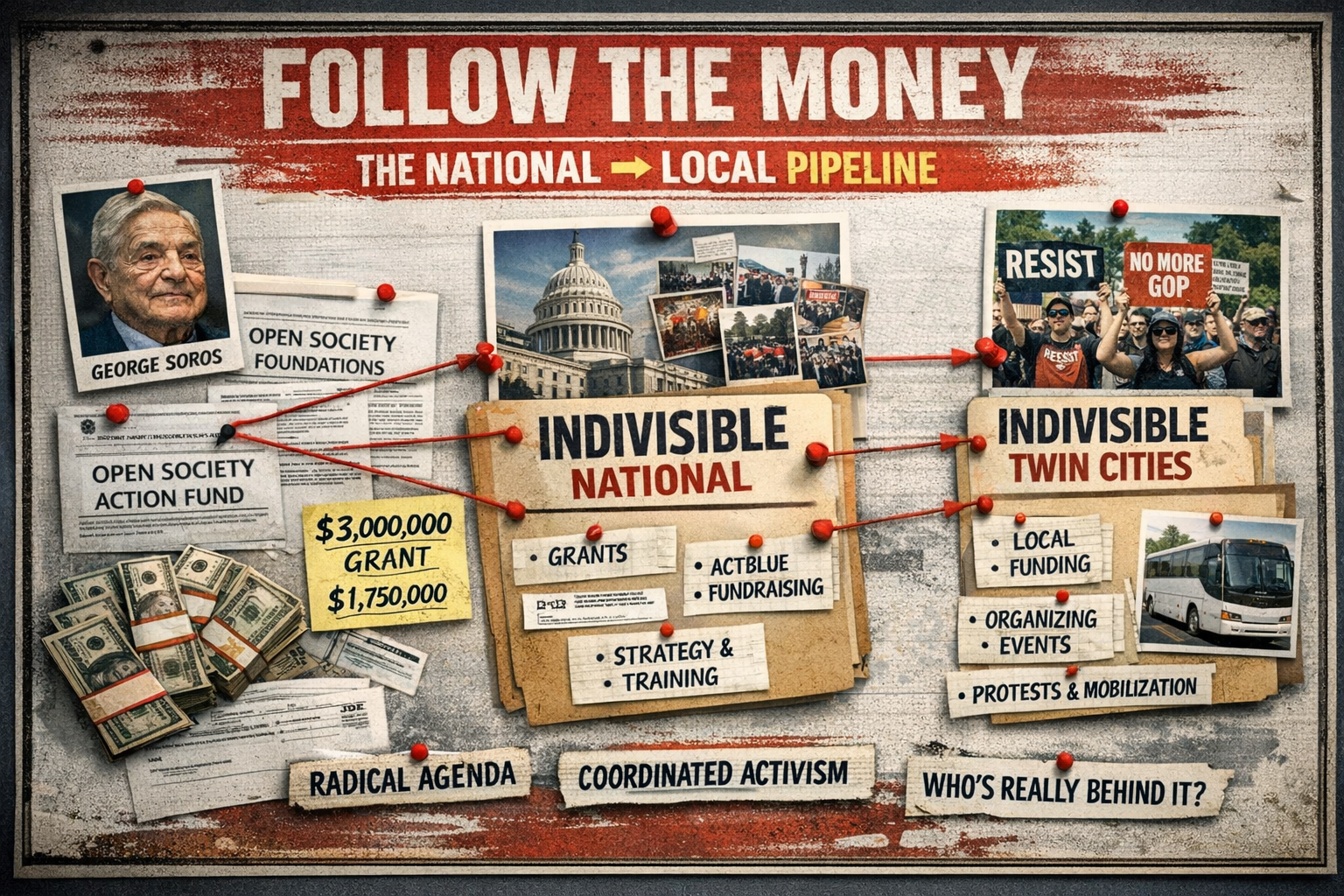
This article examines how Indivisible National and Indivisible Twin Cities functions as part of a broader national infrastructure that moves money, narratives, and logistics from elite donor networks into local political pressure campaigns. Drawing on public grant records, organizational disclosures, and the analytical framework outlined in Peter Schweizer’s The Invisible Coup, the article traces how national funding pipelines, ideological alignment, and permissive political environments converge to produce coordinated local unrest—particularly in places like Minnesota’s Twin Cities.
What emerges is not a story of isolated civic engagement, but of institutionalized activism: a system in which NGOs, philanthropy, political leadership, and street-level tactics reinforce one another while accountability becomes increasingly diffuse. Understanding this system is essential—not just to interpreting individual protests, but to assessing how modern power is exercised, quietly and at scale, outside traditional democratic checks.In The Invisible Coup, Peter Schweizer argues that the modern U.S. immigration system is not merely “broken” or overwhelmed, but is being deliberately leveraged as a tool of power. Schweizer frames this as a “coup” not in the military sense, but as a quiet shift in sovereignty and governance, where enforcement priorities, demographic outcomes, and institutional authority change without clear public consent.
Indivisible Twin Cities presents itself as a grassroots, volunteer-driven civic movement. Public records, grant disclosures, and the organization’s own operational framework reveal something far more sophisticated: a nationally funded, anti-capitalist, Marxist ideologically driven political machine designed to convert elite capital, narratives, and logistics into sustained local pressure campaigns.
This structure is not unique to Indivisible. It fits squarely within a broader system described in Peter Schweizer’s 2026 investigative book, The Invisible Coup: How American Elites and Foreign Powers Use Immigration as a Weapon—a system in which NGOs, philanthropy, political leadership, and activist networks operate in aligned lanes to produce outcomes that fundamentally reshape governance without direct public consent.
A National Organization Built on Major Foundation Funding
The Indivisible Project is a 501(c)(4) political advocacy organization founded in 2016 by former Democratic congressional staffers. From the beginning, it was conceived not as a temporary protest movement, but as permanent resistance infrastructure.
Public grant records from the Open Society Foundations network (funded by Marxist George Soros), including the Open Society Action Fund, show that Indivisible has received millions of dollars in funding over multiple years. These grants—listed in Open Society’s own public databases—are explicitly designated for “social welfare,” “advocacy,” and “organizational support.”
Open Society, founded by billionaire financier George Soros, is not a neutral charity. It is a political philanthropy committed to structural transformation of nation-states, with an anti-capitalist, pro-Marxist agenda, border regimes, and enforcement systems. Indivisible is funded because it advances those objectives.
This funding establishes capacity: paid staff, national messaging, legal support, training, data systems, and logistics that no purely volunteer organization could sustain.
Ideology: Radical Transformation, Not Incremental Reform
Indivisible does not claim neutrality. Its national platform openly frames its mission as opposing “MAGA authoritarianism,” dismantling conservative governance structures, resisting immigration enforcement, and applying constant pressure against Republican officials at every level of government.
While Indivisible does not formally label itself “Marxist,” its policy objectives, coalition partners, and funding ecosystem place it firmly within the radical left activist space. It aligns with organizations and movements that draw from Marxist, socialist, and anti-capitalist frameworks, often rebranded under modern language such as “equity,” “abolition,” or “systemic transformation.”
This ideological orientation matters because it shapes not just protest rhetoric, but tactics, escalation strategies, and political objectives.

The Schweizer Framework: Immigration as a Weaponized System
In The Invisible Coup, Peter Schweizer argues that the modern U.S. immigration system is not merely “broken” or overwhelmed, but is being deliberately leveraged as a tool of power. Schweizer frames this as a “coup” not in the military sense, but as a quiet shift in sovereignty and governance, where enforcement priorities, demographic outcomes, and institutional authority change without clear public consent.
Central to Schweizer’s thesis is the existence of aligned incentive networks—not a single command structure, but a convergence of interests involving:
Foreign governments and hostile actors that benefit from mass migration flows,
Transnational criminal networks,
Domestic elites, NGOs, philanthropies, and political actors who gain power, labor, or ideological leverage from weak enforcement.
Schweizer explicitly describes how NGOs and advocacy groups function as downstream force multipliers, moving money, narratives, and logistics in ways that normalize and protect these outcomes while blurring accountability.
Indivisible fits precisely into this ecosystem.
How National Money Becomes Local Pressure
Indivisible’s effectiveness lies in its structure. The national organization does not simply advocate—it deploys resources.
Indivisible operates:
National fundraising platforms that allow local chapters to raise and spend money through approved systems,
Direct grant programs that fund organizing, outreach, training, materials, and coordinated actions,
National toolkits that standardize messaging, protest timing, and escalation tactics across cities.
This mirrors what Schweizer describes as “influence without overt control”—where organizations appear independent locally but operate within a shared national architecture funded and sustained by elite capital.
Indivisible Twin Cities: A Local Node in a National System
Indivisible Twin Cities identifies itself as a local chapter of the national Indivisible movement. While it presents its activities as community-driven and volunteer-based, it functions within—and benefits from—the national organization’s funding pipelines, strategic guidance, and mobilization infrastructure.
This explains why protests associated with Indivisible in the Twin Cities are frequently highly coordinated, well-resourced, and rapidly mobilized, resembling professional operations rather than spontaneous civic action. Reporters recently aired protestors acknowleding they were paid to protest.
Indivisible Twin Cities is not an outlier. It is a local expression of a national system.
Political Alignment in Minnesota: A Permissive Environment
In Minnesota, this organizing has unfolded within a political climate shaped by sympathetic leadership. Governor Tim Walz and Twin Cities municipal leadership in St. Paul and Minneapolis have repeatedly taken public positions opposing federal immigration enforcement and criticizing ICE operations.
Their rhetoric closely mirrors narratives promoted by Indivisible and allied advocacy groups. While direct operational coordination is rarely formalized, the alignment between activist messaging, protest timing, and public statements from state and city leadership has created a permissive political environment—one in which organized activist pressure is politically protected rather than restrained.
This dynamic is consistent with Schweizer’s description of blurred accountability, where elected officials, NGOs, and advocacy groups reinforce one another while responsibility for outcomes becomes diffuse.
From Protest to Disruption: Tactics on the Ground
On the streets, activity tied to these movements has frequently escalated beyond peaceful demonstration. Reporting and eyewitness accounts have documented aggressive and disruptive tactics, including protesters freezing water bottles and throwing them at police, blocking streets and vehicles, surrounding law enforcement units, and employing coordinated crowd-movement techniques designed to overwhelm police lines.
These are not improvised behaviors. They mirror standardized tactics used by professionally organized protest movements nationwide, intended to exhaust law enforcement resources, provoke confrontation, and generate viral media moments that amplify political pressure.
Paid Protesters or Funded Mobilization? The Real Question
Indivisible is careful not to show line-item payments labeled “paid protesters.” However, insiders acknowledge they have cash funds for paying protestors without a paper trail. Schweizer argues, focusing solely on individual payments misses the larger system.
The reality is institutionally funded mobilization. Money flows from elite donors into national organizations, from national organizations into local infrastructure, and from infrastructure into turnout, logistics, messaging, legal support, and escalation capacity. Many argue the funds syphoned from the fraudulent Day Care Centers, Home Health, and transportation organizations in Minnesota also divert funds, which aligns with what Schweizer has uncovered.
Whether money is handed directly to individuals or used to engineer mass participation through funded systems is a distinction without meaningful difference in outcome.
The Bottom Line
Indivisible is not a simple nonprofit. It is a nationally funded, ideologically driven political operation that fits squarely within the ecosystem described in The Invisible Coup:
Funded by elite philanthropic networks,
Advancing a radical, system-changing agenda,
Operating through NGOs and advocacy structures that blur accountability,
Translating national money into local disruption and political pressure.
Indivisible Twin Cities is not an exception. It is a node in a national machine.
The funding is real.
The ideology is real.
The system is real.
And the public deserves to understand how it operates—quietly, professionally, and at scale.
References
Schweizer, P. (2026). The invisible coup: How American elites and foreign powers use immigration as a weapon. HarperCollins.
Schweizer, P. (2026, January). Immigration as a national security weapon [Television interview]. CBS News. https://www.cbsnews.com/video/invisible-coup-author-peter-schweizer-immigration/
Open Society Foundations. (n.d.). Open Society Foundations grants database. Retrieved January 2026, from https://www.opensocietyfoundations.org/grants
Open Society Action Fund. (n.d.). Organizational mission and activities. Retrieved January 2026, from https://www.opensocietyactionfund.org/
InfluenceWatch. (n.d.). The Indivisible Project. Capital Research Center. Retrieved January 2026, from https://www.influencewatch.org/non-profit/the-indivisible-project-indivisible/
Indivisible. (n.d.). About Indivisible. Retrieved January 2026, from https://indivisible.org/about
Indivisible. (n.d.). Financial support and grant programs. Retrieved January 2026, from https://indivisible.org/campaign/financial-support
Indivisible. (n.d.). Distributed fundraising program. Retrieved January 2026, from https://indivisible.org/resource/distributed-fundraising-program/
Indivisible Twin Cities. (n.d.). Indivisible Twin Cities: Minnesotans resisting MAGA. Retrieved January 2026, from https://indivisibletwincities.org/
Fox News. (2026, January). Anti-ICE protests escalate as police face projectiles and crowd tactics. https://www.foxnews.com/
Breitbart News. (2026, January). Migration pressure, NGOs, and political coordination in U.S. cities. https://www.breitbart.com/
