
Before the Crisis Comes the Pressure: How Modern Psychological Operations (Influence) Is Engineered, Scaled, and Normalized
Seeing the Pressure Before the Headline: How Psychological Influence Really Works in the Modern World
In an age of nonstop news alerts, viral outrage, and rapid-fire crises, many people feel like events are constantly surprising them. Pandemics, social movements, geopolitical shocks, cultural flashpoints—everything seems to arrive suddenly, fully formed, and emotionally charged.
But what if the surprise isn’t the event itself?
What if the real signal happens before the headline—quietly, structurally, and predictably?
This article introduces a pressure-based framework for understanding modern psychological influence, sometimes called psychological operations (PSYOPs). The goal is not to promote paranoia or conspiracy thinking. It is to help readers become literate in how influence works, so they can recognize patterns, think clearly under pressure, and avoid being unintentionally steered.
Stop Predicting Events. Start Tracking Pressure.
Most people try to understand the world by predicting events:
When will something happen?
What will the crisis be?
Who caused it?
This approach almost always makes people late.
A more accurate method is to track pressure.
Events are simply how pressure resolves itself.
Pressure builds across systems—social, institutional, regulatory, and psychological—long before it becomes visible as a breaking news story. When enough pressure accumulates, something has to happen. The event is just the release valve.
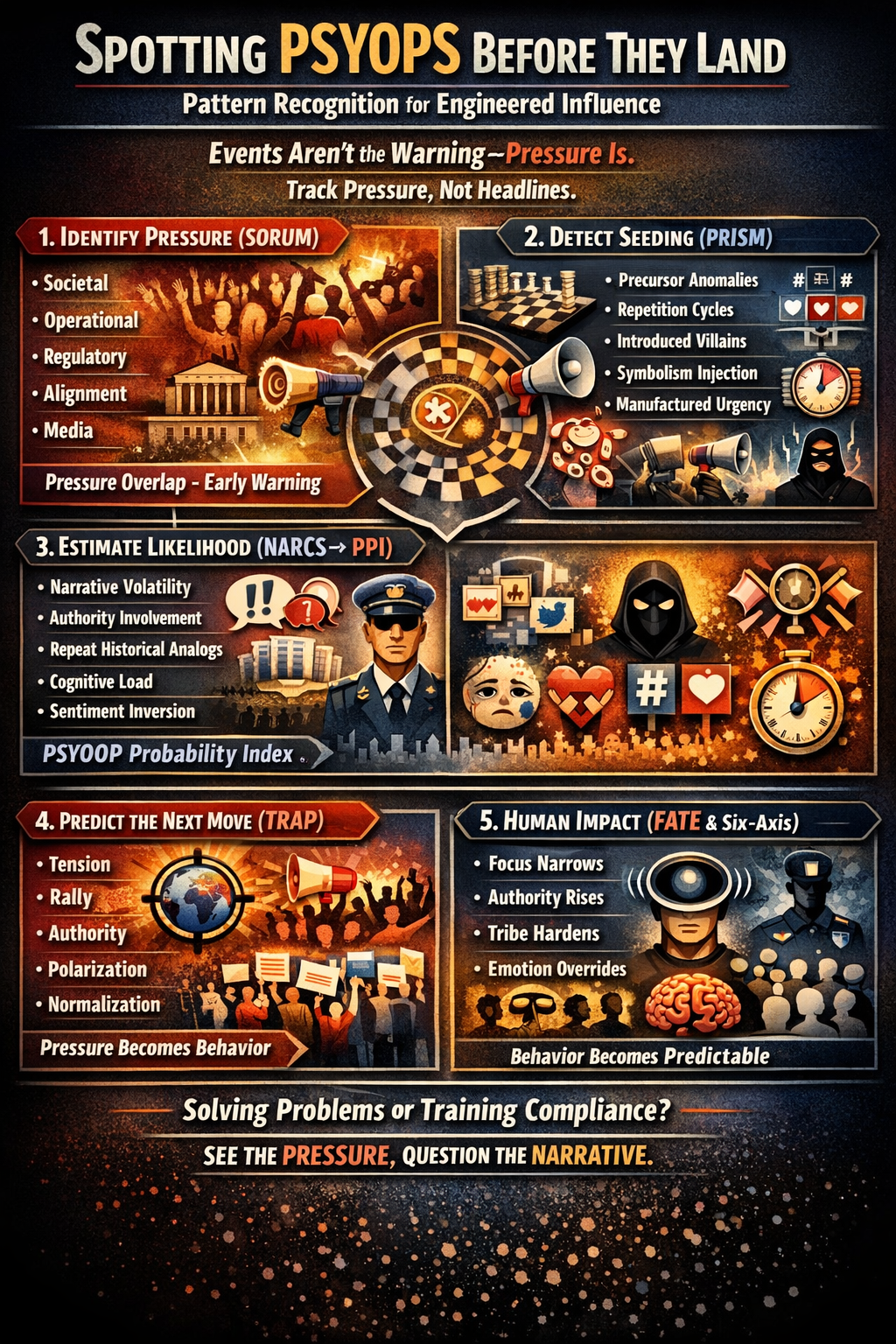
Phase One: Where Is the Pressure Coming From?
Pressure rarely comes from a single source. It forms when multiple domains begin moving in the same direction.
Key signals include:
Societal pressure: moral panics, “us vs. them” language, obsession with safety, danger, or misinformation
Operational pressure: drills, simulations, tabletop exercises, or rehearsals that appear before a crisis
Regulatory pressure: new rules or policies appearing before a crisis peaks (preparation, not reaction)
Institutional alignment: government, media, tech platforms, NGOs, and academia rapidly agreeing in unison
Media uniformity: identical phrases, metaphors, and emotional tones across outlets
When several of these appear together, it signals coordination, not coincidence.
Phase Two: Is the Environment Being Seeded?
Before people are asked to accept fear, compliance, or sacrifice, they are usually prepared psychologically.
Common seeding mechanisms include:
Precursor anomalies: oddly timed studies, simulations, or warnings
Repetition cycles: slogans or keywords appearing everywhere at once
Introduced villains: simplifying complex problems into a single group or enemy
Symbolism injection: colors, hashtags, badges, or branding that bypass rational thought
Manufactured urgency: no time for debate—“act now or else”
These techniques create familiarity before fear arrives, making later narratives feel intuitive and unavoidable.
Phase Three: How Likely Is Coordinated Influence?
Not all pressure is malicious. The key question is probability, not intent.
Influence becomes more likely when:
Language becomes emotionally extreme and highly viral
Authorities, experts, or celebrities dominate the messaging
The narrative closely resembles past campaigns that successfully shaped behavior
The public is already exhausted, stressed, or overwhelmed
Values begin to flip (questioning becomes harmful, silence becomes violence, compliance becomes virtue)
When these factors align, conditions are ripe for large-scale behavioral influence—regardless of who initiated it.
Phase Four: What Happens Next?
Pressure resolves in predictable stages:
Tension – fear, uncertainty, alarming forecasts
Rally – mass calls to action that feel morally urgent
Authority – enforcement, rule-setting, censorship, or penalties
Polarization – sorting people into “good” and “bad” groups
Normalization – new habits form; what was once extreme becomes routine
This is not speculation—it is a well-documented pattern in behavioral science and political psychology.
Phase Five: What This Does to Human Beings
Psychological influence works because it aligns with how the human brain responds under stress.
Under sustained pressure:
Focus narrows
Authority dependence increases
Tribal identity hardens
Emotion overrides cognition
At the same time:
Openness to new ideas decreases
Social connection erodes
Suggestibility rises
Compliance increases
Expectations are carefully managed
Once these levers are engaged, behavior becomes highly predictable.
The Most Important Question to Ask
When a new crisis, policy, or solution appears, the most important question is not:
“Do I agree with this?”
It is:
“Is this solving a real problem—or is it training people to adapt to pressure?”
That single question restores agency, clarity, and critical thinking.
Why This Matters
None of this requires believing in shadowy masterminds or secret cabals. Influence systems work because:
They exploit known human defaults
They scale through modern media
They operate faster than conscious awareness
Understanding pressure does not make someone cynical.
It makes them less manipulable.
In a world where information moves faster than reflection, literacy in influence is no longer optional—it is a survival skill.
References
Cialdini, R. B. (2009). Influence: Science and practice (5th ed.). Pearson Education.
Herman, E. S., & Chomsky, N. (1988). Manufacturing consent: The political economy of the mass media. Pantheon Books.
Kahneman, D. (2011). Thinking, fast and slow. Farrar, Straus and Giroux.
Sunstein, C. R. (2014). Why nudge? The politics of libertarian paternalism. Yale University Press.
Thaler, R. H., & Sunstein, C. R. (2008). Nudge: Improving decisions about health, wealth, and happiness. Yale University Press.
Tversky, A., & Kahneman, D. (1974). Judgment under uncertainty: Heuristics and biases. Science, 185(4157), 1124–1131.
Wardle, C., & Derakhshan, H. (2017). Information disorder: Toward an interdisciplinary framework for research and policy making. Council of Europe.
