

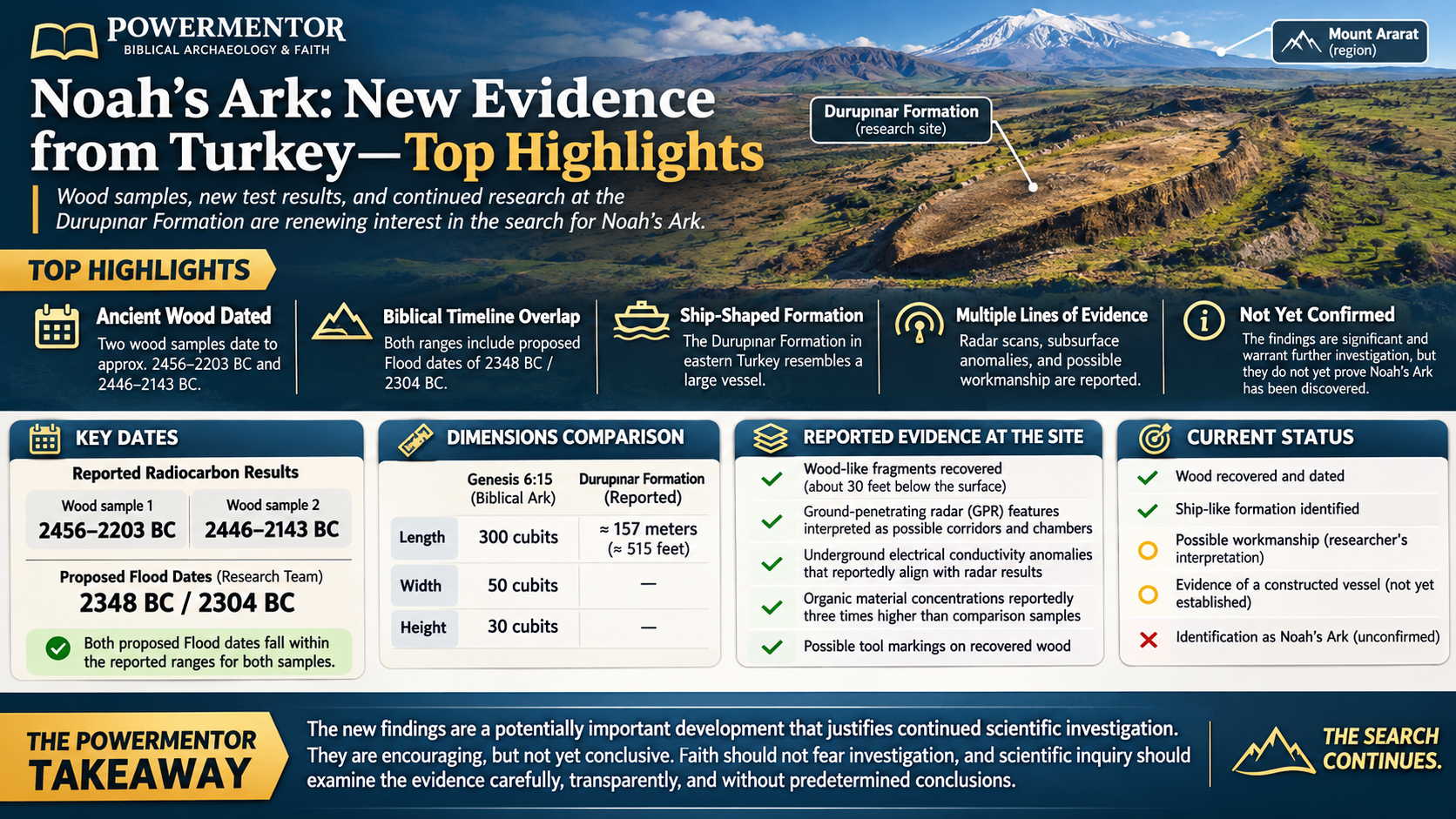
New archaeological findings from eastern Turkey are renewing interest in one of the Bible’s most significant historical accounts: Noah’s Ark and the Great Flood described in Genesis chapters 6–9.
According to a November 2026 report by The Christian Post, researchers investigating the Durupınar Formation near Mount Ararat have announced radiocarbon dating results from two recovered wood samples. The reported dates overlap with traditional biblical timelines associated with Noah's Flood.
While researchers have not conclusively identified the formation as Noah's Ark, the findings have generated renewed interest in the possibility that physical evidence connected to the biblical account may still exist.
TOP FIVE HIGHLIGHTS
1. ANCIENT WOOD DATED TO MORE THAN 4,000 YEARS AGO
Researchers report that two wood samples recovered from the investigation produced the following radiocarbon date ranges:
Sample 1: 2456–2203 BC
Sample 2: 2446–2143 BC
The reported samples were recovered from approximately 30 feet beneath the surface.
These findings are significant because both date ranges overlap with proposed chronologies for the biblical Flood.
However, radiocarbon dating establishes an estimated age for organic material, not its connection to a particular historical event.
2. BIBLICAL FLOOD TIMELINE OVERLAP
The research team identified two traditionally proposed dates for Noah's Flood:
2348 BC
2304 BC
Both dates fall within the reported radiocarbon ranges of the recovered wood samples.
This chronological overlap is one reason researchers consider the findings worthy of further investigation.
Importantly, these are proposed biblical dates derived from particular chronological interpretations. They are not universally accepted dates for the Flood.
3. SHIP-SHAPED FORMATION RESEMBLES BIBLICAL DIMENSIONS
The Durupınar Formation is a distinctive, ship-shaped geological feature in eastern Turkey.
Its reported length is approximately 157 meters (515 feet).
Genesis 6:15 describes Noah's Ark as:
Length: 300 cubits
Width: 50 cubits
Height: 30 cubits
Researchers have compared the formation's length with the biblical measurement of 300 cubits, particularly when using the longer Egyptian royal cubit.
The resemblance in shape and approximate length has attracted attention for decades, although it does not independently establish that the formation is a constructed vessel.
4. MULTIPLE LINES OF REPORTED PHYSICAL EVIDENCE
The investigation has produced several observations that researchers believe warrant further examination:
Recovered Wood: Wood-like fragments reportedly recovered approximately 30 feet beneath the surface.
Ground-Penetrating Radar: Subsurface features interpreted by researchers as possible corridors, chambers, and structural components.
Electrical Conductivity: Underground anomalies reportedly corresponding with some radar observations.
Organic Material: Concentrations reportedly three times higher than comparison samples.
Possible Workmanship: Researchers have suggested that some recovered fragments may contain markings consistent with human activity.
These findings are intriguing, but their interpretation remains under investigation. Independent analysis is necessary to distinguish evidence of human construction from natural geological processes.
5. NOAH'S ARK HAS NOT YET BEEN CONCLUSIVELY IDENTIFIED
The research team has reported encouraging findings, but several essential questions remain unanswered.
Investigators must still determine whether the recovered wood originated from a human-made structure, whether the subsurface anomalies represent actual construction, and whether the formation could be associated with an ancient vessel.
The discovery of ancient organic material does not, by itself, establish that Noah's Ark has been found.
Further laboratory analysis, geological examination, and independent scientific review will be essential.
WHY THIS MATTERS
The biblical account of Noah's Ark is more than a story about a massive vessel surviving a catastrophic flood.
It addresses divine judgment, human corruption, obedience, preservation, and God's covenant with humanity.
Genesis 8:4 records that the Ark came to rest upon the mountains of Ararat.
The passage identifies a mountainous region rather than specifically naming the summit of modern Mount Ararat, making investigations throughout the surrounding area relevant to the historical search.
If future research establishes that the Durupınar Formation contains an ancient constructed vessel, it would represent a potentially extraordinary archaeological discovery.
Whether that vessel could be connected to the biblical account would require additional evidence.
THE POWERMENTOR PERSPECTIVE
Faith should not fear scientific investigation, and science should not dismiss historical questions simply because they originate in Scripture.
The reported findings deserve serious, transparent, and independent examination.
The convergence of ancient wood, radiocarbon dates overlapping proposed biblical chronologies, a ship-shaped formation, and unusual subsurface features creates questions worthy of continued research.
At the same time, responsible investigation requires separating established findings from interpretations and unverified claims.
The ultimate objective should not be to force evidence into a predetermined conclusion, but to discover what the evidence actually reveals.
For believers, the account of Noah remains a powerful testimony of obedience, perseverance, divine judgment, and preservation.
For researchers, the Durupınar Formation remains an intriguing archaeological and geological question.
THE POWERMENTOR TAKEAWAY
The latest findings from Turkey may represent an important development in the continuing search for Noah's Ark.
Two reported radiocarbon date ranges overlap with proposed biblical Flood timelines. Researchers have also identified unusual geological and subsurface features that warrant further investigation.
The evidence is encouraging to those pursuing the Ark hypothesis, but the identification remains unconfirmed.
The search continues. The questions remain. And the pursuit of truth demands that evidence be examined carefully, transparently, and without predetermined conclusions.
SOURCE: The Christian Post, November 2026
Noah's Ark researcher says wood samples date to Genesis Flood
