

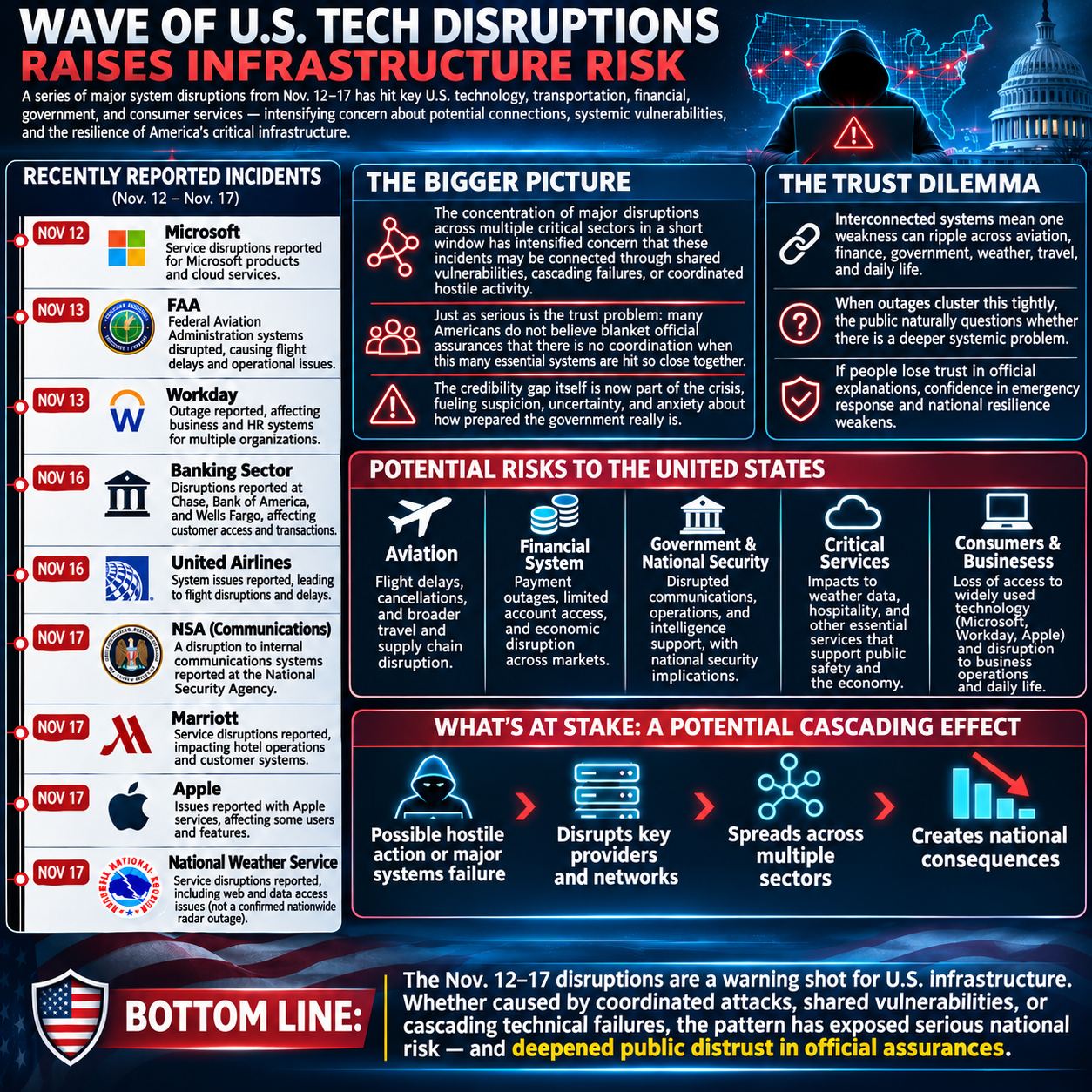
The recent wave of outages affecting Microsoft, the FAA, major financial institutions, United Airlines, the NSA, Apple, Marriott, and other digital services raises a significant national-security concern:
How resilient is the United States when essential government and private-sector systems become unavailable at the same time or in rapid succession?
The greatest danger is not necessarily that every outage represents a cyberattack. It is that America's critical infrastructure has become so digitally interconnected that a failure in one system can produce consequences across multiple industries.
This creates three distinct threats:
Cyber vulnerability: A hostile actor could exploit shared technology, software, networks, or service providers to disrupt multiple organizations.
Systemic fragility: Ordinary software defects, failed updates, and equipment problems can cause widespread disruptions even without malicious interference.
Cascading failures: When banking, aviation, communications, healthcare, or emergency services depend on systems that fail, the resulting disruption can spread well beyond its original source.
The reported incidents are real causes for concern, but the evidence does not currently establish a coordinated cyberattack. Reporting on November 17 indicated that national-security officials had found no evidence linking the incidents to hostile activity. (ABC News)
The critical question is therefore broader than "Are we under attack?"
It is: "If these systems can experience serious disruptions independently, what happens when a sophisticated adversary deliberately targets their shared dependencies?"
1. Why these outages are especially concerning
Aviation: A relatively small technical failure can have national consequences.
The November 13 FAA disruption is particularly revealing. According to the FAA, work involving a network router contributed to a nationwide ground stop, with thousands of flights canceled. This demonstrates how critical communications infrastructure can become a single point of widespread operational failure. (Federal Aviation Administration)
Banking: One institution's problem can affect other institutions.
On November 16, a technical issue at JPMorgan Chase produced disruptions involving transactions at other financial institutions. This illustrates the risk of shared payment networks and financial interdependencies. A longer or more extensive failure could affect payroll, commerce, healthcare payments, and public confidence. (Yahoo Finance)
National security: Even classified systems can suffer operational failures.
The November 17 NSA internal communications outage demonstrates that highly protected government networks are not immune to technical disruption. Reporting points toward software maintenance rather than an attack, but the incident raises important questions about backup communications and recovery capabilities. (CBS News)
Technology concentration: Too many essential services depend on too few systems.
The Microsoft, Workday, Apple, and other service disruptions illustrate the concentration risk created when organizations depend on common cloud platforms, authentication services, and software providers. Even unrelated failures can reveal weaknesses in operational resilience.
2. How a cascading infrastructure failure could unfold
The following is an illustrative scenario, not a claim that these events have occurred together.
CISA has long warned that infrastructure sectors are interdependent and that disruptions can cascade from one sector to another. That is why this scenario warrants attention even when individual incidents have nonmalicious explanations. (CISA)
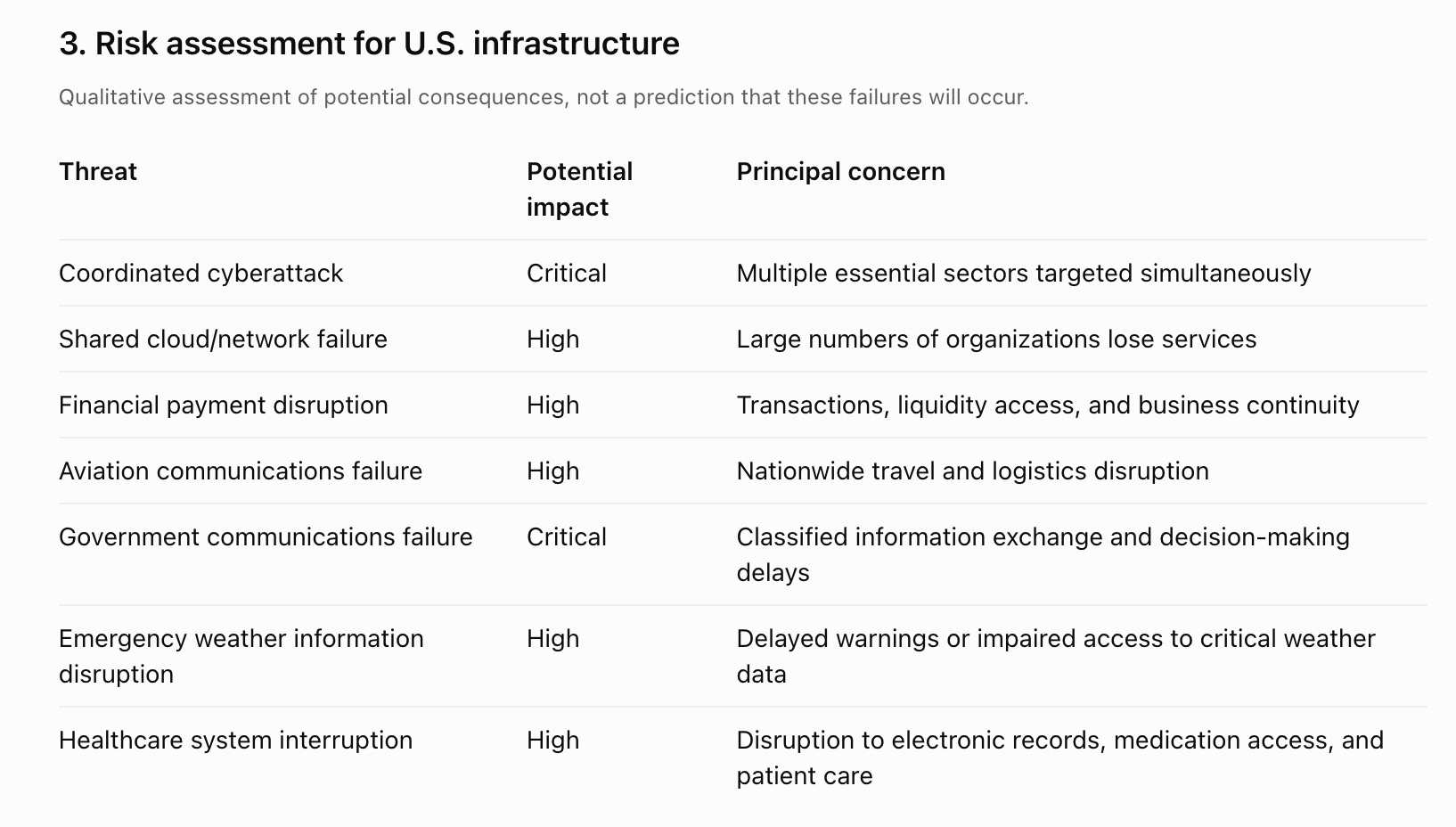
A clarification concerning the previous infographic: reports of a nationwide National Weather Service radar outage were disputed by the NWS, and Reuters withdrew an earlier report based on outdated information. Some web or API access issues were separately reported. The NWS should therefore not be depicted as having suffered a confirmed nationwide radar failure. (Investing.com)
4. The national-security dilemma
The United States faces a difficult strategic challenge.
Modernizing aging systems is essential, yet installing new technologies and integrating additional vendors can itself introduce operational risk. Meanwhile, increasing dependence on interconnected networks creates opportunities for adversaries to exploit vulnerabilities that may also be exposed by ordinary technical failures.
This creates four priorities for national leaders:
Determine the actual causes: Investigate each incident independently while examining common dependencies and the possibility of hostile activity.
Identify concentrated risks: Determine which contractors, networks, cloud platforms, and software services could create failures across multiple sectors.
Strengthen independent backup systems: Ensure emergency communications, manual procedures, alternative payment methods, and essential public services can continue without primary networks.
Test coordinated national response: Conduct realistic exercises simulating simultaneous disruptions to aviation, banking, healthcare, and government communications.
5. Strategic conclusion for PowerMentor
The events of November 12–17 represent a meaningful warning about America's digital infrastructure.
The absence of evidence of a coordinated cyberattack does not mean that our infrastructure is adequately protected against one.
In fact, the concern is that failures reportedly caused by ordinary software changes, hardware problems, and operational errors have already produced consequences across important national systems.
A hostile actor would not necessarily need to destroy American infrastructure to cause serious disruption. Denying access to critical information, interrupting communications, or rendering dependent services unavailable could be enough to create substantial economic and operational damage.
The central national-security lesson is this:
A nation can possess extraordinary military, technological, and economic power while remaining vulnerable to failures in the digital systems connecting them.
The United States must investigate whether these incidents reveal systemic weaknesses, strengthen its ability to maintain essential functions during outages, and ensure that a single point of failure cannot become a national emergency.
That is the issue worth elevating—not an unproven assertion that these events were coordinated, but the demonstrated consequences of fragile technological dependencies.
