

THE DEVELOPING SITUATION
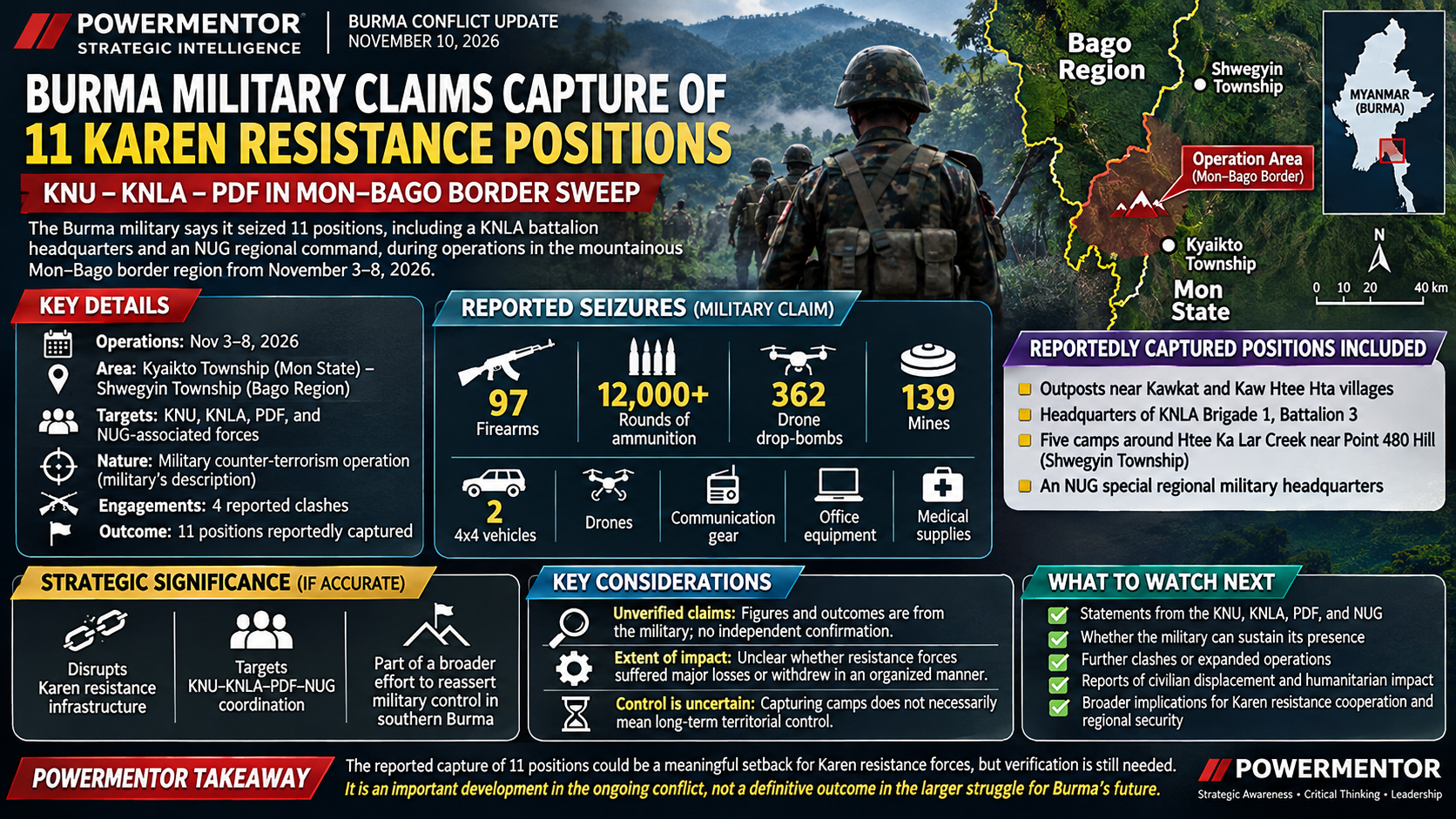
Between November 3 and November 8, 2026, Burma's military launched a coordinated operation against positions reportedly occupied by the Karen National Union (KNU), Karen National Liberation Army (KNLA), People's Defence Force (PDF), and forces associated with the National Unity Government (NUG).
According to reporting published by Eleven Myanmar, military columns operating from Theinzayat targeted resistance positions across the mountainous territory separating Kyaikto Township in Mon State and Shwegyin Township in Bago Region.
The military claims its forces captured 11 positions following four armed engagements, including facilities associated with KNLA Brigade 1, Battalion 3, and an NUG special regional military headquarters.
The reported seizures included:
97 firearms and more than 12,000 rounds of ammunition.
362 drone-deployed explosive devices.
139 mines.
Drones, communications equipment, and other military supplies.
Two four-wheel-drive vehicles.
Medical supplies and administrative equipment.
These figures originate from the Burma military and have not been independently verified. At the time of the initial reporting, independent confirmation from the KNU, KNLA, and NUG was unavailable.
Nevertheless, the reported operation deserves serious attention because of what it could mean for Karen resistance capabilities, cooperation among armed organizations, and the wider conflict.
1. WHY THIS OPERATION MATTERS
The significance of this operation extends beyond the reported capture of 11 camps.
The military claims to have struck an area containing both KNLA infrastructure and an NUG regional command facility. If accurate, this suggests an operation aimed at disrupting the coordination, logistics, communications, and operational capabilities of several resistance organizations.
The KNU and KNLA represent longstanding Karen political and military institutions, while the PDF and NUG emerged following the February 2021 military coup.
Although these organizations have cooperated against Burma's military, their histories, structures, and political objectives are not identical.
Their cooperation creates opportunities for coordinated resistance. It also introduces operational challenges involving command relationships, intelligence sharing, logistics, and differing organizational priorities.
A military operation targeting shared facilities could therefore have consequences beyond the loss of individual outposts.
The central strategic question is not simply how many positions were captured, but whether the operation materially disrupted the resistance organizations' ability to function.
That distinction is critical.
A headquarters can be abandoned while its command structure remains operational. Equipment can be replaced. Personnel can reorganize. Conversely, the loss of experienced leadership, communications capabilities, and essential logistical infrastructure can create more lasting difficulties.
The available reporting does not yet establish which circumstances apply.
2. THE IMPORTANCE OF TERRITORY AND GEOGRAPHY
The reported fighting occurred in the mountainous Mon–Bago border region, an area with strategic connections to southern Burma.
Mountainous terrain can provide natural defensive advantages, concealed movement routes, and opportunities for dispersed military operations.
However, geography alone does not guarantee security.
Sustaining military positions requires reliable supply networks, communications, medical support, intelligence, and the ability to move personnel when circumstances change.
The reported presence of drone equipment, weapons, vehicles, and communications systems suggests that the targeted locations may have supported more than temporary defensive positions.
If these facilities were functioning as regional operational centers, their loss could affect activities across a wider area.
However, the seizure of camps does not automatically establish permanent territorial control.
Holding territory requires a sustained presence, logistical support, and the ability to respond to further attacks.
The Burma military has announced its intention to continue security operations. Whether it can maintain control of the reported positions remains an important unanswered question.
3. THE BIGGER CHALLENGE: COORDINATION AMONG RESISTANCE ORGANIZATIONS
One of the most important strategic lessons from this development concerns cooperation among organizations operating in the same conflict environment.
The KNU, KNLA, PDF, and NUG have overlapping interests in opposing Burma's military, but they do not necessarily share identical long-term political visions.
For Karen communities, this distinction is particularly important.
The Karen struggle for self-determination predates the 2021 coup by decades. Its history, political aspirations, and institutional identity cannot be reduced to the more recent national resistance movement.
Cooperation among armed organizations may provide military advantages, but it does not eliminate differences in political objectives.
Effective cooperation requires clearly understood responsibilities, dependable communications, and mutual respect for each organization's identity and interests.
The reported losses in Mon–Bago do not prove that coordination failed. There is currently insufficient evidence to establish that conclusion.
However, they highlight the importance of evaluating whether cooperation produces sustainable operational capabilities and whether participating organizations retain the institutional strength necessary to pursue their long-term objectives.
Unity should be measured by effective cooperation and shared results, not merely by public declarations of solidarity.
4. UNDERSTANDING THE MILITARY'S INFORMATION STRATEGY
Another important dimension is the manner in which the operation has been presented publicly.
Burma's military describes the campaign as a counter-terrorism operation and characterizes the targeted resistance organizations as terrorist groups.
These descriptions reflect the military's official position and should not be confused with independently verified findings.
Military communications during armed conflicts frequently serve multiple purposes.
They report battlefield developments, but they may also seek to influence public perceptions, reinforce political legitimacy, reassure supporters, and undermine the confidence of opponents.
The announcement of captured headquarters, weapons, ammunition, and drone equipment may therefore have both military and informational significance.
Independent verification is essential.
Questions remain about the precise locations captured, the condition of the facilities, the number of personnel affected, and whether resistance organizations withdrew before military forces arrived.
Without independent confirmation, the reported figures should be treated as claims rather than established battlefield outcomes.
This is especially important when information is circulated internationally or used to influence public discussions among Karen communities.
5. IMPLICATIONS FOR THE KAREN PEOPLE
For the Karen people, the significance of this development is not limited to military calculations.
Decades of conflict have affected families, communities, education, healthcare, livelihoods, and the ability of displaced people to return safely to their homes.
Renewed fighting in southern Burma raises concerns about civilian security and humanitarian access.
If military operations expand, communities near contested areas could face additional displacement, restricted transportation, disrupted medical services, and interruptions to food supplies.
The current reporting does not establish the scale of civilian displacement resulting from this specific operation.
Nevertheless, civilian protection must remain central to any assessment of its consequences.
Karen communities also face a broader political challenge: maintaining attention on long-term aspirations while responding to immediate military and humanitarian developments.
Local battlefield events can dominate public discussion, but the larger questions concern political representation, territorial governance, institutional development, security, and the future of Karen self-determination.
Military developments should be examined in relation to those broader objectives rather than treated as isolated victories or defeats.
6. WHAT DOES THIS MEAN FOR THAILAND?
The reported operation took place in the Mon–Bago region, not directly along the Thai–Burma border.
There is currently no verified evidence connecting the seizure of these 11 positions to an immediate new security threat inside Thailand.
However, the wider conflict remains relevant to Thailand because of its proximity to Karen-populated territories, longstanding cross-border relationships, humanitarian responsibilities, and regional security interests.
Continued instability in Burma can affect border communities through displacement, interrupted trade, humanitarian needs, and security concerns.
Thailand's future response will depend on developments along its own border, decisions by Thai authorities, and the broader diplomatic environment.
For Karen communities and international observers, it is important to distinguish actual cross-border developments from speculation.
Diplomatic engagement, humanitarian coordination, and reliable communication with Thai authorities remain important components of regional stability.
7. THE MACRO PICTURE: LOOK BEYOND INDIVIDUAL BATTLES
One of the greatest challenges in prolonged conflicts is the tendency to focus exclusively on immediate events.
A captured camp becomes the headline.
A disagreement between organizations becomes the public argument.
A military announcement becomes the dominant narrative.
Meanwhile, the larger strategic environment continues to evolve.
The future of Burma will be shaped not only by battlefield developments but also by political institutions, international diplomacy, economic conditions, humanitarian access, and the ability of communities to develop sustainable governance.
For the Karen people, understanding this broader environment is essential.
Internal disagreements may be consequential, particularly when they involve governance, representation, accountability, or political objectives. But prolonged disputes that consume attention without producing constructive outcomes can distract from more immediate humanitarian and strategic challenges.
The Mon–Bago operation illustrates why it is necessary to examine developments at two levels:
The micro level: What happened during the operation? Which positions were captured? What equipment was lost? What forces remain operational?
The macro level: How does the operation affect regional military control, resistance cooperation, civilian security, political objectives, and the wider future of Burma?
Both levels matter.
But understanding the macro environment is essential for recognizing the long-term consequences of immediate events.
8. WHAT HAPPENS NEXT?
Several developments will help clarify the significance of this operation.
First, statements from the KNU, KNLA, PDF, and NUG may establish whether the reported captures occurred as described.
Second, subsequent fighting will help determine whether the Burma military can maintain its presence in the affected territory.
Third, evidence concerning the NUG regional command will help clarify whether the reported headquarters seizure disrupted its operational capabilities.
Fourth, humanitarian reporting will be important for determining whether nearby civilian communities have experienced displacement or other consequences.
Finally, continued monitoring of southern Burma will help establish whether the operation was a localized campaign or part of a broader military effort.
At present, the available information does not support a definitive conclusion about the operation's long-term outcome.
POWERMENTOR STRATEGIC PERSPECTIVE
The reported capture of 11 resistance positions in the Mon–Bago region represents a development that warrants close attention.
If confirmed, the loss of KNLA and NUG-associated facilities could create operational challenges for resistance organizations active in southern Burma.
However, a military announcement should not be mistaken for a complete assessment of battlefield conditions.
The durability of any territorial gain, the condition of resistance forces, and the consequences for civilians remain uncertain.
For the Karen people, the enduring issues are larger than any single military engagement.
They include the protection of communities, preservation of political identity, effective institutional leadership, regional diplomacy, and the pursuit of a secure political future.
The lesson is clear: Do not confuse the outcome of one battle with the outcome of an entire struggle.
Military positions can change hands. Organizations can reorganize. Political circumstances can shift.
What ultimately matters is whether developments on the ground strengthen or weaken the conditions necessary for lasting security, legitimate governance, and meaningful self-determination.
The Mon–Bago operation should therefore be understood not merely as a report of captured camps, but as another development in a prolonged conflict whose consequences extend far beyond the battlefield.
SOURCES AND REFERENCES
Eleven Myanmar. (November 2026). Myanmar Military Seizes 11 Outposts of KNU, KNLA and PDF in Mon-Bago Border Sweep. https://elevenmyanmar.com/news/myanmar-military-seizes-11-outposts-of-knu-knla-and-pdf-in-mon-bago-border-sweep
Associated Press. (November 2026). Reporting on the Burma military's announcement and the absence of independent verification.
Global New Light of Myanmar. (November 10, 2026). Official military-state-media reporting concerning operations in the Mon–Bago border region.
PowerMentor | Strategic Awareness • Critical Thinking • Leadership
