

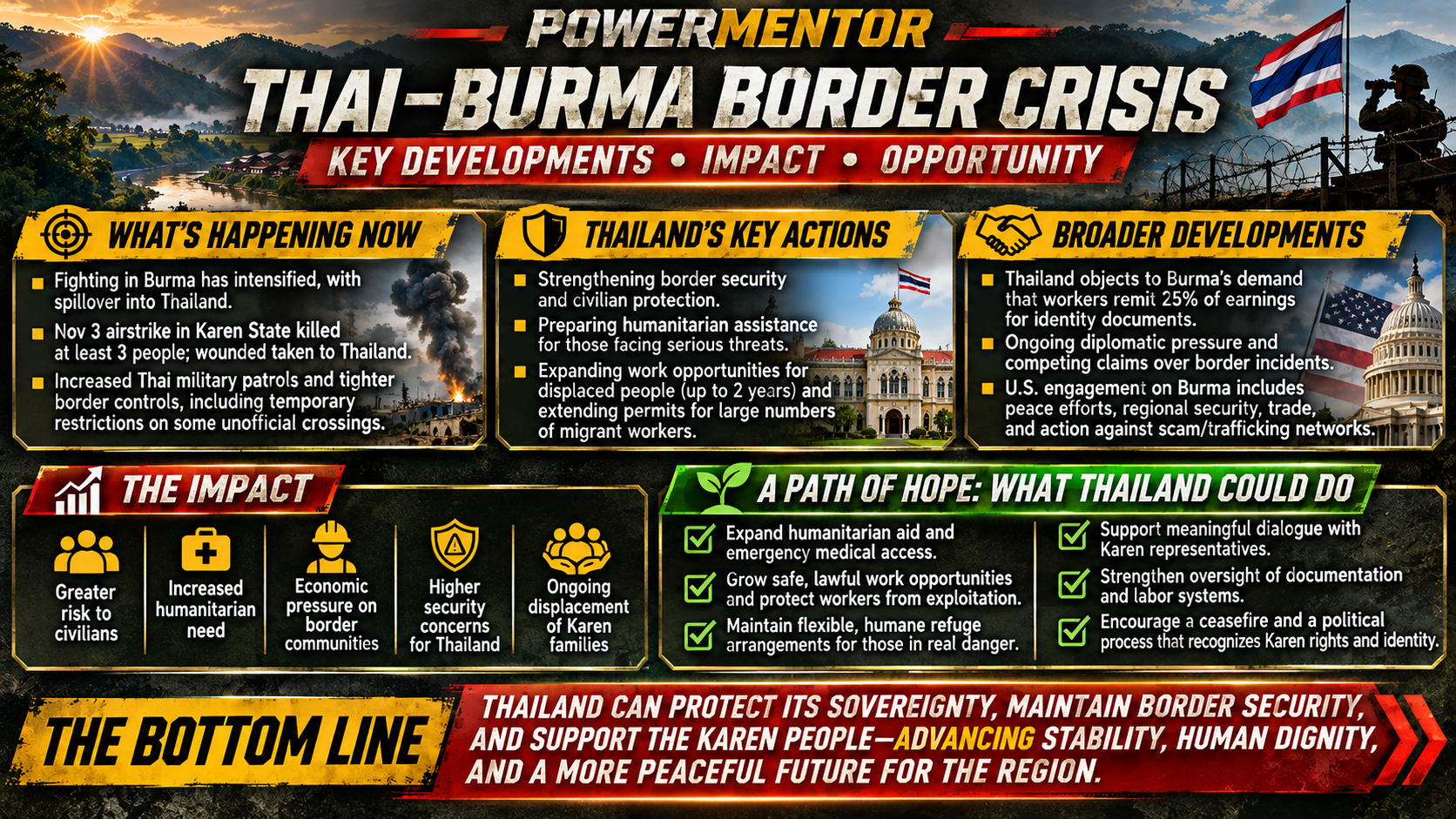
As Burma's military conflict spills across the border, Thailand faces a defining challenge: protecting its sovereignty while helping a neighboring people who have endured generations of conflict. For the Karen people of Kawthoolei, the decisions made in Bangkok could profoundly influence their security, livelihoods, and future.
A border under growing pressure
The Thai–Burma border is entering another dangerous period. Renewed fighting between Burma's military and Karen resistance forces has brought airstrikes, artillery fire, civilian casualties, damaged homes, and growing anxiety to communities along the frontier.
What was once viewed primarily as an internal conflict in Burma is increasingly affecting Thailand's national security, humanitarian responsibilities, economic interests, and regional diplomacy.
For the Karen people, these developments represent more than another chapter in a decades-long struggle. They raise urgent questions about survival, dignity, economic opportunity, and the right to determine their own future.
For Thailand, they create an opportunity to demonstrate regional leadership through a policy that combines border security, humanitarian protection, responsible economic cooperation, and meaningful dialogue with Karen communities.
Thailand does not need to enter Burma's war to become an important force for peace.
It can protect its own territory while helping establish the conditions in which Karen civilians can live safely, work legally, receive medical treatment, and participate in decisions affecting their homeland.
1. The fighting is no longer contained within Burma
On October 29, fighting near Myawaddy in Karen State sent ammunition across the Moei River into Thailand's Mae Sot district. A Thai woman was injured, and homes were damaged.
Days later, on October 31, a reported Burmese military airstrike near the Salween River damaged 17 houses in Thailand's Mae Sam Laep community in Mae Hong Son Province.
These incidents brought the conflict directly into Thai communities and prompted stronger border security measures, military patrols, and diplomatic engagement. (Myanmar Now)
The situation became more tragic on November 3, when a Burmese military airstrike struck a girls' dormitory near De Pu No in Karen State.
According to reporting published November 4, at least three people died and several others were injured. Critically wounded patients were transported across the Salween River into Thailand, where Thai medical personnel and emergency responders provided assistance. (Khaosod English)
This illustrates a fundamental reality: geography does not separate the humanitarian consequences of war.
When Karen civilians are injured, Thai hospitals may become their nearest source of lifesaving treatment. When fighting intensifies, Thai villages face risks from stray ammunition, explosive damage, interrupted commerce, and displacement.
The border may mark the limits of national sovereignty, but it cannot contain human suffering.
2. Thailand's government is strengthening border security
Prime Minister Anutin Charnvirakul's administration has responded by increasing surveillance, restricting selected unofficial trading routes, and communicating concerns to Burma's military authorities.
The Thai government temporarily suspended import-export privileges at certain unofficial crossings in Mae Sot and Phop Phra from October 30 through November 5, subject to security conditions.
Importantly, this was not a blanket closure of Thailand's officially authorized border trade. (Thairath English)
On November 9, the Royal Thai Army confirmed that it was maintaining around-the-clock surveillance, increasing patrols around Mae Sot, preparing emergency safe areas, and coordinating with local authorities to protect residents.
The military also described its use of warning fire and bilateral communications following incidents involving ammunition crossing into Thailand. (nationthailand)
These actions reflect legitimate Thai national security concerns.
Thailand has a responsibility to protect its citizens, defend its territorial integrity, prevent illegal arms movements, and maintain control over its international borders.
However, protecting Thailand's sovereignty and protecting Karen civilians are not competing objectives. A more stable, secure, and economically viable Karen region would also serve Thailand's long-term security interests.
The central challenge is ensuring that necessary security measures do not unnecessarily obstruct humanitarian assistance, lawful commerce, or access to emergency medical care.
3. A new humanitarian policy creates both concern and opportunity
On November 9, Prime Minister Anutin outlined Thailand's position following a National Security Council meeting.
He said Thailand would prepare humanitarian assistance for people fleeing the fighting, but that temporary admission would generally be limited to those facing serious threats to their lives. People admitted for protection would be expected to return when conditions permitted.
He also stated that Thai authorities had not reported new arrivals associated with the latest fighting at the time of the meeting. (Khaosod English)
This distinction matters enormously for Karen families living near active conflict zones.
Displacement does not always begin with a bomb falling directly on a house. Families may flee because nearby villages have been attacked, schools have closed, medical care has disappeared, or credible warnings indicate that an attack is imminent.
A humanitarian approach must recognize the practical realities of civilian survival.
PowerMentor believes Thailand can uphold its national security responsibilities while maintaining flexible, humane arrangements for people facing genuine danger.
That could include temporary protection, coordinated evacuation procedures, emergency medical access, and safe return only when conditions genuinely permit.
Humanitarian protection should be based on the reality of danger, not simply whether a civilian has already been wounded.
4. Thailand's labor-policy developments offer genuine hope
Amid the military escalation, an important and potentially constructive policy development has emerged.
On November 6, Thailand's Foreign Workers Management Policy Committee supported measures to expand employment opportunities for displaced people from Burma.
Under the reported arrangements, eligible displaced people could work within the districts containing their temporary shelters without individual work permits, with the employment period extended from one year to two years.
The committee also supported extensions for certain existing migrant workers and temporary legal stay and employment arrangements for more than 800,000 workers from three countries who lack regular status.
The precise implementation of these measures depends on applicable government approvals and regulations. (Khaosod English)
Thailand already has evidence that refugee employment can work.
In September 2026, UNHCR reported that more than 6,000 refugees had entered the workforce following Thailand's 2025 decision to grant eligible long-staying refugees access to employment. In October, Thailand's own delegation reported more than 6,800 displaced people participating in the labor market. (United Nations in Thailand)
The economic significance is substantial. Thai PBS reported on November 9 that Burma nationals accounted for approximately 3.33 million of Thailand's 4.23 million active foreign work permits as of September 2026. (Thai PBS World)
Legal employment offers benefits to both Thailand and displaced communities. Workers can support their families, reduce dependence on humanitarian assistance, contribute to local businesses, and build greater financial stability.
For Karen families, the opportunity to earn a lawful living represents something fundamental: dignity, self-reliance, and the ability to plan beyond the next emergency.
5. The documentation dispute exposes another vulnerability
Thailand's labor minister, Julapun Amornvivat, also publicly challenged Burma's requirement that migrant workers remit 25% of their earnings and provide salary documentation as a condition for obtaining Certificates of Identity.
The Thai government has raised concerns with Burma's ambassador and indicated that it intends to pursue the matter through diplomatic channels.
At the same time, Thailand plans to retain the Certificate of Identity centers, arguing that reliable identity verification remains necessary for immigration administration and national security. (Khaosod English)
This creates a difficult balance.
Thailand needs credible systems to establish identity and lawful employment. But workers who fled conflict should not face unnecessary financial burdens, coercion, or exploitation when attempting to regularize their status.
A constructive solution would preserve legitimate identity verification while ensuring transparent fees, independent oversight, accessible complaint mechanisms, and safeguards against exploitation.
For Karen workers, documentation should provide a pathway toward security rather than another source of vulnerability.
6. The diplomatic struggle is becoming as important as the military conflict
The conflict has also entered a dangerous contest over responsibility and public perception.
Following the October 29 incident, Burma's military and the Karen National Union issued competing accusations about who was responsible for ammunition landing inside Thailand.
The claims have not been independently resolved in the reporting reviewed. Thai officials have pursued discussions with Burma's military representatives regarding the incidents. (Myanmar Now)
This is significant because international relationships are shaped not only by battlefield developments but also by which accounts governments consider credible.
Karen organizations must therefore prioritize accurate documentation, disciplined public communication, and sustained relationships with Thai authorities.
The broader international environment makes this even more important.
Reuters reported on November 2 that a U.S. State Department strategy linked diplomatic engagement concerning Burma to peace negotiations, rare-earth resources, commercial interests, and action against transnational scam operations. (Reuters)
The implications are unmistakable: major governments are approaching Burma through a combination of security, economics, diplomacy, and strategic interests.
Karen concerns must not disappear from these discussions.
A durable settlement cannot be built solely around territorial arrangements, trade opportunities, and agreements among powerful institutions. The voices of the communities whose land and future are at stake must be heard.
7. What Thailand could do to support the Karen people
Thailand occupies a uniquely important position.
It shares a long border with Karen communities, hosts displaced populations, maintains economic relationships across the frontier, and possesses diplomatic relationships that could help reduce violence.
PowerMentor sees seven practical opportunities for constructive Thai leadership.
First: Establish stronger civilian-protection arrangements. Thailand could expand early-warning communication, coordinated emergency evacuation, temporary humanitarian reception, and cross-border medical referral systems. These arrangements could save lives without requiring Thai military involvement in Burma's internal conflict.
Second: Expand lawful employment and economic independence. Building on existing refugee employment initiatives, Thailand could make work authorization more accessible, predictable, and transparent. Greater economic independence would benefit both displaced Karen families and Thai employers.
Third: Strengthen humanitarian access. Thailand could work with credible humanitarian organizations, local medical providers, and appropriate community representatives to facilitate essential food, medicine, emergency care, and civilian assistance while maintaining safeguards against diversion to armed groups.
Fourth: Support meaningful Karen diplomatic representation. Thailand could encourage structured dialogue that includes legitimate Karen community representatives, civil society, humanitarian leaders, and relevant political stakeholders. Karen perspectives should be present in discussions that directly affect Karen communities.
Fifth: Protect workers from exploitation. Thailand could strengthen oversight of documentation centers, recruitment intermediaries, employers, and trafficking networks. People escaping conflict should not become targets of another form of coercion.
Sixth: Encourage peaceful, locally informed conflict resolution. Thailand could use its regional relationships to support ceasefires, civilian protection commitments, humanitarian access, and negotiations that recognize the political aspirations and rights of Karen communities.
Seventh: Build sustainable border partnerships. Responsible commerce, education, public health cooperation, cultural exchange, and community development could help transform border regions from recurring humanitarian emergency zones into areas of stability and shared opportunity.
None of these measures requires Thailand to surrender its sovereignty, abandon immigration enforcement, or become a party to Burma's war.
They require coordinated policy, diplomatic commitment, and recognition that human security and national security can reinforce one another.
8. The Karen people must also recognize the strategic moment
Karen communities and organizations have endured generations of displacement, military pressure, and political uncertainty.
Their survival reflects extraordinary resilience.
Yet resilience alone cannot secure a political future.
While international governments negotiate security arrangements, economic access, migration policy, and regional influence, Karen representatives must ensure that their people's interests are clearly articulated.
Internal disagreements cannot be allowed to consume the energy needed for international diplomacy.
This does not mean abandoning legitimate political differences or demanding that every Karen organization adopt an identical position.
It means recognizing shared priorities that transcend organizational divisions: protecting civilians, preserving Karen identity, securing humanitarian access, defending fundamental rights, and ensuring that Karen people have a meaningful voice in their future.
When others are negotiating the future of our homeland, Karen voices must be present at the table.
That requires credible leadership, diplomatic preparation, evidence-based advocacy, and a willingness to build relationships beyond traditional political and military structures.
9. The opportunity before Prime Minister Anutin
Prime Minister Anutin's government faces difficult choices.
Thailand must protect its citizens from cross-border violence, maintain stable relations with neighboring governments, enforce immigration laws, address trafficking and transnational crime, and preserve economic stability.
These are substantial responsibilities.
But Thailand also has an opportunity to demonstrate that national security and humanitarian leadership are compatible.
The government's willingness to expand employment opportunities for displaced people is an encouraging foundation.
Its medical assistance to civilians injured in Karen State demonstrates the importance of humanitarian cooperation.
Its diplomatic objections to burdensome migrant-worker documentation requirements show that Thailand can raise concerns with Burma while maintaining necessary administrative relationships.
Together, these actions suggest a possible path toward a more comprehensive approach.
PowerMentor hopes Thailand will build upon them—not by choosing sides in an armed conflict, but by choosing policies that protect civilians, strengthen lawful livelihoods, reduce exploitation, and create space for peaceful political dialogue.
Such leadership would serve Thailand's interests while providing meaningful support to the Karen people.
Conclusion: A future defined by cooperation, not perpetual crisis
The Thai–Burma border is more than a security boundary. It is a place where families, cultures, economies, and histories have intersected for generations.
For the Karen people of Kawthoolei, it has also become a lifeline during decades of conflict.
Today, the border presents both danger and opportunity.
The danger is that escalating military operations, competing political narratives, restrictive humanitarian access, and economic exploitation could deepen civilian suffering.
The opportunity is that Thailand can help create a more stable and humane regional environment through practical cooperation, responsible border management, expanded employment, and meaningful diplomacy.
The Karen people are not asking Thailand to fight their war.
They seek the opportunity to live safely, preserve their identity, support their families, and participate in determining their own future.
PowerMentor believes a secure Thailand and a peaceful, self-determining Karen homeland are not opposing goals. They are compatible aspirations that deserve serious diplomatic attention.
The decisions made now may shape the relationship between Thailand and the Karen people for generations.
The hope is that this moment will be remembered not simply for another escalation of conflict, but as a turning point toward greater cooperation, human dignity, and lasting peace.
Sources
The article draws on reporting and official statements published through November 9, 2026:
