

Iran’s Seven Demands: The Battle to Put Washington on the Clock
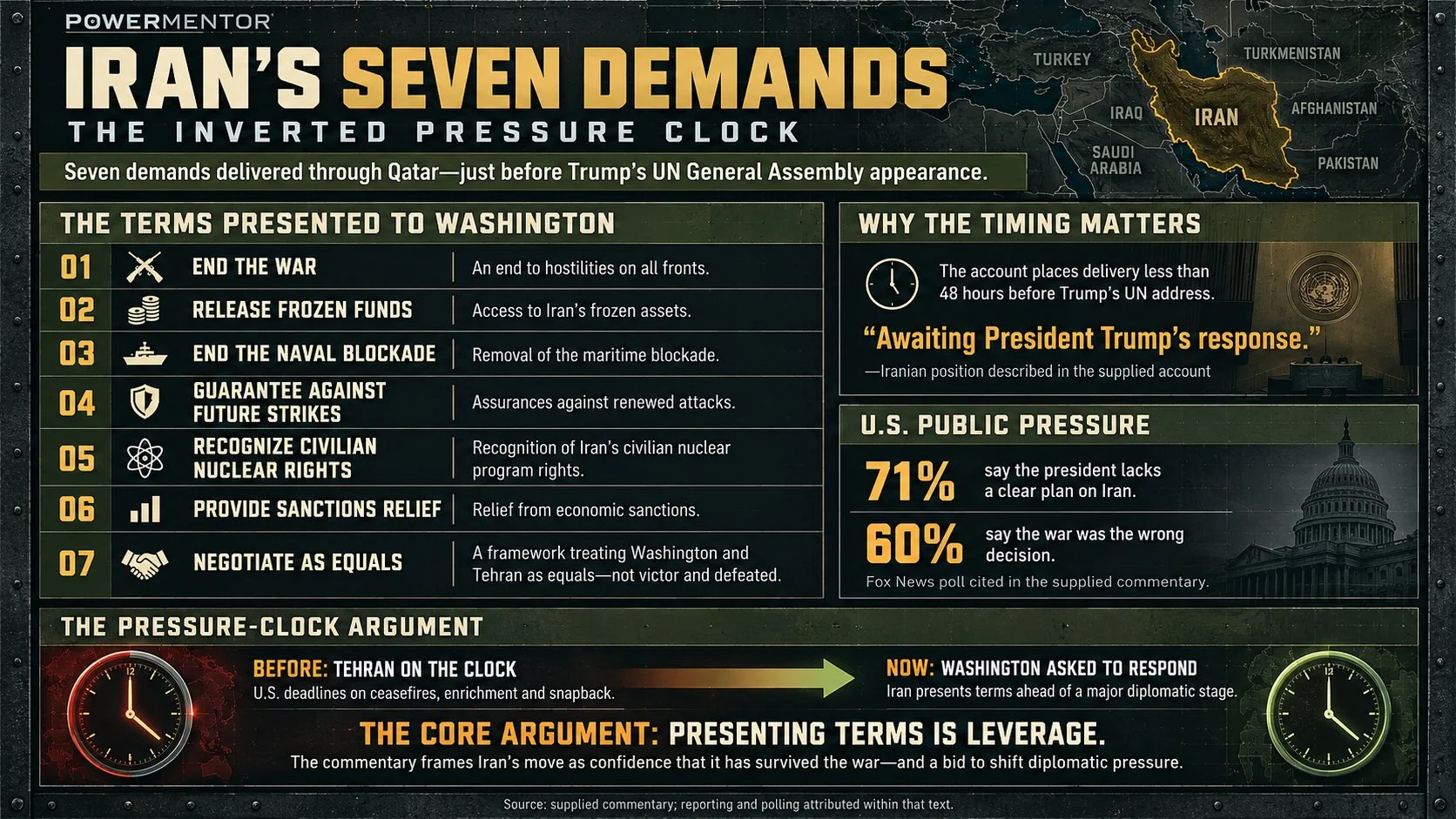
Iran has presented Washington with seven demands through Qatar, placing a diplomatic challenge before President Donald Trump ahead of his United Nations General Assembly appearance.
The message is direct: Iran is “awaiting President Trump’s response.”
Those words are the centerpiece of a calculated effort to reverse the direction of pressure. After months of American deadlines and demands, Tehran has put its own terms on the table. Now it wants Washington to answer.
The military conflict remains central. But another contest is unfolding alongside it: the struggle to define how the war ends, who sets the conditions, and which government must explain its next move to the world.
Iran is attempting to turn survival into negotiating leverage.
The seven demands show how broadly Tehran defines the outcome it wants. They encompass military operations, financial assets, maritime access, security guarantees, nuclear rights, sanctions, and the balance of power at the negotiating table.
An agreement built around these issues would shape far more than a ceasefire. It would help determine the political and economic conditions that follow the fighting.
1. An end to the war on all fronts
Iran’s first demand seeks a comprehensive end to hostilities.
The phrase “all fronts” matters. A narrow ceasefire can leave other areas of confrontation active. One battlefield may quiet down while pressure continues elsewhere, creating a cycle in which each side accuses the other of continuing the conflict through different means.
Tehran is seeking an outcome broad enough to prevent that.
For Washington, the challenge would be defining the scope of such an agreement: which operations stop, which actors are covered, and what conduct would constitute a violation.
The larger strategic message is clear. Iran wants the conflict addressed as a whole.
2. The release of Iran’s frozen funds
The second demand targets financial pressure.
Frozen assets represent resources Iran cannot freely access. Securing their release would give Tehran a tangible result to present at home and greater financial flexibility after months of conflict.
This demand also reveals how Iran measures a settlement. Stopping the fighting while leaving financial restrictions intact would preserve a major element of American leverage.
Tehran wants that leverage reduced.
For Washington, the release of funds would become a question of what it receives in return, when the money becomes available, and whether concessions are tied to specific actions.
The financial terms would be a central part of the bargaining.
3. An end to the naval blockade
Iran’s third demand addresses maritime access.
A blockade can exert pressure beyond the battlefield by restricting movement and trade. Ending it would therefore carry both practical and political significance.
Tehran is seeking the removal of a mechanism that constrains its freedom of action. It also wants to demonstrate that a settlement restores access rather than merely suspending attacks.
This is another indication that Iran’s proposed end to the war includes dismantling the conditions surrounding it.
4. Guarantees against future strikes
The fourth demand looks beyond the immediate conflict.
Iran wants assurances that an agreement will not simply create a pause before another round of attacks. Without such guarantees, Tehran could view a ceasefire as temporary exposure to the same threat.
The difficulty lies in making those assurances enforceable.
Who provides the guarantee? What obligations accompany it? What happens if one side alleges a violation? What mechanism prevents a dispute from immediately escalating into renewed strikes?
Those questions would sit at the heart of serious negotiations.
The strategic objective is straightforward: Iran wants any settlement to change its future security environment.
5. Recognition of Iran’s civilian nuclear rights
The fifth demand places the nuclear issue within the larger question of sovereignty.
Iran is seeking recognition that it retains rights to a civilian nuclear program. That would allow Tehran to argue that it defended a national entitlement through the conflict and into negotiations.
Recognition would still leave major issues to resolve, including the activities permitted, the restrictions imposed, and the arrangements for verification.
Those details would determine the substance of any agreement.
For Iran, however, securing the principle itself would carry political weight. It would influence how the outcome is understood domestically and internationally.
6. Sanctions relief
The sixth demand seeks relief from economic restrictions.
This reinforces the broader structure of Iran’s position: a settlement should produce military and economic change.
The sequencing would be critical. Tehran would have an interest in securing meaningful relief early. Washington would have an interest in connecting relief to actions it can verify.
That creates a difficult negotiation over who moves first, how progress is measured, and which measures can be restored if commitments are broken.
Sanctions relief would directly affect the value each side attaches to the agreement.
7. Negotiations on equal terms
The seventh demand shapes the entire package.
Iran wants a framework in which Washington negotiates with it as an equal, rather than dictating terms as a victor.
That does not erase differences in military strength or economic power. It establishes the political basis on which Tehran wants talks conducted.
A government that negotiates as a defeated party is expected to accept conditions. A government that negotiates as a recognized counterpart expects to help write them.
Iran is demanding the latter.
This issue reaches into national standing, domestic legitimacy, and the ability of leaders to defend an agreement before their own population. Tehran wants to emerge from negotiations able to claim that it protected its interests and retained its sovereignty.
The timing puts Trump’s UN appearance at the center of the pressure campaign.
Delivering demands ahead of a major international address creates an immediate diplomatic opening.
Trump’s appearance at the United Nations gives him a platform to define American objectives before other governments and a worldwide audience. Iran’s move places a specific proposal into that moment.
Washington now faces several possible responses: engage with the terms, reject them, present a counterproposal, or continue discussions privately.
Each choice communicates something about American strategy.
Iran’s objective is to make its proposal part of the discussion before Washington delivers its own message. Tehran wants other governments watching for an answer.
That is the purpose of announcing that it is “awaiting President Trump’s response.”
This is the inverted pressure clock.
For months, the pressure described in this conflict has centered on what Iran must do and when it must do it: meet a deadline, accept a restriction, change a position, or face consequences.
Presenting seven demands attempts to reverse that sequence.
Iran has placed terms before Washington. It is now seeking to make the American response the next major diplomatic event.
This does not require Tehran to possess greater military power. It requires Tehran to create a political situation in which its adversary must weigh the consequences of responding—or refusing to respond.
That is how diplomatic leverage can operate.
The power lies partly in shaping the choices other governments must address.
American public opinion adds pressure to explain the path forward.
The cited Fox News polling figures are striking: 71% say the president does not have a clear plan on Iran, while 60% say the war was the wrong decision.
Those numbers point to a serious challenge for Washington: sustaining public confidence in the purpose, direction, and eventual outcome of the conflict.
Americans questioning the war will want answers about its objectives, its costs, and the conditions under which it ends.
Tehran can read those numbers too.
Presenting a diplomatic package gives Iran an opportunity to press its case at a moment when Americans are already asking what comes next. It creates a proposal against which Washington’s strategy can be discussed.
The administration must therefore explain both its military objectives and its diplomatic destination.
A strategy needs an end state the public can understand.
The seven demands are an opening position with a clear strategic purpose.
Iran is seeking to establish the terms of debate before negotiations determine the terms of an agreement.
That distinction matters. A demand does not become a concession simply because it has been announced. But putting a demand on the table identifies the outcome a government intends to pursue and creates a starting point for bargaining.
Tehran has made its desired outcome visible.
It wants the fighting stopped, its funds released, the blockade ended, future strikes constrained, civilian nuclear rights recognized, sanctions eased, and its status preserved at the negotiating table.
The package communicates a single overarching position: Iran intends to participate in determining the postwar order.
Washington must now decide how to answer that position while advancing its own interests.
PowerMentor’s assessment is direct: diplomacy is an arena of power.
Governments use proposals, timing, intermediaries, public statements, and international forums to pursue objectives that military action alone cannot settle.
The ability to endure pressure matters. The ability to convert that endurance into a negotiating position matters just as much.
Iran’s move illustrates the effort to make that conversion.
For leaders and communities pursuing a political future, the lesson extends beyond this confrontation. Clear objectives, coordinated representation, and the ability to present actionable terms are essential to influence.
Internal disputes consume attention that should be directed toward the decisions shaping the future. Fragmented leadership weakens the ability to negotiate. A movement that cannot articulate what it wants leaves others greater freedom to define the outcome.
Diplomatic participation demands preparation, discipline, and the capacity to engage even with those whose interests sharply conflict with your own.
That is where leadership must rise above reaction.
Iran has presented its terms. Washington retains the power to challenge them, revise them, or advance an alternative. The consequential question is what each side can secure through the next stage of diplomacy.
The clock has become part of the contest. Tehran’s move is designed to make Washington answer next.
