

Iran, Thailand, and Burma: The Aviation Fuel Pipeline Behind the Military’s Air War
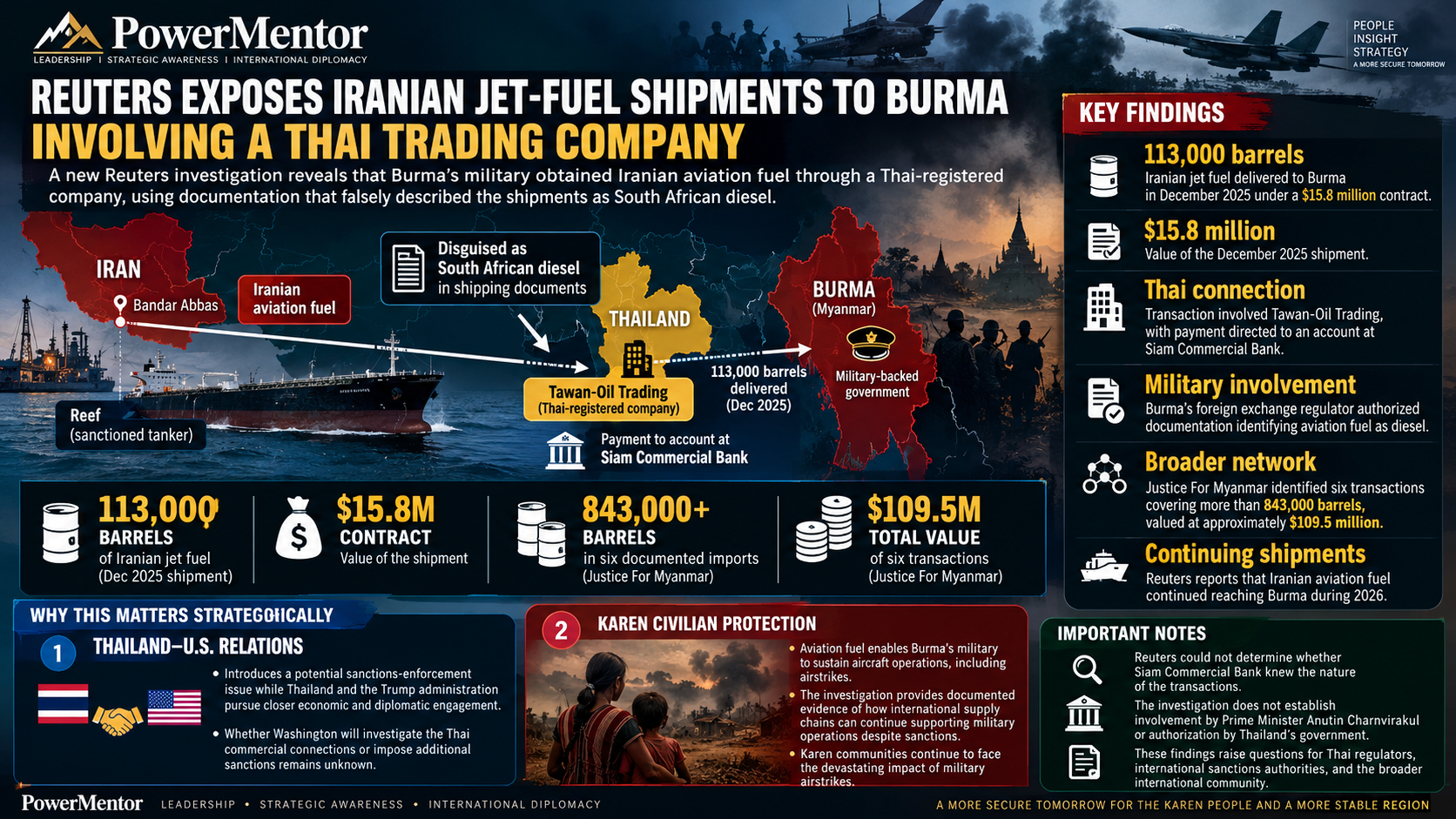
Reuters investigation exposes a $109 million fuel supply network, raising serious questions about sanctions enforcement, Thailand’s commercial connections, and the continued threat to Karen civilians.
While international attention focuses on Burma’s political future, another critical development is unfolding behind the scenes: the international supply chain that helps keep the Burmese military’s aircraft flying.
A new Reuters investigation, published October 26, 2026, describes how Iranian aviation fuel reached Burma through commercial transactions involving a Thai-registered trading company, with shipping documentation allegedly disguising the fuel as South African diesel.
The revelations raise important questions extending far beyond Burma’s borders. They involve Iranian petroleum exports, Thai commercial intermediaries, international banking channels, sanctions enforcement, and the strategic relationship between Thailand and the United States.
For the Karen people and other communities subjected to Burma’s military airstrikes, the implications are especially serious.
The central issue is no longer simply who is conducting the airstrikes. It is also who is supplying the resources that make those operations possible.
1. The $15.8 Million Shipment That Exposed the Network
At the center of the Reuters investigation is a tanker named Reef, a vessel previously sanctioned by the United States.
In December 2025, the tanker arrived in Burma carrying approximately 113,000 barrels of aviation fuel originating from Iran.
However, the commercial paperwork told a different story.
According to Reuters, the Burmese company Dynamic Wave entered into a $15.8 million agreement with Thailand-registered Tawan-Oil Trading for what was described as diesel originating in South Africa.
Shipping records, satellite imagery, and maritime intelligence analysis instead identified Iranian aviation fuel transported from Bandar Abbas.
Even more concerning, documents reviewed by Reuters indicated that Burma's own foreign exchange regulator authorized the misclassification of aviation fuel as diesel.
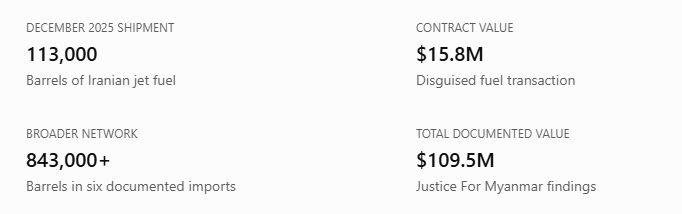
These figures demonstrate the scale of the documented transactions. The $109.5 million figure relates to six imports identified by Justice For Myanmar between December 2024 and November 2025, rather than the single December 2025 shipment investigated by Reuters. Justice For Myanmar findings
2. The Thai Connection: Why This Is a Regional Issue
The involvement of Tawan-Oil Trading introduces a particularly sensitive dimension.
Thailand shares a long border with Burma and occupies a strategically important position in regional trade, diplomacy, humanitarian operations, and security.
The Reuters investigation identifies a payment instruction directing funds to Tawan-Oil Trading's account at Siam Commercial Bank.
Justice For Myanmar's separate investigation also identified three contracts involving Tawan-Oil Trading, totaling approximately $68.49 million.
One additional finding deserves attention: Justice For Myanmar reported that Tawan-Oil Trading had entered liquidation in August 2024, yet subsequently appeared in major fuel contracts. This raises questions about corporate oversight and the legitimacy of its continued commercial activities. Justice For Myanmar
There is an important distinction between commercial involvement and government responsibility.
The evidence identifies transactions involving a Thai-registered company and a Thai banking account. It does not establish that Thailand's government authorized the scheme or that Prime Minister Anutin Charnvirakul personally participated.
Reuters also could not determine whether Siam Commercial Bank knew the true nature of the transactions.
Nevertheless, these findings raise legitimate questions for Thai financial regulators, corporate authorities, and international sanctions investigators.
Thailand's role as a regional economic and diplomatic center makes the integrity of its commercial and financial systems especially important.
3. The United States and Thailand: A Potential Diplomatic Test
The investigation arrives during an important period in U.S.–Thailand relations.
The Trump administration has emphasized economic security, sanctions enforcement, strategic competition, and regional cooperation.
Thailand, meanwhile, must navigate relationships with the United States, China, Burma, and other regional powers.
The newly documented aviation fuel transactions introduce a possible sanctions-enforcement issue into that broader diplomatic environment.
Washington could seek answers concerning the following:
Whether Thai-registered companies were knowingly facilitating restricted Iranian petroleum transactions.
Whether financial institutions had adequate systems to identify suspicious transactions.
Whether corporate ownership structures were used to conceal the true beneficiaries.
Whether existing sanctions are sufficient to disrupt the aviation fuel network.
Whether greater cooperation with Thai authorities could prevent additional shipments.
None of these potential responses should be mistaken for an announced U.S. policy decision.
However, Thailand has an opportunity to demonstrate its commitment to transparent commerce and regional security through credible investigation and enforcement.
Such cooperation could strengthen its relationship with Washington while addressing a supply network associated with Burma's military operations.
4. Iran's Role: Financial Revenue and Military Supply
Iran's involvement introduces another dimension to this investigation.
The fuel trade creates a relationship in which Iranian petroleum supplies reach Burma while generating revenue from international customers.
For Burma's military, aviation fuel is a critical operational resource. Aircraft cannot sustain missions without dependable fuel supplies, maintenance, and logistical support.
For Iran, petroleum exports provide access to revenue despite international sanctions.
This creates a strategic connection between two governments facing significant U.S. sanctions pressure.
The investigation does not establish a broader military alliance between Iran and Burma. It does, however, document a commercial supply relationship with important security consequences.
Sanctions are only as effective as the ability to identify and disrupt the networks designed to evade them.
The use of intermediary companies, misleading commodity descriptions, international financial accounts, and complex shipping arrangements illustrates the challenges confronting sanctions enforcement.
5. What This Means for the Karen People
For Karen communities, this investigation should not be viewed as a distant financial scandal.
It concerns a supply chain that helps sustain the military aviation capability used in Burma's ongoing conflict.
Aircraft and aviation fuel are important components of the military's ability to strike areas beyond the reach of ground forces.
The consequences of military airstrikes have included civilian deaths, displacement, damage to communities, and attacks affecting civilian infrastructure.
Reuters notes that military airstrikes have killed thousands of people in Burma since the 2021 coup, citing United Nations reporting. The Business Standard
The fuel investigation does not establish which specific aircraft or attacks used the documented shipments. But it reveals how the broader aviation fuel supply network continues operating despite sanctions.
This distinction matters. Preventing future civilian casualties requires attention not only to the aircraft conducting operations, but also to the commercial and logistical systems supporting those aircraft.
6. Why Karen Diplomacy Matters More Than Ever
This investigation demonstrates why the Karen struggle cannot be addressed solely through developments inside Burma.
Decisions involving the United States, Thailand, Iran, international banks, shipping companies, and sanctions authorities can directly affect conditions on the ground.
The Karen people must recognize that their future is influenced by developments taking place well beyond their borders.
Internal disagreements among Karen organizations may consume enormous amounts of attention, but international decisions involving sanctions, financial enforcement, and regional diplomacy can have consequences for the entire Karen population.
A divided political movement risks losing opportunities to influence those decisions.
A coordinated diplomatic strategy could focus on presenting documented evidence to relevant governments, encouraging enforcement against aviation fuel networks linked to military operations, strengthening international relationships, and advocating for civilian protection.
The objective should be to ensure that Karen representatives have a meaningful voice in the international discussions that affect their communities.
Diplomacy does not require agreement on every political issue. It requires recognizing shared interests and building sufficient cooperation to advance them.
The Reuters investigation provides an opportunity for Karen organizations to move beyond internal disputes and focus international attention on a documented supply chain with direct implications for civilian security.
7. What Should Happen Next?
The investigation warrants serious attention from governments, financial regulators, and organizations concerned with civilian protection.
Thailand's relevant authorities should examine the documented commercial relationships, including Tawan-Oil Trading's corporate status, ownership arrangements, and transactions.
U.S. sanctions authorities should assess whether existing measures adequately address the companies, vessels, and financial channels identified in the reporting.
International organizations should continue documenting aviation fuel supply chains and their relationship to Burma's military operations.
Karen leaders and civil society organizations should use the available evidence to strengthen diplomatic engagement with Thailand, the United States, and other influential governments.
These steps would emphasize investigation, accountability, and prevention rather than unsupported accusations.
Conclusion: Follow the Fuel, Follow the Money, and Understand the Bigger Picture
The October 26 Reuters investigation reveals something significant about the conflict in Burma.
Behind military aircraft operating over civilian communities is an international network of suppliers, brokers, shipping vessels, commercial contracts, and financial transactions.
The reported involvement of Iranian aviation fuel, a Thai-registered trading company, and deceptive documentation demonstrates how complex these networks can become.
It also illustrates why sanctions enforcement and international diplomacy matter.
For Thailand, the findings present important questions about commercial oversight and financial integrity.
For the United States, they identify a potential opportunity to examine sanctions enforcement and strengthen regional cooperation.
For the Karen people, they reinforce a strategic reality that must not be ignored:
The future of the Karen people will not be determined solely by events inside Burma. It will also be influenced by decisions made in Bangkok, Washington, and other centers of international power.
Internal divisions cannot be allowed to distract from those larger developments.
The Karen people need a coordinated diplomatic voice capable of engaging governments, presenting credible evidence, and advancing their interests internationally.
Military developments may determine immediate conditions on the ground. But diplomacy, international relationships, economic pressure, and sanctions enforcement can influence the wider environment in which the conflict continues.
The question is not simply whether the Karen people understand what is happening inside Burma. It is whether they are prepared to engage the international forces shaping Burma's future.
Sources
