

Minnesota Lawmaker’s Killer Accused Tim Walz of an Assassination Plot: Inside the Letter to FBI Director Kash Patel
The Boelter Letter: Serious Allegations, Documented Connections, and the Demand for Evidence
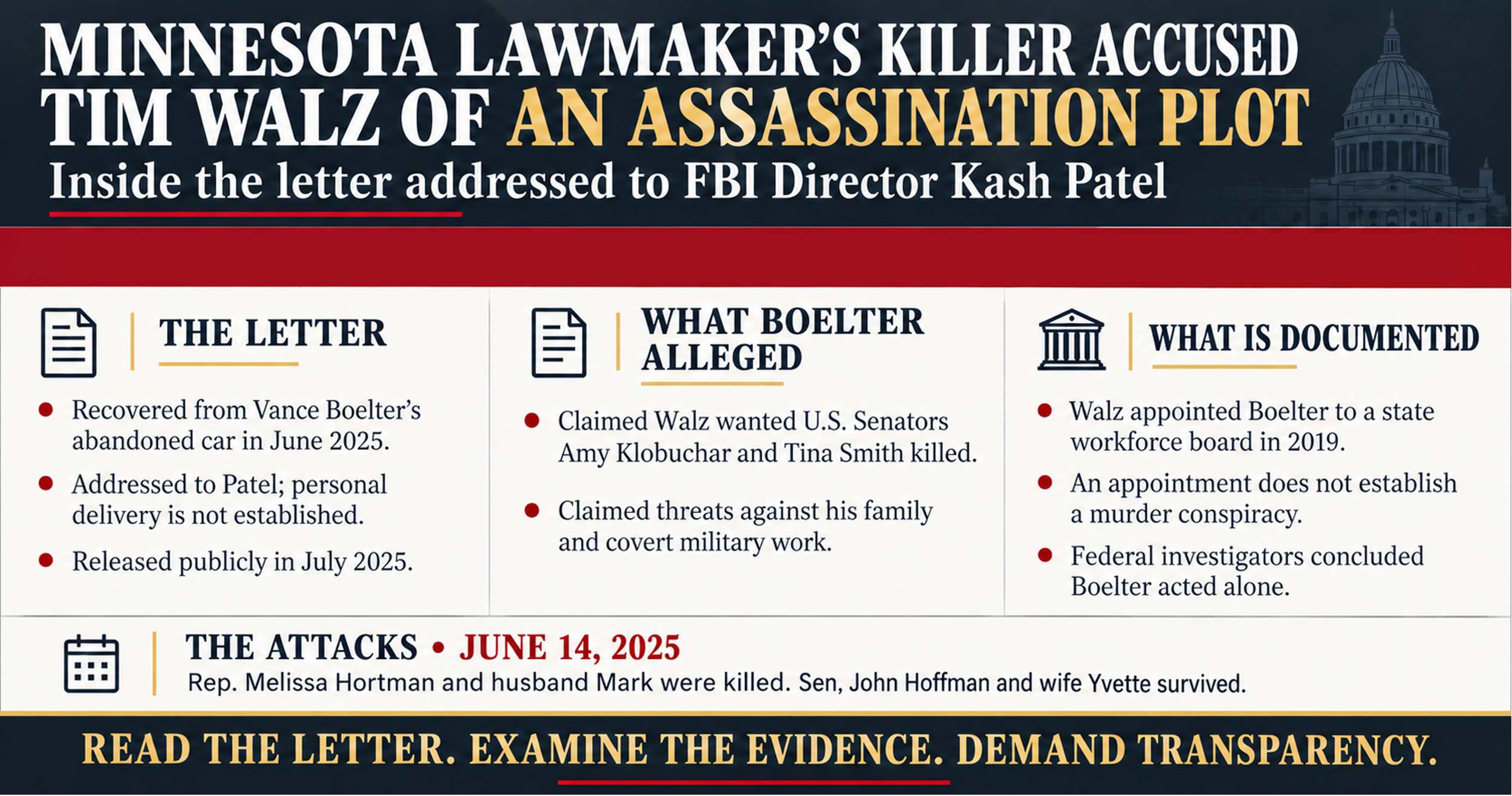
A handwritten letter recovered after the murders of Minnesota legislator Melissa Hortman and her husband, Mark, contains extraordinary allegations against Governor Tim Walz. Its author, Vance Boelter, addressed it to FBI Director Kash Patel, identified himself as the shooter, and claimed knowledge of a political assassination scheme.
The letter exists. Authorities recovered it, photographed it, and included a transcription in a federal search-warrant affidavit. Its contents deserve direct examination. So does the distinction between a documented statement and proof that the events described in that statement occurred. Federal prosecutors have said they found no evidence supporting Boelter’s accusations against Walz.
PowerMentor’s position is straightforward: serious allegations involving public officials deserve rigorous investigation and a clear explanation of the findings. Political affiliation should have no bearing on that standard. Neither automatic dismissal nor automatic acceptance serves the public.
The June 14, 2025 attacks killed Melissa and Mark Hortman and wounded state Senator John Hoffman and his wife, Yvette. Boelter used a police disguise to approach his victims. He later pleaded guilty to federal offenses and, on July 23, 2026, received two consecutive life sentences plus 40 years. The Justice Department’s sentencing announcement states that he acted alone and extensively researched his intended targets.
Those convictions establish his criminal responsibility. They also make careful examination of his account essential: a perpetrator can admit conduct while giving a false, distorted, or self-serving explanation for it.
The letter’s route into the investigation is significant.
This was a letter addressed to Patel. The publicly available account does not establish that Boelter mailed it or that Patel personally received it.
According to the FBI affidavit, investigators recovered it from a Buick abandoned near Green Isle, Minnesota. Boelter had purchased the vehicle after the shootings. Authorities released the letter publicly on July 15, 2025. The distinction matters because descriptions of a letter “sent to the FBI director” can imply a documented exchange that the available record does not show.
The handwritten pages are available for readers to inspect:
What does Boelter actually allege?
The following describes his accusations:
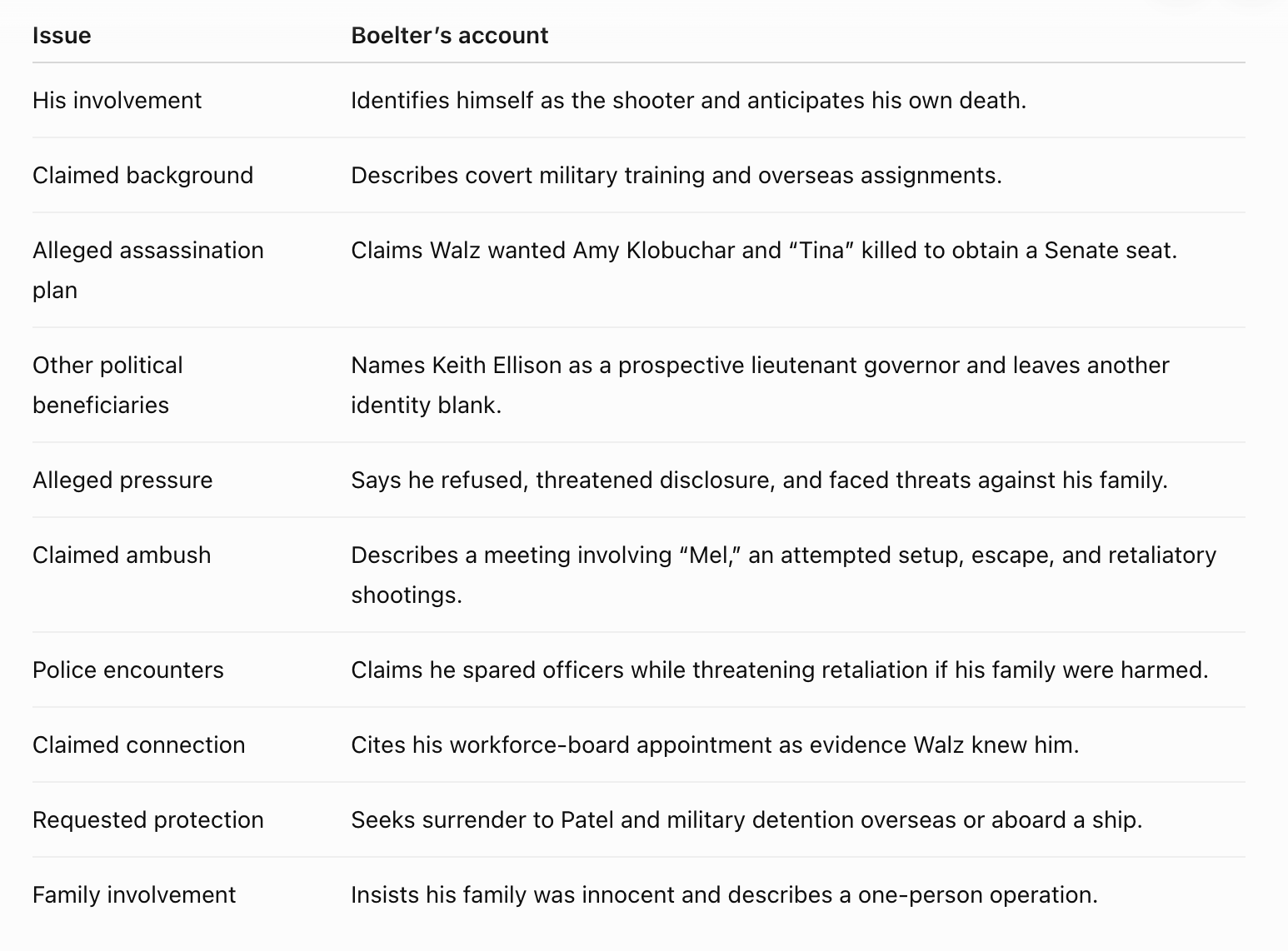
These assertions appear in the photographed letter and the affidavit’s transcription.
The Walz appointment is a documented fact.
The governor’s office announced Boelter’s appointment to the Governor’s Workforce Development Board on December 9, 2019. It identified him as a Business & Industry Representative, with a term beginning December 14, 2019, and ending January 2, 2023. The announcement remains a public record.
Any account that omits that appointment leaves out a relevant, verifiable connection.
Its evidentiary meaning, however, has limits. A board appointment establishes that an appointment occurred. Establishing private meetings, operational direction, threats, or an assassination agreement would require additional evidence.
Investigators should test those propositions separately. Readers should do the same.
Hortman’s controversial vote is also real.
On June 9, 2025, five days before her murder, Hortman supplied the only Democratic vote in the Minnesota House for legislation ending MinnesotaCare eligibility for undocumented adults. The measure passed 68–65. This is confirmed by the Legislature’s own reporting.
Her vote was part of a negotiated budget agreement intended to prevent a government shutdown, despite her personal opposition to withdrawing the coverage. Hoffman, who was also attacked, voted against the repeal. Investigators have not established the vote as the reason for the shootings.
The timing explains why people asked questions. Timing alone does not answer them.
There is another important limitation: Boelter’s letter does not identify that MinnesotaCare vote as his motive. It also does not describe a health-program fraud investigation as the reason for the attacks. Those theories require evidence independent of the letter.
The original wording matters more than viral summaries.
The affidavit states that blanks and dashes in its transcription were present in the handwritten original. Readers should not assume every missing name was concealed by investigators or substitute a preferred political figure into an empty space.
Likewise, the letter’s central alleged assignment concerns U.S. senators. Its account of the shootings involves an additional story about coercion and a supposed setup. Reducing that account to a simple declaration that Walz ordered Hortman’s murder changes the substance of what investigators actually recovered. Prosecutors said the letter did not clearly explain why Boelter targeted the Hortman and Hoffman couples.
Accuracy strengthens scrutiny. Embellishment undermines it.
What did prosecutors conclude?
At the July 2025 briefing, Acting U.S. Attorney Joseph Thompson said investigators had found no evidence that Boelter received help. He also questioned whether the letter reflected a belief Boelter held or an attempt to misdirect the investigation and excuse his crimes.
That distinction deserves attention. Calling a document “delusional” does not, by itself, explain whether the writer believed it, knowingly fabricated it, or combined factual details with invented accusations. Nor does a prosecutor’s description constitute a clinical diagnosis.
The later Justice Department statement that Boelter acted alone is a clear official conclusion. It should be reported accurately. The public should also be able to understand, to the extent disclosure is legally appropriate, what evidence supports the rejection of his specific allegations.
The questions that would test the allegation are concrete.
A serious examination would ask:
Were communications between Boelter and the officials he named identified, preserved, and examined?
Did calendars, visitor records, witnesses, or location data support any alleged meeting?
Was there evidence of payments, intermediaries, instructions, or threats?
Could his claimed military training and assignments be corroborated?
Did his account remain consistent across the letter, interviews, digital records, and subsequent statements?
What evidence specifically contradicted his account?
Which findings can be released without compromising legitimate privacy interests or remaining proceedings?
These are proposed standards of inquiry. They are not assertions that investigators failed to perform those steps.
The public materials reviewed for this article do not provide a complete, step-by-step account of how every allegation was tested. That limits an outside reader’s ability to independently assess the investigation. It does not turn an unsupported accusation into an established fact.
PowerMentor supports demanding evidence from everyone involved: the person making the accusation, officials explaining the investigation, and commentators presenting conclusions to the public.
The victims and their families deserve accountability grounded in what happened. The public deserves access to the original record and clear explanations. Officials named in criminal allegations should face the same evidentiary standard regardless of party.
Read the letter. Examine the evidence. Require precision. Public trust is earned through answers that can withstand scrutiny.


