

Why This Matters
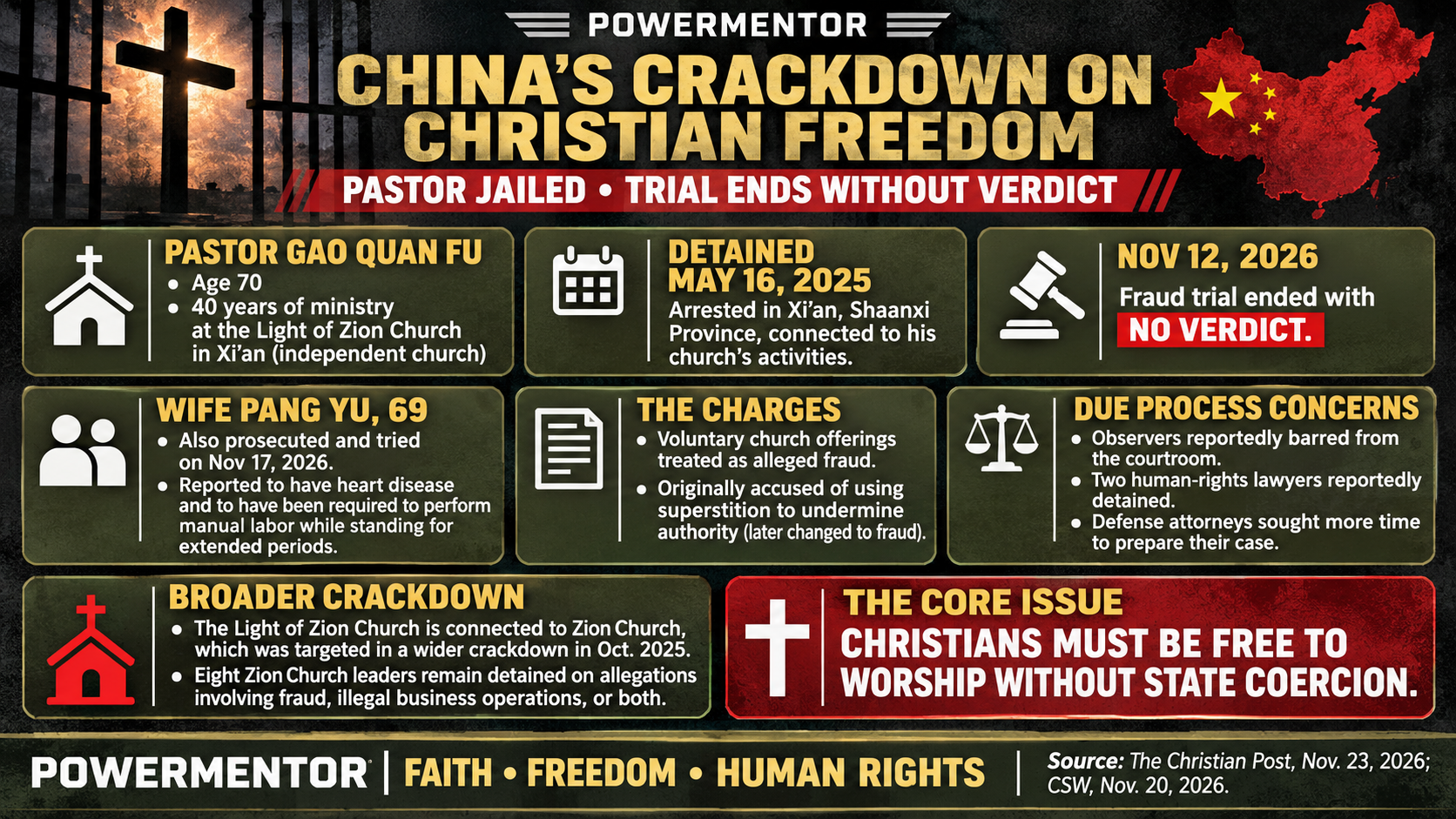
A 70-year-old Christian pastor who has served his congregation for four decades remains imprisoned in China after his trial concluded without a verdict.
Pastor Gao Quan Fu, leader of the Light of Zion Church in Xi’an, has been detained since May 2025. His wife, Pang Yu, 69, has also been prosecuted.
The case raises serious questions about religious freedom, judicial independence, and the Chinese government's treatment of Christian congregations operating outside state supervision.
At the center of the controversy is a fundamental issue: Can a government criminalize religious activity simply because a congregation refuses state control?
In This Briefing
The imprisonment of Pastor Gao Quan Fu and his wife.
Fraud allegations involving voluntary church offerings.
Reported interference with lawyers and courtroom observers.
China's increasing use of criminal prosecutions against independent churches.
The broader implications for religious freedom and human rights.
1. Forty Years of Ministry—Now Facing Criminal Prosecution
Pastor Gao Quan Fu has led the Light of Zion Church in Xi’an, Shaanxi Province, for approximately 40 years.
His church operates independently of China's government-approved religious structure.
On May 16, 2025, Chinese authorities detained Gao, initially accusing him of using superstition to undermine authority.
In September 2025, authorities changed the accusation to fraud.
His wife, Pang Yu, who assisted in the church's ministry, was also formally arrested on fraud allegations.
According to reporting by The Christian Post, the allegations concern voluntary financial contributions made by church members to support religious gatherings and pastoral activities.
The distinction matters.
Voluntary religious donations are a routine part of Christian worship throughout the world. Religious freedom advocates argue that treating such offerings as fraudulent transactions threatens the independence of churches that refuse government oversight.
2. A Trial Without a Verdict
On November 12, 2026, Gao appeared before the Beilin District People's Court in Xi’an.
His trial opened and concluded on the same day, without a publicly announced verdict.
According to Christian Solidarity Worldwide, police prevented observers from entering the courtroom and detained two human rights lawyers.
Defense attorneys had previously requested additional time to gather evidence and raised concerns about procedural fairness.
Gao's wife subsequently faced her own trial without a preliminary hearing.
As of November 23, authorities had not publicly announced the outcome of either case or established a date for further proceedings.
The concern extends beyond the charges themselves. A justice system must provide transparent proceedings, meaningful access to legal representation, and an opportunity to challenge the evidence.
3. The Human Cost of Detention
The consequences extend beyond the pastor.
Pang Yu reportedly suffers from heart disease, leg pain, and significant psychological strain.
Despite these health concerns, she has reportedly been required to perform manual labor while standing for extended periods.
The couple's son, Gao Pu, has publicly advocated for his parents and requested an investigation into alleged violations of legal procedure.
Their case illustrates how government action against religious leaders can affect entire families and communities.
For a congregation that has relied on the same pastor for decades, his imprisonment also disrupts spiritual leadership, pastoral care, and community stability.
4. A Broader Pattern of Pressure on Independent Churches
The Light of Zion Church is connected to Zion Church, another independent Protestant congregation targeted during a nationwide crackdown in October 2025.
According to The Christian Post, eight Zion Church leaders remain detained on allegations involving fraud, illegal business operations, or both.
Religious freedom organizations have expressed concern that Chinese authorities increasingly rely on conventional criminal accusations rather than explicitly religious offenses when prosecuting independent church leaders.
The U.S. Commission on International Religious Freedom identifies Gao as a prisoner held in connection with his religious activities and reports that authorities had previously pressured him to bring his congregation under Chinese Communist Party oversight.
These developments raise an important strategic concern:
If ordinary religious activities can be reclassified as criminal conduct, the state can restrict religious independence without explicitly outlawing Christianity.
The allegations must still be evaluated through fair legal proceedings. However, the reported restrictions on observers, lawyers, and defense preparation deepen concerns about whether such proceedings are possible.
5. Religious Freedom Is a Test of Government Power
The central issue is not whether governments may investigate genuine financial wrongdoing. They may, provided they respect due process and fundamental rights.
The issue is whether criminal law is being used to punish religious independence.
Freedom of religion includes more than permission to worship within government-approved institutions.
It also encompasses freedom of conscience, peaceful assembly, religious teaching, and the ability to organize religious communities without arbitrary interference.
A government that determines which religious organizations may operate independently exercises enormous power over its citizens' beliefs and associations.
For Christians, this also raises a biblical question about the relationship between faith and political authority.
Acts 5:29 (GNT):
"We must obey God, not men."
This principle has historically shaped Christian resistance to demands that violate religious conscience.
6. The Strategic Implications
The case of Pastor Gao highlights three concerns.
First: Criminal law can become an instrument of religious control.
When voluntary offerings and independent religious administration become grounds for prosecution, religious organizations may face pressure to surrender their independence.
Second: Judicial transparency is essential to human rights.
Blocking observers, detaining lawyers, and limiting defense preparation—if established—undermine confidence in the fairness of proceedings.
Third: Religious persecution is an international concern.
The treatment of peaceful religious communities should matter to governments, human rights organizations, and faith communities beyond China's borders.
The principles at stake apply equally to Christians and members of other religious traditions.
PowerMentor Perspective: Faith Cannot Be Imprisoned
Pastor Gao's case is about more than one minister or one congregation.
It represents a continuing struggle between religious conscience and government authority.
For 40 years, Gao reportedly served his congregation. Today, he and his wife face criminal allegations while religious freedom organizations question the fairness of their treatment.
A government may regulate institutions and investigate actual crimes. But it should not use criminal proceedings to compel religious obedience or silence peaceful worship.
When the state demands control over conscience, religious freedom is no longer secure.
The international community should continue seeking transparency, due process, humane treatment, and accountability in this case.
Religious liberty is not a privilege granted only to those who agree with the government.
It is a fundamental human right.
Forward March.
PowerMentor — Leadership | Faith | Freedom | Strategic Awareness
Source
Primary source: Anugrah Kumar, The Christian Post, November 23, 2026, “70-year-old Protestant pastor remains jailed after trial ends without verdict; wife tried as accomplice.”
The reporting cites Christian Solidarity Worldwide and the U.S. Commission on International Religious Freedom. Allegations of procedural violations and religiously motivated prosecution are attributed to the family and religious freedom advocates. No criminal verdict has been publicly reported.
