

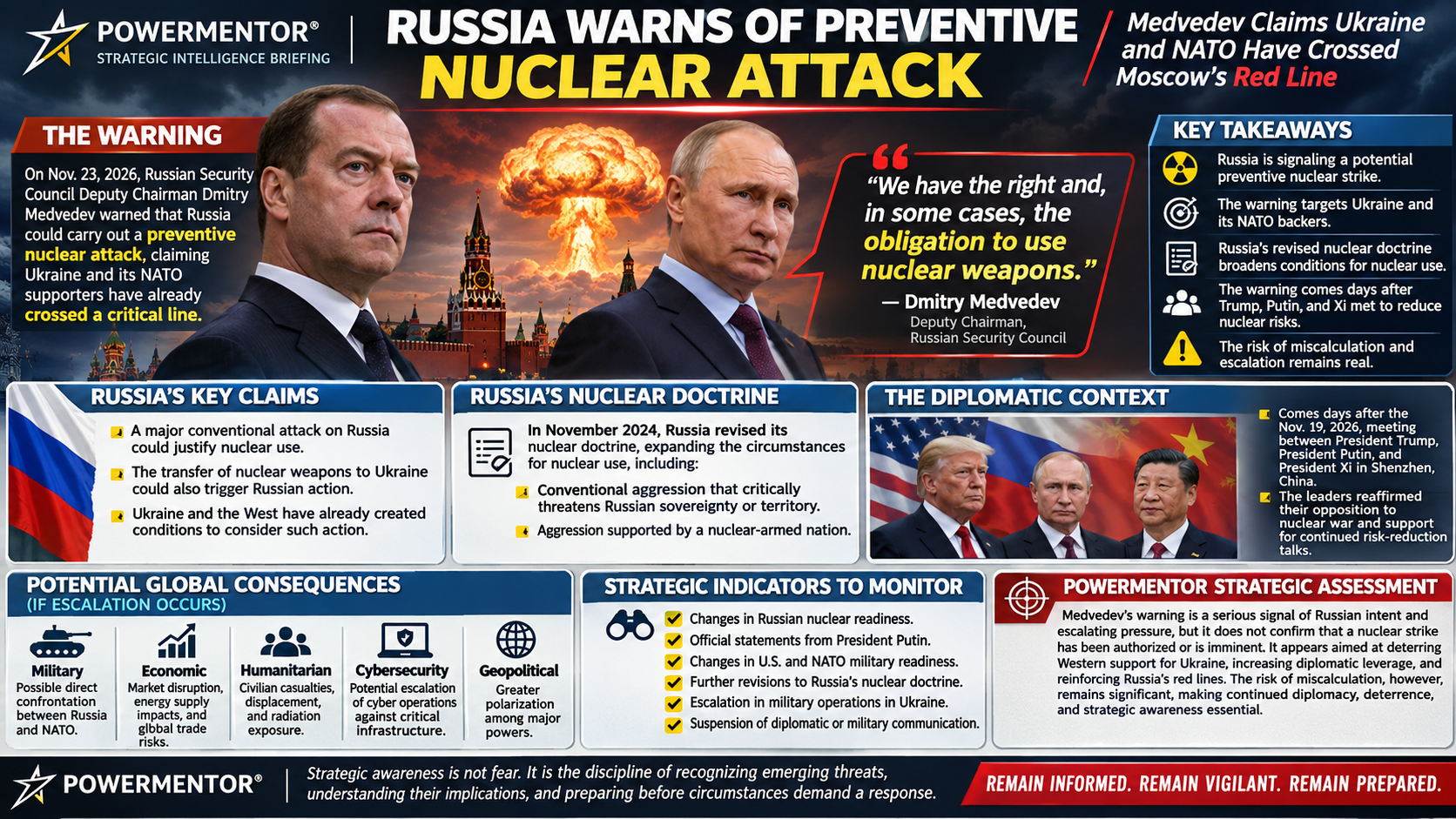
The international security environment is facing renewed uncertainty after a senior Russian official raised the possibility of a preventive nuclear strike. The warning comes just days after President Donald Trump, Russian President Vladimir Putin, and Chinese President Xi Jinping met to discuss reducing nuclear risks.
The developments highlight the fragile balance between diplomacy, nuclear deterrence, military escalation, and global security.
In This Briefing
Russia's latest nuclear warning.
Moscow's accusations against Ukraine and NATO.
Russia's evolving nuclear doctrine.
The significance of President Trump's recent diplomatic engagement.
Potential global consequences.
Strategic warning indicators to monitor.
Russia Issues a Nuclear Warning
On November 23, 2026, former Russian President Dmitry Medvedev, now deputy chairman of Russia's Security Council, raised the prospect of Moscow conducting a preventive nuclear attack.
Medvedev argued that devastating conventional military attacks or the transfer of nuclear weapons to Ukraine could provide grounds for Russian nuclear action.
He further claimed that Ukraine and its Western supporters had already created circumstances in which Moscow could contemplate such action.
These statements deserve serious attention given Medvedev's position within Russia's national security leadership.
However, he acknowledged that Russia has not yet determined nuclear weapons to be necessary in the Ukraine conflict and that the ultimate decision rests with President Putin.
Understanding Russia's Nuclear Doctrine
In November 2024, Russia revised its nuclear doctrine, expanding the circumstances under which it could consider nuclear retaliation.
The revised framework includes situations involving conventional aggression that critically threatens Russian sovereignty or territorial integrity, as well as aggression supported by a nuclear-armed nation.
Medvedev's latest statements suggest an effort to extend the interpretation of that doctrine beyond retaliation to potentially include preventive action.
This distinction is significant. Retaliation is a response to an attack, while preventive military action seeks to eliminate a perceived future threat before it fully materializes.
Such an interpretation could increase the risk of miscalculation between nuclear powers.
The Trump–Putin–Xi Diplomatic Effort
The warning comes only days after the November 19 meeting between President Trump, President Putin, and President Xi in Shenzhen, China.
The three leaders reaffirmed their shared opposition to nuclear war and expressed support for continued discussions concerning nuclear risk reduction and nonproliferation.
President Trump's direct diplomatic engagement with Russia and China provides an important channel for communication between the world's leading military powers.
However, Medvedev's subsequent statements demonstrate that diplomatic engagement does not automatically eliminate underlying military tensions or competing national security interests.
Maintaining communication between world leaders remains critically important.
The Potential Global Consequences
A nuclear escalation involving Russia and Ukraine could produce consequences far beyond Eastern Europe:
Military: An increased possibility of direct confrontation between Russia and NATO.
Economic: Disruption of international markets, energy supplies, and global trade.
Humanitarian: Civilian casualties, displacement, radiation exposure, and overwhelming demands on healthcare systems.
Cybersecurity: Potential escalation of cyber operations against critical infrastructure.
Geopolitical: Increased polarization and competition among major world powers.
National security: Greater pressure on governments to strengthen military readiness and emergency preparedness.
These are potential consequences of escalation, not predictions that a nuclear confrontation is imminent.
Strategic Warning Indicators
PowerMentor encourages continued monitoring of the following developments:
Changes in Russian nuclear readiness.
Official announcements from President Putin.
Changes in American and NATO military readiness.
Further revisions to Russian nuclear doctrine.
Escalation of military operations between Russia and Ukraine.
Suspension of diplomatic or military communication channels.
Official government emergency preparedness advisories.
Progress or deterioration in international nuclear arms-control negotiations.
Multiple indicators occurring simultaneously would warrant greater strategic attention than political rhetoric alone.
PowerMentor Strategic Assessment
Medvedev's statements should neither be dismissed nor interpreted as confirmation that Russia has decided to launch a nuclear attack.
They may serve several strategic purposes, including deterring Western military support for Ukraine, increasing diplomatic pressure, signaling Russian resolve, and shaping international perceptions of the conflict.
The danger is that repeated threats, combined with military escalation and competing interpretations of national security, can create conditions in which miscalculation becomes increasingly consequential.
Diplomacy, credible deterrence, intelligence assessment, and effective communication remain essential to preventing escalation.
Strategic awareness is not fear. It is the discipline of recognizing emerging threats, understanding their implications, and preparing before circumstances demand a response.
Sources:
