

Greenland’s Watchtower: The Front Edge of Western Hemisphere Defense
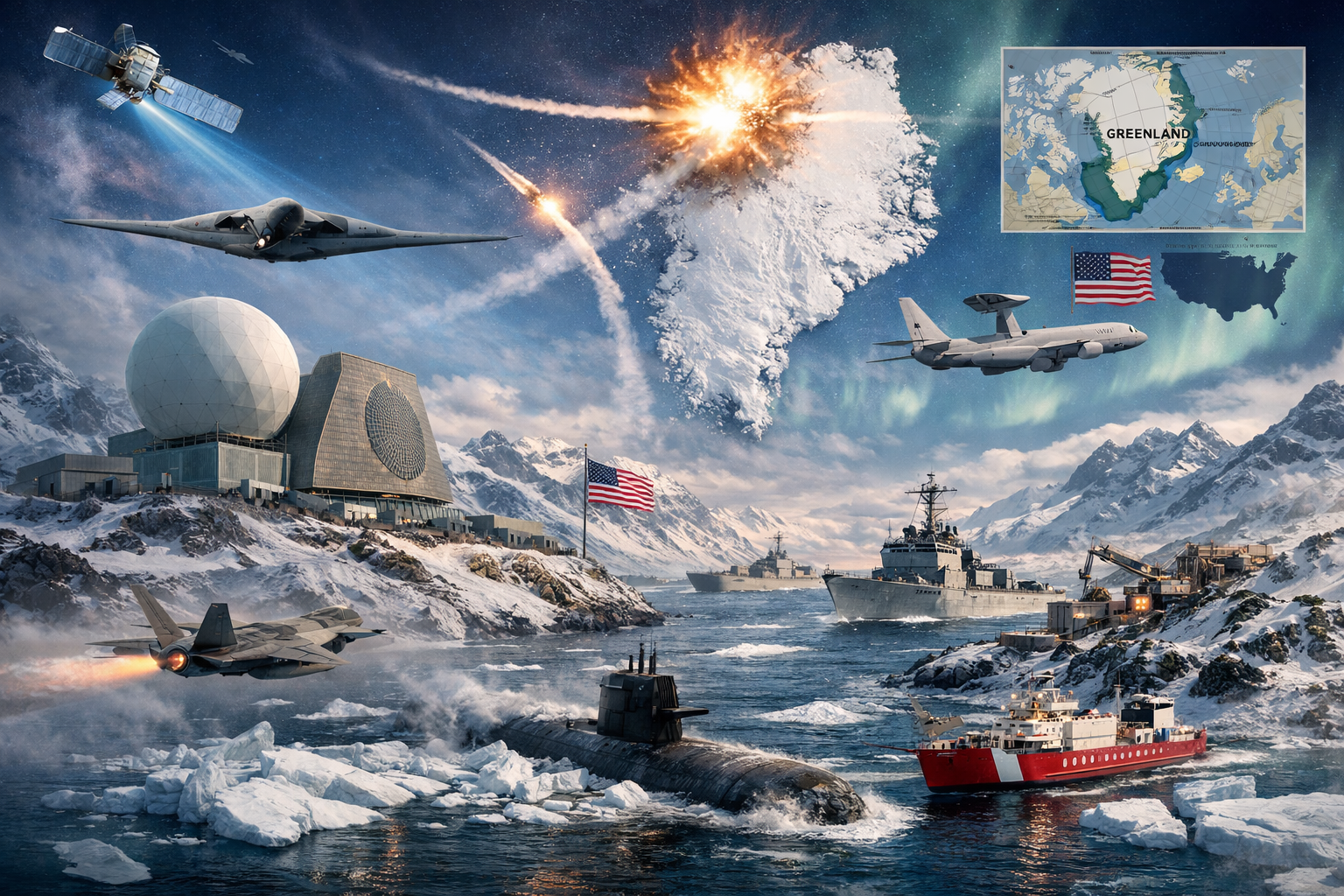
Why Greenland matters strategically (the core drivers)
1) Geography that plugs straight into North America’s defense network
Greenland sits on the shortest “great-circle” routes between North America and Europe—and between Russia’s Arctic and North America. That geography is why the U.S. has maintained a major defense presence there since the early Cold War under a U.S.–Denmark defense agreement.
What that buys the U.S.:
Earlier warning time for threats coming over the Arctic (the fastest path for many missile trajectories).
A forward sensor position that’s hard to replicate elsewhere because Greenland is physically “in the way” of the Arctic approach.
2) Pituffik (Thule) = missile warning + missile defense sensing + space domain missions
The U.S. Space Force is explicit about why Pituffik Space Base exists: it supports Missile Warning, Missile Defense, and Space Surveillance through its radar and tracking capabilities.
That matters for “Western Hemisphere” security in a very literal way:
Those sensors feed the warning/assessment systems that support homeland defense and NORAD-style early warning.
3) The GIUK Gap: controlling the Atlantic “gate”
Greenland anchors one side of the GIUK Gap (Greenland–Iceland–UK)—a long-recognized naval choke region that matters for tracking submarines and protecting Atlantic sea lanes between North America and Europe.
Why this is a big deal strategically:
In a crisis, NATO reinforcement and logistics to Europe depend on safe Atlantic transit.
Monitoring the GIUK area supports anti-submarine warfare and broader maritime awareness.
4) The Arctic is opening—so competition rises (even if war isn’t the goal)
The Pentagon’s Arctic framing is essentially “monitor-and-respond,” emphasizing awareness, posture, and allied cooperation as activity increases.
Separately, Congress tracks the Arctic trend line (sea-ice decline → more activity → more strategic interest).
5) Minerals/rare earths: potential leverage, but not “easy money”
Greenland does have meaningful mineral potential, including rare earths, and that’s part of the strategic discussion.
But multiple analyses stress major constraints: harsh climate, limited infrastructure, high costs, and environmental/technical hurdles.
So minerals can be a strategic hedge (diversifying away from China over time), but they’re not a quick switch you flip.
What Trump’s “plan” appears to be (based on public reporting, not speculation)
The starting point: acquisition talk
Trump publicly entertained the idea of the U.S. buying Greenland during his first term.
The current framing in reporting: “national security priority” + Arctic competition
Recent reporting characterizes Trump’s renewed interest as driven by national security: Arctic positioning, monitoring adversary activity, and strategic access—more than a straightforward real-estate/resources play.
The practical pathways (what the U.S. can actually do, short of “buying”)
Even without any change in sovereignty, the U.S. already has (and can expand) influence via:
Defense posture and upgrades at Pituffik/related sensors (the mission is openly missile warning/defense + space surveillance).
Diplomatic presence and investment—the U.S. reopened a consulate in Nuuk explicitly to deepen ties and Arctic cooperation.
Allied agreements with Denmark/Greenland under the existing defense framework (the U.S. has operated there since 1951 through agreement).
If Greenland ever chose independence, some analysts discuss “Compact of Free Association”-style relationships as one possible model Greenland might consider—though that would be Greenland’s political choice, not a U.S. unilateral move.
(Important reality check: Denmark and Greenland have repeatedly rejected the idea of being “sold,” and reporting underscores that Greenland’s future is a matter of Greenlandic decision-making. )
How Greenland helps “secure the Western Hemisphere” (in concrete strategic terms)
1) Hardened Arctic early warning = more time to decide, more time to intercept
If your priority is homeland defense, the value of Greenland is that it supports earlier detection and tracking of threats crossing the Arctic route—feeding warning and attack assessment systems.
2) Atlantic shield: protect the North Atlantic approach and NATO lifelines
The GIUK region is part of the architecture that helps detect and deter submarine movement into the open Atlantic—relevant for keeping North America–Europe sea lines open in a crisis.
3) Deny rivals “easy positioning” near North America’s Arctic flank
You don’t need a large adversary fleet “around Greenland” for Greenland to matter—its value is that it’s a fixed geographic advantage for sensors, patrol, and presence as Arctic access grows. (And note: recent reporting also includes allied pushback on claims about specific Chinese/Russian activity “around Greenland.”)
References
Agreement between the Government of the United States of America and the Government of the Kingdom of Denmark concerning the defense of Greenland. (1951, April 27). Avalon Project, Yale Law School. https://avalon.law.yale.edu/20th_century/den001.asp
Associated Press. (2026, January 6). Why Greenland is strategically important to Arctic security. https://apnews.com/article/6066195d0c6b9e1bbe6da27d55b26ece
Associated Press. (2026, January 11). Greenland’s harsh environment and lack of infrastructure have prevented rare earth mining. https://apnews.com/article/3f47c0b2ae3edfb322a908ee39c42c05
Center for Strategic & International Studies. (2024, September 12). The GIUK Gap: A new age of A2/AD in contested strategic maritime spaces. CSIS Nuclear Network. https://nuclearnetwork.csis.org/the-giuk-gap-a-new-age-of-a2-ad-in-contested-strategic-maritime-spaces/
Department of Defense. (2024). 2024 Department of Defense Arctic strategy. https://media.defense.gov/2024/Jul/22/2003507411/-1/-1/0/DOD-ARCTIC-STRATEGY-2024.PDF
International Institute for Strategic Studies. (2019). The GIUK Gap’s strategic significance. https://www.iiss.org/publications/strategic-comments/2019/the-giuk-gaps-strategic-significance/
Pompeo, M. R. (2020, June 10). Statement by Secretary Pompeo on the opening of U.S. Consulate Nuuk. U.S. Department of State (archived). https://2017-2021.state.gov/statement-by-secretary-pompeo-on-the-opening-of-u-s-consulate-nuuk/
Reuters. (2026, January 6). Trump advisers discussing options for acquiring Greenland; U.S. military “always an option”. https://www.reuters.com/world/trump-advisers-discussing-options-acquiring-greenland-us-military-is-always-an-2026-01-06/
Reuters. (2026, January 11). Nordics reject Trump’s claim of Chinese and Russian ships around Greenland, FT reports. https://www.reuters.com/world/china/nordics-reject-trumps-claim-chinese-russian-ships-around-greenland-ft-reports-2026-01-11/
U.S. Department of State. (2004, August 6). Defense: Greenland—Agreement amending and supplementing the agreement of April 27, 1951. https://www.state.gov/wp-content/uploads/2019/02/04-806-Denmark-Defense.done_.pdf
U.S. Space Force. (n.d.). Pituffik Space Base, Greenland (12th Space Warning Squadron mission and Upgraded Early Warning Radar). Peterson Space Force Base. https://www.petersonschriever.spaceforce.mil/pituffik-sb-greenland/
