

Tucker Carlson in Persian While Iran Goes Dark: How the Internet Blackout and a Regime-Friendly Interview Became a Propaganda Machine
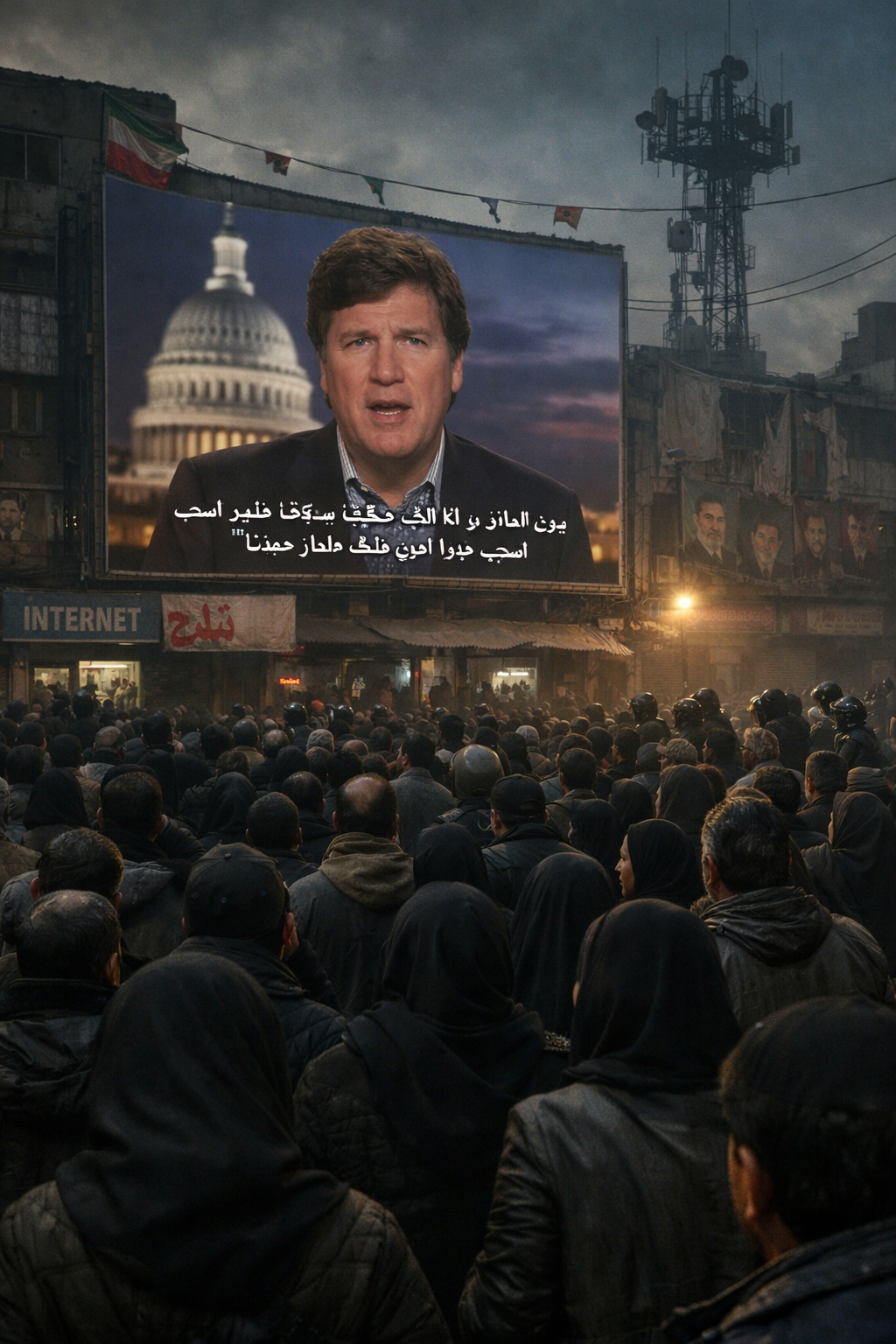
As Iran’s protest movement intensifies, the Islamic Republic has moved on two tracks at once: cut the country off from the internet while flooding state TV with curated messaging—including Persian-dubbed Tucker Carlson content. See video
Sources inside Iran are consistent with what outside reporting has captured: when the internet is throttled, IRIB becomes the loudest—and for many, the only—national feed. In that information vacuum, clips from Carlson’s interview with Iran’s leadership can be edited into “proof” that the regime is right and its critics are liars.
Part I — The Blackout: Why the Regime Turns the Internet Off First
Recent reporting describes Iran instituting an internet blackout as protests spread and the state escalates threats and repression.
This is not just censorship—it’s operational control:
Disable protest coordination (group chats, meet-ups, rapid response to security deployments).
Stop visual evidence (videos of shootings, arrests, funerals) from circulating.
Delay and distort casualty reality long enough for state TV to define the narrative first.
With the internet constrained, the regime’s messaging doesn’t need to “win” online—it just needs to dominate the offline channel (television) that remains available.
Part II — The “Tucker Clips” Strategy: 8 Statements Tehran Can Exploit
Iran’s propagandists don’t need Tucker Carlson to endorse them. They need short, repeatable moments that can be dubbed, chopped, and looped until they feel like consensus.
Below are eight specific Carlson statements/questions from the published transcript that can be weaponized for state TV.
Clip 1: Framing it as a “U.S.–Iran war”
Carlson opens by describing “a pause… in the war between the United States and Iran.”
How Tehran exploits it: “Even the American host admits it’s a U.S. war,” reinforcing victimhood and justifying harsh “defense” at home.
Clip 2: Normalizing the claim that the U.S. bombed Iran
Carlson references Trump’s statement that the U.S. bombed enrichment facilities and asks whether Iran would give up enrichment for peace.
How Tehran exploits it: A ready-made “U.S. aggression” soundbite—useful for rallying nationalist emotion during crackdowns.
Clip 3: “No way to know” — then setting up Iran’s “transparency” reply
Carlson says there’s “no way for the rest of the world to know” enrichment levels if inspections stop and asks about verification.
How Tehran exploits it: Edit out skepticism, keep the setup, then air Pezeshkian’s “we welcome supervision” line to sell “we’re transparent; they’re politicized.”
Clip 4: Putting “IAEA spying for Israel” into the mainstream
Carlson raises reports that the IAEA was spying and passing information to Israel: “Do you believe that?”
How Tehran exploits it: The question alone legitimizes the allegation; Tehran can use it to discredit inspections and blame leaks on “Zionist infiltration.”
Clip 5: Leading with the assassination claim
Carlson asks: “Do you believe the Israeli government tried to assassinate you?”
How Tehran exploits it: A dramatic headline clip that supports the regime’s narrative of being under constant foreign attack—perfect during internal unrest.
Clip 6: The “Death to America” prompt, built for reframing
Carlson mentions “death to America” chants and “Great Satan,” then asks whether Americans should fear Iran.
How Tehran exploits it: Use Tucker’s prompt to acknowledge the slogan, then air the regime’s softened explanation as “misunderstanding”—aimed at reducing foreign pressure and domestic doubt.
Clip 7: The Trump fatwa / assassination denial segment
Carlson asks about fatwas against Trump and whether Iran has ever backed an attempt on Trump.
How Tehran exploits it: This is a clean denial clip—a “we did not do that” loop Iran can replay for international audiences and domestic consumption.
Clip 8: “Sleeper cells” → invitation to issue a calming assurance
Carlson raises “sleeper cell” allegations and invites a statement telling Iranians in the U.S. not to commit violence.
How Tehran exploits it: “We seek peace; accusations are propaganda”—while simultaneously presenting the U.S. as paranoid and anti-Iranian.
Why this works during a blackout: Iran can replay these segments while citizens can’t easily check context, compare coverage, or see what was omitted.
Part III — What Tehran Doesn’t Want People to See (and why)
The propaganda value increases if IRIB excludes anything that:
centers Iranian protesters’ demands,
highlights corruption, inflation, or regime violence,
or shows the full complexity of Iran’s regional behavior.
This is why blackout + looped clips are a powerful combination: silence the competing narrative, then saturate the remaining channel.
Part IV — Qatar + “Turning on Israel”: Why Critics Say Carlson Is Especially Useful
Two widely circulated claims: (1) Carlson has “ties to Qatar,” and (2) he is accused of “turning on Israel.”
**A) “Ties to Qatar” — what the public record shows
Carlson has conducted major interviews with Qatar’s leadership, including Qatar’s prime minister/foreign minister, and this has fueled a public dispute in U.S. politics where some commentators accused him of being “bankrolled” or influenced.
Why Tehran benefits: Qatar is central to regional diplomacy and messaging; clips that appear to validate Qatar-friendly frames can indirectly align with Iranian narratives about Gaza, the U.S., and Israel—especially when repackaged for Persian audiences.
**B) “Turning on Israel” — what’s being reported
There is broad commentary and reporting about Carlson’s repeated criticism of Israel and claims he amplifies narratives about Israeli influence in U.S. politics; this has generated strong backlash from pro-Israel voices and analysts.
Why Tehran benefits: Iranian state TV can clip Carlson’s Israel-critical framing and present it as: “Even prominent Americans admit Israel is the problem,” which supports Tehran’s external narrative while it represses dissent at home.
Bottom line
Iran’s leadership is pursuing a modern authoritarian formula:
Black out independent information when protests erupt.
Fill the vacuum with state TV “proof”—including select Carlson clips that can be edited into validation of regime storylines.
Use controversy around Qatar and Israel to amplify polarization abroad and credibility at home.
References
Amwaj.media. (2025, July 8). Iranian president draws cheers, jeers after interview with Tucker Carlson (Media Monitor).
Financial Times. (2026). Iran hardens crackdown on protests.
The Guardian. (2025, July 7). Iranian president says Israel tried to assassinate him.
Reuters. (2025, July 5). Tucker Carlson says to air interview with president of Iran.
The Independent. (2025, June 19). MAGA civil war gets uglier as Laura Loomer hurls Qatar allegations at Tucker Carlson…
Times of Israel. (2025, July 7). Iran’s president claims Israel tried to kill him, says open to new nuke talks with US.
Times of Israel. (2025, December 18). Ben Shapiro blasts Tucker Carlson…
Singju Post. (2025, July 8). Transcript: Tucker Carlson interviews President of Iran Masoud Pezeshkian.
The Times. (2026). Iran protests latest…
Jewish Journal. (2025, December 29). Tucker Carlson prefers Qatar to Israel. The facts don’t.
