

Exposé: Burma (Myanmar)’s “Election” Was Rigged Before a Single Vote Was Cast
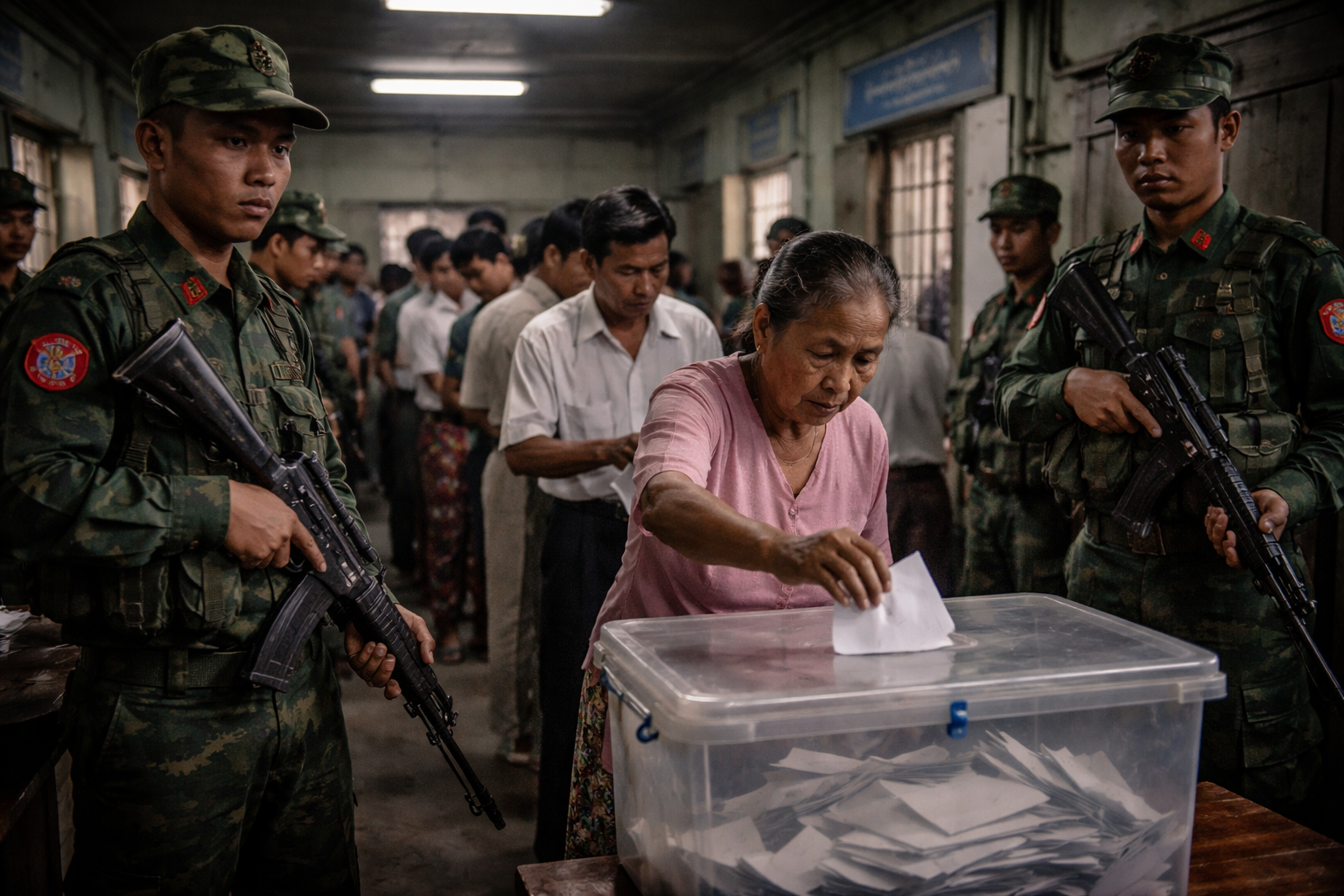
Burma (Myanmar)’s junta didn’t “win” an election this week. It manufactured one.
What happened on December 28 (Phase 1 of a three-stage vote, with additional phases scheduled for January 11 and January 25) was not a democratic contest. It was a state-run legitimization exercise—organized amid civil war, enforced through repression, and structured to ensure the military’s proxy forces emerge “victorious” regardless of what ordinary people want. AP News Reuters
Below is how the rigging works—step by step—and why the outcome is effectively predetermined.
1) Rigging starts with who is allowed to exist in politics
A real election requires real opposition. The junta ensured that wouldn’t happen.
Major opposition was eliminated: Aung San Suu Kyi’s National League for Democracy (NLD)—the dominant electoral force in 2015 and 2020—was dissolved after refusing to re-register under new military rules. AP News
Opposition leaders are jailed; speech and press are crushed: The UN Special Rapporteur has warned against recognizing the junta’s “sham” vote, noting political prisoners, outlawed freedoms, and ongoing attacks against civilians. OHCHR
The result is a ballot that may look crowded on paper—but is hollow in reality: only six parties are positioned to compete nationally, with the USDP (the military’s proxy) as the dominant force. AP News
When the strongest rivals are banned, dissolved, imprisoned, or driven underground, “choice” becomes theater.
2) The junta controls the map—by shrinking where voting is allowed
The regime is not running a national election. It’s running a partial election in the areas it can police.
Phase 1 voting took place in 102 of 330 townships, and about 65 townships won’t participate at all due to fighting. AP News
Reuters reports the election is explicitly phased because it cannot be held nationwide during the civil war. Reuters
The European Parliament’s analysis underscores the deeper problem: the regime is attempting elections while controlling only a fraction of territory, with the vote widely described as an attempt to seek international legitimacy. European Parliament
A vote that excludes huge swaths of the country—especially areas outside junta control—is not an election. It’s a controlled-count exercise.
3) The “rules” guarantee military power even if it loses
Even in the best-case scenario (a free vote), the system is built to keep the military on top:
Under Burma (Myanmar)’s constitution, the military automatically holds 25% of parliamentary seats—before anyone votes. AP News
That structural guarantee means the playing field is tilted by design. Add bans, intimidation, and restricted voting geography, and the outcome becomes even more locked in.
4) Fear—not enthusiasm—drove turnout on the ground
Multiple reports describe a public climate defined by anxiety and coercion, not civic participation.
The UN human rights framework and observers have warned the vote is happening in an atmosphere of fear, violence, and deep political repression. International Commission of Jurists
The Guardian reported many residents feared consequences for not voting, describing people who believed the military could come to homes and arrest them—and noted the UN rights office received reports of displaced people being warned of punishment if they didn’t return to vote. The Guardian
KASU/NPR reporting describes a new law banning so-called “interference” in the election process, alongside detentions and prosecutions tied to criticism—even social media activity. Kasu
When citizens show up to avoid punishment—when silence feels safer than speech—turnout becomes a measure of fear, not legitimacy.
5) Criminalizing dissent is part of the vote-count
A rigged election doesn’t just shape ballots. It shapes what people are allowed to say about ballots.
Reporting describes an “election protection” framework used to arrest people for criticizing the vote, including sticker campaigns and even private messages, with severe penalties. The Guardian
Human rights and civil society groups have urged the world to reject the election outright as lacking fairness, transparency, legitimacy, and credibility. Forum-Asia
If questioning the election can land you in prison, the regime doesn’t need persuasion. It has compliance.
6) The junta’s desired headline: “We held an election”
That is the core objective: a photo-op for legitimacy.
Reuters summarizes the international critique bluntly: the election is widely derided as a sham aimed at entrenching military rule through proxies; ASEAN says it will assess developments cautiously to avoid conferring “premature legitimacy.” Reuters
The UN Special Rapporteur has explicitly warned ASEAN against legitimizing what he calls a fraudulent “charade,” including by sending observers. OHCHR
European Parliament analysis likewise frames the elections as an attempted legitimacy grab, while the humanitarian and conflict crisis continues. European Parliament
The regime’s strategy is not “representation.” It’s recognition—to claim a mandate, divide external actors, and pressure the world to treat the junta as normal.
7) Early “results” fit the script
Even before final official tallies, the pattern looks exactly like a managed outcome.
The military-backed USDP has claimed it won a commanding lead in Phase 1—88 of 102 contested lower-house seats—even as official results were still pending. AP News
In a genuine contest, parties don’t need to manufacture inevitability. In a staged one, inevitability is the point.
Bottom line
Burma (Myanmar)’s junta did not hold a democratic election. It executed a pre-engineered process with these core features:
Real opposition removed (banned/dissolved/jailed) AP News
Voting restricted to manageable terrain AP News
Military power structurally guaranteed AP News
Fear used as the turnout mechanism The Guardian International Commission of Jurists
Dissent criminalized to control the narrative The Guardian
This is what “rigged” looks like in practice: not one dramatic act of fraud on election day, but a long chain of control—law, force, exclusion, intimidation, and narrative management—so the “winner” is effectively selected in advance.
