

EUROPE IN TURMOIL: THE FOUR HORSEMEN OF THE WESTERN CIVILIZATIONAL APOCALYPSE
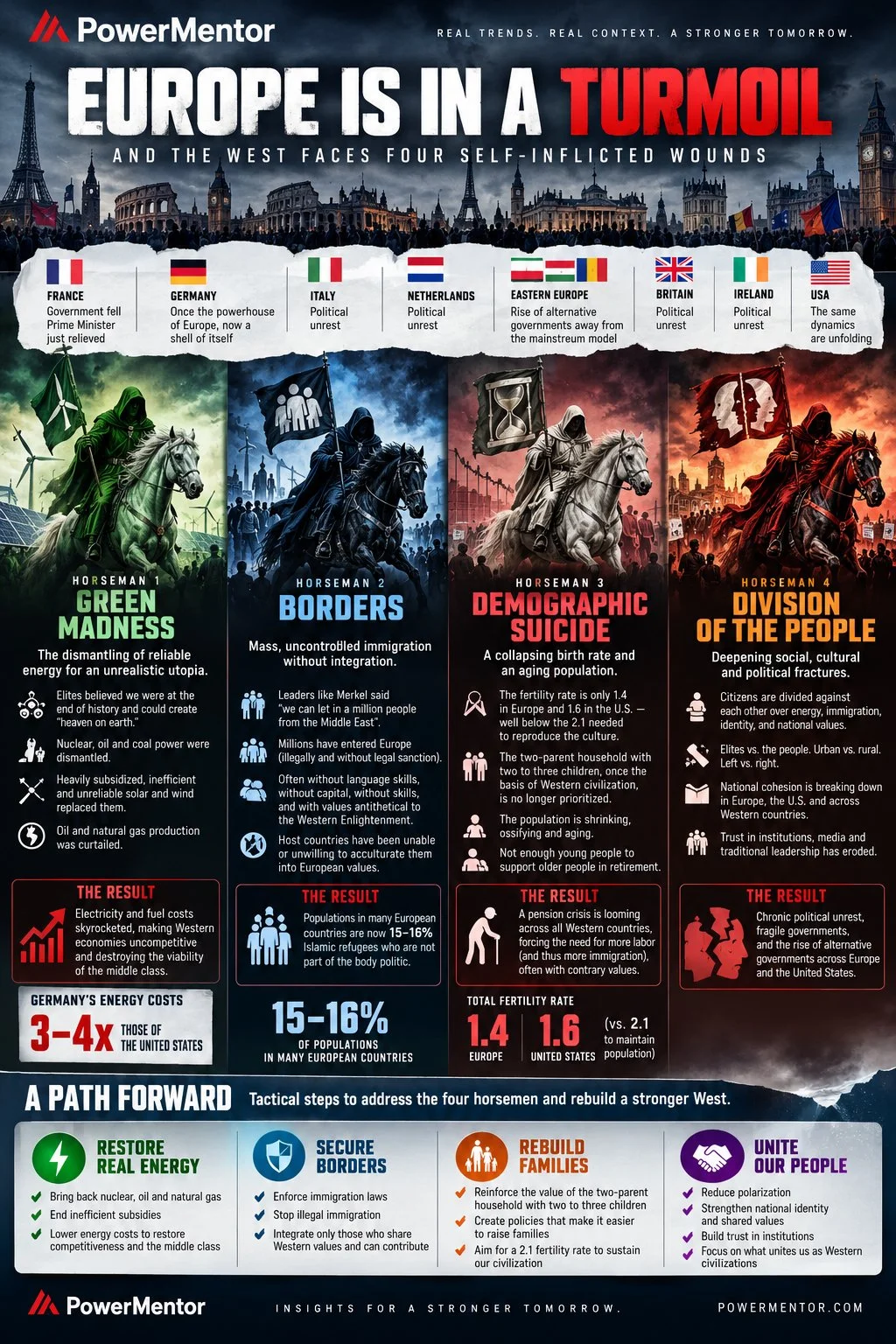
Four Self-Inflicted Wounds Threatening Europe, America, and Western Civilization
A Civilization at a Crossroads
Europe is in turmoil. Governments are struggling, political movements are gaining strength, and millions of citizens are questioning the direction of their countries.
In France, political instability has been accompanied by widespread protests and unrest. Germany, once Europe's unquestioned industrial powerhouse, faces serious economic challenges. Italy, the Netherlands, Britain, Ireland, and countries across Eastern Europe are experiencing political pressures that challenge the traditional political establishment.
The United States is experiencing many of these same pressures.
What is happening?
These problems did not emerge overnight. They reflect decades of political choices, economic decisions, demographic changes, and growing divisions within Western societies.
I would describe these threats as the Four Horsemen of the Western Civilizational Apocalypse.
They are:
Green Madness: Energy policies that place ideology ahead of affordability, reliability, and economic competitiveness.
Borders: Immigration systems struggling with enforcement, integration, and public confidence.
Demographic Suicide: Declining birth rates, aging populations, and weakening family formation.
Division of the People: Growing political, cultural, and social hostility that threatens national unity.
These four challenges are interconnected. When one becomes worse, it places additional pressure on the others.
And the people who often suffer the most are the middle class, working families, and those least able to absorb the consequences.
HORSEMAN ONE: GREEN MADNESS
When Energy Policy Becomes an Economic Burden
Energy is the foundation of a modern civilization.
Factories need energy. Hospitals need energy. Businesses need energy. Families need affordable electricity, transportation, heating, and cooling.
Without reliable and reasonably priced energy, a nation cannot maintain a competitive economy or a strong middle class.
Yet many Western governments pursued an ambitious energy transformation, seeking to replace fossil fuels with renewable sources such as wind and solar.
The problem is not the existence of renewable energy. The problem arises when political timelines move faster than the development of reliable, affordable alternatives.
Germany provides a warning.
For decades, Germany was Europe's industrial engine, known for automotive manufacturing, engineering, chemical production, and high-quality exports.
But Germany also chose to phase out nuclear power and reduce reliance on traditional energy sources.
When Russian natural gas supplies were disrupted, the country's energy vulnerabilities became painfully clear.
Businesses confronted higher production costs, while households faced pressure from energy bills and inflation.
The International Energy Agency reported that electricity prices for energy-intensive European industries remained approximately twice those of comparable industries in the United States in 2025.
That difference matters.
When manufacturers must pay significantly more for energy than their international competitors, they face difficult choices: increase prices, reduce production, relocate operations, or eliminate jobs.
Every one of those decisions can affect working families.
The Economic Consequences
A nation can pursue environmental protection and still recognize that economic survival depends upon reliable energy.
The challenge is developing policies that protect the environment without undermining the industries, jobs, and households that sustain society.
An effective energy strategy should include dependable electricity generation, diversified fuel supplies, modern infrastructure, technological innovation, and realistic implementation timelines.
A nation that makes its own energy unaffordable risks making its own economy uncompetitive.
The middle class cannot be expected to carry unlimited financial burdens in pursuit of political objectives.
HORSEMAN TWO: BORDERS
When Immigration Exceeds a Nation's Capacity to Integrate
A sovereign nation must be able to determine who enters its territory, how immigration laws are enforced, and what is required of those who wish to become permanent members of society.
This is not a rejection of immigration. Immigration has contributed greatly to the development of Western nations, including the United States.
The challenge arises when migration occurs faster than governments and communities can responsibly accommodate it.
In 2015, German Chancellor Angela Merkel became closely associated with the phrase Wir schaffen das—“We can manage this”—as Germany received large numbers of asylum seekers.
The humanitarian objective was to protect people fleeing conflict and persecution.
But receiving large numbers of people also creates serious responsibilities.
New arrivals may need housing, education, language instruction, employment opportunities, healthcare, and assistance understanding the laws and expectations of their new country.
When these systems are overwhelmed, pressure builds on public services and local communities.
Immigration and Integration Are Not the Same
Allowing someone to enter a country is only the beginning.
Successful integration requires more than physical residence.
It means learning the language, understanding the law, participating in society, becoming economically self-sufficient where possible, and respecting the fundamental rights and responsibilities that govern the host nation.
Countries also have responsibilities to provide clear expectations and workable pathways to integration.
When immigration policy is poorly administered, governments risk losing public confidence.
Citizens begin questioning whether their leaders are protecting national sovereignty, managing public spending, and preserving the stability of their communities.
These concerns have become important political issues in Germany, France, Britain, the Netherlands, Italy, Greece, and other Western countries.
Why Borders Matter
Effective border management must distinguish among lawful immigration, asylum protection, and unlawful entry.
It should include security screening, consistent enforcement, timely decisions on immigration claims, and meaningful integration requirements.
The objective should be a system that protects legitimate humanitarian needs while maintaining national sovereignty and public confidence.
A nation that cannot manage its borders will struggle to manage the responsibilities that exist within them.
HORSEMAN THREE: DEMOGRAPHIC SUICIDE
A Civilization That Is No Longer Replacing Its Population
Perhaps the most serious long-term challenge facing Western civilization is its declining birth rate.
Unlike a political crisis or an economic recession, demographic decline develops over generations.
Its consequences can remain hidden until they become extremely difficult to reverse.
For a population to replace itself naturally over time, the fertility rate generally needs to be approximately 2.1 children per woman.
Yet Western nations have fallen substantially below this level.
Eurostat reported that the European Union's fertility rate declined to just 1.34 children per woman in 2024, the lowest recorded in its comparable series.
The United States also remains well below replacement level.
Why This Matters
When societies experience persistently low birth rates, their age structures change.
Over time, fewer young adults enter the workforce while larger numbers of older citizens enter retirement.
This places pressure on the economic systems supporting society.
There are fewer workers relative to retirees, greater demand for healthcare and elder services, and growing pressure on pensions and social insurance programs.
Countries must then confront difficult choices involving taxation, retirement ages, economic productivity, immigration, and public spending.
The Decline of the Family
For generations, the family played a central role in sustaining Western communities.
Parents raised children, passed down traditions, taught responsibility, and helped prepare the next generation to contribute to society.
Today, many young adults face substantial obstacles to marriage and parenthood.
Housing is expensive. Childcare costs are high. Economic uncertainty makes long-term commitments more difficult.
At the same time, cultural attitudes toward marriage, family responsibilities, and parenthood have changed.
The traditional two-parent household with children, once a widely promoted social model, no longer occupies the same central position in public life.
The concern is not that every family must look identical. It is that societies need conditions in which people who want to marry, raise children, and build stable households can realistically do so.
The Pension and Workforce Challenge
Declining fertility does not necessarily mean that a country's total population immediately shrinks. Immigration and longer life expectancy can offset population decline for periods of time.
But sustained low birth rates create structural pressures that cannot be ignored.
Some governments turn to immigration to address labor shortages.
Immigration may help meet workforce needs, but it also requires effective integration, housing capacity, and long-term economic planning.
A country cannot rely indefinitely on emergency measures to solve problems created over generations.
A civilization must invest in the next generation if it expects that generation to sustain the civilization.
HORSEMAN FOUR: DIVISION OF THE PEOPLE
When a Nation Begins Fighting Itself
The fourth horseman may be the most dangerous because it undermines society's ability to confront the first three.
Western nations are becoming increasingly divided.
Political differences that once allowed for debate and compromise are turning into personal hostility.
Citizens are separated by ideology, class, geography, religion, economic interests, and competing understandings of national identity.
The divisions are visible across Europe and the United States.
Urban communities increasingly find themselves in conflict with rural communities.
Political parties treat their opponents as enemies rather than fellow citizens.
People lose trust in government, news organizations, universities, and other major institutions.
The result is a society in which even legitimate problems become difficult to solve because citizens no longer agree on the facts, priorities, or values needed to move forward.
The Erosion of Common Identity
A successful nation requires more than borders, economic production, and political institutions.
It also requires a shared commitment to the principles holding its people together.
That does not mean everyone must agree on every issue.
It means citizens must recognize that they share a common future, even when they disagree about how to achieve it.
When people begin viewing fellow citizens as enemies, national unity weakens.
When political disagreement becomes personal hatred, compromise becomes nearly impossible.
And when trust disappears, every new crisis has the potential to deepen the division.
Leadership and Accountability
Political leaders carry a responsibility to govern for the broader public, not merely those who support them.
They must explain difficult decisions, accept accountability, and resist the temptation to exploit social divisions for short-term advantage.
Citizens also have a responsibility to distinguish between disagreement and hostility.
A society can withstand intense political debate.
It cannot indefinitely sustain a culture in which every disagreement becomes a battle over whether the other side deserves to belong.
A divided civilization becomes less capable of protecting itself, correcting its mistakes, or planning for its future.
HOW THE FOUR HORSEMEN WORK TOGETHER
These threats do not operate independently.
High energy costs weaken economic competitiveness and make it harder for families to afford homes and raise children.
Low birth rates create workforce shortages and put pressure on pension systems.
Immigration becomes one response to those shortages, but poorly managed migration can place additional pressure on housing, public services, and social cohesion.
Political division then makes it increasingly difficult for governments to develop lasting solutions.
The result can become a destructive cycle:
Economic pressure creates public frustration. Public frustration produces political conflict. Political conflict weakens effective governance. Weak governance allows the original problems to grow.
This is how a series of manageable challenges can develop into a much broader crisis of public confidence.
The West possesses extraordinary resources, institutions, knowledge, and productive capacity.
Yet even wealthy civilizations can undermine their own strength when they fail to address long-term problems.
A PATH FORWARD: REBUILDING WESTERN STRENGTH
The challenges facing Western civilization require practical leadership rather than slogans.
First, restore energy competitiveness. Develop energy systems that are affordable, reliable, diversified, and capable of supporting economic growth.
Second, restore confidence in national borders. Enforce immigration laws, protect legitimate asylum processes, and establish clear expectations for lawful entry and integration.
Third, strengthen families and future generations. Remove unnecessary economic barriers to raising children, support stable households, and develop sustainable plans for aging populations.
Fourth, rebuild national unity. Restore confidence in institutions through transparency, accountability, equal treatment under the law, and leadership committed to the common good.
None of these challenges can be solved through political theater.
They require long-term planning, measurable results, honest evaluation, and the willingness to correct failed policies.
THE FINAL QUESTION: CAN THE WEST CORRECT ITS OWN COURSE?
Civilizations rarely face only one defining challenge.
They encounter a combination of economic, demographic, political, and cultural pressures.
Their future depends in part upon whether leaders recognize those pressures early enough and whether citizens retain sufficient trust to confront them together.
Europe and the United States remain capable of responding to their problems.
They possess productive economies, established institutions, technological innovation, educated populations, and long traditions of civic participation.
But these strengths should never be taken for granted.
Policies have consequences. Cultural choices have consequences. Leadership decisions have consequences.
The consequences may not become clear immediately, but future generations eventually inherit them.
The greatest danger to Western civilization may not come from an external enemy. It may come from our failure to confront the weaknesses we have allowed to develop within our own societies.
The four horsemen—green madness, borders, demographic suicide, and division of the people—represent a warning about the direction of the West.
The question is no longer simply whether these problems exist.
The question is whether Western nations have the leadership, discipline, and collective resolve to address them before their consequences become irreversible.
