

Trump’s New Talks With Burma: Stop the Scams. Protect the People.
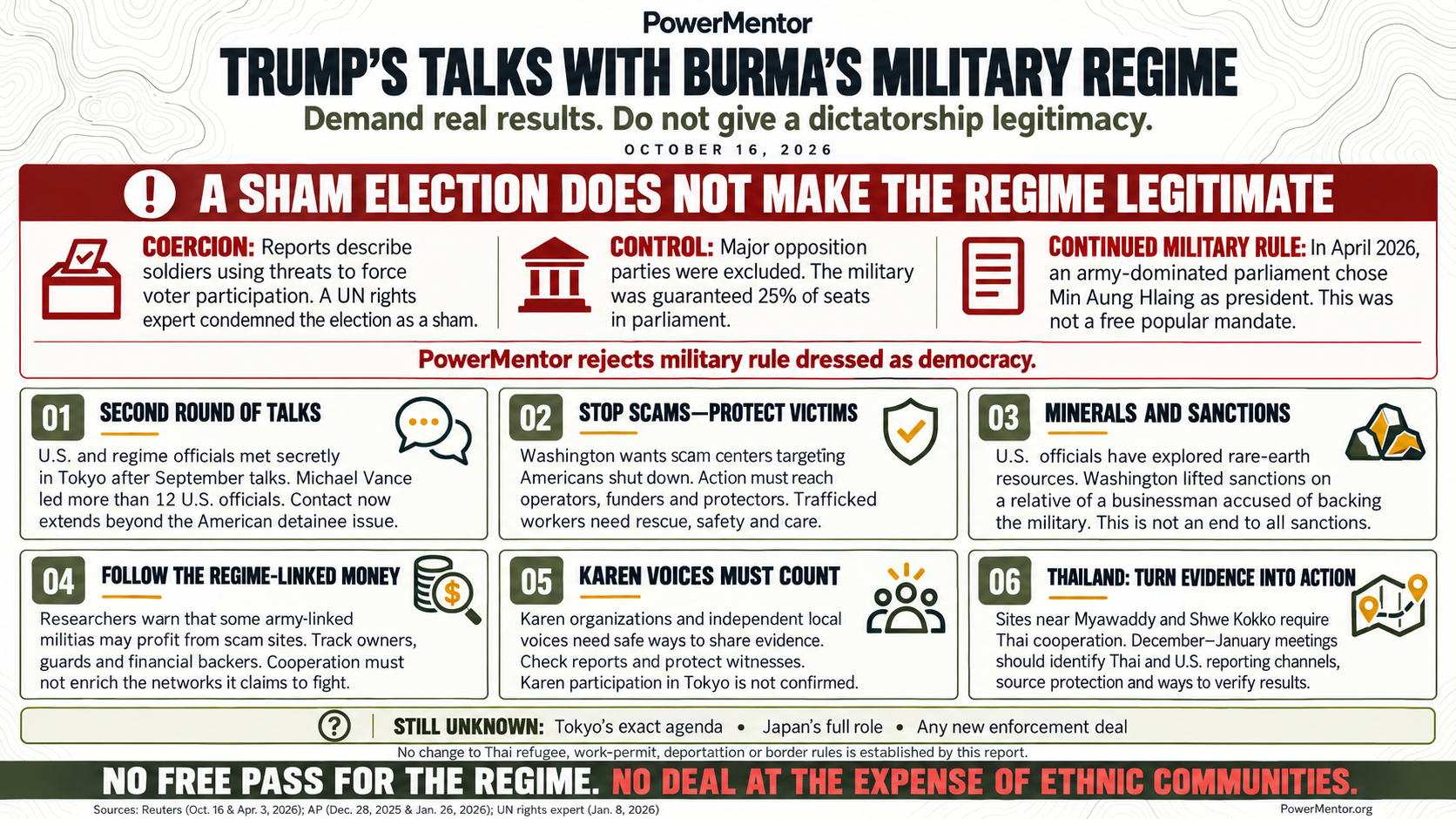
The Trump team has held more talks with Burma’s corrupt military regime.
Reuters reported on October 16 that the two sides met in secret in Tokyo, Japan, last week. This was their second meeting in about a month. The earlier talks took place in September.
These talks could affect Americans who lose money to scams. They could also affect people trapped in scam centers and Karen families near the Thai border.
The big question is simple: Will these talks lead to real help?
A Sham Election Does Not Make the Regime Legitimate
Burma remains under a brutal military dictatorship. Talks with its rulers must not be treated as proof that their rule is legitimate.
The army seized power in 2021. It then held an election in December 2025 and January 2026 while major opposition parties were shut out. A quarter of seats in parliament were reserved for the military. These were not the conditions for a free and fair vote.
There were reports of soldiers using threats to make people vote. A UN human rights expert condemned the military-run election as a sham. Fear and force do not give people a free choice.
In April 2026, a parliament dominated by the military and its allies chose Min Aung Hlaing as president. He did not win that post through a direct, free vote of the people.
PowerMentor rejects this attempt to dress military rule as democracy. A new title does not erase abuse. U.S. talks must demand real action and accountability, not give the regime a free pass. Deals over scams or minerals must not push Karen families and other ethnic communities aside.
What Has Changed?
U.S. official Michael Vance led the American team. His title is Assistant Secretary of State. More than 12 U.S. officials took part.
A second meeting shows that the two sides are still talking. Their contact has gone beyond one meeting about freeing an American held in Burma.
But a meeting is not a result. The public does not yet know what the two sides discussed in Tokyo. There is no confirmed new deal to fight the scam centers.
Japan hosted the talks. Its full role is still unclear. We should not assume that Japan led the talks or helped reach a deal.
Why Scam Centers Matter
A scam is a trick used to steal money. A scam center is a place where groups run these crimes.
The United States wants Burma’s help to shut down scam groups that target Americans. This remains a major goal of its outreach.
There are people at risk on both sides of these crimes. Some lose their savings. Others are trapped and forced to take part in scams.
People who are moved, held, or forced to work through threats or lies may be victims of human trafficking. They need safety and care.
A strong plan must stop the people who run the crimes. It must also help the people they harm.
Money and Minerals Are Also Part of the Picture
U.S. officials have also looked at Burma’s rare-earth resources. Rare earths are minerals used to make many types of modern tools and machines.
This means the U.S. has more than one interest in Burma. Crime is one concern. Access to key resources is another.
That does not prove that minerals were discussed at the second meeting. The subjects of that meeting have not been made public.
The U.S. has also removed sanctions from a relative of a businessman from Burma accused of helping the military.
Sanctions are rules that limit access to money, trade, or business. Countries use them to put pressure on people or groups.
Washington described this step as part of a new way to deal with Burma. It does not mean that all sanctions have ended. It also does not prove that the claims against the businessman were false.
Follow the Money Behind the Scams
Reuters reported concerns from researchers about armed groups linked to the military. Some control land where scam centers operate. Researchers warn that some of these groups may earn money from the scams.
This raises a hard question: Can a group help stop a crime while it gains money from that crime?
These concerns need proof and close review. A claim alone does not prove that each person or group is guilty.
But the concern cannot be ignored. Any plan must look at who owns the sites, who guards them, and who gets paid.
Closing one building is not enough if the same bosses move the work elsewhere.
The goal must be to stop the whole chain of crime, including the people who fund it and protect it.
Karen Voices Need to Be Heard
The Karen people are an amazing ethnic people with their own history and culture. Karen communities have been affected by deals about crime, land, and security. In addition, the Karen and other ethnic groups have been attacked and brutalized for decades.
There is no confirmation that Karen leaders took part in the Tokyo talks.
That leaves key questions. Will Karen groups have a way to share facts? Will local people have a voice? Can people speak without fear of harm?
No armed group should be treated as the voice of every Karen family.
Officials need to hear from trusted local sources. They also need to check what those sources say. Facts should be backed by records, other witnesses, or other sound proof.
Why Thailand Matters
Thailand is next to Burma. Scam sites around Myawaddy and Shwe Kokko make work across the border a key part of any plan.
One country cannot solve every part of a crime that crosses borders.
Thai and American officials need clear ways to receive and check reports. They also need ways to act on strong proof and help victims reach safety.
This gives added weight to PowerMentor’s planned Thailand visit in December and January.
Meetings with Thai officials can help answer a practical question: How can trusted people share facts with those who can act?
Questions Worth Asking
Who can safely report a scam site or its backers?
Which Thai and U.S. offices can receive those reports?
How will officials check the facts?
How will they protect witnesses and victims?
Will Karen groups and local people have a chance to be heard?
Will the effort reach the bosses and money sources?
How will officials show that a site has closed for good?
These questions help turn broad promises into steps that can be checked.
What We Still Do Not Know
The details of the Tokyo talks are not public. No new crime-fighting deal has been confirmed. Karen participation has not been confirmed.
This news also does not establish any October 16 change to Thailand’s refugee protections, migrant work permits, deportation steps, or border-entry rules.
Talks between governments do not, by themselves, change those rules.
The PowerMentor View
Talks can open a door. What happens next is what counts.
Success must mean fewer scams, safer victims, and action against those who pay for and protect these crimes.
It must also mean that Karen families are heard and protected.
The test is clear: Stop the crime. Follow the money. Protect the people.
Source: Reuters report on U.S. talks with Burma’s military-backed rulers in Tokyo, October 16, 2026.
Election sources: UN human rights expert statement, January 8, 2026; Associated Press election reports, December 28, 2025 and January 26, 2026; Reuters report on the parliamentary presidential vote, April 3, 2026.
