

THAI GOVERNMENT OFFICIALS LINKED TO CHILD TRAFFICKING INVESTIGATION: ALLEGATIONS OF CORRUPTION, BETRAYAL, AND EXPLOITATION
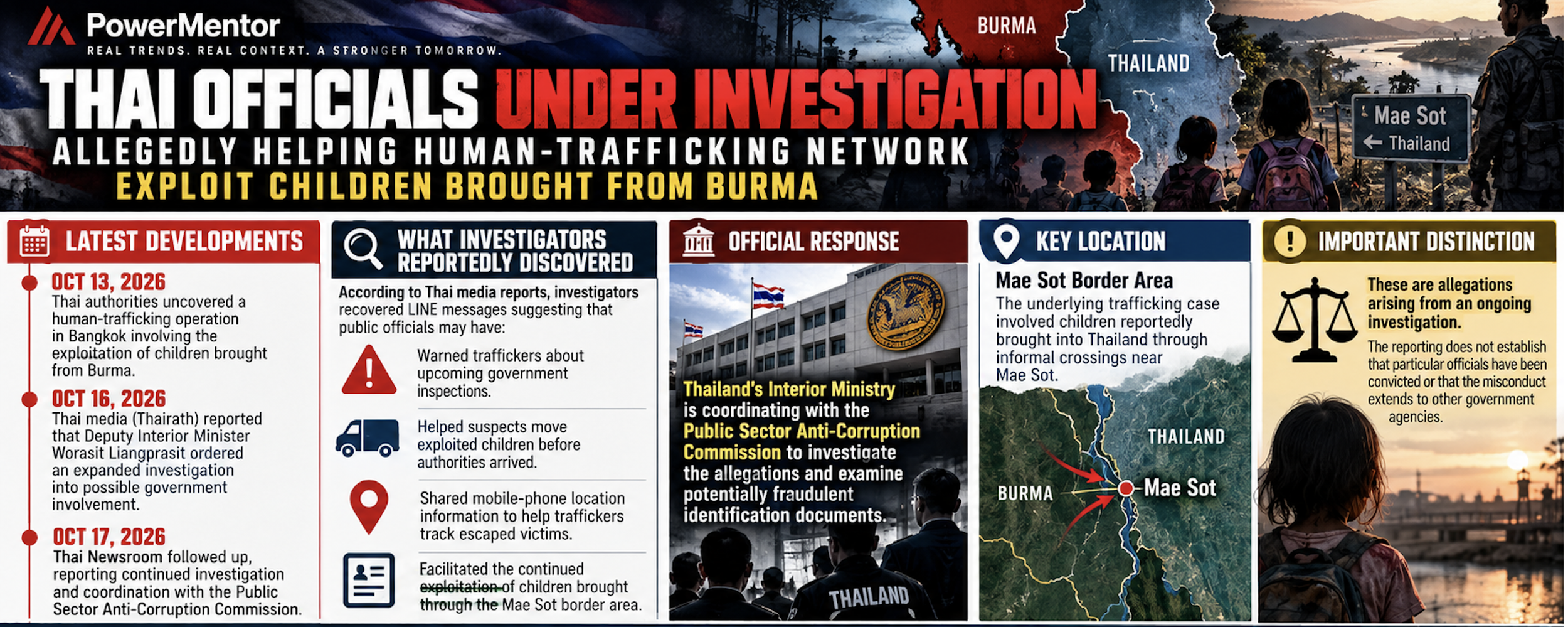
Children Brought From Burma Were Allegedly Abused and Forced Into Labor While Public Officials May Have Helped Their Traffickers Evade Authorities
WHEN THOSE TRUSTED TO PROTECT CHILDREN MAY BE HELPING THEIR EXPLOITERS
A disturbing human-trafficking investigation in Thailand has raised serious questions about government corruption, the protection of vulnerable children, and the possible involvement of public officials in organized criminal activity.
On October 13, 2026, Thai authorities uncovered a trafficking operation involving children brought into Thailand from Burma through the Mae Sot border region.
The children were reportedly subjected to physical abuse, threats, and forced labor. They were made to sell flowers, garlands, and orange juice in Bangkok's tourist districts, including the Khao San Road area.
But what investigators reportedly discovered afterward may be even more alarming.
Evidence recovered from the messaging application LINE allegedly revealed that some Thai government officials were assisting the trafficking network.
According to reports published October 16–17 by Thairath, Thai PBS, and Thai Newsroom, certain officials may have warned traffickers about government inspections and even provided location information about victims who had escaped.
These allegations are now the subject of an expanded government investigation.
The central question is no longer simply how traffickers exploited vulnerable children.
It is whether individuals entrusted with enforcing Thailand's laws used their government positions to help criminals continue that exploitation.
1. THE OPERATION: CHILDREN BROUGHT FROM BURMA AND FORCED INTO LABOR
On October 13, Thailand's Department of Provincial Administration conducted an enforcement operation known as Protecting the Rosebud.
The operation targeted a human-trafficking and forced-child-labor network operating in Bangkok.
Investigators reported that victims had been brought across the Thailand–Burma border near Mae Sot in Tak Province.
They were then transported to Bangkok, where they allegedly faced abusive and exploitative conditions.
Thai authorities reported identifying eight victims, including children as young as five years old.
According to the investigation, the victims were subjected to physical violence, intimidation, and mistreatment.
Some reportedly suffered burns caused by heated spoons being pressed against their bodies. Others were beaten or threatened.
The children were allegedly forced to sell flowers, garlands, and orange juice in busy tourist areas, sometimes working into the early morning hours.
Reports indicated that some received only 10 Thai baht for each sale.
These were not ordinary working conditions.
The allegations describe vulnerable children being controlled, abused, and exploited for financial gain.
Thai authorities arrested four suspects during the October 13 operation, and the eight identified victims were placed under the care of Thailand's Ministry of Social Development and Human Security.
2. THE DISCOVERY: GOVERNMENT OFFICIALS ALLEGEDLY HELPED THE TRAFFICKERS
Following the arrests, investigators examined communications recovered from suspects' phones.
The LINE messaging records reportedly revealed information suggesting that government officials had provided assistance to members of the trafficking organization.
Three allegations are especially serious.
Advance Warnings About Inspections
Some officials allegedly provided traffickers with advance notice of government inspections.
This included information about when authorities planned to conduct enforcement activities in the Khao San Road area.
Such warnings would have allowed suspects to move exploited children before investigators arrived.
If established, this conduct would represent more than a procedural failure.
It would mean government information was allegedly used to undermine the very enforcement operations intended to protect trafficking victims.
Helping Traffickers Track Escaped Victims
Perhaps the most disturbing allegation involves the possible misuse of mobile-phone location information.
Investigators reportedly recovered messages suggesting that officials shared location information obtained through mobile-phone signal checks with traffickers.
The information allegedly helped criminals locate victims who had escaped.
Consider the implications.
A trafficking victim who manages to escape should be able to seek protection from authorities.
Instead, the investigation raises the possibility that people with access to government information helped traffickers locate those attempting to flee.
If proven, such conduct would represent a serious abuse of authority and a direct threat to victim safety.
Suspected Fraudulent Identification Documents
Authorities are also examining identification documents allegedly used by the trafficking organization.
Investigators are assessing whether fraudulent documents helped facilitate the movement and exploitation of victims.
This raises additional questions about document verification, border enforcement, and whether improper assistance allowed traffickers to avoid detection.
Together, these allegations point to a critical investigative issue: whether government access, information, or authority was misused to protect the trafficking network.
3. THAILAND'S INTERIOR MINISTRY ORDERS AN EXPANDED INVESTIGATION
On October 16, Deputy Interior Minister Worasit Liangprasit publicly addressed the allegations.
He ordered the investigation expanded to examine possible involvement by government personnel.
Thailand's Interior Ministry is coordinating with the Public Sector Anti-Corruption Commission and other relevant authorities.
The investigation is examining the recovered communications, potential official misconduct, and the legitimacy of identification documents linked to the case.
Worasit has called for accountability and legal penalties against anyone found responsible.
His response represents an important test of Thailand's willingness to confront possible corruption within its own institutions.
The investigation must determine who provided the information, whether official authority was abused, and whether other individuals participated in protecting the trafficking operation.
It must also establish whether there were isolated acts of misconduct or a broader network of assistance.
As of the October 16–17 reporting, these matters remain under investigation. The available reporting does not establish criminal convictions against specific public officials.
4. THE MAE SOT CONNECTION: WHY THE BORDER WITH BURMA MATTERS
The trafficking network reportedly brought victims into Thailand through informal crossings near Mae Sot.
Mae Sot sits across the border from Myawaddy in Karen State, Burma.
The region is a critical corridor for cross-border trade, migration, humanitarian activity, and law-enforcement cooperation.
It is also a region where criminal exploitation and human-trafficking concerns require continued attention.
The circumstances of this case raise important questions.
How were vulnerable children moved across the border?
Who organized their transportation?
How were identification documents obtained?
Did anyone assist traffickers in avoiding inspections or checkpoints?
And how could victims be transported from a border region into Bangkok and then subjected to exploitation?
These are questions investigators must answer through evidence.
An Important Distinction
This case has not been established as part of the scam-compound networks operating around Myawaddy or Shwe Kokko.
The confirmed geographic connection is the reported movement of trafficking victims through the Mae Sot border area.
Any organizational or financial connection to other criminal networks would require separate evidence.
Nevertheless, the case demonstrates why trafficking investigations must follow the movement of victims, the activities of facilitators, and the financial and communication networks supporting exploitation.
5. THE GREATEST DANGER: WHEN VICTIMS CANNOT TRUST THE SYSTEM
For victims of human trafficking, escaping an exploiter may be only the beginning of their struggle.
They need safety, shelter, medical care, legal protection, and confidence that the people receiving their information will not misuse it.
That confidence becomes extremely difficult to maintain when government officials are suspected of sharing sensitive information with traffickers.
Imagine a child escaping captivity.
That child may have experienced violence, intimidation, isolation, and repeated threats.
Finding the courage to escape can mean risking everything.
Now imagine the possibility that someone with government access could help the trafficker locate the child again.
This is why the allegations involving mobile-phone location information demand particular scrutiny.
The people who possess sensitive information about trafficking victims must never become another threat to those victims.
Protecting witnesses and informants is equally important.
People who provide information about trafficking organizations, illegal border crossings, or criminal compounds may place themselves and their families at risk.
Their identities, locations, communications, and testimony must be protected through appropriate safeguards.
Without those protections, victims and witnesses may be reluctant to cooperate with investigators.
And without their cooperation, criminal networks can become more difficult to dismantle.
6. CORRUPTION CAN UNDERMINE EVEN THE STRONGEST ANTI-TRAFFICKING OPERATIONS
Governments can establish specialized task forces, strengthen border enforcement, increase penalties, and announce major anti-trafficking initiatives.
But those efforts can be undermined if sensitive information reaches the criminals being investigated.
Consider the potential consequences of an official leaking inspection schedules.
Traffickers can move their victims.
Evidence can disappear.
Suspects can avoid arrest.
Witnesses can be threatened.
And the government may be left investigating an empty building instead of rescuing vulnerable people.
The same concern applies to unauthorized access to personal information.
If location data or government records are misused, the consequences can be immediate and dangerous.
This case highlights several areas that deserve examination:
Access controls: Who can obtain sensitive government information about enforcement operations and trafficking victims?
Information security: Are access records maintained and reviewed for unauthorized activity?
Independent accountability: Can allegations involving officials be investigated without interference?
Witness protection: How are victims and informants protected from retaliation?
Document integrity: Can fraudulent identification documents be detected and traced?
Cross-border coordination: Are Thai authorities able to identify traffickers and their facilitators operating across the border with Burma?
These are not merely administrative questions.
They concern the ability of government to carry out its most fundamental responsibility: protecting people from exploitation and abuse.
7. WHAT THIS MEANS FOR KAREN COMMUNITIES AND HUMANITARIAN WORK
Karen communities have endured decades of conflict, displacement, insecurity, and humanitarian hardship in Burma.
Families living near the Thailand–Burma border may face additional vulnerabilities when poverty, displacement, and limited access to legal protection create opportunities for traffickers.
Criminal organizations can exploit those vulnerabilities by promising employment, transportation, shelter, or a better future.
Children are especially vulnerable because they may lack the ability to recognize deception, escape abusive situations, or seek assistance safely.
For humanitarian organizations and individuals working with displaced communities, this investigation reinforces several essential priorities.
First, protect the identity and location of vulnerable individuals.
Second, carefully evaluate the channels through which sensitive information is shared.
Third, establish trusted methods for reporting suspected trafficking and exploitation.
Fourth, ensure that people providing evidence understand the risks associated with disclosure.
Finally, recognize that the presence of government authority does not automatically eliminate the need for independent safeguards and verification.
The allegations in Thailand demonstrate why trust must be supported by accountability.
8. THAILAND HAS AN OPPORTUNITY TO DEMONSTRATE ACCOUNTABILITY
Thailand's decision to investigate possible government involvement is significant.
The Department of Provincial Administration's operation reportedly led to arrests and the identification of victims needing protection.
The Interior Ministry has now directed investigators to examine whether public officials helped the trafficking organization.
Those actions create an opportunity for a thorough, evidence-based investigation.
The next steps will be important.
Investigators must determine whether the communications are authentic, identify everyone involved, trace the source of the disclosed information, and establish whether any laws were violated.
Where sufficient evidence exists, appropriate prosecutions should follow.
Any implicated officials must receive due process, and wrongdoing must be established through evidence rather than assumption.
Victims and witnesses must be protected throughout the investigation.
The results should also inform changes to any systems that allowed sensitive information to be compromised.
True accountability requires more than identifying the traffickers. It requires examining whether anyone with official authority helped them operate.
9. THE QUESTIONS THAT MUST BE ANSWERED
This investigation should not end with public statements.
There are important questions that deserve documented answers.
Who allegedly warned traffickers about upcoming government inspections?
How did those individuals obtain the inspection information?
Who allegedly accessed or shared mobile-phone location information concerning escaped victims?
Was that information obtained through authorized government systems?
Who supplied or facilitated the use of potentially fraudulent identification documents?
Were there other individuals who knowingly assisted the trafficking network?
Were victims previously identified by authorities but left without protection?
What safeguards are being implemented to prevent further information leaks?
Are the victims receiving appropriate protection, medical attention, and support?
Will the findings of the investigation be made public while protecting victims and legitimate investigative needs?
These questions are fundamental to determining what happened and whether the responsible institutions can prevent similar abuses.
POWERMENTOR PERSPECTIVE: PROTECT THE VULNERABLE. INVESTIGATE THE CORRUPTION. HOLD THE GUILTY ACCOUNTABLE.
Human trafficking is not simply an immigration problem or a border-security issue.
It is the exploitation of human beings for the financial benefit of others.
When children are involved, the consequences are especially devastating.
The reported abuse of children brought from Burma into Thailand is deeply disturbing.
The allegations that government officials may have helped traffickers avoid inspections and track escaped victims make this investigation even more serious.
The children in this case were not political actors.
They were not responsible for the circumstances that made them vulnerable.
They were human beings who deserved protection.
No government employee should be permitted to use public authority, confidential information, or institutional access to facilitate the exploitation of another person.
If these allegations are established, accountability must extend beyond the immediate traffickers to anyone who knowingly helped them.
That accountability should be determined through a fair and independent legal process.
Thailand's response will be measured not simply by the announcement of an investigation, but by whether that investigation identifies wrongdoing, protects victims, and produces meaningful safeguards against future abuse.
THE BOTTOM LINE
When traffickers exploit children, it is a crime.
When officials knowingly help traffickers, it becomes a profound abuse of public trust.
And when victims who escape are tracked down through misused information, the very systems designed to protect them risk becoming instruments of their exploitation.
The victims deserve safety.
The investigation deserves independence.
And anyone proven to have participated in this trafficking operation deserves to be held accountable under the law.
There must be no protection for human traffickers—and no special protection for public officials who knowingly assist them.
Sources
Thairath, October 16, 2026 — Deputy Interior Minister Worasit orders expanded investigation into suspected official involvement in Khao San Road trafficking. https://en.thairath.co.th/news/politic/2966700
Thai Newsroom, October 17, 2026 — Further investigation of officials allegedly linked to the trafficking network. https://thainewsroom.com/2026/10/17/further-probe-of-officials-allegedly-linked-to-khao-san-road-area-human-trafficking-ring/
Thai PBS, October 16, 2026 — Investigation into leaked messages and possible government involvement. https://www.thaipbs.or.th/news/content/571168
